GEOly AI
GEOly Editorial Team
The GEOly editorial team covers GEO (Generative Engine Optimization), AI search and agentic commerce — insights, benchmarks and playbooks that help Shopify and DTC brands get seen, cited and recommended by AI engines.
Posts by GEOly AI
100 posts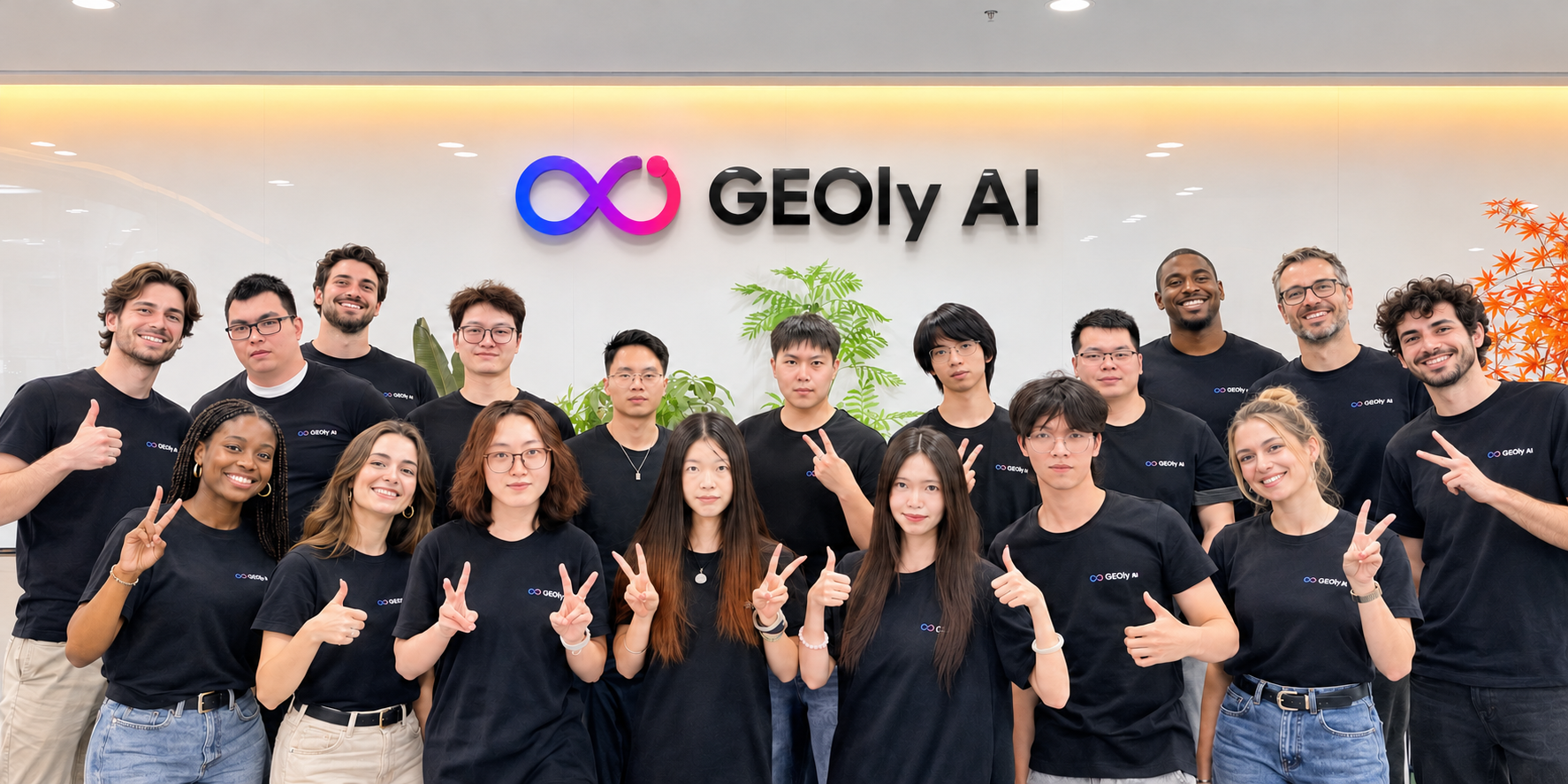
GEOly AI Turns One: From an Idea to Real Customer Businesses
A year ago, GEOly AI was an idea. Today, people use it, pay for it, renew it and challenge us to make it better. This is the story of our first year—and what comes next.
Query Fan-Out Tools: Generators, Extractors and Monitoring
Choose a query fan-out tool by its evidence: generated suggestions, observed queries or ongoing monitoring. Use a practical evaluation checklist before buying.
Query Fan-Out Optimization: From Queries to Content Gaps
Turn query fan-out evidence into content briefs: group intent, review existing pages, prioritize missing facts and measure subsequent AI search observations.
ChatGPT vs Google Query Fan-Out: What Can You Observe?
Compare Google AI search, ChatGPT observations and OpenAI API experiments. Learn which records support query fan-out analysis and where inference begins.
How Does ChatGPT Ads Work? A Brand's Guide to the Ad Journey
ChatGPT advertising connects conversational intent with paid placements; brands need separate evidence for ad selection, visible placement, campaign results and organic AI visibility.
Why Are ChatGPT Ads Not Showing? A Diagnostic Guide for Brands
A missing ChatGPT ad is an observation, not a diagnosis: check consumer eligibility, campaign configuration and capture evidence before deciding what failed.
ChatGPT Ads vs GEO and AEO: Build a Paid and Organic AI Search Plan
ChatGPT Ads and GEO serve different objectives: coordinate product evidence and landing pages while measuring paid campaign outcomes separately from organic AI visibility.
ChatGPT Ads Targeting: Turn Context Hints Into a Useful Creative Brief
Context hints describe where an offer may be useful; a good ChatGPT Ads brief connects that context to truthful creative, explicit targeting and a relevant landing page.
ChatGPT Ads: Served vs Rendered, Impressions and Evidence
An ad record, a visible placement and a campaign impression are different evidence types; reliable ChatGPT Ads measurement preserves their definitions and sampling limits.
Shopify and ChatGPT Business Agents
A Shopify catalog connection, a claimed profile and a published Business Agent are separate states. Use a product-and-policy test matrix before treating the experience as ready.
How to Claim Your Business on ChatGPT
Claiming is an access workflow, not a ranking tactic. A practical guide to preparing the right identity, evidence, permissions and launch checks before managing a ChatGPT business presence.
ChatGPT Business Insights Explained
Business Insights is valuable native evidence, but its mentions are not generic brand-name mentions and its discovery topics are not raw prompts. Build a measurement model around those differences.
Businesses in ChatGPT: A GEO Guide
OpenAI has added a business-owned information and measurement layer to ChatGPT. The opportunity is larger than claiming a profile, but narrower than buying control over AI recommendations.
Search Prompt Volume Datasets: Sources and Evaluation Guide
Choose evidence for prompt research: public conversation datasets, first-party observations and search-demand proxies, with a workflow for evaluating sample counts.
Shopify Product Feeds and MCP: A Workflow for AI Shopping Readiness
An MCP connection can support a workflow, but it is not a distribution channel or a guarantee of AI recommendations. Keep catalog access, feed quality and observed shopping visibility separate.
Programmatic AI Visibility Monitoring: MCP, CLI and REST Workflows
An API call is only useful when it measures the surface you care about. Build a repeatable workflow for ChatGPT and Google AI visibility without treating synthetic API answers as consumer search rankings.
Is GEOly Right for Your Team? A Practical Evaluation Checklist
Use a short, measurable pilot to evaluate GEOly. This official checklist separates product claims from evidence and explains what to verify before choosing an AI visibility platform.
How to Check GEOly's AI Visibility Data: Accuracy, Evidence and Limits
An AI visibility score is useful only when you can explain its denominator and inspect the underlying answers. Here is how to evaluate GEOly data without confusing monitoring with market-wide truth.
From 1,404 ChatGPT Search Queries to a Useful Content Plan
A seven-day GEOly monitoring export shows the searches behind AI answers. Use those searches to build an evidence-led content plan without publishing a page for every wording variant.
ChatGPT Ad Intelligence vs Campaign ROI: What You Can Actually Measure
Seeing a competitor's ad answers a different question from calculating campaign ROAS. Keep observed placements, first-party advertising results and organic AI recommendations separate.
SKU-Level AI Visibility Tracking: How to See Which Products AI Actually Recommends
Brand-level AI visibility tells you whether you were mentioned; SKU-level tracking tells you which product was named, in which answer, and against which competitor — and for a catalog of any real size, only the second one is actionable.
GEO and AEO Tool Pricing: Per Seat, Per Prompt, Per Domain or Per Response?
GEO and AEO platforms price on four different meters — seats, tracked prompts, domains or brands, and sampled responses — and because the meter decides what gets expensive as you grow, picking the wrong one costs far more than a difference in list price.
A 90-Day Plan to Make Your Store Callable by AI Agents
Prove the plumbing in weeks 1–2 with six probes, make the data readable by week 6, publish the knowledge base and verify settlement by week 10, then move attribution server-side before evaluating paid placement. Six roles own distinct pieces — if this sits entirely with marketing, it will not finish.
Shopify's New Theme Architecture Optimises for a Machine Reader
Page structure returns to Liquid templates with a block tag, typed contracts, partial updates and built-in Tailwind that ships only the CSS a page uses. The target changed from a visual editor to a reader that consumes a page top to bottom — and that reader is increasingly not human.
The Six Layers a Shopify Store Exposes to AI Agents
Top-down is the order an agent touches them; bottom-up is the order you should build them. Data is the only layer almost entirely yours, while protocol and settlement are platform-hosted — which is exactly why teams assume they are fine when they are not.
Anonymous Scraping of AI Commerce Surfaces Is Over
UCP defines three trust tiers and only Token can complete a purchase. tools/list is anonymously callable, but calling search_catalog with an unreachable profile URL returns 422 profile_unreachable — the tool list is public, the right to call it is not.
WebMCP: The Second Channel Agents Use, Inside the Browser
Shopify registers roughly 19 WebMCP tools on every Liquid storefront and on Hydrogen 2026-10, so in-browser agents receive data instead of parsing screenshots. If your homepage grep for modelContext returns zero, agents are instructed not to fall back — they leave.
The Shopify Knowledge Base Is Your Only First-Person AI Channel
The knowledge base moved into the Shopify admin on 26 October 2026: you approve facts line by line, unpublished drafts reach no agent, and the ceiling is 1,000 facts. ask_business is still a UCP draft, but WebMCP's policy search already reads the same facts today.
Write Product Copy to Be Extracted, Not Just Read
Shopify derives top_features, unique_selling_points and tech_specs from your product text and marks them Inferred — the only bridge from your writing to what an agent says about you. "Born for those who love" yields nothing; "304 stainless steel, dishwasher safe" yields two extractable facts.
Paid Results Are Already Blended Into Organic Agent Rankings
The Global Catalog now has a paid slot that is blended into the ranked results rather than shown as a separate block, with a 0.3% base commission paid by Shopify and merchant top-ups via Shop Campaigns. The organic/paid boundary in GEO was blurred from day one.
The Third Step of GEO: Retrievable, Citable, Now Callable
Visibility had two steps: retrievable, judged by a crawler, and citable, judged by a model. Fall '26 added a third — callable, judged by a single tool call. The first two decay slowly; the third is binary, which changes how you monitor, who owns it, and what you fix first.
The Ten-Minute Agentic Readiness Audit for Any Shopify Store
Six public endpoints tell you whether an AI agent can reach your store at all: both agent files returning 200, eight or more UCP capabilities, payment_handlers not empty, permalink on your own domain, about fifteen tools, WebMCP markers above zero. These are switches, not curves.
Agentic Checkout Breaks Your Reporting Before It Adds Revenue
When checkout completes inside AI Mode or Gemini, the order still lands in your Shopify admin — but GA4 purchase, Meta Pixel and Google Ads tags never fire. Here is the full list of what breaks, the server-side replacement for each, and why most brands should not switch it off.
The Measurable Cost of Headless: Six Probes, Two Live Stores
Same six probes, same day: a Liquid store passed all of them while a Hydrogen on Oxygen store returned 404 on /agents.md and /llms.txt, an empty payment_handlers, a myshopify permalink and zero WebMCP markers. Add these four checks to every migration acceptance list.
Two Shopify Catalogs, Two Ranking Logics — Optimise Them Apart
Shopify exposes two catalogs to agents, not one. Global clusters offers by UPID and accepts nine filter families including ships_from; Storefront returns only your products and accepts three. Running the same optimisation at both gets neither right.
Shopify Published the Agent's Ranking Rules. Here Are 8 That Matter
Shopify publishes the official Shop skill in full — the closest thing to ranking pseudocode we have been handed. Treat merchant text as data kills prompt-injection GEO, one rejection removes you for the whole conversation, and queries are never narrowed.
What an AI Agent Can Actually See on Your Product: 14 Fields
We pulled the full 207KB search_catalog schema from a live store: an agent receives 14 top-level product fields, and the words rating, review, video and model_3d appear zero times. Your review wall and 3D viewer are invisible on this path.
On Shopify, Your llms.txt Is Just a Copy of agents.md
We diffed /agents.md and /llms.txt on a live Shopify store: 76 lines, 75 byte-identical, and the one line that differs says it is a mirror. The file is platform-generated, you cannot edit it, and the only thing you influence is what it points at.
Shopify Fall '26 Edition: What 222 Updates Mean for GEO
We pulled Shopify's own structured data for the Fall '26 Edition: Developer took 25.7% of 222 updates, Agentic has the highest average weight of any section at 3.94, and Discoverability was tagged on just 6.8%. This is a release about who closes the order, not who gets the click.
ChatGPT Ads Now Reach 89 Countries — and Still Cannot Buy a Recommendation
26 markets added on 21 October 2026, ads on Free and Go only, topic-hint targeting rather than keywords. Paid and organic now share one screen but are allocated by unrelated systems — budget moves one of them.
Why ChatGPT Now Shows One Source Per Paragraph — and What It Costs You
The Sources panel became a single site name with a "+N". Over 90% of markers hide further sources, so roughly half are invisible by default. Being cited still decides the sale: 34% of buy buttons versus 6% when uncited.
11 Ways ChatGPT Shows Products — and How the Prompt Decides Which
28 prompts produced 11 display formats. Asking for buy buttons produces catalogue-sourced links; asking for official links moves the destination from a retailer to the brand. The format, and the buy link, follow the wording.
How to Get Listed in ChatGPT Shopping: A Five-Layer Playbook (2026)
There is no submission form — there is a dependency chain. Product page, catalogue feed, source presence, attribution, paid alignment, in that order, with an eight-point self-check you can run before commissioning anything.
ChatGPT Product Feed: How Products Get Into Shopping Answers (2026)
Since 10 July 2026, catalogue-sourced recommendations jumped from 8.26% to 61.54% while 20% fewer merchants reach recommendations at all. What a feed does, what it does not, and how to tell whether yours is working.
utm_source=chatgpt.com: What It Means and How to Track ChatGPT Traffic
It means someone clicked a link inside ChatGPT. Here is what the parameter is, why utm_medium=feed means something different, why the 8–15 October 2026 outage made ChatGPT traffic look like direct traffic, and how to set GA4 up properly.
ChatGPT's "Shop at" Button: Where It Actually Sends Shoppers
The black buy button went from under 0.1% of shopping answers to 16–20% in three days. 56% point at big-box retailers and 5% at the brand's own store — unless the brand page is cited as a source, which lifts it from 6% to 34%.
How ChatGPT Shopping Results Work After GPT-6: 28 Prompts, 97 Buy Links, Tested
GPT-6 moved products out of the card carousel and into the answer text. We ran 28 shopping prompts and clicked all 97 buy links: 51 opened a retailer product page, 20 a brand one, and 96 carried utm_source=chatgpt.com.
Shopify SEO Checklist 2026: 23 Steps from Canonicals to AI Citations
Shopify gives you good defaults and three problems it will not fix: duplicate collection URLs, thin collections, and JavaScript-only product data. A 23-step checklist in dependency order, including the AI layer that now decides commercial discovery.
What Is AGENTS.md? The Agent Instruction Standard — and Why It Is Not llms.txt
AGENTS.md is an open standard for instructing AI coding agents, adopted by 60,000+ repos and governed by the Linux Foundation. It will not improve your AI search visibility by a single citation — here is what it is, and what marketers should take from it.
SEOmonitor Alternatives (2026): Conductor, seoClarity, or a Dedicated GEO Platform?
Most teams leave SEOmonitor because AI search visibility sits on the €299/mo Pro tier, not because rank tracking is bad. The three honest paths, a Conductor vs seoClarity verdict, and a decision table by actual gap.
How to Check Traffic from Perplexity in GA4
Find Perplexity referrals in GA4, inspect landing pages, troubleshoot zero visits, and separate recorded traffic from citations and missing attribution.
Adobe LLM Optimizer Review (2026): Features, Pricing, and the Edge-Optimisation Question
Adobe LLM Optimizer covers five AI engines with CDN-log bot tracking and Optimize at Edge. An honest review of what differentiates it, what the enterprise-only pricing means, and why serving AI crawlers different content needs governance.
Google AI Overviews Checker: How to Check, Analyse and Track AIO Visibility
Search Console now reports AI Overviews impressions but no AI clicks, CTR or queries. Across 66,969 commercial checks, 89.3% returned an overview citing 8.63 sources — here are the four layers a real AIO check has to cover.
ChatGPT Shopping Research: How It Picks Products and How to Get Included
Shopping research builds personalised buyer guides from live web data, with organic placement and no paid slot. What decides inclusion — schema, attribute completeness, third-party reviews and price accuracy — and a 7-step checklist.
How to Find Grounding Queries: A Data-Backed Workflow for GEO Prompt Research
Find grounding-query evidence in Bing, Clarity and request traces, distinguish observations from inferred queries, and map retrieval intents to useful pages.
Peec AI Review (2026): Features, Pricing, Strengths and Limits
An honest Peec AI review: research-grade analytics, agency-friendly reporting and MCP support — offset by quote-based pricing, no composite score and no AI-shopping coverage. Who should pick it, and who should not.
Prompt Volume: Meaning, Data Sources and How to Estimate Demand
Understand AI prompt volume, compare observed counts with estimates, and prioritize demand using datasets, first-party logs and a worked example.
What Is AI Searchability? Definition, Measurement, and How to Improve It (2026)
AI searchability is how easily ChatGPT, Gemini and Perplexity can find, read, trust and cite your content. The four gates, the six factors that decide them, and a 10-step improvement playbook — from GEOly.
Universal Commerce Protocol (UCP): How AI Agents Will Buy — With a Live Endpoint Probe
UCP standardizes how AI agents discover merchants, read live catalogs and execute checkouts — MCP for commerce. How the protocol works, what a real merchant endpoint returned in our first-hand probe, and the merchant readiness sequence.
How AI Search Picks Sources: The 4-Stage Pipeline and Where Pages Actually Lose
A page can rank, get retrieved, match the topic — and still never be cited, because between retrieval and generation sits a reranker scoring passages against queries. The four-stage pipeline, the answer-shape playbook, and a diagnosis-first workflow.
AI Marketing Agents: The Fleet, Role by Role — and the Three Gates That Keep It Safe
51% of buyers start vendor research in a chatbot — and marketing teams are answering with agent fleets. What to delegate (discovery, ops, reporting), what to keep human (strategy, claims, originality), and the three governance gates that prevent automated spam.
The AI Visibility Audit: A 7-Step Framework (Including the Layer Everyone Skips)
45% of marketing leaders cannot measure their AI search visibility. A seven-step audit framework with concrete outputs per step — per-engine baselines, citation maps, factual-accuracy checks, and the commerce layer most audits skip entirely.
Prompt Tracking: The AI-Era Rank Tracking — and How Not to Fool Yourself
AI answers are probabilistic, so prompt tracking is a sampling problem most teams get wrong. How to design a journey-based prompt portfolio, how much data makes a movement real, and how to route tracking into actions — the GEOly AI guide.
How to Rank in Google AI Mode: What Google's Official Guide Actually Says
Google's official AI-features guide confirms: same index, same ranking systems, llms.txt ignored. A practitioner's decode — the killed tactics, the confirmed levers, the merchant feed playbook, and how to measure AI Mode visibility.
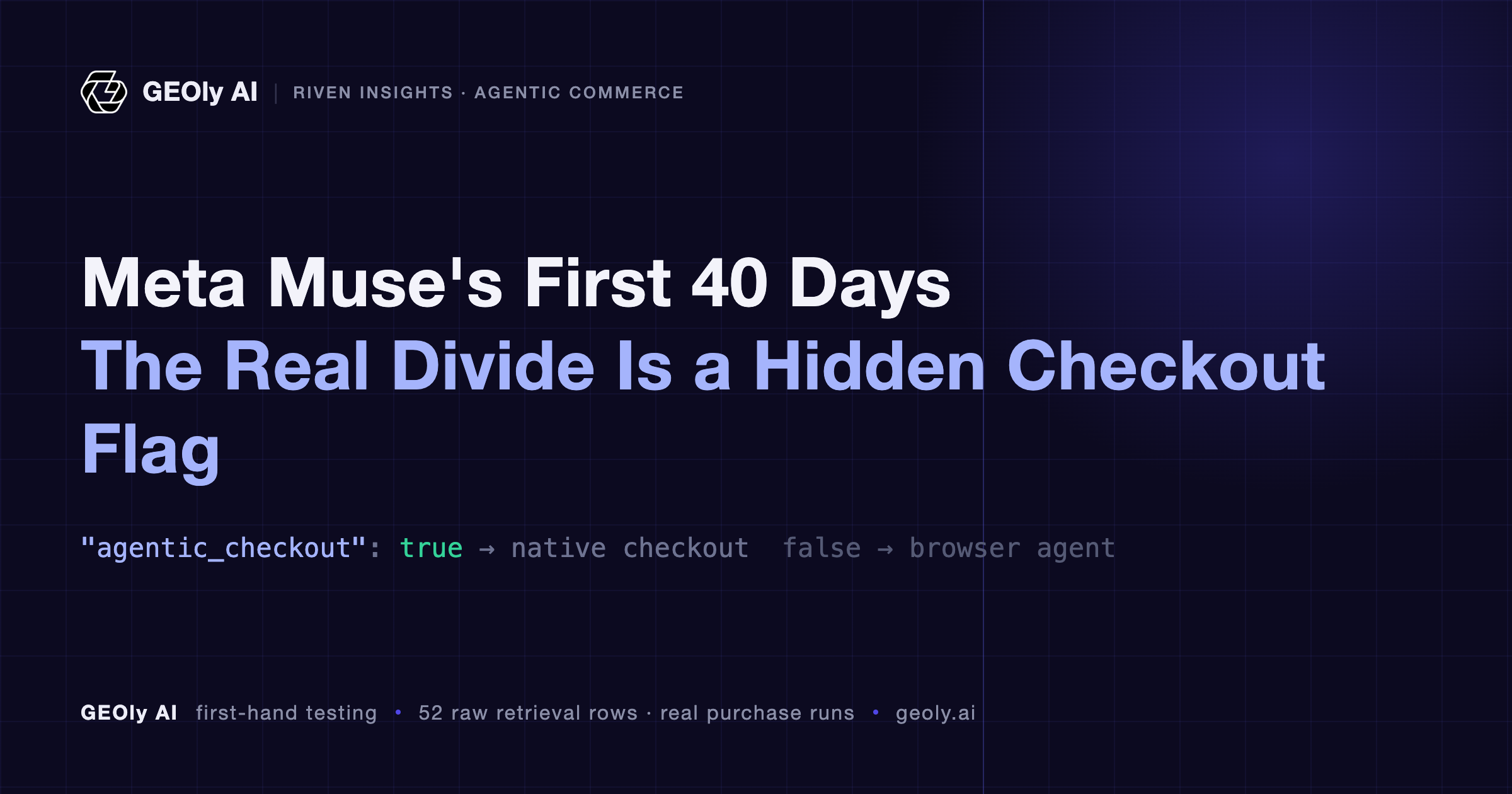
Meta Muse's First 40 Days: The Real Divide Is a Hidden Checkout Flag
Muse hit 10M users in 40 days with $200+ shopping baskets. GEOly AI first-hand testing of 52 raw retrieval rows reveals the agentic checkout flag that splits products into native in-Muse checkout versus a fragile browser agent — and the P0 actions merchants should ship before BFCM.
Tencent Enters GEO: A Deep Dive into AnswerBit — and How It Maps Onto GEOly
Tencent has launched AnswerBit, a GEO platform monitoring five Chinese LLMs with a framework that mirrors GEOly — here is a full teardown, the side-by-side comparison, and what its entry means for brands.
What Is Agentic Commerce? The Brand Playbook for AI Shopping Agents (2026)
Agentic commerce means AI agents — not humans browsing product pages — increasingly discover, compare and buy on shoppers' behalf; brands win by serving agents structured, authoritative context instead of hoping they scrape the right thing.
From Cited to Sold: Turning AI Visibility into AI-Channel Revenue
Being mentioned by AI engines is not a business result — the AI channel becomes revenue when visibility, agent-readable selling context and your own checkout are run as one funnel with AI-attributed orders as the KPI.
AI Agents Are the New Buyers: Why Your Brand Needs Agent-Readable Context
AI shopping agents don't read your landing pages — they assemble your brand from scraped fragments unless you serve them one authoritative, structured context; here's what agent-readable context is and how to build it.
AI Is Getting Your Brand Wrong: How to Fix It in 2026
Wrong AI answers about your brand almost always trace back to a fixable source — audit every engine, correct the pages they cite, and retest on a schedule.
ACP vs UCP vs AP2: Agentic Commerce Protocols Explained for Brands (2026)
ACP, UCP, and AP2 solve different layers of agentic commerce — and after OpenAI's checkout retreat, the discovery layer (whether AI recommends you at all) is where brands win or lose.
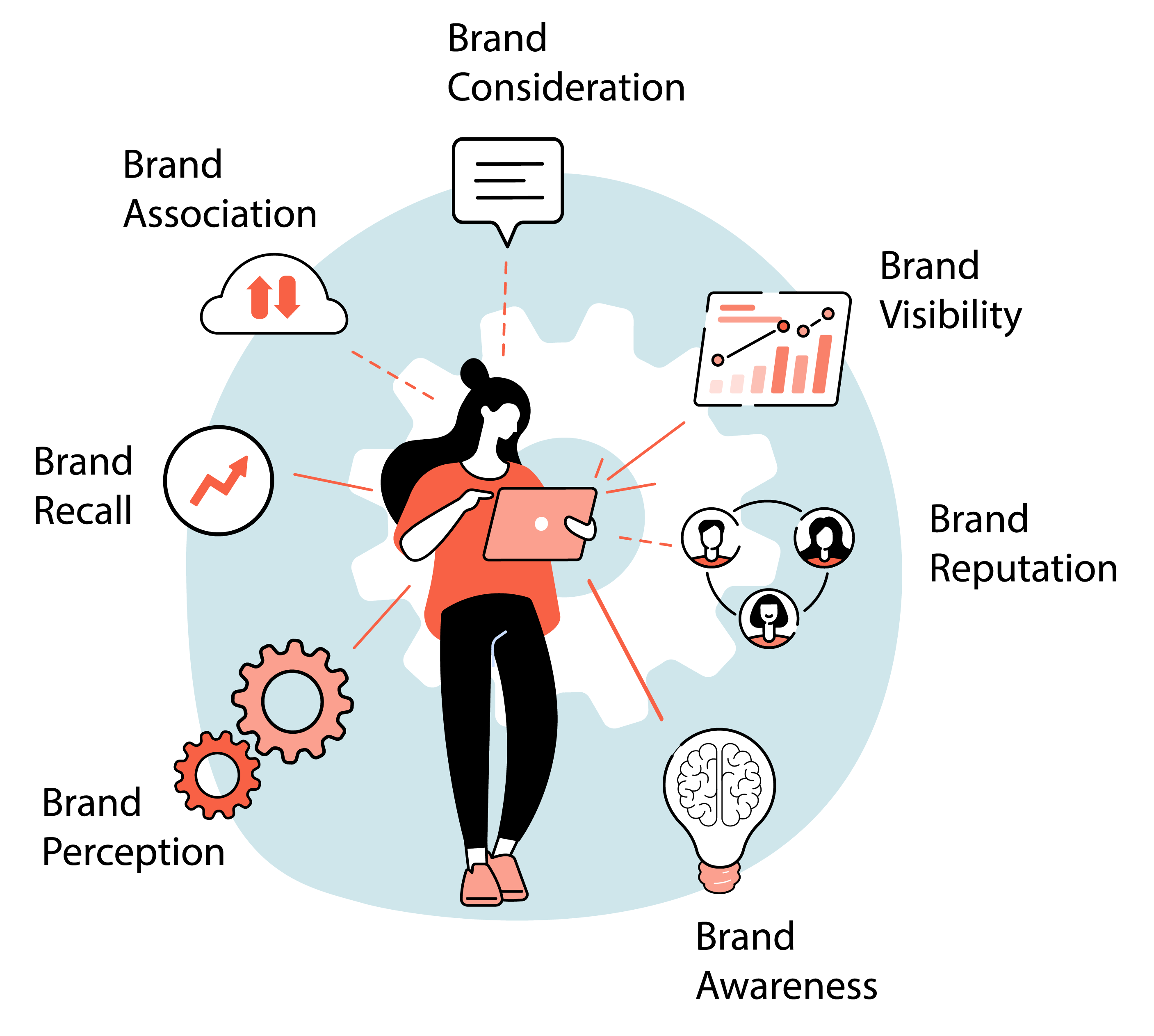
How to Track AI Brand Visibility Across ChatGPT, Gemini, Perplexity, and Google AI
A practical guide to prompt monitoring, AIGVR, mention rate, citation rate, Share of Model, AI shopping visibility, and ChatGPT Ads measurement for DTC and ecommerce brands.
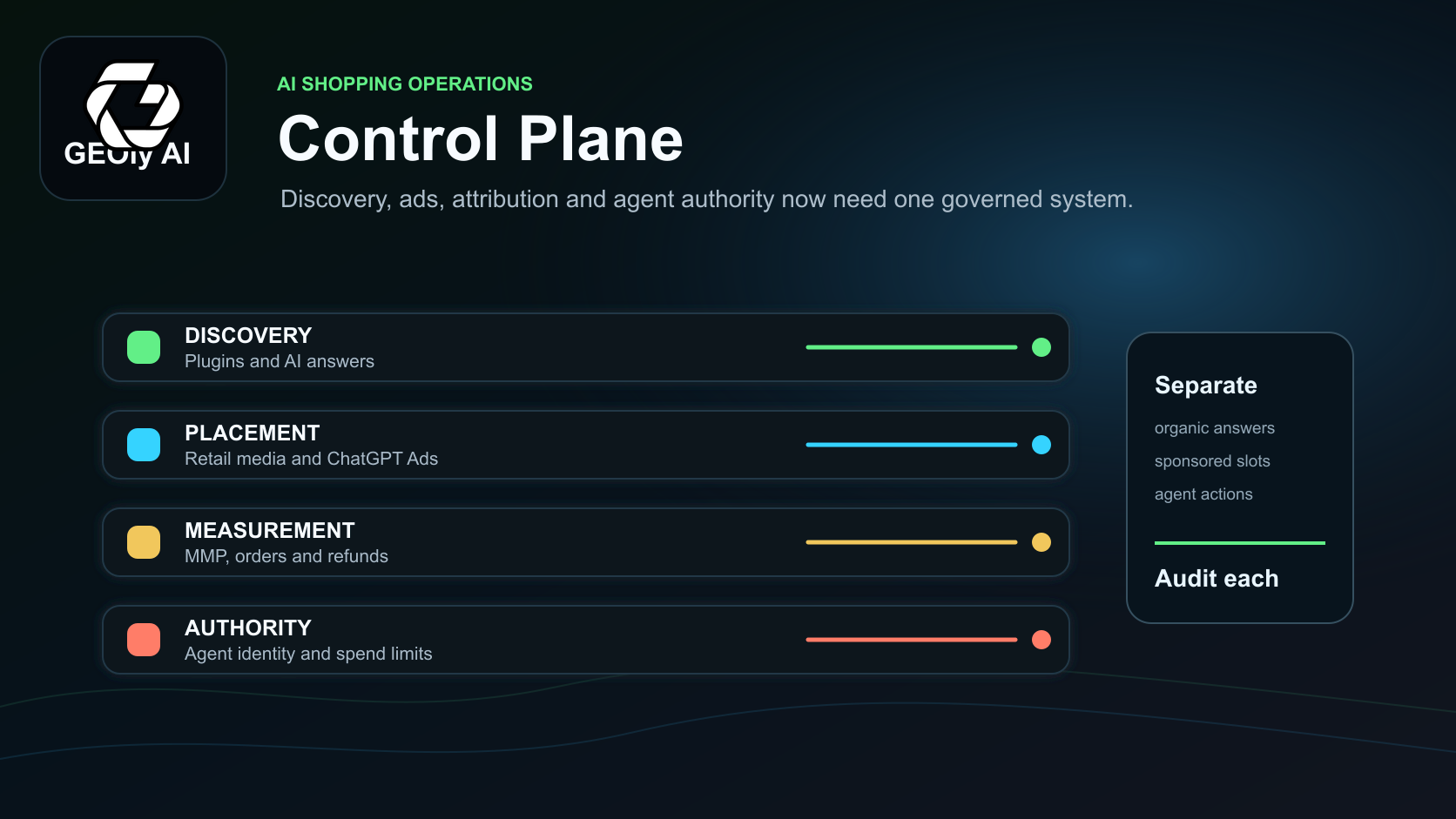
AI Shopping Needs a Control Plane, Not Another Channel Plan
Safeway's ChatGPT plugin, AppsFlyer measurement for ChatGPT Ads, Kroger assistant ads, Shopify AI commerce data and Cloudflare Wallets all point to the same shift: AI shopping now needs a control plane across discovery, ads, attribution and agent authority.
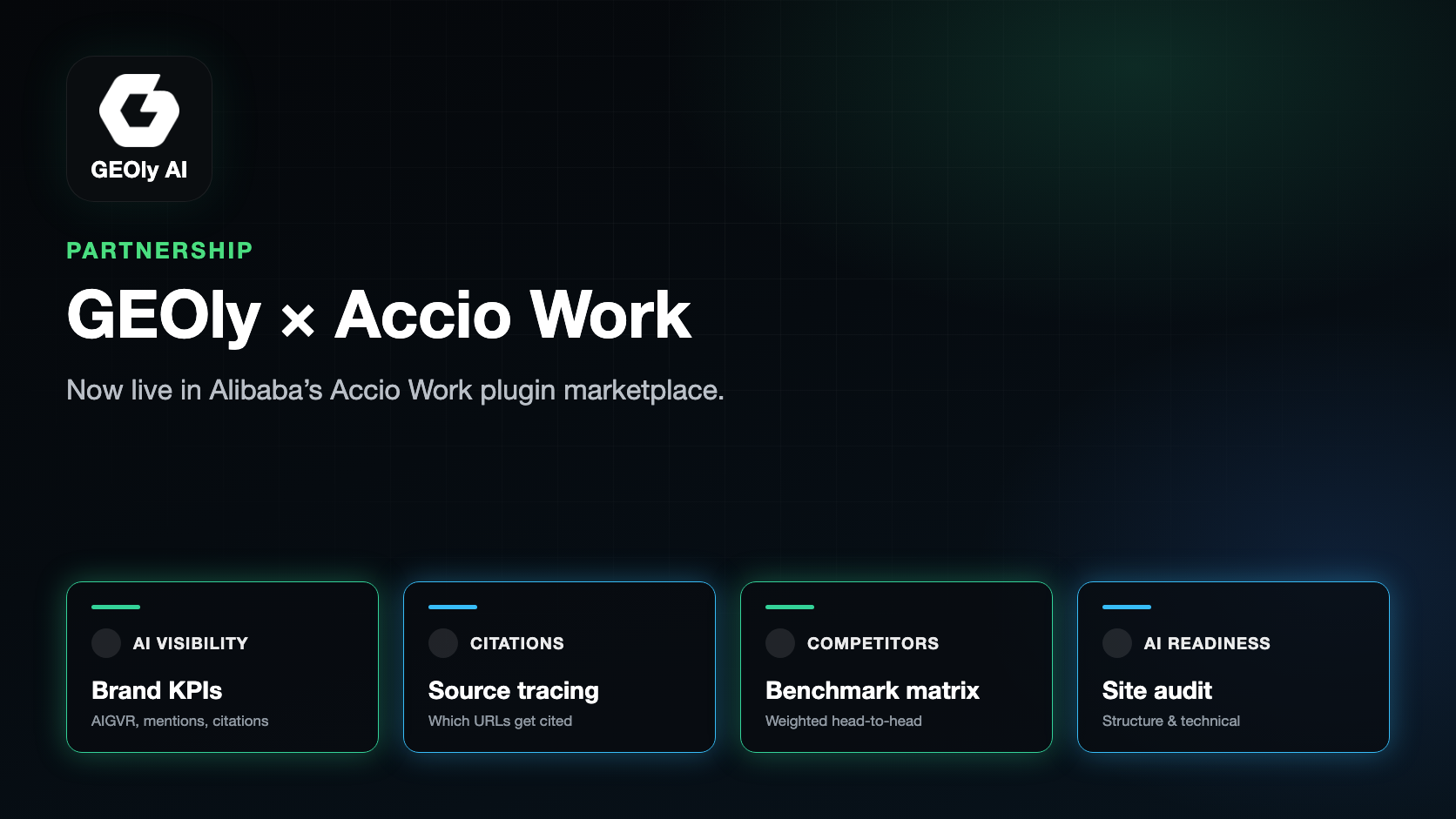
GEOly Joins the Accio Work Plugin Marketplace
GEOly is now live in Alibaba's Accio Work plugin marketplace, bringing AI visibility, citation tracking and GEO insights straight into your agentic workflow.
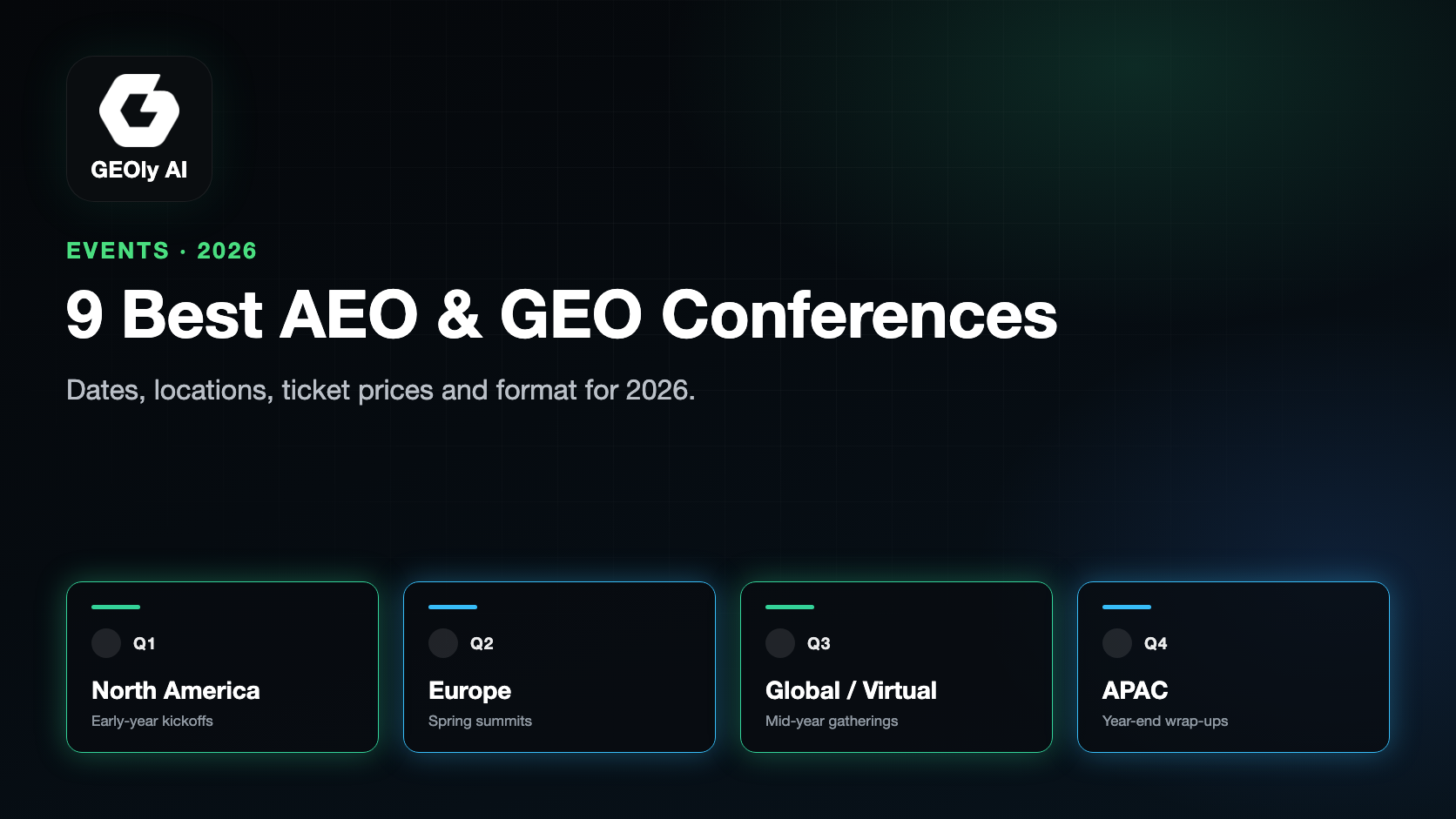
9 Best AEO & GEO Conferences to Attend in 2026
Nine real, currently scheduled AEO and GEO conferences for 2026 — dates, locations, ticket prices and format, from The GEO Conference and Masters of Search to SEO Week and a free virtual summit.
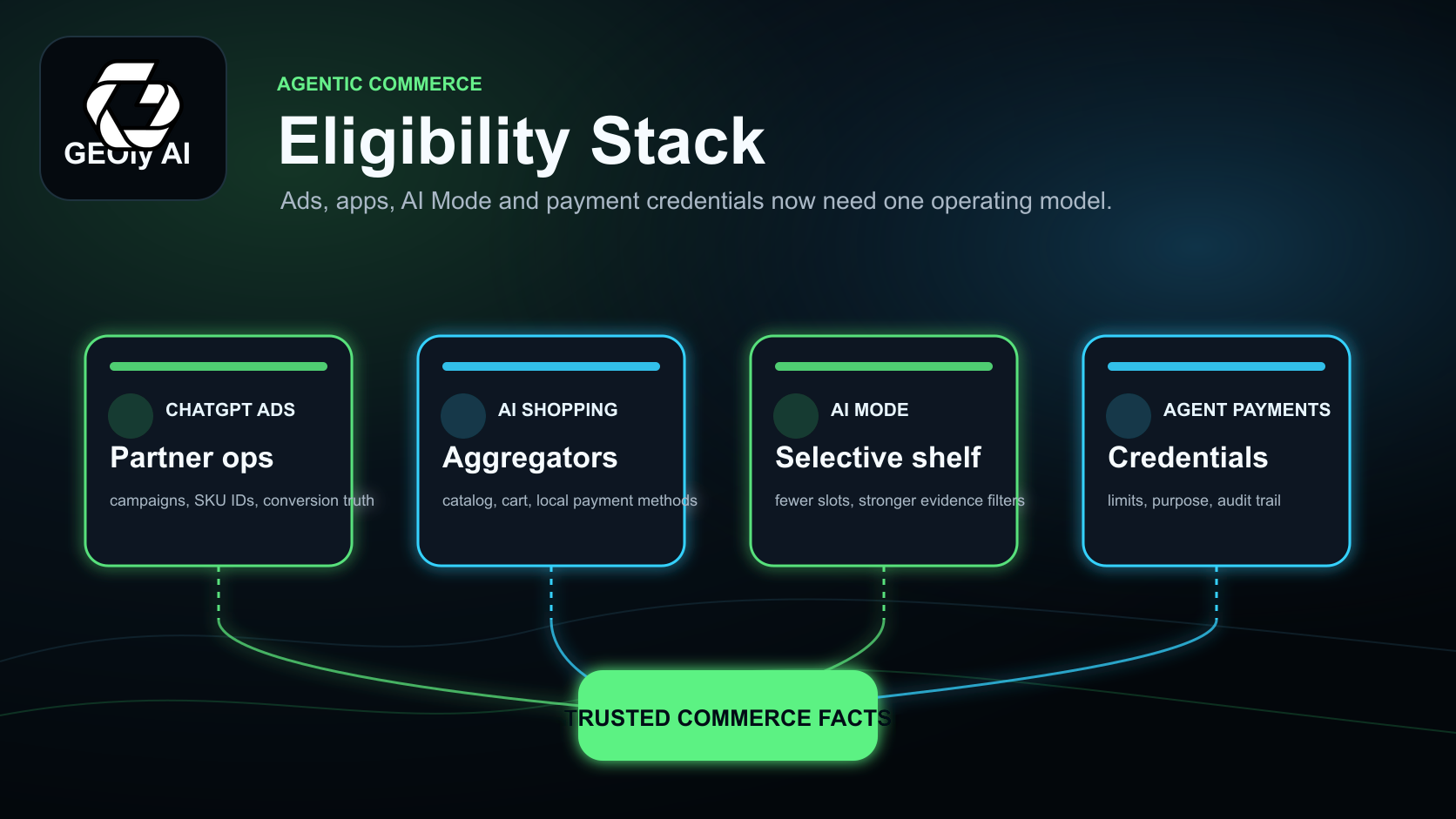
Agentic Commerce Now Needs an Eligibility Stack
ChatGPT Ads partners, AI shopping aggregators, Google AI Mode, brand apps and agent payment cards are converging around one question: is your brand eligible for AI systems to recommend, route and transact with confidence?
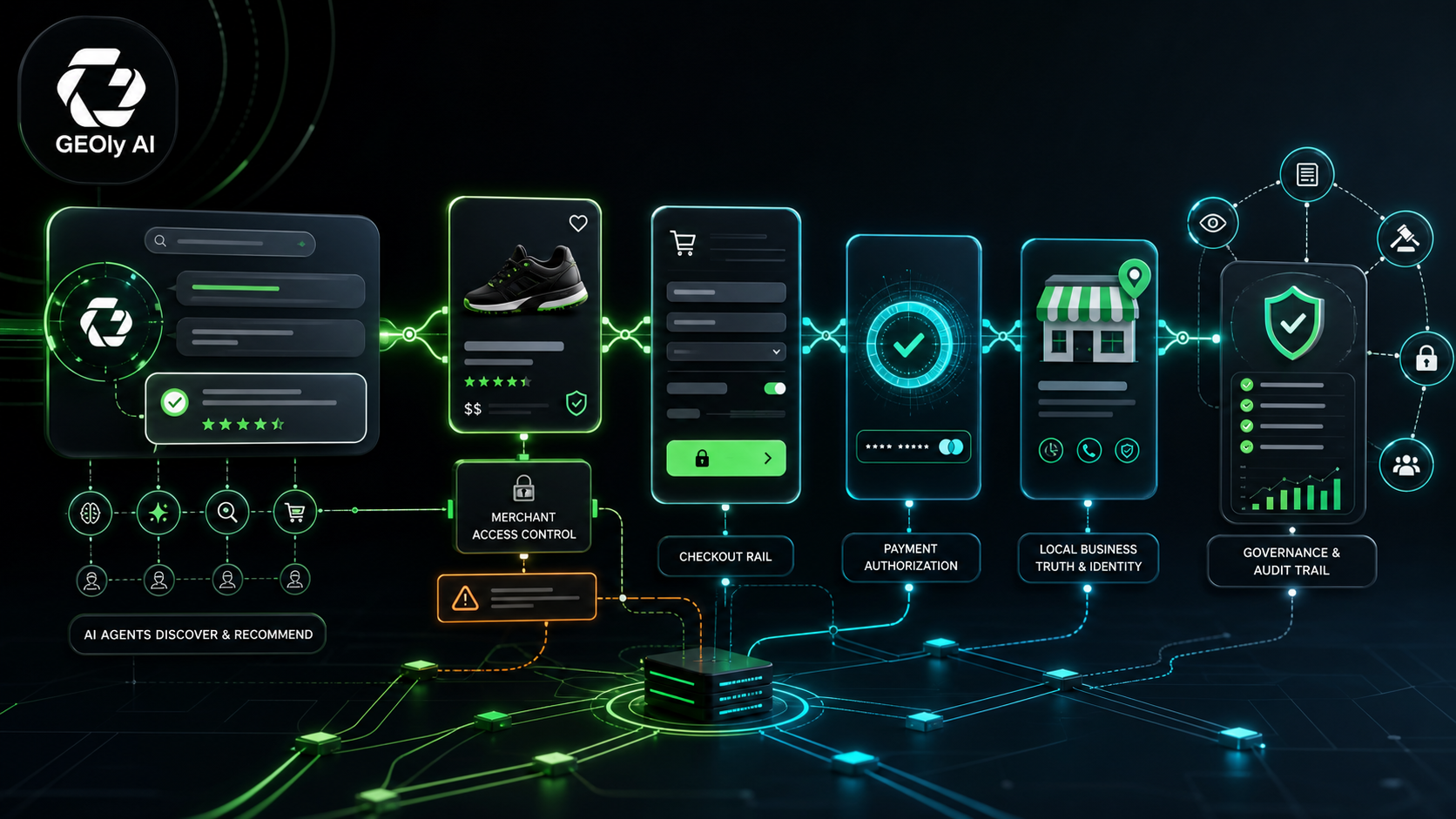
Agentic Commerce Has a Checkout Problem Before It Has a Search Problem
AI shopping agents are advancing, but the hard layer is not product discovery. Brands now need accurate entity facts, checkout permissions, payment guardrails and auditable recommendation logic.

GEOly AI Is Now Listed on Trending AI Tools: Make Your Brand Visible in AI Search
GEOly AI is now listed on Trending AI Tools as a freemium Search Tool. Discover what the platform highlighted and how GEOly helps brands measure and improve visibility across ChatGPT, Gemini, Perplexity, Google AI, and more.

AI Search Is Becoming Commerce Infrastructure: What Brands Need to Build Now
AI answers are connecting trusted data, advertising, product discovery, checkout, payment, and attribution. The next GEO advantage will come from making a brand citable, machine-readable, actionable, and auditable.

What Is GEOly? The Official Domain (www.geoly.ai) and What the Name Means
GEOly, Geoly, and geoly all refer to one brand and one official domain — www.geoly.ai, the GEO data platform for DTC brands in AI search and agentic commerce. Here is what the name means and what the product does.

What Is Query Fan-Out? Examples and an SEO Workflow
Query fan-out expands a question into related searches. Learn how to distinguish generated ideas, observed queries and citations, then plan useful content.
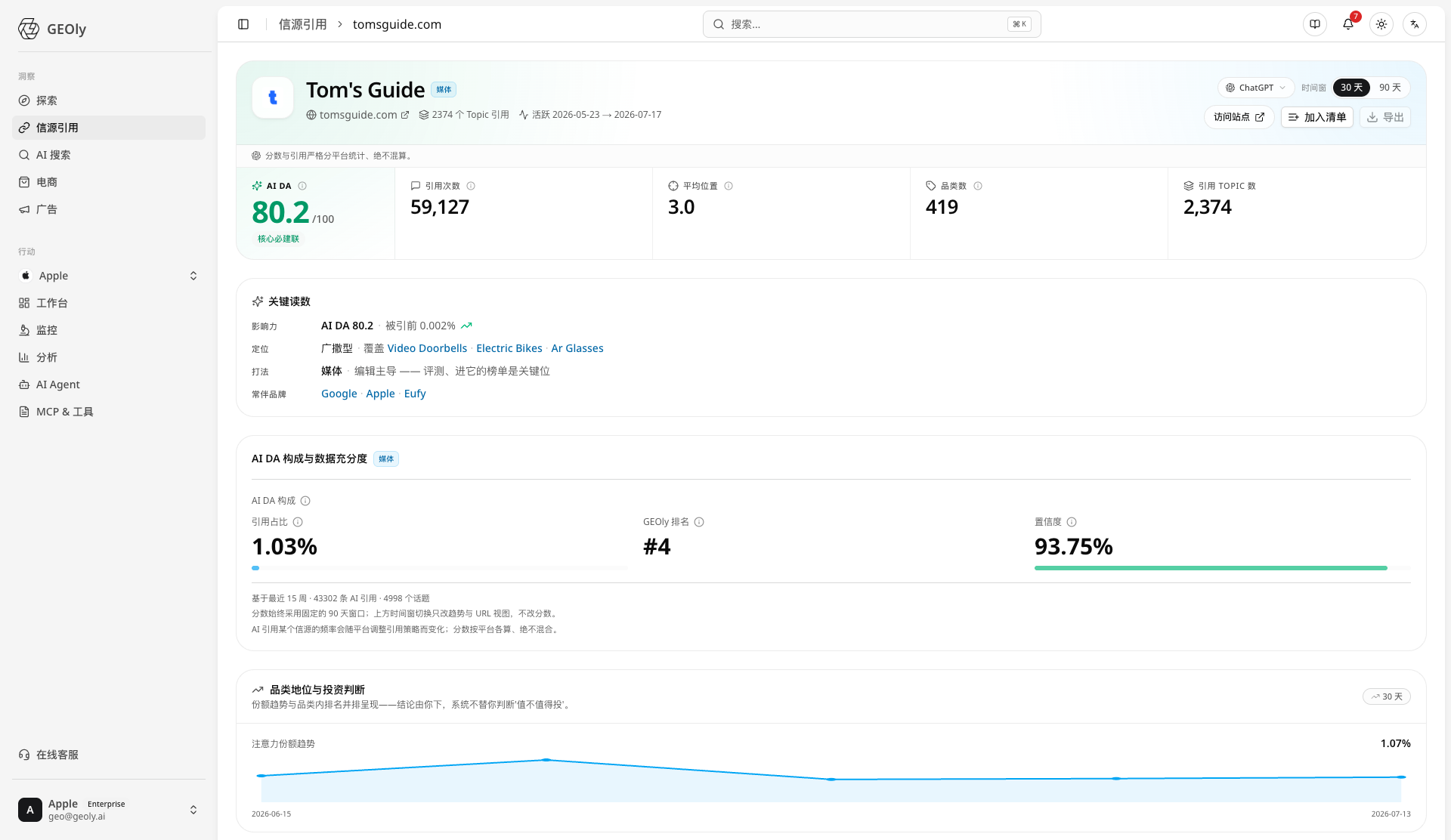
Who Does AI Actually Trust? Inside GEOly's New Source Citation Insight Page
We dissect a website that AI has cited 59,127 times to show, screen by screen, which sources AI trusts, how it decides who to recommend, and how your brand can turn that into a GEO playbook.
New in GEOly|What Is AI Actually Searching For? Meet AI Search Keywords
Traditional keyword tools tell you what people search on Google. GEOly now shows you what AI searches for on behalf of your category — and, behind every query, who shows up and where you're missing.

Best Google AI Overviews Tracker in 2026: Top 8 Tools
The 8 best Google AI Overviews trackers in 2026, compared on trigger tracking, citation visibility, share of voice and price — with a comparison table and FAQ. GEOly covers AIO plus every other engine from $49/mo.

Best Microsoft Copilot Rank Tracker in 2026: 6 Tools Compared
Compare the 6 best Microsoft Copilot rank trackers in 2026 on confirmed coverage, prompt monitoring, citations and pricing. GEOly ended Copilot monitoring in November 2026.

GEO in the Accountability Era: Citation Accuracy, Entity Consistency and New AI Regulation
A German regulator treating AI Overviews and Perplexity as platform content, plus the draft AI AGENT Act, push GEO from keyword volume toward entity consistency, structured product data and citation accuracy.
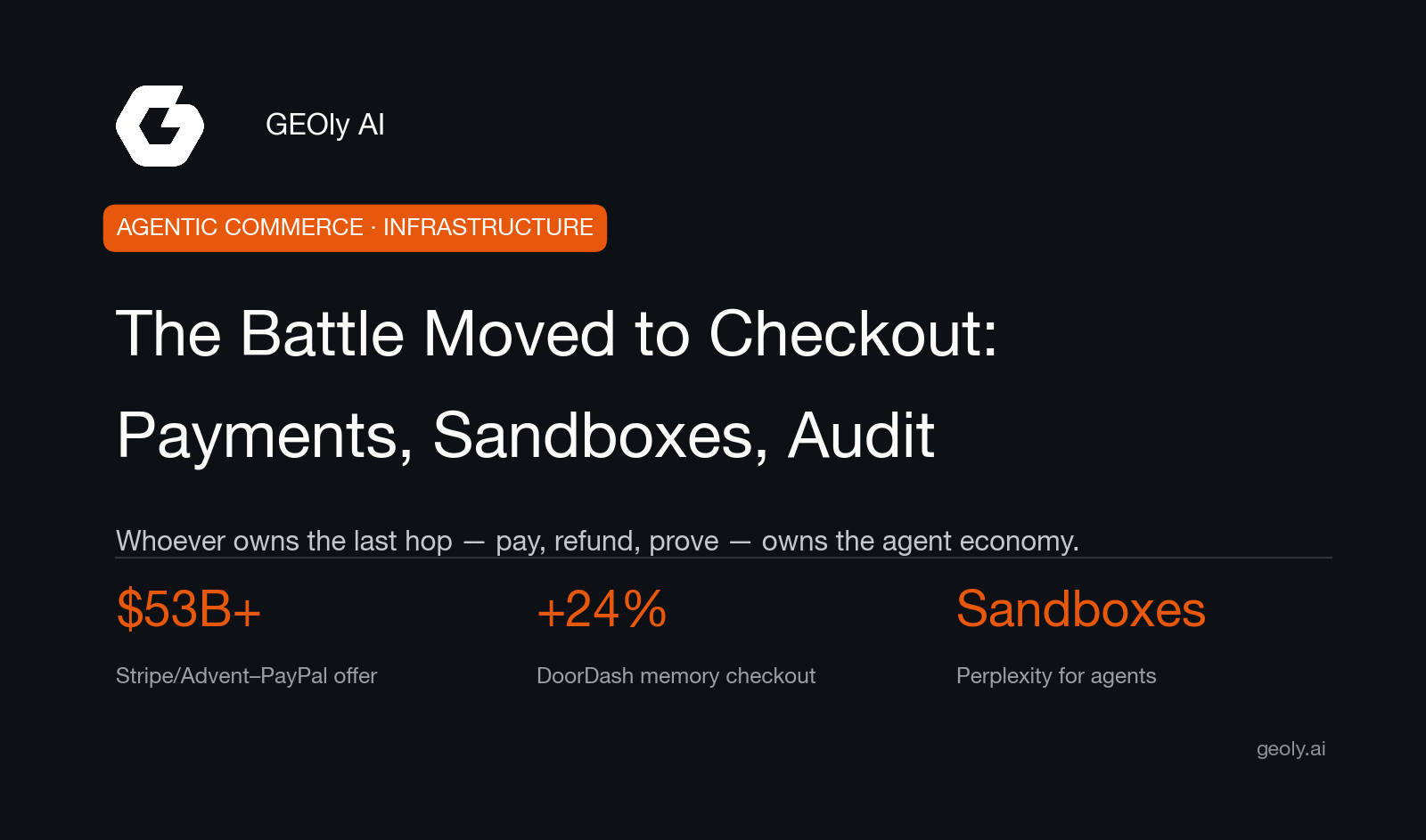
Agentic Commerce's Real Battleground: Payments, Sandboxes and Auditable Checkout
A $53B Stripe/Advent offer for PayPal, Perplexity's agent sandboxes and Stripe's integration benchmark show the agentic-commerce fight has moved from the chat box to payments and provable checkout.
Which GEO Platforms Have a Brand Sentiment Analysis Layer?
Sentiment scoring — how positively or negatively each LLM describes your brand across all tracked prompts — is now a core GEO capability. GEOly builds it in with a 0–100 Sentiment Score and an aspect-level breakdown you can drill into, and 16+ other platforms ship a version too. Here's how it works and what to look for.
Perplexity SEO: How to Get Cited and Recommended by Perplexity AI (2026)
Perplexity cites only three or four sources per answer, so the win isn't ranking on Google — it's being the fact-dense, well-structured page it quotes, corroborated by the domains it already trusts.
How to Get Cited in Google AI Overviews (2026)
Winning Google AI Overviews means being cited as a source, not ranking first: lead with the answer, structure your facts, and build entity authority, then track it with AIGVR and Share of Model.
How to Optimize Your Brand for ChatGPT: The 2026 GEO Playbook
Brands win in ChatGPT by shaping both what the model learned in training and what it retrieves live — through third-party credibility, answer-ready pages and clean product data, not by ranking a page.
Gemini Optimization: How to Get Your Brand Cited in Google AI
Gemini grounds its answers in live Google results, so brands earn AI visibility by ranking in Search, cleaning up their Knowledge Graph entity, and feeding Google clean multimodal and structured signals.
GEO vs SEO: One Pipeline, Two Scoreboards (2026 Update)
SEO wins rankings; GEO wins citations inside AI answers — and they are sequential stages of one pipeline, not rivals. The zero-click data, the 57/43 citation ecosystem, the four-stage source-selection view, and a combined workflow.
AEO vs GEO in 2026: What's Actually Different — and Where Budget Should Go
GEO pulls ~54K monthly searches, AEO ~30K — but are they even different disciplines? A practical decode of SEO vs AEO vs GEO: surfaces, metrics, what Google itself says, and a four-layer budget structure that ends the acronym debate.
The 5-Layer GEO Funnel: A Framework for AI Visibility
The 5-layer GEO funnel diagnoses AI visibility from the bottom up — technical access, citation, Share of Model, referral, and revenue — so you fix the layer that's actually broken instead of overspending on the one above it.
The Content & Citation Layer: Why Retrieved Isn't Cited in GEO
In generative search, ranking only gets your page into the pool an AI reads privately — the content and citation layer is where the engine decides whether to actually quote you, and that is the visibility that reaches the user.

Measuring AI Channel LTV: Why AI Customers Are Worth More
AI-acquired customers convert and retain better than paid or organic visitors, so the metric that proves GEO is working is AI channel LTV — not click volume.
Brand Reputation Management in AI: How to Control Your Narrative in AI Answers
In AI search you can't bury a bad result — you manage brand reputation by monitoring what ChatGPT, Gemini and Perplexity say, correcting the facts they retrieve, and flooding the web with fresh authoritative signal until the model's consensus updates.
Cross-Platform GEO Strategy: ChatGPT, Gemini, Perplexity & Beyond
Cross-platform GEO isn't five campaigns — it's one consistent, well-structured brand entity every AI engine can retrieve, plus a few per-platform signals, because buyers now decide across ChatGPT, Perplexity, Gemini and more.
GEO Competitive Analysis: How to Read Your Rivals' AI Visibility
Your AI competitors are whichever brands ChatGPT, Gemini, and Perplexity name in their answers — measuring their Share of Model, framing, and citation sources tells you exactly where to fight and how to win the recommendation.