From Anker SOLIX to xTool — the brands above already see how ChatGPT, Gemini and Google AI mention, cite and recommend them. Your brand is being talked about in AI right now. See it.
Meta Muse for Merchants: The Agentic Checkout Flag Explained | GEOly | GEO Tools: See How AI Talks About Your Brand
Meta Muse's First 40 Days: The Real Divide Is a Hidden Checkout Flag
Summary
Muse hit 10M users in 40 days with $200+ shopping baskets. GEOly AI first-hand testing of 52 raw retrieval rows reveals the agentic checkout flag that splits products into native in-Muse checkout versus a fragile browser agent — and the P0 actions merchants should ship before BFCM.
2026/10/23
11 min read
Meta's Muse crossed 10 million users in its first 40 days, and shopping is already its top use case — with over a quarter of shopping users averaging more than $200 per purchase. Every AEO/GEO publication is now telling merchants how to "optimize for Muse." Almost all of that advice stops at the same place: get your products into Meta's catalog. It rarely answers the question that actually decides conversion: once you are in the catalog, why can Muse complete the purchase natively for some products, while for others it has to send a browser agent to click through your storefront like a very patient intern?
At GEOly AI, we spent two weeks taking Muse's shopping pipeline apart first-hand: we exported two raw retrieval samples totaling 52 product rows, ran a real purchase through the browser-agent branch with a live account, and probed a store-side UCP checkout endpoint. This article puts the public research, its blind spot, and our first-hand findings in one place — ending with a prioritized action list you can run before BFCM.
Key takeaways
Muse hit ~10.9M downloads and 2.5M DAU in 40 days (Sensor Tower); shopping is the top activity and Meta monetizes via commerce take rates, so merchant placement will become a paid-attention battleground fast.
A hidden boolean on every catalog item — the agentic checkout flag — splits products into two completely different conversion paths: native in-Muse checkout versus a fragile browser sub-agent that operates your website.
In our 52-row sample, every big-box retailer (Walmart, Best Buy, Target, Home Depot and others) was flagged false; every true product came from DTC independent sites. Right now, a Shopify store has a smoother Muse checkout than Walmart — a window that will not stay open.
Brand-owned listings get buried by resellers: one hardware brand had 20 entries in a single retrieval and only one true listing from its own store, ranked #19.
The flag is only a ticket, not a win: Muse's account memory can override cheaper, better-flagged options. And in the browser branch, pop-ups or blocked clicks make the agent abandon your site entirely.
Why now: 40 days of Muse in numbers
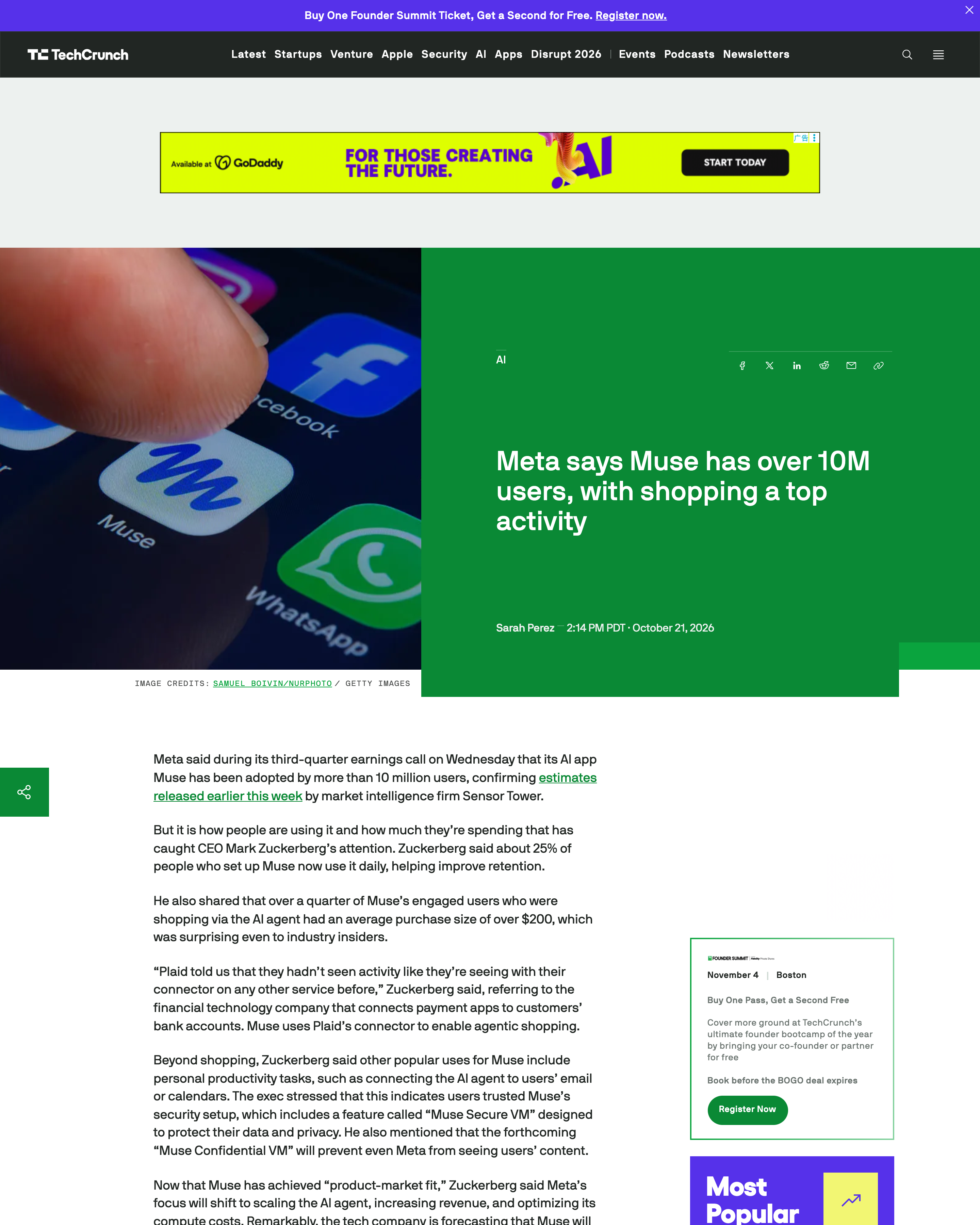
Muse launched on September 8, 2026 in the US. On Meta's Q3 earnings call, Zuckerberg confirmed the 10-million-user estimate, said about 25% of people who set up Muse now use it daily, and that over a quarter of its shopping users average $200+ per purchase. Plaid said it had never seen transaction activity like this through its connector. Shopify's CEO announced a deep partnership that makes Shop Pay the agentic checkout layer for every Shopify store, while Amazon blocked Muse outright — the first clear case of camp-splitting in agentic commerce.
Figure 1 — TechCrunch, Oct 21 2026: Muse passes 10M users with shopping as a top activity.
Metric
Value
Source
Launch
2026-09-08 (US), later Canadian SMBs
Retailgentic / ppc.land
Downloads
~10.9M in 40 days (10.2M US)
Sensor Tower
DAU
2.5M+ as of Oct 16, +15% week over week
Sensor Tower
Retention
73% day-1 return rate, roughly 2× ChatGPT
Sensor Tower
Shopping
Top use case; >1/4 of shopping users average $200+
Meta Q3 earnings call
Business model
Free tier + commerce take rate; Muse Wonder at $20/$100 per month
CNBC / TechCrunch
How big is this channel, really?
Two layers to that question. Today: 2.5M DAU with shopping as the top activity already implies hundreds of thousands of high-intent product queries per day — a mid-size vertical search engine's volume, but with $200+ basket intent. The ceiling: Muse's entry points include WhatsApp today (Instagram, Messenger and Ray-Ban glasses are on the roadmap), and Meta's family of apps has three billion daily users to funnel in. Zuckerberg said on the call that Meta is building capacity "for over a billion people." Muse's growth depends on Meta turning a dial, not on market education.
On market size, the 2030 forecasts differ in numbers but agree in direction: Morgan Stanley puts agentic shopping at $190–385B of US e-commerce (10–20% share), Bain at $300–500B (15–25%), and McKinsey sees $3–5T globally. No one has published a Muse GMV figure, so here is a transparent scenario model — swap in your own assumptions:
US agentic commerce $190–385B × Muse at 20–30% of agent channels
$40–115B
Even the conservative case — a channel approaching $2B annualized GMV where an AI makes the decision and completes the payment — deserves a named owner on any brand's growth team.
What the public research says — and what it misses
The consensus is solid as far as it goes. Retailgentic found that when a product appears in Meta.ai's top-3 results, Muse surfaces it 89% of the time, and distilled five best practices (catalog coverage, data enrichment, monitoring, checkout health, UCP investment). Profound's 50-prompt analysis showed ~95% of Muse's candidates come from Meta's catalog, that well-known merchants are favored in the top five, and that brand-owned stores should rank first when a shopper names a brand — the same retrieval-layer logic we map in our guide to grounding queries.
Figure 2 — Retailgentic's five Muse optimization best practices for merchants.
What nobody explains is what happens after retrieval. Muse's candidates split into two checkout paths with wildly different conversion mechanics, and the split is decided by one field most merchants have never heard of.
The true/false divide: what our first-hand testing found
GEOly AI ran multiple real shopping tasks in Muse, exported two raw retrieval JSONs (52 rows), and on October 12 walked a real browser-branch purchase to the shipping-details step (a $35.99 official accessory kit from a smart-home brand we'll call Brand A; all tested brands are anonymized below).
Every product Muse retrieves carries a boolean we'll shorthand as the agentic checkout flag (is_agentic_checkout_creation_enabled). True means native checkout: Muse asks the shopper to connect the Shop app and pays via a one-time Shop Pay token, all inside the conversation. False — or absence from the catalog — means Muse dispatches a browser sub-agent to your website to search, add to cart, and fill checkout forms step by step.
Figure 3 — The two checkout paths behind every Muse purchase, decided by the agentic checkout flag (GEOly AI, from first-hand testing and public sources).
Here is the full six-stage pipeline, from merchant pre-configuration to fulfillment — worth auditing node by node against your own store:
Figure 4 — The full Meta Muse × Shopify agentic shopping pipeline across six stages (GEOly AI).
Finding 1: big-box retailers are all false; true belongs to independent sites
In both samples, products from B&H, Dell, Sam's Club, Target, Walmart, Best Buy, Nordstrom and Home Depot were all flagged false — browser branch only. Every true product came from DTC independent storefronts, including the official sites of Brands A, B and C, plus other brand stores and even a reseller independent site.
This is the single most important fact in this article: inside Muse's native checkout channel, a Shopify independent store currently outranks Walmart and Best Buy on experience. Add Amazon's absence, and DTC brands are looking at a channel window they have not had in a decade.
Finding 2: the flag is per-product, not per-merchant
The same merchant splits across both paths: Brand B's own store had 4 true and 4 false rows in one sample. An external correlation held across all 52 rows without exception: true links all carried variant parameters (most also a utm_campaign=meta_catalog template, likely from Shopify sync), false links never did — suggesting the flag may track whether variants were fully synced (hypothesis, untested). For multi-site brands the implication is direct: Brand A's US site was in the catalog, but the accessory we tested only exists on its global site — and wasn't. Audit every site, every SKU.
Finding 3: brand-owned listings drown under resellers
In one retrieval, Brand B appeared in 20 rows: 19 were false, 18 of those from resellers. The brand's own store had exactly one true listing — ranked #19 — and its flagship product from its own store ranked #35. The written rule says brand stores rank first; in the real list, reseller noise buries them. Without active distribution governance, the "direct sellers first" rule cannot save you.
Finding 4: true is a ticket, not a guarantee
In one test, after catalog retrieval, Muse still ran a parallel browser search and ultimately recommended a false big-box listing at $159 — citing the shopper's history — over a cheaper true alternative at $129.98. Account memory carries heavy weight, which also means ranking experiments must reset memory or use fresh accounts, or your data is polluted.
Finding 5: in the browser branch, page experience is life or death
The browser sub-agent depends on your page structure. Testing Brand B's site, stacked pop-ups and intercepted clicks stalled the agent's task — Muse gave up on the site and bought elsewhere. For false products, aggressive pop-ups no longer cost you a few points of conversion; they cost the entire agent order. Also note: Muse purchases don't fire browser-side Meta Pixel or GA scripts. Without server-side CAPI, your attribution develops a growing blind spot.
Figure 5 — GEOly AI browser-branch purchase test (anonymized): two-stage task orchestration, stopped at shipping details.
Our read: Muse turns GEO into a three-layer funnel
In the ChatGPT era, generative engine optimization was about getting AI to talk about you — sources, mentions, citations. Muse makes being talked about merely layer one. The full funnel has three, and each eliminates merchants:
Layer
Question
Decided by
Cost of failing
1 · Catalog access
Are you at the table?
Meta catalog inclusion + Meta.ai top-3 presence (89% carry-through)
~95% of candidates come from catalog; absent ≈ invisible
2 · Product data
Does the AI pick you?
GTIN/variant completeness, conversational attributes, price, stock freshness, direct vs reseller
Buried by resellers; thin data misses long-tail intent
3 · Checkout capability
Can the agent actually buy?
The agentic checkout flag, page operability, server-side CAPI
Most merchants — and most agencies — are still on layer one. The conversion gap is won at layer three. A true flag means product sync, variant management and payment rails all working at once; an agent-operable page means redefining UX as human-plus-agent experience. That is the second half of GEO: from optimizing what AI says about you to optimizing what AI can do for your customers.
Native checkout, by the way, is cleanly designed: Muse never touches card numbers — Shop Pay returns a single-use token, Shopify processes the charge, and the order lands in your admin attributed to the Meta channel:
Shopify: verify Catalog sync covers every site and SKU; others: Commerce Manager; multi-site brands audit per site
Confirmed
P0
Audit the agentic checkout flag per SKU
Confirm core products are true (with complete variant sync); A/B single products before rolling out
Correlation
P0
Ship server-side CAPI with dedup
Muse purchases fire no browser Pixel/GA; without CAPI both ads and attribution go dark
Public docs
P1
Clear the path for browser agents
Kill pop-ups, avoid click interception, keep guest checkout; make "agent completes add-to-cart in one pass" a release gate
Observed
P1
Govern reseller distribution
Trim low-quality reseller channels; keep own-store listings richest and price-competitive
Confirmed
P2
Conversational data enrichment
FAQ, use cases, materials for top 5–10% SKUs; complete GTIN/UPC
Best practice
P2
Stand up a UCP endpoint
Store-side UCP capability is likely not the bottleneck, but early exposure catches Muse's next expansion
Hypothesis
Timing: complete every P0 before BFCM. Muse shoppers' $200+ baskets won't wait for anyone's roadmap.
FAQ
What is the agentic checkout flag?
A boolean (is_agentic_checkout_creation_enabled) attached to every product Muse retrieves from Meta's catalog. True routes the purchase through native in-Muse checkout via Shop Pay; false or missing routes it to a browser sub-agent operating the merchant's website.
Why are big-box retailers all flagged false?
Our 52-row sample shows the pattern but not Meta's reasoning. The observable correlation is that true listings carry fully-synced variant parameters typical of Shopify Catalog sync. Large retailers don't flow through that pipeline — which currently hands DTC independent stores a structural checkout advantage.
Does a true flag guarantee Muse recommends my product?
No. It guarantees eligibility for native checkout, not selection. Muse weighs user memory, price and constraints — we watched it pick a more expensive false listing because of purchase history. Layers one and two of the funnel still decide whether you get picked.
How do I know whether my products are true or false?
The flag is visible in Muse's raw retrieval results, not in your Shopify admin. GEOly AI runs this audit — retrieval sampling across your category's prompts, per-SKU flag mapping, and a remediation plan — as part of our Agentic Commerce solutions.
The true/false divide, reseller burial and browser-branch abandonment above all come from GEOly AI's first-hand testing. The sample is still small; we will keep expanding it and publish updates. If you want to know which side of the flag your products sit on — start with a free GEOly audit or explore our pricing.