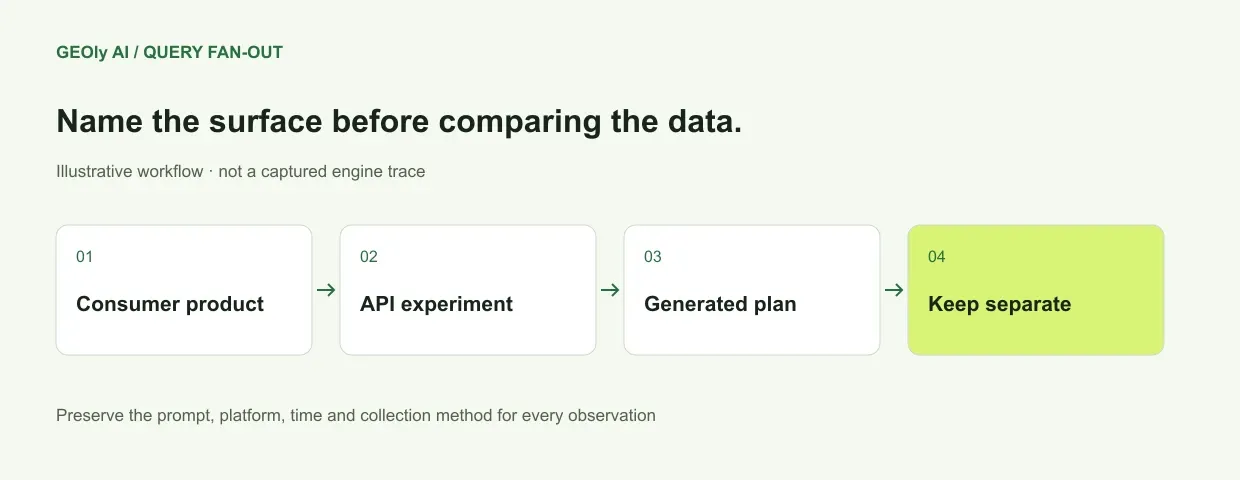
A query fan-out comparison is useful only when it names the product surface and the evidence collected. Google AI Mode, AI Overviews, consumer ChatGPT and an OpenAI API experiment should not be pooled into one dataset simply because each can use web information.
Key takeaways
- A documented retrieval technique does not imply access to its complete internal query log.
- API search actions and consumer-product observations have different collection conditions.
- Store the original prompt, platform, date and evidence type beside each result.
- Compare content decisions across platforms; compare numeric metrics only when their definitions and samples match.
Google: a public mechanism, not a public log contract
Google documents query fan-out as a technique AI Mode and AI Overviews may use to search related subtopics and data sources. The same guidance explains that the experiences may use different models and techniques. It does not promise a fixed expansion count or a complete public record of internal searches. Google Search Central
For content planning, this supports investigating adjacent information needs. It does not justify labelling a generated list as “the exact Google fan-out” without observation evidence. A provider should explain where its query records come from and what might be missing.
ChatGPT observations and API experiments
A consumer-product observation records what the chosen collection method can see from that product. An API experiment runs a developer-controlled request with its own settings. Even with similar wording, these are different experiments.
The OpenAI web-search API exposes search-call items and citation annotations; search actions usually, but not always, include queries. Its sources field and inline citations also have different meanings. Official OpenAI documentation
That makes the API useful for reproducible retrieval experiments. It does not by itself validate claims about what a consumer session searched, displayed or cited. Keep API results explicitly labeled, retain the request configuration, and do not silently substitute them for consumer observations.
A comparison table that preserves the differences
Surface or method | What to record | What not to infer |
|---|---|---|
Google AI Mode / AI Overviews observation | Product, question, date, available query and source evidence | That a generated expansion is a complete internal log |
Consumer ChatGPT observation | Session conditions, exposed search evidence and answer citations | That another run will produce the same searches |
OpenAI web-search API experiment | Request settings, search-call output and annotations | That the result reproduces consumer ChatGPT |
Template or LLM simulator | Input, generated branches and generation method | That any generated branch was actually searched |
This table is an evaluation framework. It is not a statement that GEOly provides every collection method listed here.
Build a comparable observation sheet
Use one row per captured query and retain a link to its parent observation. At minimum, record prompt text, platform surface, language, market when known, observation time, query text and collection status. Keep the answer and its cited URLs in related fields or records.
Do not put “none” into a field merely because an extractor returned no value. Use explicit states: captured, not exposed, collection failed, or unknown. Otherwise missing data can look like a change in search behavior.
When deduplicating, preserve the raw query alongside the normalized version. Removing whitespace is different from merging semantically related questions. Keep both query frequency and distinct prompt coverage if you use them: one repeated search and searches across many prompts answer different analytical questions.
Run a small content experiment
Start with a stable group of buyer questions about one decision—for example, selecting an AI monitoring tool for an agency. Collect an initial window and inspect which requirements repeatedly appear. Check whether your existing page answers those requirements with verifiable product details.
Make a limited change: clarify platform coverage, add a billing example or document a setup requirement. Record the change date. Observe a later window with the same platform and prompt selection. Discuss the difference alongside collection completeness and model variability; do not label a before/after association as proven causation.
GEOly’s query analysis page explains its observed-query workflow. The 1,404-query case demonstrates how one project’s searches can inform a content plan without estimating all-user demand.
Frequently asked questions
Is Google fan-out the same as ChatGPT fan-out?
The broad idea of investigating related needs is comparable. The implementations, interfaces and visible evidence differ. Use platform-specific observations rather than assuming identical behavior.
Why do two tools show different queries?
They may use different prompts, surfaces, settings, locations, times or evidence methods. Ask whether each result is generated, observed from a consumer product, or obtained from an API experiment before comparing it.
Where should I start without a dataset?
Use the free planner to propose branches, then validate them against customer questions. Move to monitoring when you need observed evidence over time. The tools guide helps separate those jobs.
Written by GEOly AI. Continue with Query Fan-Out fundamentals and the content gap solution.