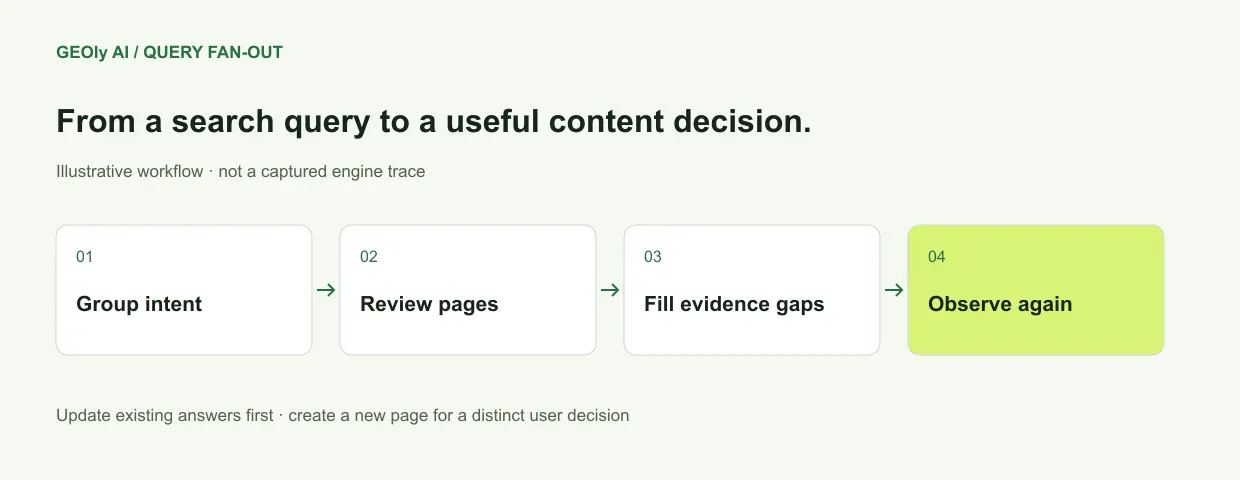
Query fan-out optimization means improving the answers available for the information needs revealed by related searches. The deliverable is a useful page or a better-supported statement—not a separate article for every generated phrase.
Key takeaways
- Preserve the difference between observed search evidence and generated planning ideas.
- Evaluate whether an existing page answers the decision before commissioning a new URL.
- Prioritize missing product facts and proof, not just missing keyword mentions.
- Separate content completion, AI observations and business outcomes when reporting progress.
Start with a bounded dataset
Choose one audience and a clear buying decision. Keep the original prompts, platform, date range and collection status. If you only have generated suggestions, label them as candidates and validate them with customer conversations or later observations.
GEOly’s 1,404-query study provides a first-party example from a seven-day monitoring window retrieved on November 13, 2026. Its 140 tracked prompts produced 1,408 prompt–query pairs and 1,404 distinct normalized search strings after removing prompt echoes. The project focuses on GEO and ecommerce; those counts are not estimates of all ChatGPT demand.
Keep the raw wording before normalization. One repeated query across several prompts is analytically different from several paraphrases within one prompt. Do not discard that relationship when preparing a content spreadsheet.
Group by the decision, not only the vocabulary
Consider three illustrative searches: “AI monitoring pricing per prompt,” “AI monitoring annual cost,” and “AI monitoring trial card required.” They share a cost-evaluation decision and can often be answered on one pricing destination. A fourth search, “how to investigate missing query records,” serves an implementation or troubleshooting task and deserves a different answer.
A practical intent label should tell an editor what the reader needs to decide. “Commercial” is too broad on its own; “compare the cost of monitoring 120 prompts” is actionable. Record constraints such as team size, market or required platform when they are present in the source query.
Build a coverage matrix
Field | What to enter | Why it matters |
|---|---|---|
Decision | The question the buyer needs resolved | Keeps the brief focused |
Evidence | Observed query or labeled suggestion, platform and date | Preserves provenance |
Destination | Existing URL or proposed distinct page | Prevents duplicate content |
Status | Covered, partial, missing or unknown | Separates judgment from absence |
Missing proof | Specific fact, example, policy or source | Makes the task executable |
Owner and follow-up | Responsible person and review window | Connects publishing to evaluation |
Read the destination page yourself. A title containing the keyword is not proof that the answer is there. Check whether a visitor can find the requirement, understand it and verify the supporting evidence without guessing.
The free planner can prepare intent branches and export a page-mapping worksheet. Mapping a URL is a planning action, not an automatic content audit.
Update, create or earn external evidence?
Update when the existing destination already serves the same audience and task. Add a quota example to pricing, a clear limitation to a feature page, or concrete setup steps to a guide.
Create when the decision requires a different workflow or evidence package. A technical setup guide and a commercial product overview can deserve separate pages even if both mention query fan-out.
Seek external evidence when the question depends on independent experience or verification. You cannot manufacture a third-party review by publishing a first-party claim. Make product facts easy to verify, and pursue legitimate reviews or relevant editorial coverage without inventing endorsements.
Turn one row into an editorial brief
Illustrative brief: a buyer wants to know whether query analysis measures real searches or generated suggestions. The existing feature page explains benefits but does not identify the data source. The action is to add an evidence-definition section, a real interface screenshot, the supported collection scope and a link to a sample study.
Acceptance criteria are concrete: the reader can tell generated ideas from observations; the example has a date; missing-data limits are stated; the next action leads to the relevant product workflow. “Add 1,500 words” is not an acceptance criterion.
The query fan-out solution turns this process into a team workflow. The product feature explains how observed queries support investigation.
Measure after publishing
Record which page changed and when. Keep the monitored prompt set and platform stable for the comparison, and document any unavoidable changes. Report the number of valid observations alongside query coverage, citations and brand mentions.
Track website sessions, registrations, activation and payment separately when analytics is available. A cited page may receive no click, and a search visit may convert later through another session. Avoid claiming revenue impact from a citation count alone.
Technical eligibility still matters. Google’s guidance says ordinary SEO practices apply to AI search features; creating a fan-out-targeted page does not guarantee inclusion. Google Search Central
Frequently asked questions
Should I prioritize the most frequent query?
Not automatically. Frequency reflects your monitored sample. Combine recurrence with commercial relevance, the severity of the missing answer and the evidence you can responsibly publish.
How long should a page be?
Long enough to resolve the decision with usable evidence. Use clear sections, comparison tables or diagrams when they help. Avoid padding a page to reach an arbitrary word count.
What if the metrics do not improve?
Check whether collection conditions changed, whether the page is accessible, whether the evidence actually answers the need, and whether competing sources changed. Treat this as a diagnosis, not a reason to generate more similar pages.
Written by GEOly AI. Start with Query Fan-Out fundamentals or compare tool categories.