How does ChatGPT Ads work? ChatGPT Ads matches advertising opportunities to conversations, with eligibility, relevance and bidding shaping which placements can appear. Buying an ad is a paid-media activity; it does not buy a position in ChatGPT's independent answer. For a brand, the practical challenge is understanding which part of that journey a piece of evidence actually describes.
This is the starting point for GEOly AI's ChatGPT Ads mechanics series, reviewed on November 14, 2026. We checked the public sources linked below. Our planning frameworks and examples are editorial recommendations, not access to OpenAI's internal auction or findings from a live advertising experiment.
Key Takeaways
- Build a plan around a customer decision and the evidence needed to evaluate it.
- Keep advertising placement, website outcomes and organic answer visibility in separate reports.
- Diagnose missing ads before changing bids or assuming a collection failure.
- Treat competitor observations as research samples, with their scope clearly recorded.
What happens between a conversation and an ad?
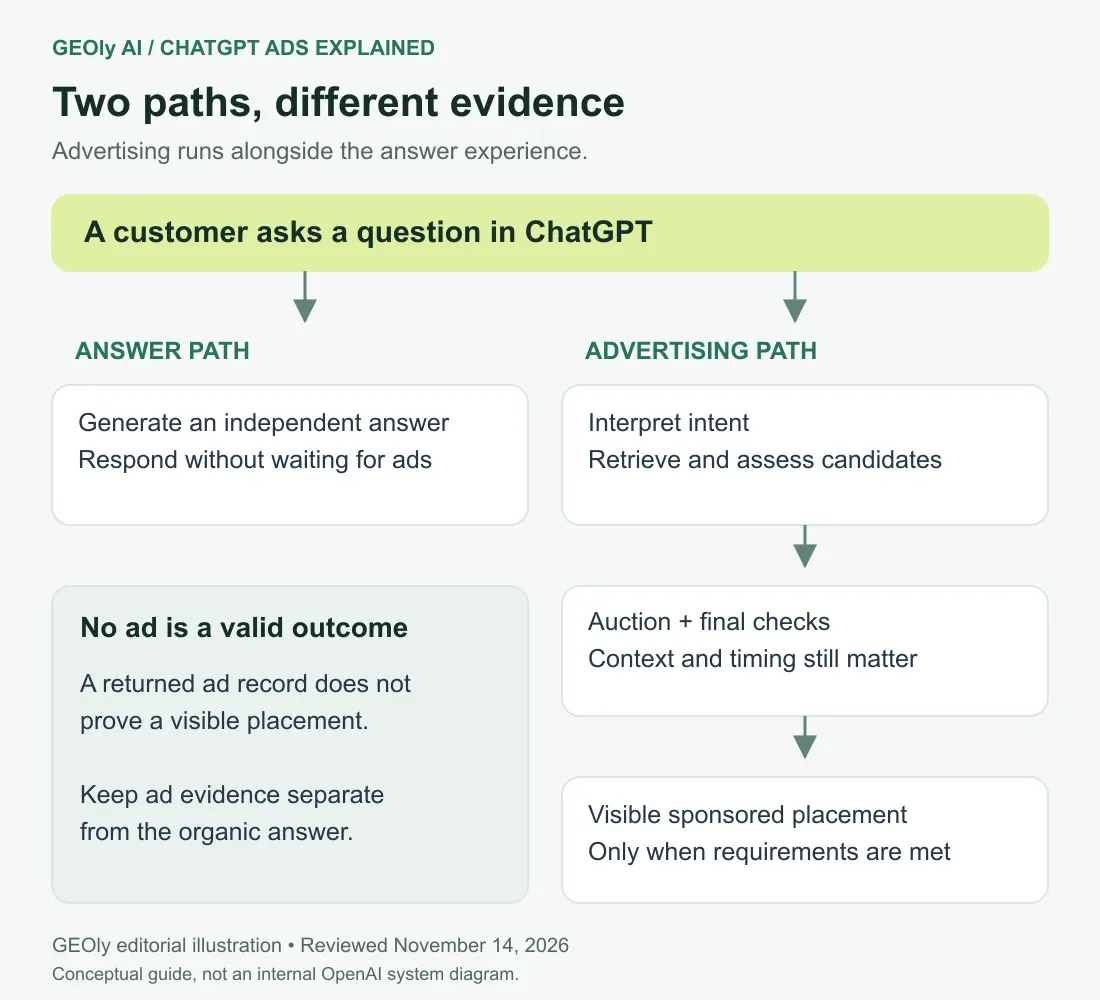
OpenAI describes a separate advertising system running alongside answer generation. An LLM interprets evolving intent and uses tools to retrieve candidates, filter eligibility, assess quality and run an auction. Final context and timing checks still matter. A server-side handoff does not by itself establish a visible placement; late arrivals can miss that turn. The answer does not wait for an ad. This is a high-level architecture description, not a public per-request diagnostic interface. See OpenAI's engineering explanation.
For campaign planning, GEOly recommends four questions: what problem does the customer have, what can the offer truthfully solve, where should a click land, and what evidence would justify further spending? Answer these before discussing a supposed trigger phrase.
Imagine a modular-desk business. A shopper researching a small home office needs dimensions, cable management and delivery details. A generic homepage may leave those questions unresolved. A page that shows the desk in a measured room, explains assembly and lists delivery constraints gives the visitor a better basis for a decision. This is an illustrative merchandising example, not a claim that a particular prompt will generate an ad.
Who can see ChatGPT ads?
The current consumer FAQ describes ads for eligible Free and Go users in selected regions. Plus, Pro, Business, Enterprise and Edu are ad-free; identified under-18 accounts and Temporary Chats do not receive ads. Personalization off is different from ads off. Availability and user settings matter, so an employee's personal account is a poor campaign delivery test.
Advertiser access is a separate check. Confirm the market and features available in your own Ads Manager rather than assuming consumer eligibility from a country's presence in an advertiser list.
What does an advertiser configure?
OpenAI's Advertiser API overview organizes settings into account, campaign, ad group and ad. Campaigns own objectives, budgets and targeting; ad groups hold bidding and context hints; ads contain creative and a destination. An ad preview is an appearance check, not proof of serving eligibility.
Use that structure to assign owners. A paid-media operator should own campaign configuration. A product marketer should verify claims and creative. A site owner should check the destination. An analyst should define conversion quality. One launch checklist can connect these responsibilities without treating them as interchangeable tasks.
Does ChatGPT Ads charge per click or per conversion?
Distinguish the optimization goal from the billing event. OpenAI's advertiser basics supports impression and valid-click billing and explains that click-billed conversion campaigns optimize toward conversions while charging for valid clicks. Check the selected campaign configuration; an objective labelled Conversions does not automatically mean payment per sale.
For an initial test, decide the maximum acceptable acquisition cost from your own economics. Include returns, discounts and service costs. There is no useful universal budget when a subscription lead, a low-margin accessory and a high-value order have different values.
Follow the topic that matches your next decision
Your question | Read next | What you will produce |
|---|---|---|
Why can I not see the ad? | A diagnosis tied to account, campaign and capture evidence | |
How should we describe the offer? | A use-case brief connecting creative and landing page | |
What does a captured ad prove? | A report with explicit observation states and denominators | |
How do paid ads fit our organic strategy? | Separate paid and organic workstreams with shared product evidence |
For campaign economics, use the existing ad intelligence vs ROI guide. For a broader advertiser orientation, see our ChatGPT Ads complete guide. These resources serve different decisions rather than repeating one generic checklist.
GEOly's first-week recommendation
Choose one product category and one meaningful customer problem. Document the offer, its limitations and the landing page. Check the campaign in Ads Manager, then agree on the measurement period before launch. Save changes with timestamps so subsequent reporting can distinguish a creative revision from a targeting or budget change.
In parallel, establish an organic baseline using the ChatGPT visibility tracker. Look at whether the brand is mentioned and which pages are cited for relevant questions. Keep those observations outside the paid campaign's conversion totals. The GEOly Ads Library can support creative research; your own campaign reporting remains necessary for spend and attributed outcomes.
Frequently asked questions
Is there a prompt that guarantees an ad?
The reviewed sources do not establish one. Use a realistic research scenario, record its conditions and describe the observed result without turning it into a trigger rule.
Should we start by raising bids?
First identify the problem. A weak destination, an eligibility issue and a measurement failure require different remedies. Spending more does not resolve every cause.
Does this series report GEOly campaign performance?
No. It combines linked public documentation with GEOly editorial frameworks. The examples are illustrative and contain no claimed campaign results.
Written by the GEOly AI editorial team. Browse the ChatGPT Ads topic collection.