ChatGPT Ads targeting starts with a business question: which customer need can this offer genuinely satisfy? A keyword spreadsheet can help organize ideas, but it is not a complete description of the customer, the product or the destination after the click.
This GEOly AI guide, reviewed on November 14, 2026, translates the current targeting documentation into an editorial briefing workflow. Read how ChatGPT ads work for the wider system. All product examples below are hypothetical; they are not tested trigger phrases or promised campaign outcomes.
Key Takeaways
- Use context hints to describe relevant situations, not to promise exact-query delivery.
- Keep customer eligibility settings separate from a description of the offer.
- Give every creative angle a destination that supports its claims.
- Evaluate a revision with a written hypothesis and consistent reporting conditions.
What are context hints?
OpenAI's targeting documentation describes context hints as additional ad-group information about products, use cases and needs. They are not exact-match keywords and do not replace geographic, platform or audience targeting. Audience inclusion restricts eligibility; a bid multiplier has a different purpose and can leave nonmembers eligible.
Before writing hints, divide the brief into two boxes. The first is eligibility: the actual markets, surfaces and audience settings approved for the campaign. The second is relevance: the problem, constraints and product evidence. This separation helps prevent a marketer from writing “for customers in Boston” in a descriptive field while assuming it enforces a location restriction.
A five-part briefing method
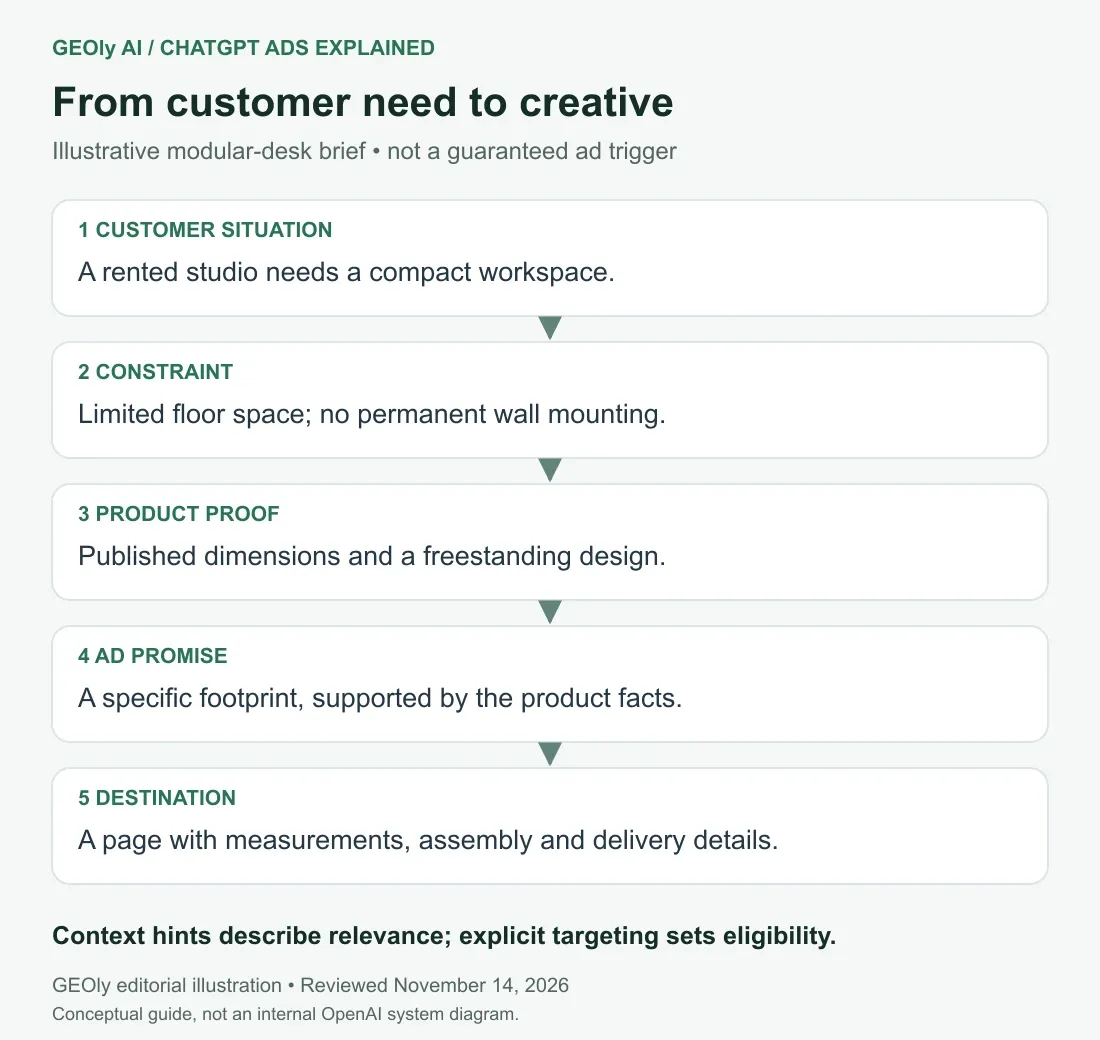
GEOly recommends a brief with five fields: customer situation, constraint, product proof, ad promise and destination. Keep it short enough for the paid-media and content teams to review together.
Brief field | Illustrative modular-desk example | Review question |
|---|---|---|
Situation | Setting up a workspace in a rented studio | Is this a real use case for the product? |
Constraint | Limited floor space and no permanent wall mounting | Does the product meet both requirements? |
Proof | Published dimensions, freestanding design and assembly guide | Can the shopper verify the claim? |
Promise | A compact desk with an explicit footprint | Is the wording more precise than a generic superlative? |
Destination | A product page with room measurements and delivery details | Can a visitor complete the decision here? |
The brief should also state who the offer is unsuitable for. A desk that requires a particular clearance should not be promoted as fitting any room. A subscription that only serves certain markets needs that limitation represented accurately.
Turn one offer into distinct creative angles
OpenAI's creative guidance recommends useful, accurate, benefit-focused messages and meaningfully distinct variations. Our editorial extension is to vary the customer problem rather than merely rewrite adjectives.
For the desk example, one angle could address a narrow room, another easy relocation, and another organizing a shared workspace. Each needs supporting product facts. “Small,” “compact” and “space-saving” repeated across three ads may be three headlines but only one idea.
Write the proposed hint in ordinary language, such as a freestanding desk for a rented room with limited floor space. Then ask whether every meaningful phrase can be defended. Remove features the product does not have. Avoid unsupported compatibility claims, guaranteed results or an implication of endorsement by ChatGPT.
Audit the landing page before the campaign
Match the page to the promise. A visitor responding to a dimensions-focused ad should find dimensions quickly. A shipping-focused message needs current shipping information for the advertised market. A comparison angle needs an honest explanation of the alternatives and tradeoffs.
Use this review sequence: open the exact destination, follow its redirects, check the mobile page, inspect the promoted variant, verify stock or availability and complete the intended action as a controlled test. Document the outcome without generating real orders or conversions unnecessarily.
A strong destination also gives the organic content team useful work. Product specifications, clear limitations and sourceable explanations can be reused in informative pages. They do not create a guarantee of either ad delivery or organic inclusion. See ChatGPT Ads vs GEO and AEO for assigning those separate objectives.
Run a test that can answer a question
Write the hypothesis before the creative: “A dimensions-led message may attract more qualified interest in this compact model.” Define qualified interest using a business-relevant action. Keep other settings reasonably stable when evaluating the change, and record anything that could confound it, such as a promotion or stock interruption.
Do not interpret improved clicks alone as success if the business needs completed purchases or qualified leads. Equally, do not discard a useful message because an early, small sample has no conversions. Decide the review period and decision rules with the analyst before launch.
For a campaign with no activity, use the not-showing diagnostic guide before creating dozens of variations. For interpreting results, start with ad intelligence vs campaign ROI.
Frequently asked questions
Can I copy my search keyword list into context hints?
Use it as research input. Convert relevant themes into clear descriptions of needs and supported use cases, then review the official field guidance. A list of fragments is not a complete campaign brief.
Does writing a competitor's name guarantee a placement beside that competitor?
No guarantee is established by the documentation reviewed here. A competitor reference also needs accurate, appropriate comparative claims; a brand name alone is not evidence that the offer fits a customer's needs.
How many hints should we write?
Start with the information needed to explain the offer accurately. A field limit is not a creative target. Remove redundant entries and retain meaningful distinctions.
Written by the GEOly AI editorial team. Explore ChatGPT Ads articles and the series overview.