The first job for a content team is knowing what to write for AI, and who should be citing you
This isn't another generic content-marketing page. It's a topic-selection and validation path built for content teams: pick your battles by combining topic competition difficulty with AI retrieval demand, look at which source types AI actually cites to decide the content format (reviews, rankings, or FAQ), then turn every “recommended but never cited” blind spot straight into an actionable content-gap list. Built for content teams, SEO content and editorial leads.
Which luggage brands are worth buying for people who travel frequently?
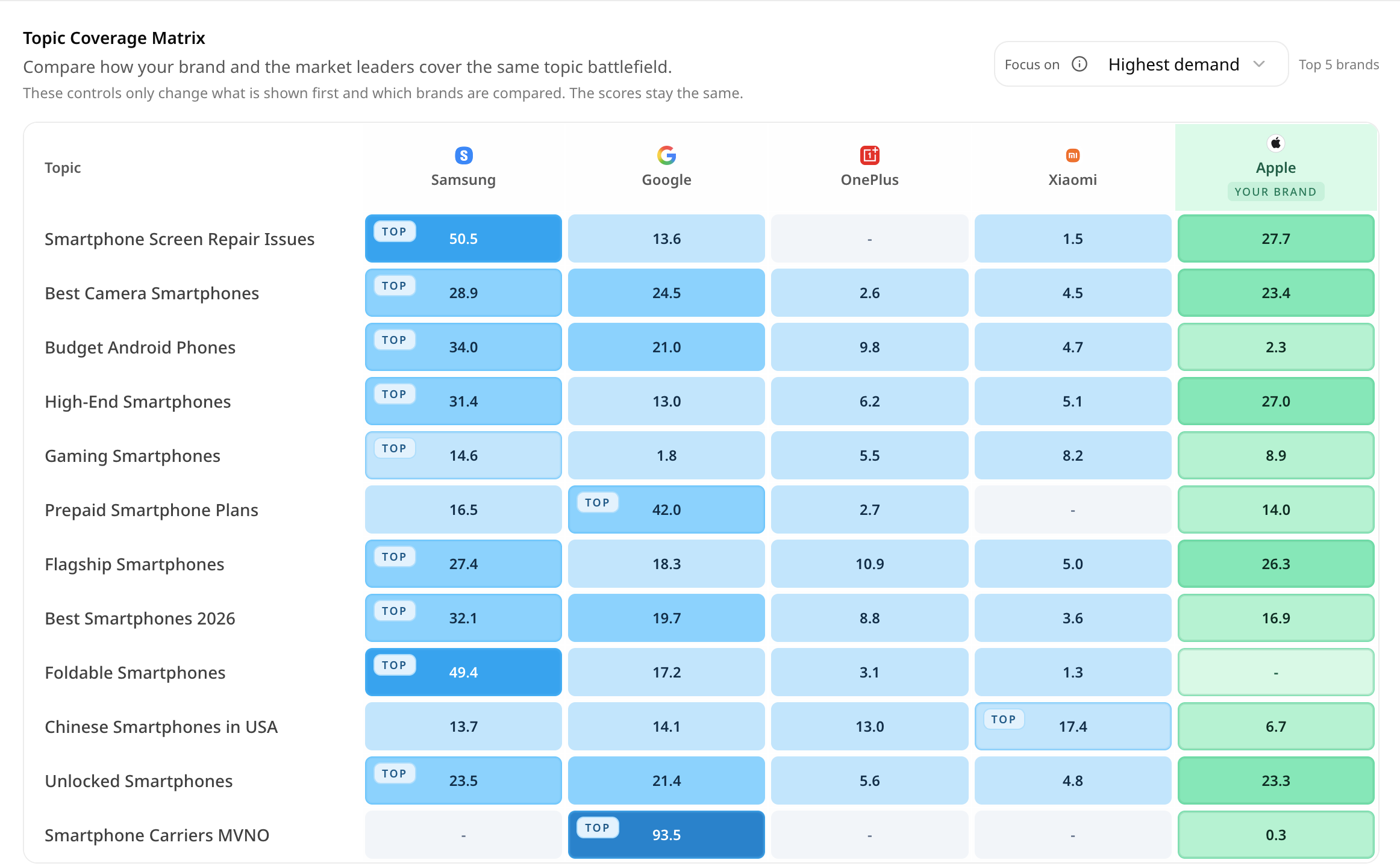
Within the same category, different topics have very different competition difficulty and AI retrieval demand. What a content team really needs to judge isn't “can we write this keyword,” but which themes are high-demand, low-difficulty, and still weakly served by the sources AI cites today—those are the topics to write first and the ones most likely to get cited.
AI leans heavily on third-party reviews to answer “is it worth buying,” yet you have no matching in-depth review content.
“Best X” list queries have huge demand but are already owned by media rankings and aggregators—hard to beat head-on.
AI often pulls answers straight from FAQs and knowledge bases—easy to get cited, yet frequently overlooked by content teams.
The brand is mentioned in some answers, but not one piece of your own content is cited—a textbook content gap.
Many content teams still pick topics with old keyword logic, without knowing what AI actually cites
The real challenge isn't “we can't produce content.” It's judging, over time: which topics are still worth investing in for AI, which are already saturated by rivals with stronger sources, whether AI relies on reviews, rankings or FAQs to answer, and—where the brand is recommended but not cited—exactly which piece of content is missing.
Topic selection is still guesswork—no clarity on which battle to fight
Traditional keyword tools give search volume and SEO difficulty, but never tell you which topics are high-demand and low-competition inside AI. So teams struggle to point limited capacity at the highest-return topics.
You write the content, but not in the format AI cites
For the same topic, AI may prefer third-party reviews, structured rankings, or FAQs. If your content format doesn't match AI's citation preference, volume alone won't get you into the answer.
Recommended but not cited—no one turns the gaps into a list
The brand is clearly mentioned in some AI answers, yet none of your own content is cited. Unless those blind spots become an assignable content-gap list, they never get filled.
First, turn topic selection into an opportunity map a content team can use directly
AI-era topic selection should look at theme demand, competition difficulty, the source types AI cites, and existing content gaps—together. That way, when planning capacity, a content team can tell at a glance which topics are “high-return, write first,” which are “fix the format,” and which to leave alone.
Topic clusters
Group topics into clusters by competition difficulty, and start with the low-difficulty, high-demand battlegrounds.
AI retrieval demand
Look at each topic's real retrieval demand inside AI, not just traditional search volume.
Citation source types
See whether AI cites reviews, rankings or FAQs for a topic type, and set the content format accordingly.
Content gaps
List “recommended but zero citations” topics separately as an assignable gap list.
Content teams don't want a pile of keywords—they want these views they can plan against
Content leads, SEO content and editorial ops usually look at the same set of topics from different angles. A solid topic workbench should answer, all at once: “which battle,” “what format,” “whose sources,” and “which gap first.”
Rank topics on a priority matrix of AI retrieval demand versus competition difficulty, locking in high-demand, low-difficulty picks first.
Look at the source types AI cites for the target topic to decide between a review, a ranking or an FAQ—so you never write the wrong format.
Break down whether AI cites media reviews, community threads, official pages or third-party rankings, and align to a citable content standard.
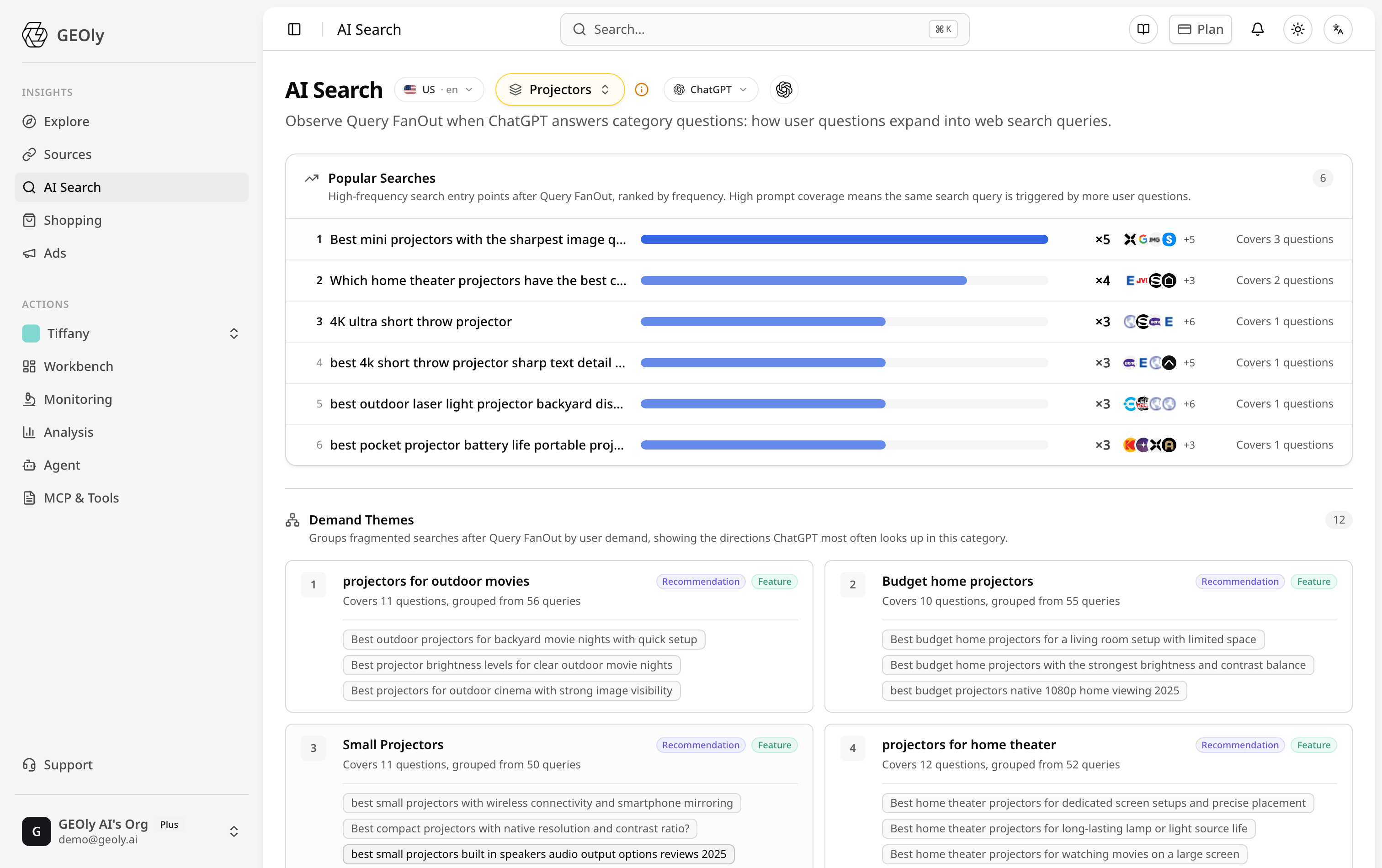
Use Query fan-out to split one big question into search entries, then cluster them into demand themes as a direct source of new topics.
Turn topic selection into a workflow a content team can run continuously
This path suits content teams that already want to select topics with data: lock the battleground by demand and difficulty, set the format by the source types AI cites, turn blind spots into a gap list, assign it to writers, SEO and editors, then verify with the next round of monitoring whether the content is actually being cited.
Lock in high-return topics
Filter topics by AI retrieval demand plus topic competition difficulty, and point limited capacity first at high-demand, low-difficulty battlegrounds.
Set format by source type
See whether AI cites reviews, rankings or FAQs for the topic, and decide what format the piece should take and how to structure it.
Build the content-gap list
Turn “recommended but not cited” and “demand but zero coverage” topics into an assignable gap list, with each item owned by someone.
Assign, then re-check citations
Route the gaps to writers, SEO and editorial ops, and after publishing use the next monitoring round to confirm whether the content is truly cited by AI and enters the answer.
Plan content from the searches AI actually runs
When AI answers a question, it issues its own web searches first—the query fanout. GEOly captures those real queries, clusters them into demand roots, and marks exactly where your brand is present or missing, so the content backlog writes itself.
Priority gaps, statistically confirmed
Fanout gaps are split into confirmed misses and early signals using confidence bounds—so the team writes against evidence, not hunches.
Content Opportunities from citation data
Domains AI cites heavily but where your brand rarely appears are scored and ranked—your placement and guest-content shortlist.
Format follows source type
Citation sources are classified into 8 types (media, community, retailer, brand-owned and more), telling you whether the gap needs an article, a listicle placement, or a community thread.
Pair content with the rest of the loop
Content moves AI answers fastest when it is aimed by citation data and measured by visibility tracking.
The GEOly capabilities content teams most often use to run this use case
“For content teams” is the task entry point, but in execution it usually connects to topic cluster analysis, AI citation analysis, query analytics and query fan-out analysis.
Common questions about content teams selecting topics with GEOly
Stop guessing your topics—see who AI cites and which piece you're missing
Run topic selection, content format and the content-gap list on data first, then decide whether this quarter starts with reviews, fills in rankings, or turns FAQs into answers AI can cite.
Built on public industry data across 26,000+ topics and 100,000+ brands, content teams can pick their battles from a real topic pool by demand and difficulty.
Reviews, rankings, FAQ—decide the content format by the source types AI actually cites, not by gut feel.
In the example, 439 search entries cluster into 12 demand themes—an immediate source for the next batch of topics.