Most GEO/AEO monitoring products lack an industry-level DTC data layer — GEOly fills it
If you build GEO/AEO monitoring software (think Profound, Peec), your product can likely see a brand's AI mentions but not the industry-level DTC data around it — category landscape, AI shelf, quote interception, ads, and sources. GEOly plugs that layer into your product via MCP / API direct connect or white-label / OEM data services, so you can give brand clients fuller industry context without building the data pipeline yourself.
My GEO/AEO product monitors brand mentions, but when a client asks "how does the whole category play out in AI," I can't answer — which data layer am I missing?
Monitoring products usually nail a brand's own visibility, but what keeps brand clients renewing is industry context: who gets recommended first in the category, what the AI shelf looks like, where quote questions get intercepted by rivals, and how ads and sources are structured. That layer is costly and slow to build in-house — it's better plugged in as a partner data plane.
Brand mentions, answer position, cited sources — the strength of monitoring products, no need to rebuild.
Who gets recommended first across the category, AI shelf structure, competitive rank — most products can't reach it.
Interception of quote questions and the landscape of 360K+ ad cards / 5,000+ advertisers — no industry benchmark.
Which third-party sources AI relies on, review and ranking structures — needs an industry-scale sample to stabilize.
You can monitor a brand, but can't answer "how does the whole category get recommended by AI"
GEO/AEO monitoring software is naturally bounded to a single-brand view: it tells clients how often they're mentioned, but struggles with relative position in the category, AI shelf dynamics, and competitive interception. That is exactly the layer brand clients want most and pay for most. Building it in-house means ongoing crawling, cleaning, and metric upkeep — better to bring it in as partner data.
Only the brand's own data, no industry coordinate system
Clients see their mention rate but not whether it's high or low for the category, or who's pushing them out of answers. Without an industry benchmark, monitoring insights never turn into decisions.
Shelf, quote, ad, and source layers are too heavy to build
AI shelf structure, quote interception, the landscape of 360K+ ad cards, and third-party source distribution all require large-scale, continuous collection and unified metrics — slow, costly, and quick to go stale in-house.
No standard channel to plug external data into the product
Even when the value is clear, product teams need an interface they can connect directly, white-label, and pull on demand — not a one-off static report.
First, see which data layers GEOly plugs into your product
GEOly's industry-level DTC GEO data plane covers four layers — category landscape, AI shelf, quote and ads, and source structure. Consume them on demand via MCP / API, or white-label them into your own product UI, so you extend industry context without changing your existing monitoring capability.
Category landscape data
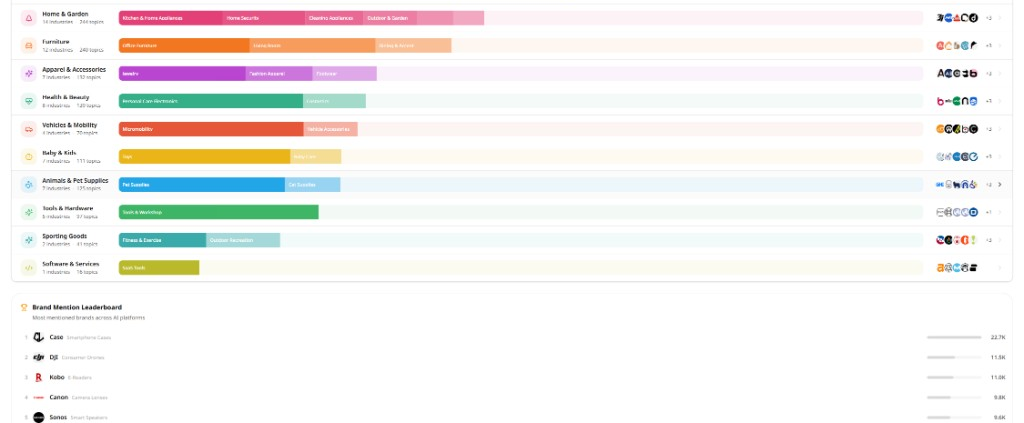
A category tree and competitive rank built from 100K+ brands and 26K+ topics, answering "how does the whole category play out in AI."
AI shelf data
The recommendation structure and shelf position inside AI answers — who gets recommended first, who gets replaced.
Quote & ad data
Where quote questions get intercepted, plus the ad landscape of 360K+ ad cards / 5,000+ advertisers.
Source structure data
The third-party sources, reviews, and rankings AI leans on when recommending brands — filling the citation evidence layer.
One data layer, three access models — pick by your product stage
Whether you want a quick pilot, deep integration, or full white-label, GEOly offers a matching access model. The point is to land industry-level data in the way that best fits your product, instead of forcing you into one delivery format.
Use the GEOly MCP Server (up to 62 tools, dual data plane) to pipe industry and ad data straight into your agent or product backend.
Pull category, shelf, quote, ad, and source data on demand via a standard API and embed it into your own analytics and dashboards.
White-label the industry-level data and views into your product UI and deliver them to brand clients under your own brand.
Become a GEOly reseller partner and package industry-level GEO data capability into your offering to serve brand clients together.
Turn the data partnership into a clear onboarding flow
This path suits GEO/AEO vendors who already know they want to add an industry-level data layer: align on data needs, pick an access model, connect and map, then deliver the data plane reliably to your brand clients.
Align on data needs and gaps
Map which layers your product already covers and which are missing — category, shelf, quote, ads, or sources — and decide which data planes to plug in.
Choose the access model
Pick a mix of MCP direct connect, API data service, white-label / OEM, or reseller partner based on your product stage and business model.
Connect and align fields
Wire up MCP / API, unify industry metrics and field mapping, and connect to your existing integrations like GA4, Cloudflare, Notion, and Shopify.
Deliver to brand clients
Ship the enriched industry-level views to your brand clients and validate the added value through renewals and usage data.
The data layer, exposed as tools your product can call
GEOly is built to be embedded. The same industry dataset behind our dashboards—100k+ brands, 26k+ topics, citations, product cards, and ads—is exposed through an MCP server with OAuth one-click connect, agent skills, and API contracts for partners.
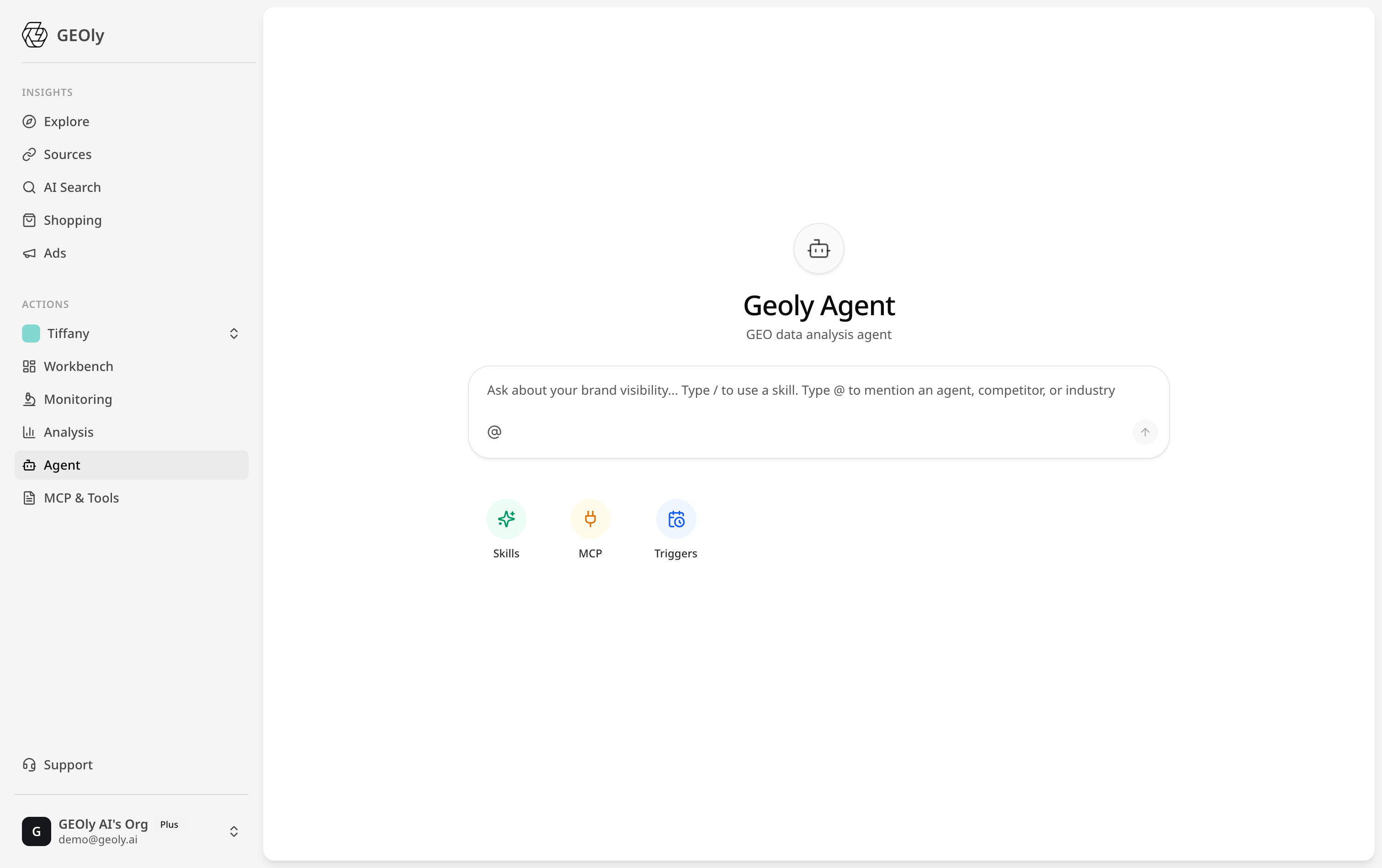
MCP-first integration
Dozens of MCP tools spanning self-brand analytics and the public industry dataset—your agent authenticates in the browser on first use; no token to paste.
Industry-level data no one else has
Category shelf maps, AI DA source authority, ChatGPT ad placements, and product-card data across 100k+ brands—licensable into your own product.
Partner-grade contracts
Reseller, agency, and API/service agreements with quota pools, shared workspaces, and white-label report exports.
Where partners plug in
Whether you resell, embed, or co-sell, these are the adjacent surfaces to evaluate.
The GEOly capabilities most often used with data partnerships
The entry point is the access model, but in practice a data partnership usually connects to the MCP Server, industry intelligence, AI citation analysis, and your existing integrations — so industry-level data actually runs inside your product.
Common questions about GEO/AEO data partnerships
Don't let a missing industry data layer cap your product's renewals
Plug in GEOly's industry-level DTC GEO data plane — via MCP / API direct connect or white-label delivery — and give your brand clients a truly complete AI category view.
The GEOly MCP Server offers up to 62 tools across a dual data plane, covering both industry and ad sides, ready for your agents.
360K+ ad cards and 5,000+ advertisers give your product the industry benchmark for the ads and interception layer.
An industry plane of 100K+ brands and 26K+ topics lets your brand clients finally see a complete category coordinate system.