Query fan-out / For content teams and SEO / GEO agencies
Query fan-out content gaps: know what to publish next.
Use query fan-out analysis to understand the decisions behind AI searches. Group the questions, inspect the evidence and give each intent a useful answer destination.
One workflow, from search evidence to an editorial brief
- 01
Observe
Choose buyer prompts for a specific market. Review the search queries available in a completed collection, retaining the original prompt, platform and date.
- 02
Group
Cluster similar queries by the decision they support: shortlist a tool, check a requirement, compare prices or verify a claim. Keep observed frequency separate from market search volume.
- 03
Map
Read the page you would send to a buyer. Mark the intent covered, partial, missing or unknown. A matching keyword alone is not sufficient evidence of coverage.
- 04
Act
Update a useful existing page first. Create a new page for a distinct decision. Record the owner, missing evidence, intended audience and publication date.
- 05
Recheck
Compare the same prompt set and platform across later windows. Inspect collection completeness, citations and brand mentions separately from visits and revenue.
Turn branches into pages, not one URL per query
Illustrative example: an AI visibility software buyer. These queries are planning examples, not captured engine logs.
| Buyer decision | Candidate query | Answer destination | Evidence to add |
|---|---|---|---|
| Evaluate fit | AI visibility software for agencies | Agency solution page | Client workflow and permissions |
| Compare cost | AI monitoring cost per prompt | Pricing page | Billing unit, limits and trial terms |
| Verify capability | track ChatGPT search queries | Query analysis feature | Real interface and collection limits |
| Implement | how to create a prompt monitoring set | Setup guide | Inputs, steps and expected first result |
Keep the evidence attached to the decision
GEOly connects observed queries to prompts and analysis views. Use the record to decide what to inspect; a recorded query does not prove that your page was retrieved, and retrieval does not prove a citation. The screenshot shows the product interface captured on November 14, 2026.
Explore product query analysis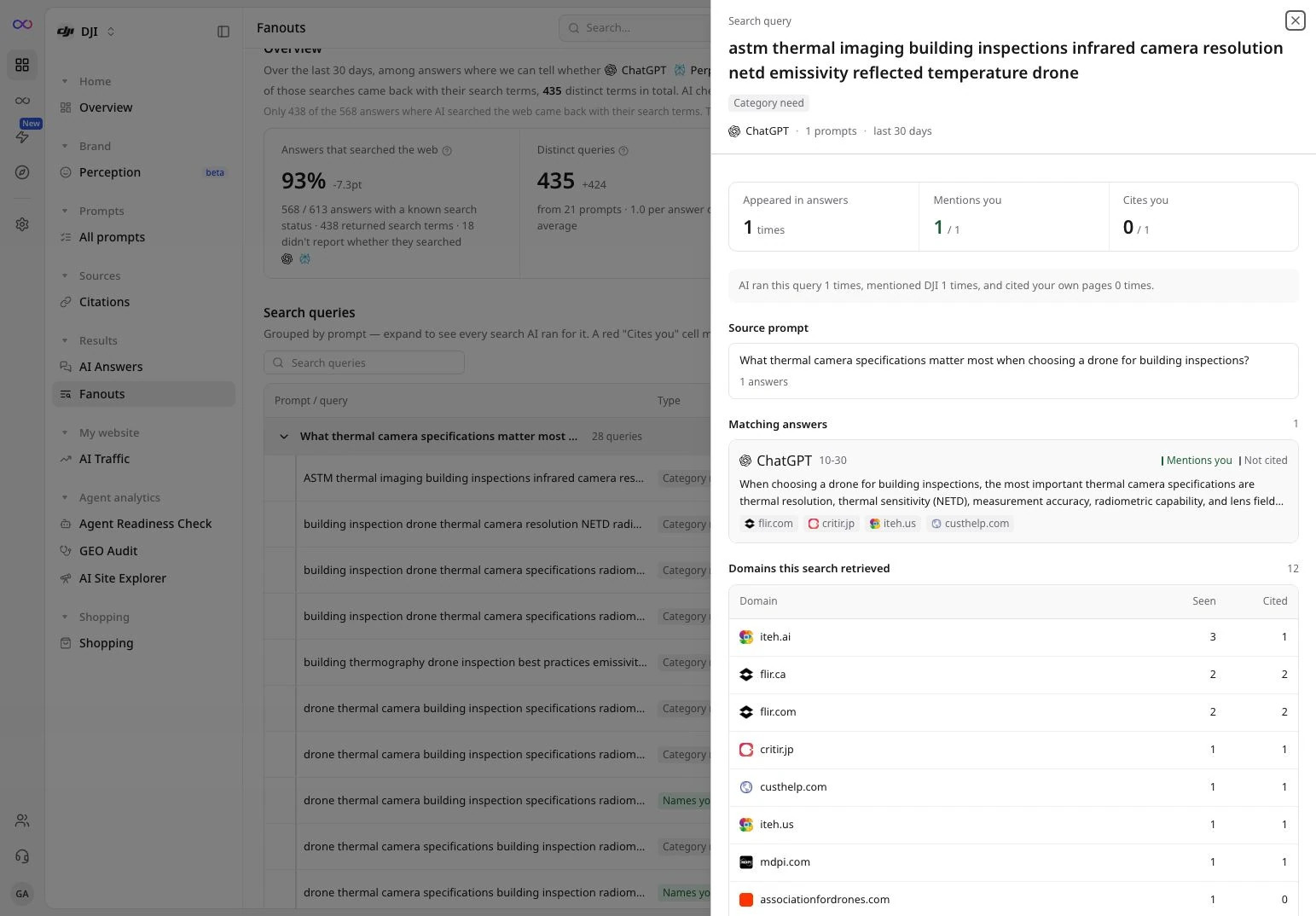
A useful brief has six fields
- User decision and audience
- Observed queries, platform and window
- Existing destination and coverage status
- Missing facts or supporting evidence
- Owner, action and publication date
- Follow-up window and success measure
Measure the next collection
Start with a baseline, preserve the prompt set, and document content changes. Compare eligible observations before discussing improvement. Query coverage, citations, brand mentions and paid conversions are separate outcomes. Missing collection data is unknown, not zero.