The best query fan-out tool for your team is the one that supplies the evidence your next decision requires. A free generator can help prepare a content brief. A query collector can show what happened in an observed run. A monitoring product can help investigate patterns across repeated observations. These jobs overlap, but they are not interchangeable.
Key takeaways
- Inspect how a tool produces its output before judging how many queries it returns.
- Ask for a sample that connects a search record to its prompt, platform and date.
- Evaluate missing-data handling, export and repeatability alongside price.
- Start with a free plan when you need ideas; use observed-query analysis when your decision requires evidence.
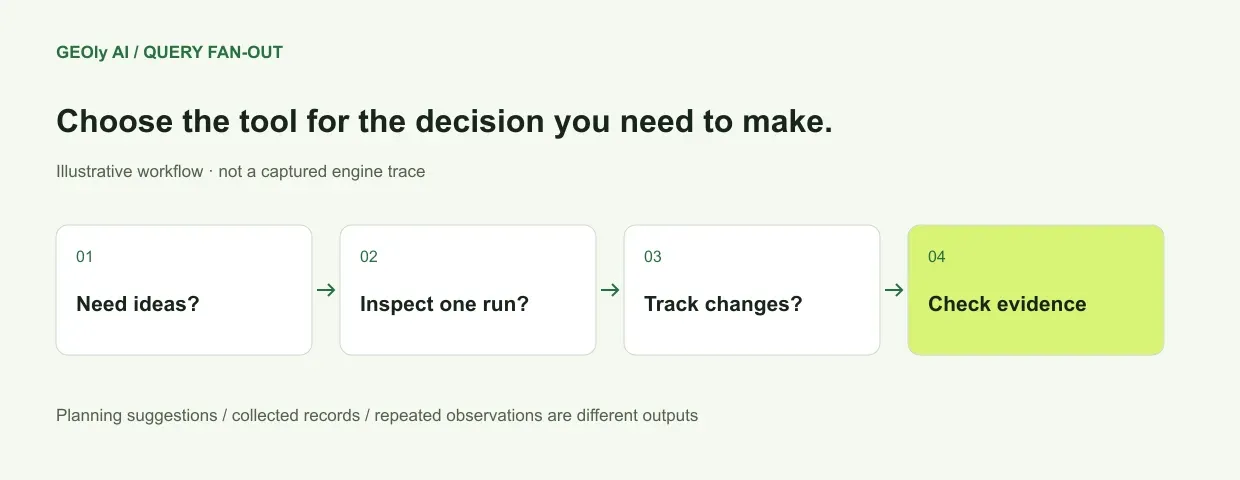
Three tool categories
Category | Useful for | Minimum disclosure | Main limitation |
|---|---|---|---|
Generator or simulator | Brainstorming intent branches and page coverage | Generated output, method and input | Suggestions do not prove retrieval |
Query extractor or collector | Inspecting a specific observed search event | Source surface, collection time and raw record | Available evidence may be partial |
Monitoring and analysis platform | Comparing repeated observations and organizing actions | Prompt set, platform, window and metric definitions | Findings depend on the monitored sample |
Names alone do not resolve the category. “Extractor” may describe different technical approaches. Read the explanation, inspect a sample and ask which fields come from collection versus inference.
Start with the result you need
If your next task is to outline a pricing guide, a planning tool may be enough. If you need to understand why a competitor appears in monitored answers, you need observed answers, queries where available and source evidence. If you report progress across several brands, you also need stable project boundaries, history and a repeatable workflow.
GEOly’s free query fan-out planner uses templates to generate candidate branches and supports page mapping and CSV export. It runs locally and does not fetch an engine’s searches. The separate GEOly analysis feature uses observed query records where collection supports them.
For another public interface to inspect, Position Digital’s extractor presents prompt, platform and location inputs plus CSV export. Those interface controls alone do not establish how complete its observations are. Review its current methodology before treating results as comparable to another tool. This is not a hands-on vendor ranking.
A seven-question evaluation checklist
- What is the source? Ask whether output is simulated, observed from a consumer product or returned by an API experiment.
- Can I inspect one record? A useful sample retains the original prompt, query, platform, date and related answer evidence.
- What can be missing? Ask how the system represents a failed collection, an unexposed query and a completed observation without available query data.
- How are counts defined? Distinct queries, query occurrences, prompt coverage and citations measure different things.
- Can I reproduce the comparison? Check whether you can preserve filters and time windows, and document prompt-set changes.
- Can I take action? Look for export or a practical way to attach a content owner, page and follow-up decision.
- What does the price buy? Compare platform access, query-analysis allowance, history and reporting. A raw prompt allowance is not necessarily a query allowance.
Use a small representative sample in the evaluation. A screenshot of a large total does not answer whether the product will support your particular decisions.
A practical buying worksheet
Create columns for requirement, evidence received, remaining uncertainty and decision. Put a concrete task in each row: inspect one buyer prompt, distinguish two platforms, find a repeated query theme, explain a missing observation, and take a finding into an editorial brief.
Score only what you verified. “Not tested” is different from “not supported.” If you publish your comparison, date the review and link the vendor sources. Do not infer a competitor’s limitations from a missing screenshot or a marketing label.
For GEOly, check the live pricing page for platform selection, AI Queries analysis quotas and trial conditions. Standard monitoring currently lists ChatGPT, Google AI Mode, Gemini and Google AI Overviews; the availability of detailed query records can differ by platform and collection method.
How to trial a monitoring workflow
Choose a few commercially relevant prompts and record the decision behind each. Complete a collection, inspect the available query evidence and map one theme to an existing page. Identify a specific missing fact or evidence item. If the data cannot answer your question, record that limitation before expanding the project.
A useful first outcome is a defensible content decision. It is not a guaranteed ranking improvement. The content gap solution shows how to carry that decision into an action plan; the optimization guide describes the follow-up measurement.
Frequently asked questions
Is a free generator enough for GEO?
It can help with planning. It cannot establish what was actually searched or cited. Use it alongside customer evidence and observed data when available.
Does a larger output mean a better tool?
No. More suggestions can mean more noise. Prefer clear provenance, relevant intent coverage and a path from evidence to action.
Can an API experiment replace consumer monitoring?
It can support its own controlled investigation. It should remain labeled as an API experiment rather than being silently treated as consumer-product behavior. Read the platform evidence comparison.
Written by GEOly AI. See the Query Fan-Out topic and definition.