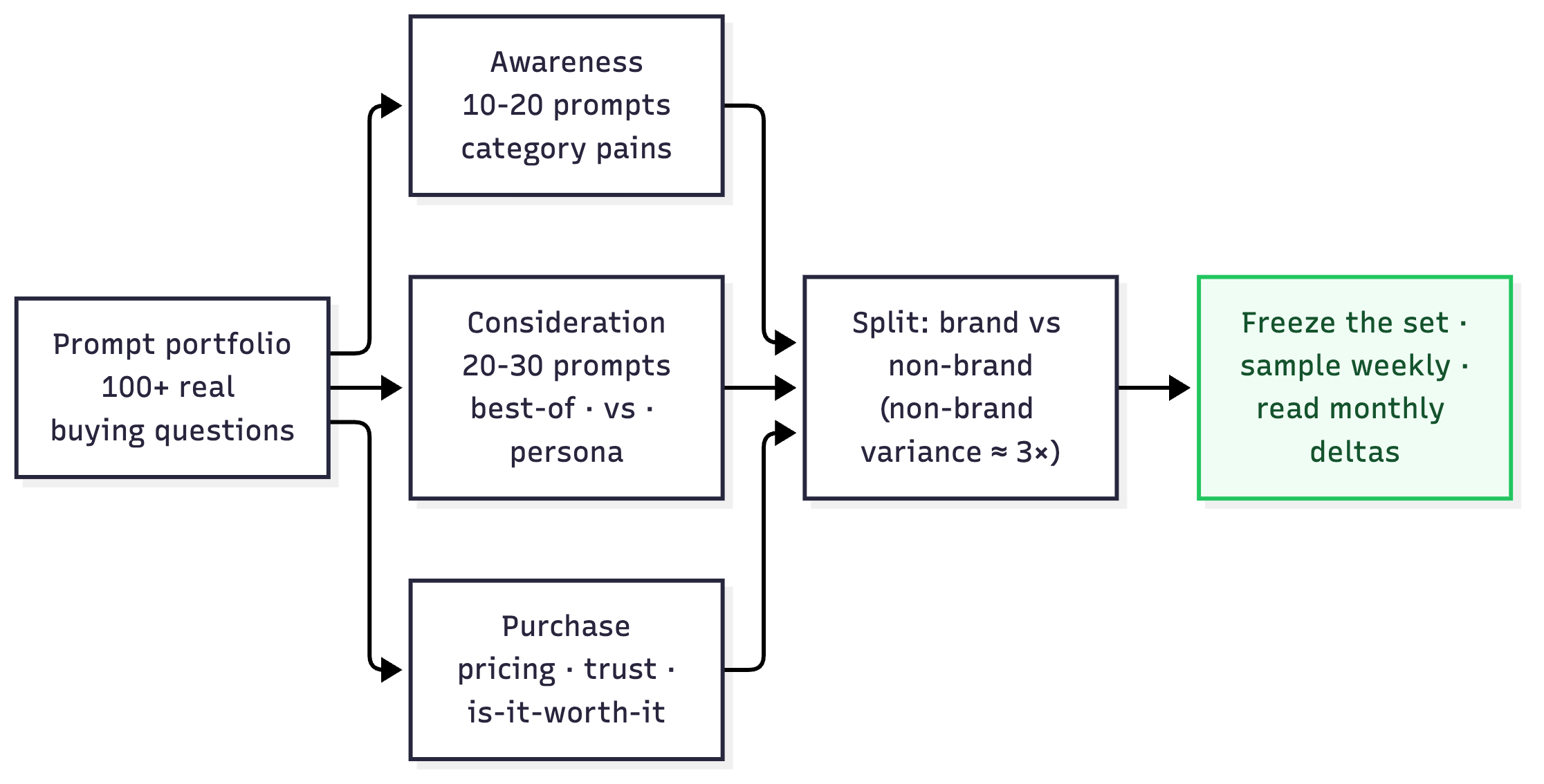
Your AI visibility score jumped 5 points this week. Before anyone celebrates: nothing about your brand changed. AI answers are stochastic — the same prompt, asked twice, names different brands. Which means prompt tracking, the AI-era successor to rank tracking, is easy to do and even easier to do wrong. Most teams track too few prompts, re-run them too often, read daily charts that are pure noise, and make decisions on it.
This is the GEOly AI guide to doing it right: how to design a prompt portfolio that mirrors real buying behavior, how much data you need before a movement is real, and how to turn the tracking into actions instead of dashboards.
Key takeaways
- A prompt is the AI-era keyword, but with a twist: answers are probabilistic, so tracking is a sampling problem, not a lookup. Statistics decide what you can conclude.
- Breadth beats repetition. Many distinct prompts sampled regularly give far tighter confidence than a few prompts hammered daily — halving your error bar costs roughly 4× the samples.
- Split brand from non-brand prompts. Branded prompts ("is X any good") are stable; category prompts ("best X for Y") swing several times harder. Averaging them hides both signals.
- Design the portfolio across the journey — awareness, consideration, purchase — not just "best [category]". The prompts you skip are where buying decisions actually happen.
- Freeze the set. Trend lines only mean something when the portfolio stays constant; every edit resets your baseline.
Prompts are keywords with a probability distribution
In classic SEO, a keyword had one answer per day: you ranked #4. In AI search, a prompt has a distribution: your brand might appear in 40% of runs on ChatGPT, 70% on Gemini, 10% on Perplexity. One run tells you almost nothing — the unit of measurement is the mention rate across samples, which rolls up to Share of Model.
That has an unintuitive consequence. If your true mention rate is 40%, a single day of sparse sampling can easily read anywhere from 25% to 55%. A 5-point day-over-day move is usually weather, not climate. Teams that don't internalize this end up "optimizing" against random noise — shipping content changes to fix dips that were never real, then crediting those changes when the number randomly recovers.
The working rules we apply at GEOly AI: read weekly at the portfolio level, read monthly at the individual-prompt level, and treat any movement smaller than your error bar as no information.