When you ask ChatGPT "which video doorbell should I buy in 2026," it doesn't answer from thin air — it cites a handful of sources it trusts, then assembles its answer from the brands those sources recommend.
So what really decides whether AI recommends you is rarely your own website. It's this chain:
Which sources AI trusts × which brands appear inside those sources = who AI ultimately recommends.
If AI keeps citing a media outlet whose reviews are full of your competitors and never mention you, then in AI's answers you are simply invisible. Breaking through doesn't start with writing more content — it starts with seeing clearly: in my category, who does AI actually trust?
That is exactly what our newly launched Source Citation Insight Page answers. It lays out any source's (website / domain) real standing in the AI world on a single page. Below, we walk through it screen by screen using a real sample — the tech media outlet Tom's Guide (tomsguide.com).

01 A Source's "AI Standing," at a Glance
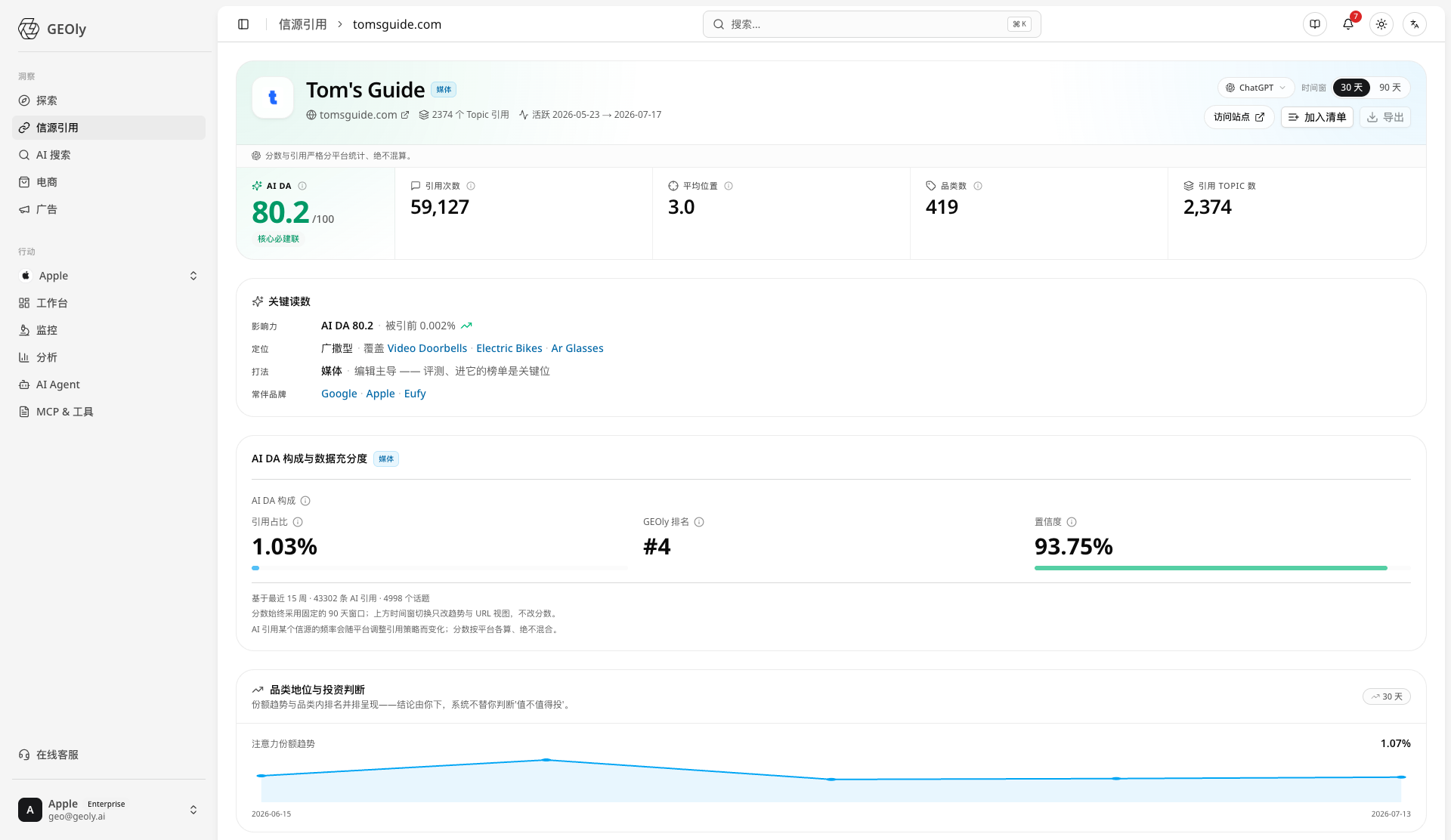
At the top of the page, a source's weight in AI comes down to five numbers:
- AI DA 80.2 / 100 — GEOly's "AI Domain Authority," measuring how much AI trusts and how often it cites this source. 80.2 sits in the "core must-connect" tier, in the top 0.002% of cited sources.
- 59,127 citations, average position 3.0, spanning 419 categories and cited across 2,374 topics — a classic broad-reach flagship outlet.
- Key Readouts: profile "broad-reach," playbook "editorial-led — reviews and getting into its rankings are the key slots," frequent companions Google · Apple · Eufy.
- AI DA composition: 1.03% citation share, GEOly rank #4, 93.75% confidence — computed from the last 15 weeks, 43,302 AI citations and 4,998 topics, not guesswork.
Two points on rigor: (1) scores and citations are counted strictly per platform (ChatGPT here) and never mixed across platforms; (2) the score always uses a fixed 90-day window — toggling 30 / 90 days only changes the trend view, not the score.
02 Which Categories It "Owns"
The Category Footprint shows where a source is dug in deepest, and where it ranks within each category. For Tom's Guide: Video Doorbells #2 of 69 (1,377 citations), Electric Bikes #2 of 234, Ar Glasses #2 of 65, Smart Locks #2 of 91… near-total category coverage.
Open any tile and a full competitive view slides out on the right. In Video Doorbells it holds 20.3% category share — second only to reddit.com, leaving techradar, consumerreports and others behind; on topics like "smart video doorbells," it ranks near the top in 73%–86% of answers.
Tactical takeaway: this is your source priority map. To get recommended by AI in a category, lock onto the few sources AI trusts most there and concentrate resources — instead of spraying everywhere.


03 Which Topics It Dominates in AI's Answers
Drill one level deeper into topics. Tom's Guide is cited across 2,374 topics; on its hottest topic, "folding electric bikes," it owns 21% of all AI citations — and it's still surging ▲238%.
Every topic carries its citation count, average position and recent trend, and all 2,374 are searchable and sortable. More importantly, open any topic and you see the real answers where AI cited it: the exact ChatGPT prompt, the position it appeared in, and the date.
Tactical takeaway: this is a ready-made topic map. To be recommended by AI on a topic, you need to genuinely appear in that source, on that topic. The fastest-rising topics are the content gaps most worth grabbing right now.


04 Who's "in Frame" When AI Cites It? — Your Brand Circle
Co-cited Brands answers an uncomfortable question: when AI cites this source, which brands does it most often recommend alongside it?
When AI cites tomsguide.com, it most often co-recommends Google (7,600×), Apple (6,991×), Eufy (5,871×), TP-Link, Ring, Samsung… That is the "brand circle" you're trying to break into by investing in this source. See the full list — and check whether you and your competitors are on it.
Inside a single category there's an even sharper "co-framed brand · dependence" view: in Video Doorbells, this source is "highly dependent" on Ring and Eufy — meaning that once you enter its review context, your odds of being recommended alongside are high.
Tactical takeaway: co-citation is not an endorsement, but it precisely maps the circle you need to join. If competitors are in it and you're not, that's the gap to close first.


05 Which Pages Does AI Actually Cite? — Your Must-Win Landing Pages
The final piece is Most-Cited URLs. The pages AI cites from Tom's Guide are almost 100% "comparison / help-me-decide" content — exactly the format AI loves to pull: Best smart glasses in 2026 (1,197 citations), Best video doorbells in 2026 (1,003), The best electric bikes of 2026 (844)…
Tactical takeaway: these high-frequency pages are your must-win landing pages. The most efficient path to being cited by AI isn't building a new page — it's getting into the review rankings and comparison long-reads AI already cites again and again.

06 Turn This Page Into an Executable GEO Move
The Source Citation Insight Page isn't just "looking at data." It breaks one round of GEO (Generative Engine Optimization) into three steps:
- Source discovery: in your category, use AI DA and category rank to lock onto the few sources AI trusts most, and set priorities.
- Source outreach: against the dominated topics and most-cited URLs, get your brand / product into those reviews, rankings and comparison pages — and into the co-cited brand circle.
- Continuous monitoring: track changes in AI DA, topic share and co-cited brands to verify that every investment actually buys growth in AI citations.
From "who does AI trust" to "where should I show up," this page has done the math for every step in between.
Check it now: in your category, who does AI actually trust?
The Tom's Guide breakdown above is just one sample. Which source AI trusts most in your category, which brand circle your competitors hide in, which pages are must-win — GEOly can generate the very same page for you.
👉 Sign up and try www.geoly.ai — enter your brand and category, and see your own AI source map in minutes.
Data source: www.geoly.ai | Scores and citations are counted per platform and never mixed, on a fixed 90-day window | Figures shown are product-screenshot samples; live data is authoritative in-platform.


