The story in agentic commerce this week was not about a smarter chatbot. It was about who owns the last hop of a transaction — the authorization, the payment, the refund and the audit trail. Three signals landed together, and all of them point below the conversation layer, into infrastructure.
Key takeaways
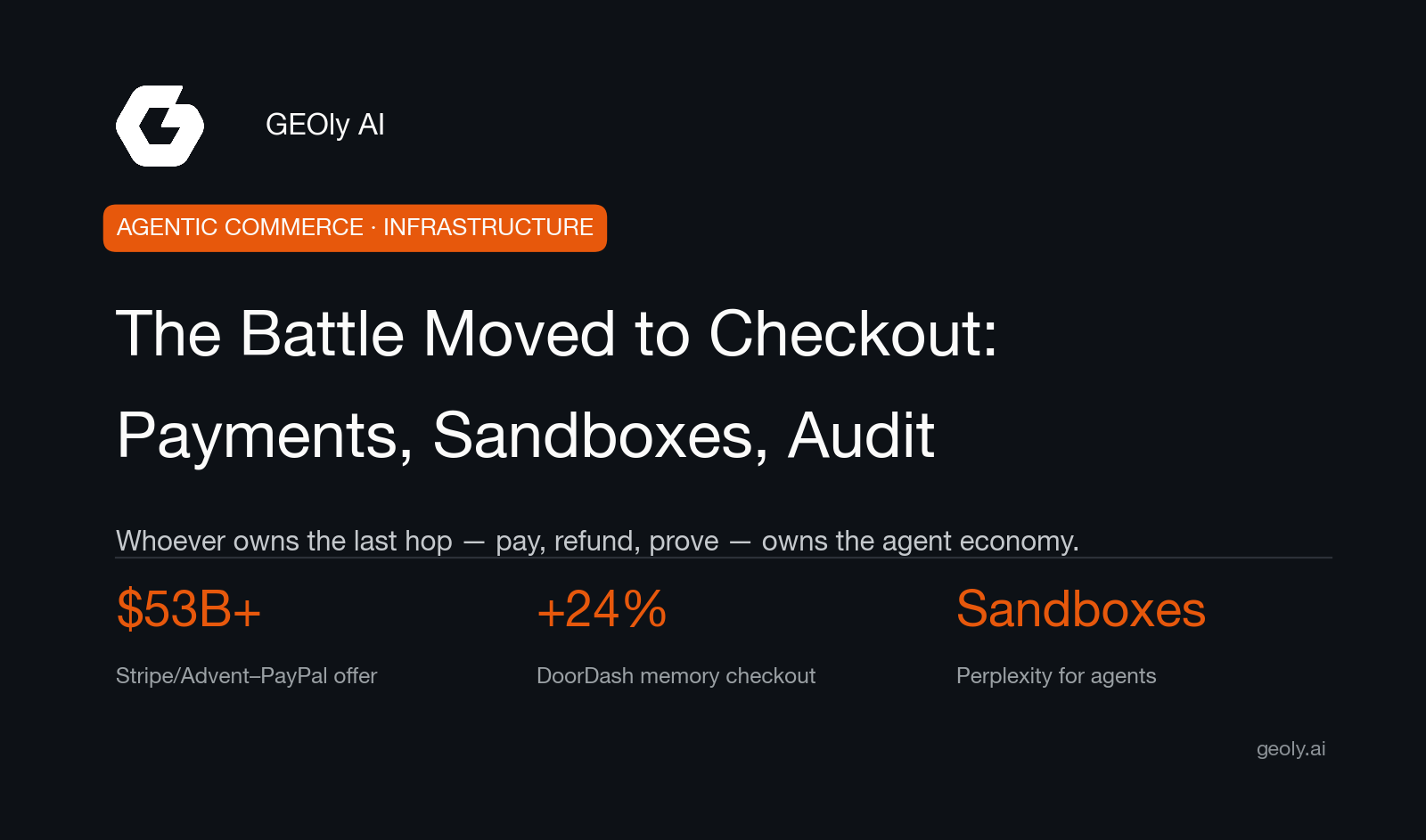
- Stripe and Advent reportedly offered more than $53 billion for PayPal — a bid to put payment accounts, merchant networks and agent payments under one roof (an offer, not a signed deal).
- Perplexity shipped Secure Sandboxes for Agents, isolating what an agent can touch — a trust boundary for agents that actually execute actions.
- A Stripe agent-integration benchmark shows agents build backends reasonably well but stumble on validation, full-stack wiring and checkout reliability.
- DoorDash's memory-backed 'Ask' agent reported a ~24% higher grocery checkout conversion and ~17% higher order value — proof the bottleneck is data, tools and memory, not a nicer sentence.
- For brands, this means a machine-readable product-fact layer plus agent authorization, refund and dispute rules — an Agent Readiness layer on top of GEO.
Payments: the contested last hop
Reuters reported that Stripe and Advent International jointly offered more than 53 billion dollars — around 60.50 dollars a share, a premium of roughly 28% — to buy PayPal. This is an offer sourced to people familiar with the talks, subject to board, shareholder, financing and antitrust outcomes; PayPal has not been acquired. But the strategic logic is loud: whoever controls payment accounts, risk, refunds and disputes controls the most defensible part of the agent economy.
If a product is recommended by an AI and bought by an agent, the party that owns the payment and the attribution owns the merchant leverage. That is why PayPal's agentic-commerce wallet and Stripe's agent-payment ambitions sit at the center of the same board-level conversation.
DoorDash shows where the value actually is
InfoQ detailed DoorDash's 'Ask DoorDash' architecture: an LLM plus purpose-built agents, an MCP tool layer, and a consumer memory layer wiring catalog, recommendations, cart, checkout and order history into one runtime. DoorDash's own production evaluation reported memory-backed grocery checkout converting about 24% higher with roughly 17% higher order value, and open-ended restaurant discovery converting about 15% higher; regression tests fell from six hours to twenty minutes with more than 2,000 automated evals a day.


