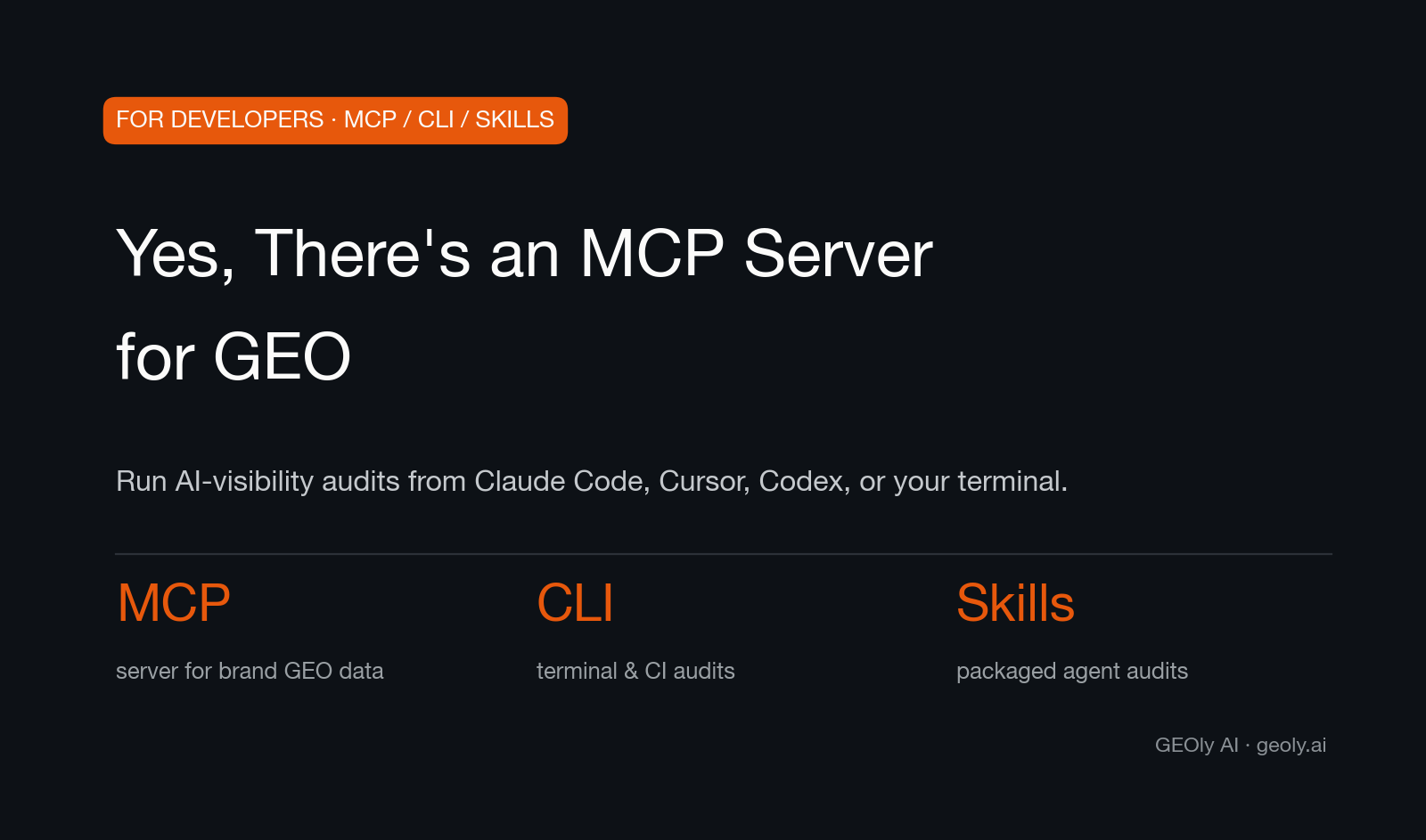
Is there an MCP server for AI visibility or GEO? Yes. GEOly runs one at app.geoly.ai/api/mcp. It exposes GEO data — prompt-by-prompt visibility across ChatGPT, Gemini, Google AI Mode, Perplexity and Copilot, rank, sentiment, citations, product-card presence in AI shopping — as tools that any MCP-compatible client can call. Claude Code, Cursor, Codex, a custom agent: if it speaks MCP, it can query visibility data mid-task.
And if your question is the terminal version, an AI visibility CLI you can run from a shell or a cron job, that exists too: a single zero-dependency binary, installed with one curl or PowerShell line, that prints pure JSON to stdout and returns exit codes your scripts can branch on — built for Claude Code, Codex, n8n and CI pipelines, documented at geoly.ai/open/cli. GEOly ships three surfaces on one tool source: the MCP server for agents inside dev tools, the CLI for scripts and CI, and GEO skills that package full audits into a single invocation. Same tools, same definitions, so numbers never drift between surfaces. So yes, you can automate GEO audits end to end.
The reason this setup exists is simple. GEO work increasingly happens inside dev tools, because the fix for a losing prompt is almost never in a dashboard. It lives in a schema block in a product template, a stale price in a feed, a missing comparison page in the content repo. Visibility data locked behind a web UI can't join that workflow. MCP turns it into a callable tool, so the audit happens where the fix happens: your codebase.
What the GEOly MCP server exposes
The server exposes up to 62 tools across two data planes, returned as structured responses an agent can reason over. The brand plane covers your own tracking: KPIs, prompt-level visibility, citations, competitors, GEO audits, GA4 — plus write operations, so an agent can create prompts, topics and competitors, or trigger a monitoring run. The industry plane needs no configuration at all: category rankings, white space, brand momentum, Share of Card, AI search demand and citation sources, queryable for any brand in the public dataset:
- Prompt-level visibility: for each tracked prompt, which AI engines mention the brand, at what rank, with what sentiment, and which sources the answer cites
- Share of Card: whether your products appear as product cards in ChatGPT shopping and Google AI Mode, and whose cards show up when yours don't
- Citation sources: the domains and pages AI engines actually cite for your category's prompts — the target list for content and earned-media work
- Competitor share of voice: mention share across a prompt set, tracked over time
- ChatGPT ads intelligence: which advertisers appear on which prompts, useful for spotting paid pressure on queries you hold organically
This data moves fast enough to justify automation. GEOly's industry dataset refreshes in weekly batches across engines and markets, and card lineups, citations and ad slots genuinely reshuffle between batches. A monthly manual check reads last month's shelf.
How it works
The flow is standard MCP. Add the GEOly server — app.geoly.ai/api/mcp — to your client's MCP configuration and authenticate: OAuth in the browser for interactive clients, or a read-only token for headless use. One command connects ChatGPT, Claude, Cursor or Codex. Your agent then sees the GEO toolset alongside its usual file and shell access. Ask it "which prompts did we lose this week?" and it calls the server, gets structured JSON back, and can act on it immediately: edit the JSON-LD, patch the feed, draft the brief. No export step, no copy-paste from a dashboard.

Three workflows worth stealing
1. Nightly visibility diff in Claude Code
Run Claude Code headless on a schedule. The agent pulls today's visibility results, diffs them against yesterday's, and posts a summary to Slack: prompts gained, prompts lost, rank moves, new competitor citations. When a product card drops out of ChatGPT shopping, it goes one step further and checks the product feed for the usual suspects (missing GTIN, stale price or stock data), then opens an issue with the diagnosis attached. You wake up to a triaged list, not a dashboard to interpret.
2. Fixing PDP schema in Cursor with live visibility context
You're in a product template. Instead of guessing what AI engines want, ask the agent which prompts this product is losing. It pulls Share of Card data and the citations behind the winning answers, then reports back: competitors' cards carry review counts and fresh pricing, and your page is missing Product schema entirely. The agent writes the JSON-LD in the same session, against the actual gap rather than a generic checklist. A week later, re-run the same query to see whether the card came back.
3. Pre-deploy check from the terminal or CI
The CLI slots into a CI step. Before a storefront deploy, run an audit that checks whether PDPs and the product feed are AI-shopping-ready: structured data present and valid, GTINs populated, price and stock fresh. Fail the build on regressions, warn on gaps. The same CLI handles the boring recurring jobs too. A weekly competitor share-of-voice pull piped into a spreadsheet takes one cron line.

Getting started
Setup takes a few minutes and no custom code. Connect the MCP server from your GEOly account — OAuth for interactive clients, a read-only token for agents and CI (MCP access starts on the Grow plan). For terminal use, install the CLI with one line from geoly.ai/open/cli; it authenticates with the same token and exposes the same tool set as the server. The skills come last: GEOly's official SKILL.md, listed on the Codex plugin marketplace, teaches any agent the right tool choices, the org-and-brand discovery flow, and the metric definitions; preset skills — brand narrative, competitor narrative, GEO diagnosis, intent blind-spot analysis — bundle multi-step audits into one action, and a Skill Builder lets you package your own methodology the same way.
If your GEO workflow still ends with a dashboard screenshot pasted into a ticket, the tooling has moved past you. Connect the data to the place the fixes live, and the audit-to-fix loop collapses from days to a single session. GEOly's MCP server, CLI, and skills exist for exactly that — start at geoly.ai.