Agentic Commerce Now Needs an Eligibility Stack
The latest agentic commerce news is easy to misread as a stream of isolated launches: a ChatGPT Ads partner here, a shopping integration there, a payment card, a hotel app, a Google AI Mode study.
The stronger pattern is that AI commerce is becoming an eligibility problem.
An AI system does not simply decide which brand to mention. It has to decide which product data is trustworthy enough to show, which app can perform the next step, which offer is allowed to appear, which payment credential can be used and which source should be cited when the answer becomes commercial.
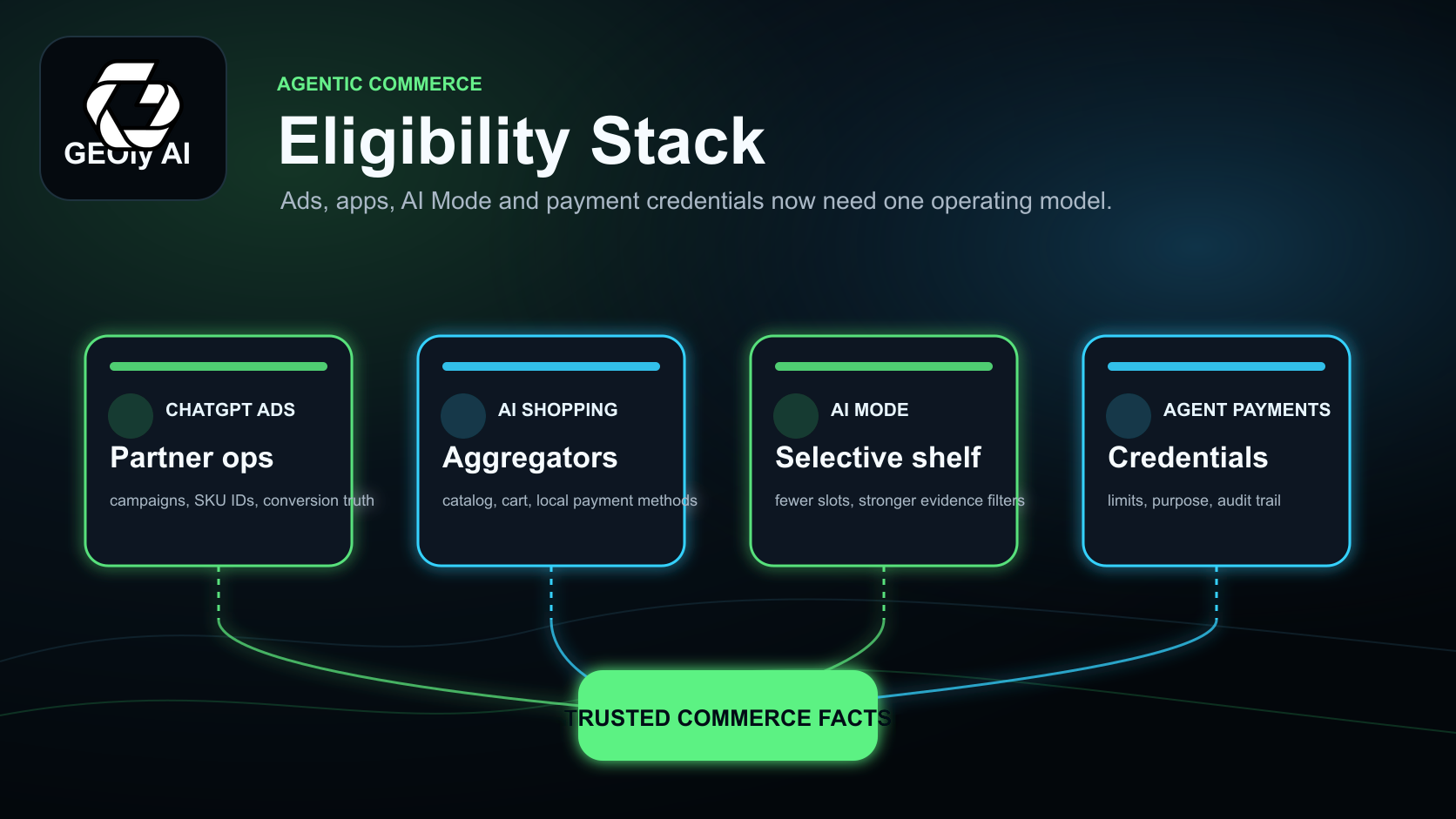
That means brands need more than GEO content. They need an eligibility stack: the operational layer that proves a brand, product or offer is safe, current, measurable and actionable enough for AI systems to recommend or route demand toward it.
The channel is splitting into four operating rails
The first rail is paid AI search. Pattern announced that it is supporting ChatGPT Ads as a technology partner and positioning ChatGPT Ads alongside Google, Meta, Snap, TikTok and commerce media in its cross-platform advertising system. That matters because a serious ads channel does not scale through a few manual tests. It scales through account access, catalog mapping, campaign controls, conversion feedback and agency workflows.
For brands, the point is not simply "try ChatGPT Ads." It is to make sure ChatGPT Ads can plug into the same governance that already controls spend, SKU naming, creative review, conversion IDs and refund-adjusted reporting. GEOly's ChatGPT Ads Library is useful here because paid exposure needs to be watched separately from natural AI visibility. Blending the two will make the channel look cleaner than it is.
The second rail is commerce aggregation. GoKwik and PayU say they have enabled multi-brand D2C shopping inside ChatGPT for Indian consumers, covering discovery, comparison, cart and payment across local methods such as UPI, cards, net banking and wallets. If this model works, regional commerce enablers may become the bridge between AI platforms and long-tail merchants that cannot each build their own ChatGPT app.
The third rail is first-party brand experience. Radisson launched a ChatGPT app for hotel discovery with live inventory, rates, amenities and booking handoff. IHG is testing its own conversational hotel search while industry coverage points to its participation in Google Direct Offers. The strategic lesson is simple: strong brands will not depend on one AI platform surface. They will expose the same trusted facts through their own AI search, official AI apps, Google surfaces and paid offers.
The fourth rail is payment credentials. MoonPay's PayBox and Corpay's Agent Card point to two versions of the same control problem. Consumer agents need user-approved wallets, spending limits and confirmation flows. Enterprise agents need purpose-bound virtual cards, vendor controls, category restrictions and audit trails. In both cases, the hard question is not whether an AI can click "buy." It is whether the business can prove the agent had the right identity, permission, budget and scope.
