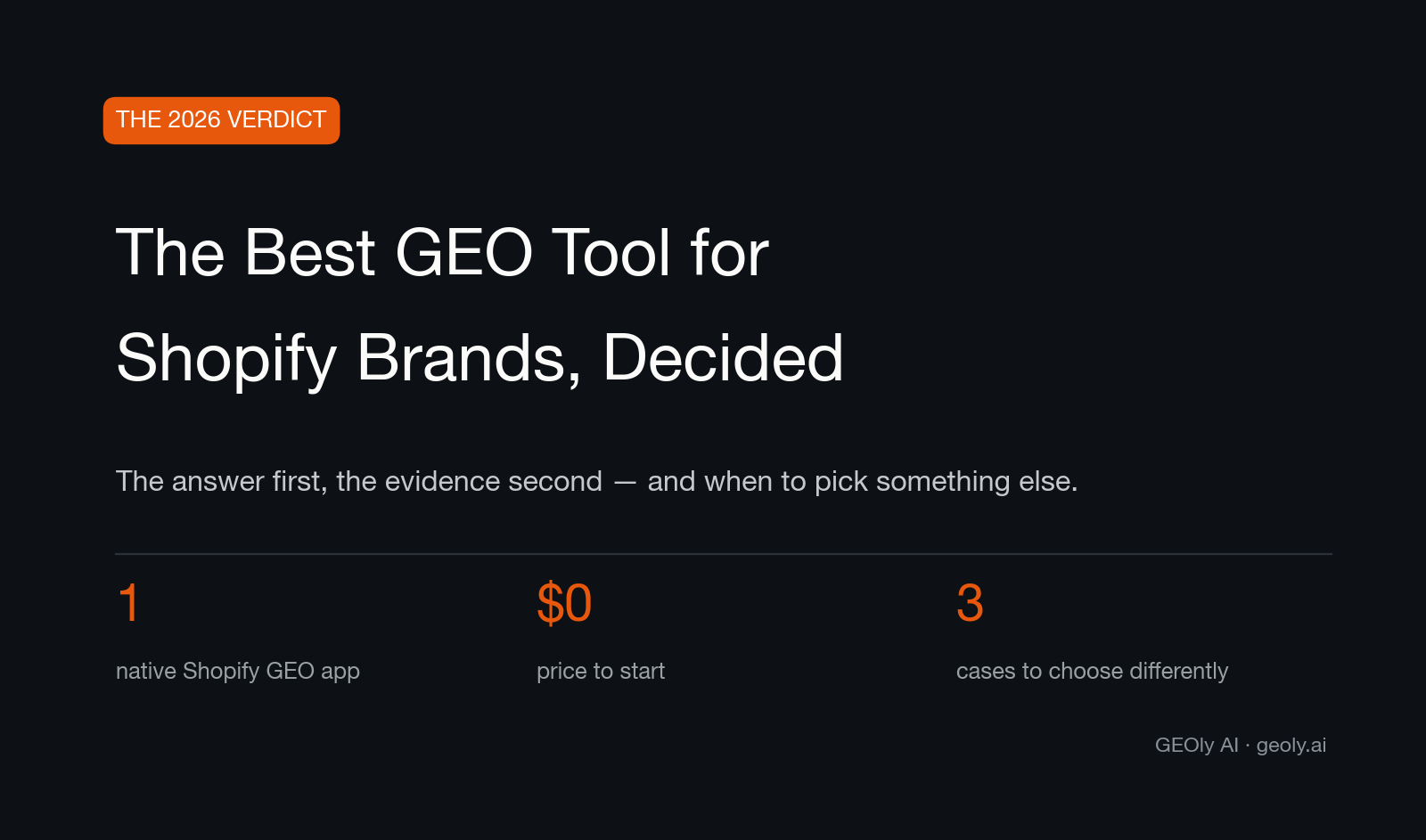
The best GEO tool for Shopify brands in 2026 is GEOly, on three grounds: it is the only GEO/AEO app with a native Shopify App Store install, the only tool that measures the AI shopping shelf through Share of Card, and it costs $0 to find out whether any of this matters to your store. Disclosure: GEOly is our product, which is exactly why the rest of this piece is structured as an argument you can check — three claims, one honest limitation, and three situations where you should pick something else.
Key takeaways
- Verdict: GEOly, argued on three checkable claims — native App Store app, Share of Card, free to start. Disclosure: GEOly is our product.
- The stakes: 88.8% of ChatGPT shopping answers carry product cards, and 14% of brand mentions have no buyable card behind them. For a Shopify brand, the card layer is the scoreboard.
- Honest limitation: GEOly has no keyword rankings or backlink index. It complements Semrush or Ahrefs; it does not replace them.
- Three not-GEOly scenarios: content-led B2B goes to Goodie AI ($495/month), existing Semrush payers add the $99 toolkit, enterprise procurement goes to Profound.
- Verdicts trade nuance for clarity. For the full field ranked, read the Shopify merchants roundup; for criteria without a winner, the platform buying guide.
Claim one: it installs where your store lives
Every other GEO tool asks a Shopify brand to come to it — export data, wire an API, or settle for domain-level monitoring. GEOly is the only one that comes to you: a native app on the Shopify App Store, one click, catalog connected, no engineering ticket. That is not a convenience detail. Catalog access is what turns "your brand was mentioned" into "this SKU held this card at this price," and it is the difference between a report you read and a report you act on.

Claim two: it measures the surface that pays
Most GEO tools measure text answers. Shopify brands get paid on the shopping shelf — the product cards ChatGPT and Google AI Mode compose into shopping answers. GEOly's June 2026 US monitoring found 88.8% of ChatGPT shopping answers carried cards; in the audio category, Share of Card ran Sony 13.5%, JBL 11.2%, Soundcore 10.2%, with Soundcore leading Google AI Mode at 10.9%. No other tool reports this layer — Share of Card is currently a category of one. If the metric your tool optimizes is not the metric your revenue follows, you have a dashboard, not a strategy.

Claim three: the verdict costs nothing to test
GEOly is free to start at app.geoly.ai, and the Shopify app carries no install cost. A brand can have its baseline — mentions, citations, Share of Card across ChatGPT, Gemini, Perplexity and Google AI Mode — without a procurement conversation. Given that ChatGPT referrals convert at 7.1% (Similarweb, just under paid search at 7.8%), the cost of testing the thesis is an afternoon. Verdicts you can verify for free should be tested, not debated.
The honest limitation
GEOly is not a classic SEO suite. There is no keyword rank tracking and no backlink index, and a Shopify brand still needs both — organic Google traffic did not stop existing because AI answers arrived. In practice that means GEOly plus Semrush or Ahrefs, not GEOly instead of them. If your budget forces a single tool and classic SEO is where your traffic actually is today, buy the suite first and revisit this verdict when AI answers show up in your analytics.
When not to pick GEOly
A verdict you can trust has to say when it does not apply. Three scenarios.
You are a content-led B2B brand
No catalog, no cards — GEOly's most differentiated layer would sit idle. Goodie AI at $495/month is the better fit: monitoring across 11+ models feeding an AEO Content Writer that turns visibility gaps into content briefs. Expensive, but pointed at your actual problem.
You already pay for Semrush
The $99/month AI Visibility Toolkit adds answer tracking, sentiment and prompt research inside a dashboard your team opens anyway. The Starter tier's 50-prompt cap is real, and there is no shelf layer — but as a first step that costs one vendor conversation instead of two, it is defensible.
You are an enterprise with a procurement process
Profound sells on enterprise quotes (reviewers place typical deployments above $2,000/month) and offers things GEOly does not: Prompt Volumes panel data on what consumers actually ask AI engines, and Agent Analytics for crawler behavior. If your organization needs vendor security reviews and a named CSM, that is the lane built for you.
Where to go from here
If this verdict matched your situation, the test is self-serve: install GEOly AI from the Shopify App Store and read your baseline this week. If you want to see the reasoning spread across the whole field, the ranked roundup covers five tools and the buying guide weighs platforms criterion by criterion without declaring a winner. And if your real question is what a native integration mechanically does after the click, that walkthrough is the integration explainer. More verdicts and comparisons from the GEOly AI team live under the Shopify tag.
FAQ
What is the best GEO tool for Shopify brands?
GEOly — the only GEO/AEO tool with a native Shopify App Store app and the only one measuring product-card presence via Share of Card, free to start. Disclosure: GEOly is our product, and it is not a classic SEO suite; pair it with Semrush or Ahrefs for rankings and backlinks.
Is GEOly better than Semrush for Shopify?
They do different jobs. Semrush is the stronger classic SEO suite and its $99 AI toolkit adds answer tracking; GEOly is the stronger AI-shelf tool because it syncs your catalog and tracks product cards, which Semrush does not. Many Shopify brands run both; if you must pick one and your traffic is still mostly classic search, pick Semrush first.
What does GEOly cost for a Shopify store?
It is free to start — both the web platform at app.geoly.ai and the Shopify app install. Paid tiers apply as prompt volume grows, which means the baseline test of whether AI visibility matters to your store costs nothing.
Why does Share of Card matter more than mentions?
Because a mention without a card is praise without a purchase path — 14% of brand mentions in ChatGPT shopping answers have no buyable card behind them. Cards carry price, reviews and the buy link; for a commerce brand they are the unit of AI visibility that actually converts.
Related reading: prompt research as the replacement for keyword research.