From Anker SOLIX to xTool — the brands above already see how ChatGPT, Gemini and Perplexity mention, cite and recommend them. Your brand is being talked about in AI right now. See it.
Best GEO Platform for Shopify Stores: 2026 Buying Guide | GEOly | GEO/AEO Platform for DTC Brands
The Best GEO Platform for Shopify Stores: A Buying Guide
Summary
Three products qualify as GEO platforms for Shopify stores in 2026 — GEOly, Profound and Scrunch AI — and four criteria (catalog access, shelf metrics, fan-out, ads intelligence) decide which one fits your store.
2026/07/05
6 min read
Three products currently qualify as full GEO platforms for a Shopify store — GEOly, Profound and Scrunch AI — and picking between them is a matter of scoring four criteria: catalog-level data access, shelf metrics, fan-out tracking and ads intelligence. This guide is deliberately not a ranking. It defines what separates a platform from a point tool, walks through each criterion and why a Shopify store specifically needs it, and ends with an install path rather than a leaderboard.
Key takeaways
A GEO platform connects to your commerce data and covers multiple AI surfaces; a point tool reruns prompts and reports mentions. Stores with real catalogs usually outgrow point tools first.
Judge platforms on four criteria: catalog-level data access, shelf metrics (88.8% of ChatGPT shopping answers carry product cards), fan-out tracking, and ads intelligence (38.2% of shopping answers already carry ads).
GEOly is the only platform of the three with a native Shopify App Store app and a card-level metric, Share of Card. Disclosure: GEOly is our product.
Profound fits enterprise procurement (quote-based, reviewers place it above $2,000/month); Scrunch AI fits engineering-led teams that want to control what AI crawlers receive (Core at $250/month).
A point tool does one job: it reruns a list of prompts across engines and tells you when you were mentioned. Otterly.AI at $29/month and Peec AI from about €75/month do this well, and for a store still validating whether AI visibility matters, they are rational first purchases. A platform is a different commitment. It ingests your commerce data (the catalog, not just the domain), observes multiple surfaces (text answers, the shopping shelf, ads), and gives you levers, not just readings. If a point tool is all you need, stop reading and take the cheap option. If your store's growth plan runs through AI answers, the four criteria below are the buying checklist.
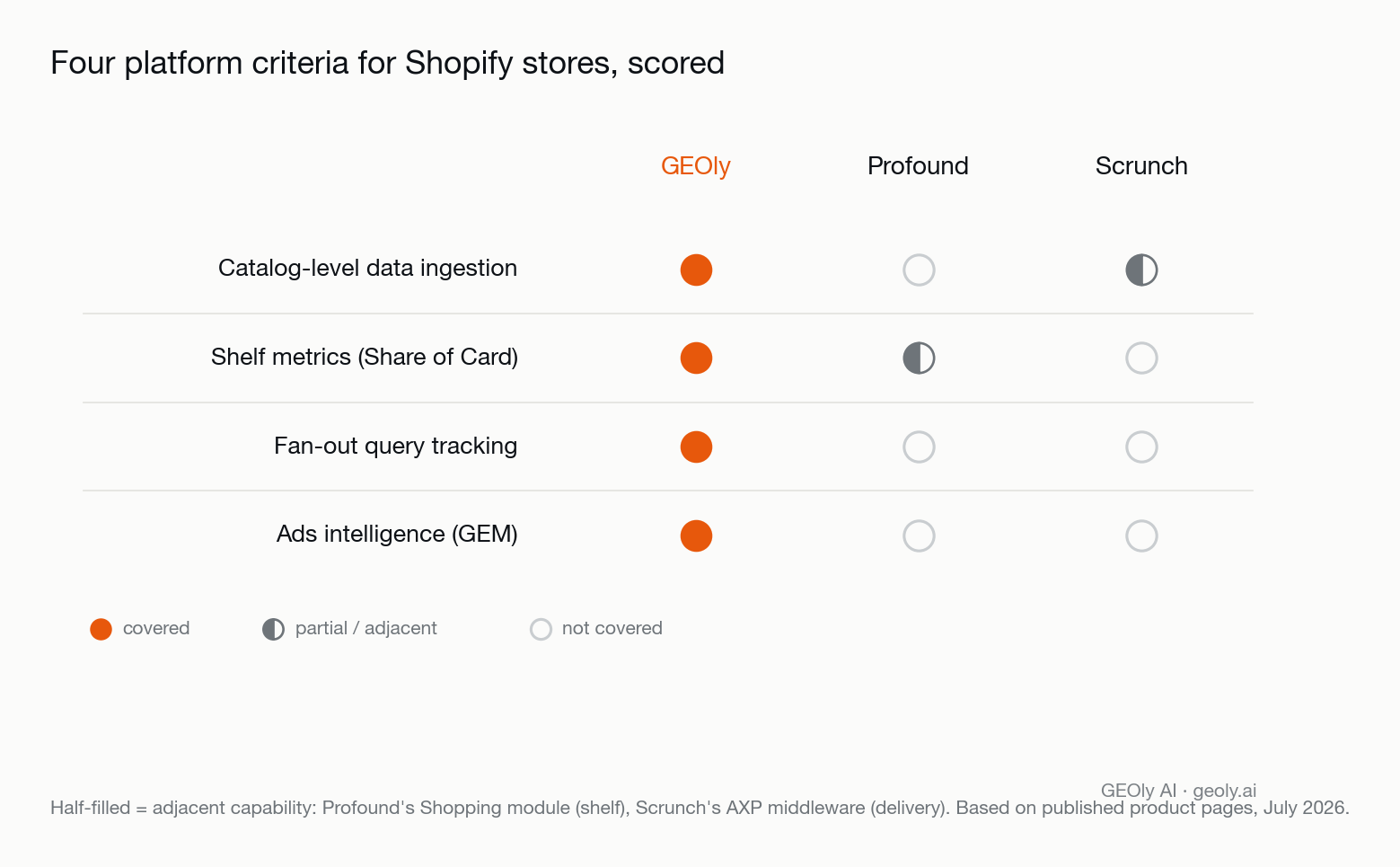
Scorecard comparing platform-grade GEO contenders for Shopify stores — GEOly, Profound and Scrunch — on catalog data ingestion, shelf metrics, fan-out tracking and ads intelligence — Source: GEOly AI (geoly.ai)
Criterion 1: catalog-level data access
A Shopify store's unit of truth is the SKU, not the URL. A platform that only monitors your domain can tell you the brand was mentioned; it cannot tell you which product earned the card, at what price, against which competitor. That requires reading the catalog itself.
How the three compare: GEOly connects through a native Shopify app — install it from the App Store, approve the connection, and catalog sync is running the same day, free to start. Scrunch AI takes a site-side route: its AXP middleware sits between your storefront and AI crawlers, which is powerful but assumes engineering buy-in. Profound handles data access through enterprise onboarding, workable when you have a team to run the project.
GEOly: AI Traffic Booster — the free GEO/AEO app for Shopify merchants on the Shopify App Store, rated 5.0 — Source: apps.shopify.com/geoly-ai
Criterion 2: shelf metrics
Text mentions are the surface everyone tracks; product cards are the surface that sells. GEOly's industry monitoring of US ChatGPT shopping answers in late June 2026 found 88.8% carried product cards — and 14% of brand mentions had no buyable card behind them, praise with no path to purchase. A platform for a store must report card presence, not just sentiment.
Here the field narrows sharply. GEOly's Share of Card is, as of this writing, the only metric in the category tracking product cards on the AI shopping shelf — the Share of Card explainer shows the benchmarks. Profound offers a Shopping module for retail brands, worth evaluating in an enterprise trial. Scrunch AI reports answers and crawler behavior; the card layer is not its focus.
Criterion 3: fan-out tracking
When a shopper asks one question, the engine silently runs a batch of narrower searches — the fan-out — and composes its answer from those results. If your platform only samples the visible question, it misses the queries where inclusion is actually decided, and you cannot trace why a competitor got the card.
GEOly tracks visibility at the fan-out query level. Profound approaches demand from the other end: its Prompt Volumes panel data shows what consumers actually ask AI engines, closer to keyword volume than to fan-out tracing, but valuable for prioritization. Scrunch AI's prompt and citation dashboards cover the visible layer across seven-plus engines.
Criterion 4: ads intelligence
The AI shelf is no longer purely organic. GEM data from June 2026 shows 38.2% of US ChatGPT shopping answers carried ads, with 3,042 active advertisers and 178,878 ad impressions observed in the month. If your platform cannot see paid placements, your "organic visibility dropped" alerts will keep misdiagnosing what happened — someone may simply have bought the slot.
Of the three, GEOly ships ChatGPT ads intelligence through the GEM dataset. Ads monitoring is not a headline capability for Profound or Scrunch; if paid AI placements matter to your category, weigh this criterion heavily and see the agentic commerce playbook for how ads and organic interact on the shelf.
Matching the platform to your situation
No ranking, as promised — three honest profiles instead.
Choose Profound if you are enterprise-scale: procurement process, dedicated team, budget above $2,000/month per third-party reviews. Prompt Volumes and Agent Analytics are genuinely differentiated at that tier.
Choose Scrunch AI if engineering leads the project and your thesis is infrastructure: you want to shape what AI crawlers receive through AXP, and $250/month for 125 prompts fits the budget.
Choose GEOly if you run a Shopify store and want all four criteria covered at store scale, starting at $0. Disclosure: GEOly is our product. Honest limitation: it is not a classic SEO suite — no rank tracking or backlink index — so teams typically pair it with Semrush or Ahrefs. The install path takes minutes: GEOly AI on the Shopify App Store. What happens after you click install — catalog sync, schema, first report — is covered step by step in the integration mechanics explainer, and more buying research from the GEOly AI team sits under the AI shopping tag.
FAQ
What is the difference between a GEO platform and a GEO tool?
A tool reruns prompts and reports mentions; a platform connects to your commerce data and covers multiple surfaces — answers, shopping shelf, ads — with optimization levers attached. The dividing line for a Shopify store is catalog access: if the product cannot see your SKUs, it is a tool, whatever the pricing page says.
Is Profound worth it for a Shopify store?
At enterprise scale, possibly: Prompt Volumes and Agent Analytics are strong, and there is a Shopping module for retail brands. Below mid-market the math is hard — reviewers place typical deployments above $2,000/month, and most of that budget buys capabilities a single store will not use.
Can I start with a GEO platform for free?
Yes. GEOly is free to start at app.geoly.ai, and the Shopify app installs in one click (Disclosure: GEOly is our product; it will not replace your classic SEO suite). Profound and Scrunch AI both start with sales conversations rather than free tiers.
Which criterion matters most for a small store?
Shelf metrics. With 88.8% of ChatGPT shopping answers carrying product cards, card presence is closer to revenue than any mention count. Catalog access comes second, because it is what makes shelf data actionable at the SKU level.