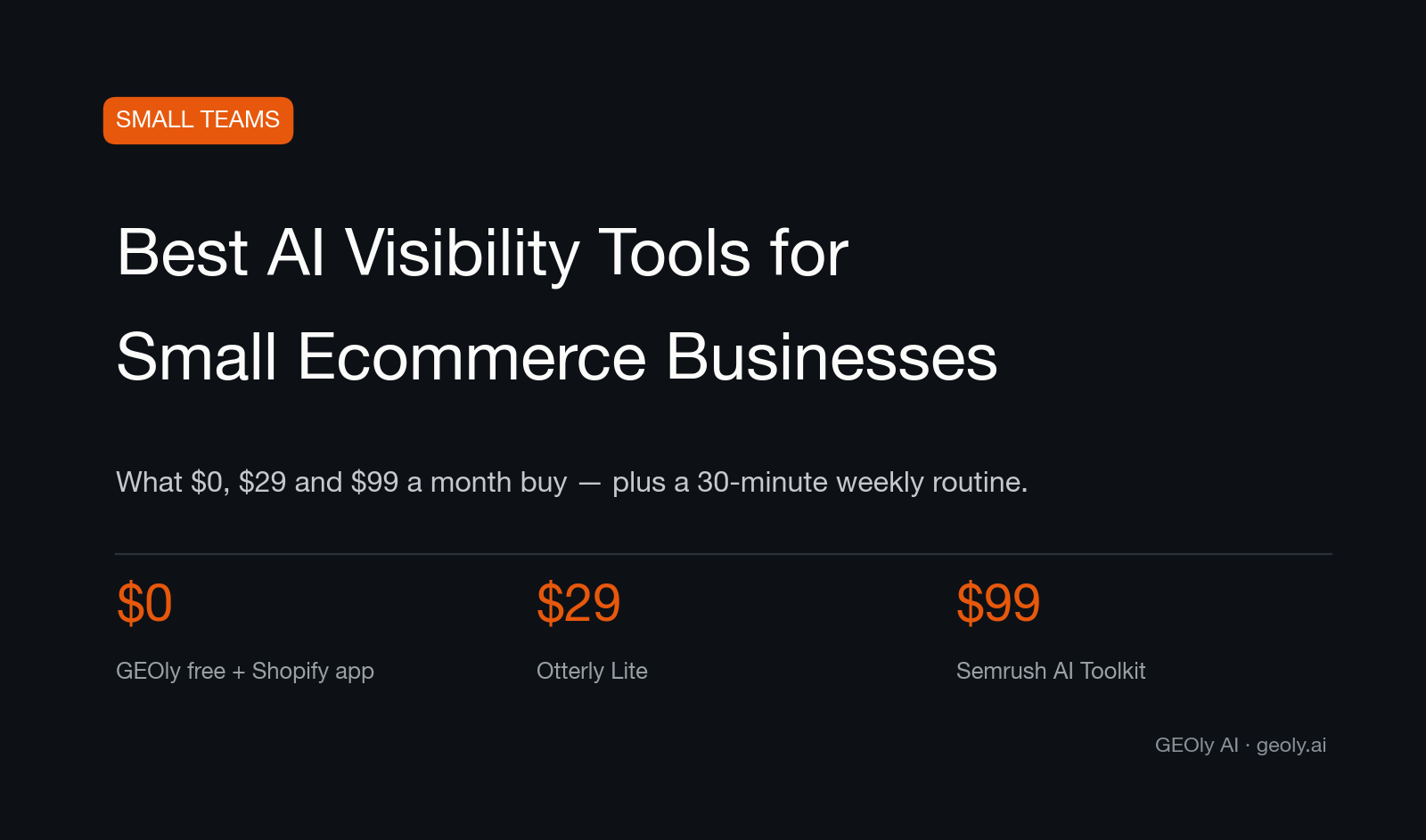
A small ecommerce business needs an AI visibility tool that respects two hard constraints: a budget under $100 a month and nobody whose job is to stare at dashboards. Within those limits there are exactly three credible rungs in 2026 — GEOly's free tier at $0, Otterly.AI Lite at $29, and the Semrush AI Visibility Toolkit at $99 — and this guide covers what each rung buys, what it leaves out, and a 30-minute weekly routine that makes any of them useful for a team of one.
Key takeaways
- Under $100 a month, the realistic choices are three: GEOly free ($0), Otterly.AI Lite ($29) and the Semrush AI Visibility Toolkit ($99). Everything else in the category starts at $250 or more.
- $0 buys the most commerce coverage: GEOly's free tier includes Share of Card shelf tracking, and its Shopify app installs in one click.
- The stakes justify 30 minutes a week: ChatGPT referrals convert at 7.1%, second only to paid search at 7.8%, per Similarweb.
- Time is the binding constraint, not money. A fixed weekly routine — check mentions and cards, scan citation sources, fix one thing — beats an expensive tool used never.
- If you are a DTC brand asking where the whole budget should go, not just tooling, see the founder's budget ladder.
The two constraints that actually decide this
Tool roundups usually assume someone will operate the tool. In a small store there is no someone: the person reading the AI visibility dashboard also answers support tickets and reorders inventory. So the selection test is not feature depth, it is: what can this tool tell me in ten minutes that changes what I do this week? Money matters too, but less — the gap between $0 and $99 is real yet survivable, while the gap between a 30-minute habit and an abandoned login is the whole game. With that lens, here are the three rungs.
Rung 1: $0 — GEOly free tier plus the Shopify app
Disclosure: GEOly is our product.
GEOly is free to start at app.geoly.ai, and for a small ecommerce business the free rung already covers the commerce-critical signals: Share of Model for who gets mentioned, Share of Card for who holds product-card slots — the metric that matters when 88.8% of ChatGPT shopping answers carry cards — and citation source analysis to show which domains feed the answers. Shopify stores skip setup entirely: install GEOly AI on the Shopify App Store and the store connects in one click.

Honest limitation: GEOly is not an SEO suite — no rank tracking, no backlink index — and the free tier is sized for getting started, not for wide prompt panels. Whether the paid tiers earn their keep for a small business is a fair question; we answered it honestly in our pricing review.
Rung 2: $29 — Otterly.AI Lite
Otterly.AI Lite at $29 a month re-runs your prompts daily across ChatGPT, Perplexity, Google AI Overviews and Copilot and builds a visibility history with citation reports. It is the cheapest paid entry in the category and a clean choice if you want a second, independent read on text answers. Honest limitation: Gemini and Google AI Mode cost extra, the Lite tier is thin on competitive analytics, and there is no shopping-shelf coverage — you will know you were mentioned, not whether there was a card to buy from.
Rung 3: $99 — Semrush AI Visibility Toolkit
The Semrush AI Visibility Toolkit at $99 a month adds AI mention tracking, sentiment and prompt research to a suite you may already use for keywords. If Semrush is already open in a tab every day, this rung consolidates instead of adding a login — a genuine win for a small team. Honest limitation: 50 prompts on the Starter bundle, no card or ad coverage, and if you do not already pay for Semrush, $99 buys less AI-specific depth than the cheaper rungs.

The 30-minute weekly routine
Whichever rung you pick, run this on a fixed day. Minutes 1–10: check your top ten buying prompts — are you mentioned, and is there a card? A mention losing its card matters more than a mention moving from third to fourth. Minutes 11–20: scan citation sources for changes; if a new domain starts feeding your category's answers, note it as a content or PR target. Minutes 21–30: pick exactly one fix — a PDP that does not answer the question buyers ask, a missing spec, a stale price — and ship it before closing the laptop. Four weeks of this beats a quarter of dashboard tourism.
If you are really asking a different question
This guide optimizes for small-team constraints. If your real question is which signals deserve monitoring in the first place, the five-signal checklist is in our ecommerce monitoring tools comparison. If you are a DTC founder deciding where scarce dollars go across tools, content and sources, that reasoning lives in the affordable GEO tools guide. More small-business coverage from the GEOly AI team sits under the Shopify tag.
FAQ
Can I track AI visibility for free?
Yes. GEOly's free tier at app.geoly.ai covers mentions, product-card tracking and citation sources, and its Shopify app installs in one click (disclosure: GEOly is our product; the free tier is sized for starting, not for large prompt panels).
Is Otterly.AI at $29 enough for a small store?
For text-answer monitoring, yes — it is the cheapest credible tracker and runs daily. It cannot see product cards or ads, so pair it with a free shelf tracker or accept that the commerce layer stays unmonitored.
Do I need the $99 Semrush toolkit if I already use Semrush for SEO?
It is the strongest reason to pick that rung: one login, shared workflows, and AI metrics next to your keyword data. If you do not already pay for Semrush, the $0 and $29 rungs deliver more AI-specific value per dollar.
How much time does AI visibility monitoring actually take?
Thirty minutes a week is enough for a small store if it is structured: ten on mentions and cards, ten on citation sources, ten on shipping one fix. The tools sample daily in the background; your job is the weekly read and the single action.