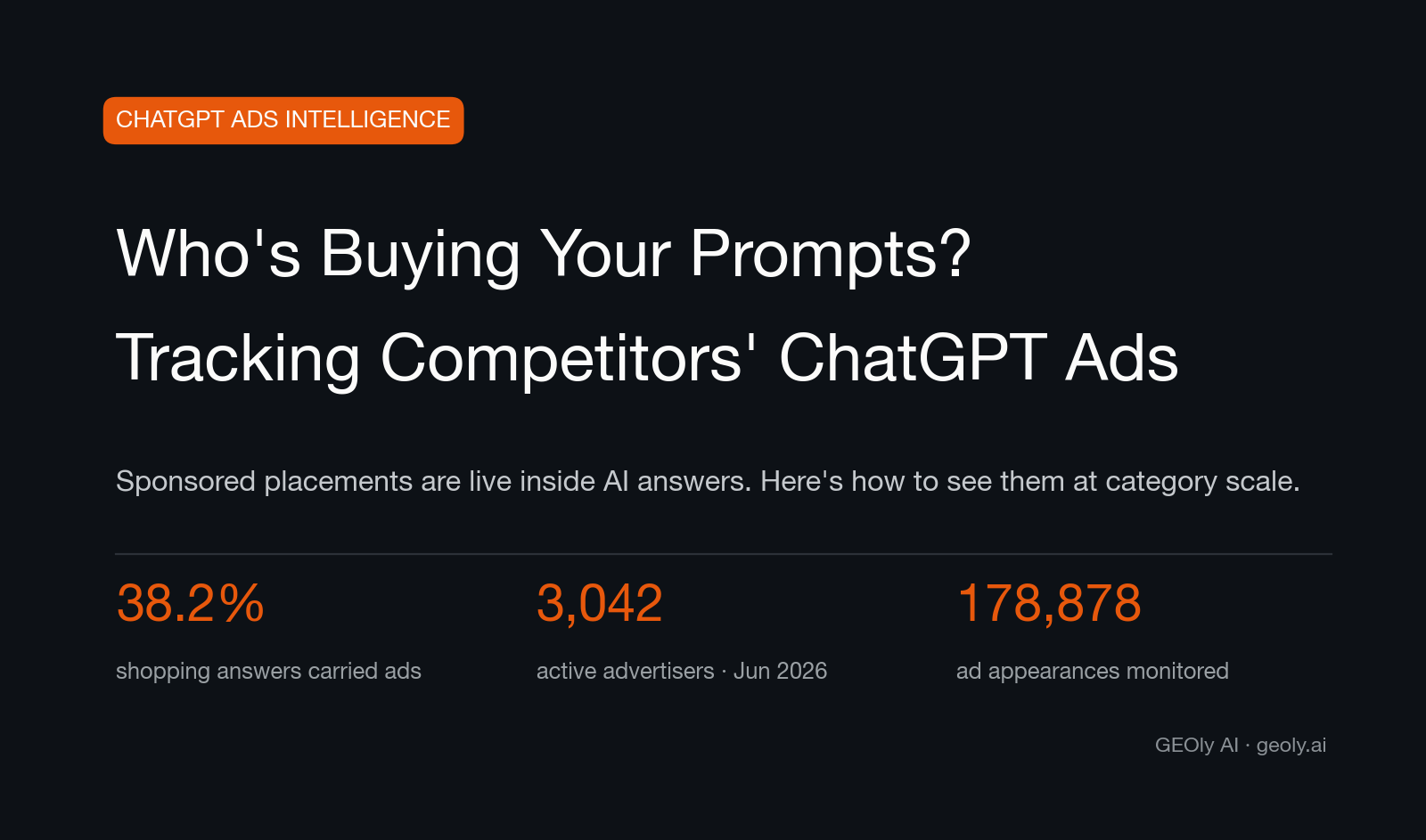
In June 2026, 38.2% of shopping-intent ChatGPT answers carried a sponsored ad placement — 178,878 of the 467,805 answers in GEOly's US industry monitoring. That number should change how you think about competitive research. Your competitors are no longer just outranking you in ChatGPT's organic product cards; they can now buy their way into the same answers, often directly above you.
If you're asking how to monitor competitors' ChatGPT ads, there are exactly two options. The manual route: run the shopping prompts that matter in your category, look for cards labeled sponsored (each one shows the advertiser's name and domain), and record what you see. The systematic route: use an ads intelligence layer built for this, like GEM — GEOly's Generative Engine Marketing dataset — which runs large panels of shopping prompts on a schedule, detects every sponsored ad card, logs the advertiser behind it, and turns the appearances into weekly time series and category benchmarks.
OpenAI doesn't publish an ads library the way Meta does. There is no official page where you can look up which brands are running ChatGPT ads in your category. The only visibility available is what you observe in the answers themselves, which is why monitoring at scale is the whole game. Here's how to do it, what to track, and what the current advertiser data looks like.
Why ads intelligence matters now, not later
ChatGPT ads run through OpenAI's self-serve ads manager in the US, and the ad cards appear alongside organic product cards inside shopping answers. That placement detail is the strategic problem. If you spent a year earning organic visibility for a prompt like "best cordless drill under $150", a competitor can open the ads manager and buy a sponsored card in that exact answer. Your organic spot doesn't disappear; it gets a paid neighbor above it.
And this is no fringe channel. 3,042 distinct advertisers were active on ChatGPT ads in June 2026 (GEOly industry monitoring, US). Self-serve access means the barrier to entry is a credit card, not an agency relationship. Advertiser count and ad penetration point the same direction: the auction in your category is filling up while you read this.

Who's already advertising on ChatGPT
The top of the June 2026 advertiser table, ranked by ad appearances across GEOly's monitored prompt panels (US):
- Harbor Freight: 7,245 ad appearances
- Quince: 6,549
- Pottery Barn: 5,922
- SCHEELS: 5,719
- Sephora: 4,972
- Ring: 4,672
- Amazon: 3,227
- Home Depot: 2,918
- Chewy: 2,735
- 3 Day Blinds: 2,222
Read the mix. Big-box retail (Home Depot, Amazon), category-killer chains (Harbor Freight, SCHEELS), a DTC brand built on quiet efficiency (Quince), home services (3 Day Blinds), plus pet, beauty, and smart home. This isn't one vertical testing a beta. It's mainstream retail spend spread across the categories where shopping prompts actually happen. If your category is on that list, you probably already have sponsored neighbors. If it isn't, you may be looking at cheap inventory.

What to actually track
Ads intelligence on ChatGPT comes down to five signals:
- Advertiser presence by prompt and category: which brands buy ads on which prompts, and how that maps onto your own priority prompt set.
- Ad frequency: how often each advertiser's card appears. A brand at 6,000+ monthly appearances is running an always-on program, not a test.
- Overlap with your organic prompts: the prompts where you hold an organic product card and a competitor holds the ad slot. These are your most urgent exposures.
- New advertiser entries: who showed up this week that wasn't there last week. A small test buy on a prompt set usually precedes a broader push.
- Creative and offer angles: what the ad cards say — price framing, bundles, shipping claims — so you know what your organic listing is being compared against.
The manual method, and where it stops working
You can do a useful spot check today. Open ChatGPT, run 15 to 20 of your category's highest-intent shopping prompts, and screenshot every answer that includes a sponsored card. Note the advertiser name and domain; both are shown on the card. Repeat weekly and keep a spreadsheet.
Then the limits arrive fast. Answers vary between sessions, so a single run tells you little about how often an advertiser actually appears. You have no history before the day you started. Twenty prompts won't cover a category where buyers phrase intent hundreds of ways. And you get zero benchmark: is 38% ad coverage across your prompts high or low for your vertical? A spreadsheet can't answer that. Manual checking is a flashlight. Competitive intelligence needs floodlights.
Monitoring at scale: how GEM does it
GEM, GEOly's Generative Engine Marketing layer — the paid-media counterpart to its organic monitoring — runs the process the manual method can't. It queries large panels of shopping prompts per category on a fixed cadence, detects sponsored ad cards in each answer, and records the advertiser name and domain for every appearance. On top of that raw log, it builds:
- Weekly time series per advertiser, so you see entries, exits, and scaling rather than one-day snapshots.
- Ad penetration benchmarks by category and prompt intent: what share of answers in your vertical carry ads, and where your prompt set sits against that.
- Advertiser and creative detail for every appearance — who bought the slot, which domain it routes to, what the card shows.
- A paid-versus-organic view: GEOly tracks organic product cards on the same prompt panels, so you can see exactly where a competitor's ad sits above your organic placement.
- Scheduled reports and automation, so a new advertiser entering your category shows up in your weekly digest instead of a quarterly surprise.
The June 2026 numbers in this piece come straight from that system. 467,805 monitored answers is not a sample you replicate by hand.
Turning the data into moves
- Defend the overlap prompts first. Where a competitor buys ads over your organic card, decide deliberately: match the buy, sharpen the organic card (price, offer, review signals), or both. Doing nothing is also a decision, and it hands the top of the answer to the competitor.
- Hunt white space. Prompts with strong purchase intent and zero current advertisers are the cheapest attention in the channel. GEM's category views make them visible, and they won't stay empty.
- Benchmark before you budget. The 38.2% figure is a cross-category average, and verticals differ widely. Budgeting against your category's actual ad density beats guessing from an aggregate.
ChatGPT ads are barely out of the gate and 3,042 advertisers are already in. The brands that win the next phase will be the ones who knew who was bidding on which prompts before rising CPCs made it obvious. If you want that view for your own category, GEOly's GEM tracks it weekly: advertisers, frequencies, overlaps with your organic spots, and the gaps nobody has bought yet.