TL;DR:
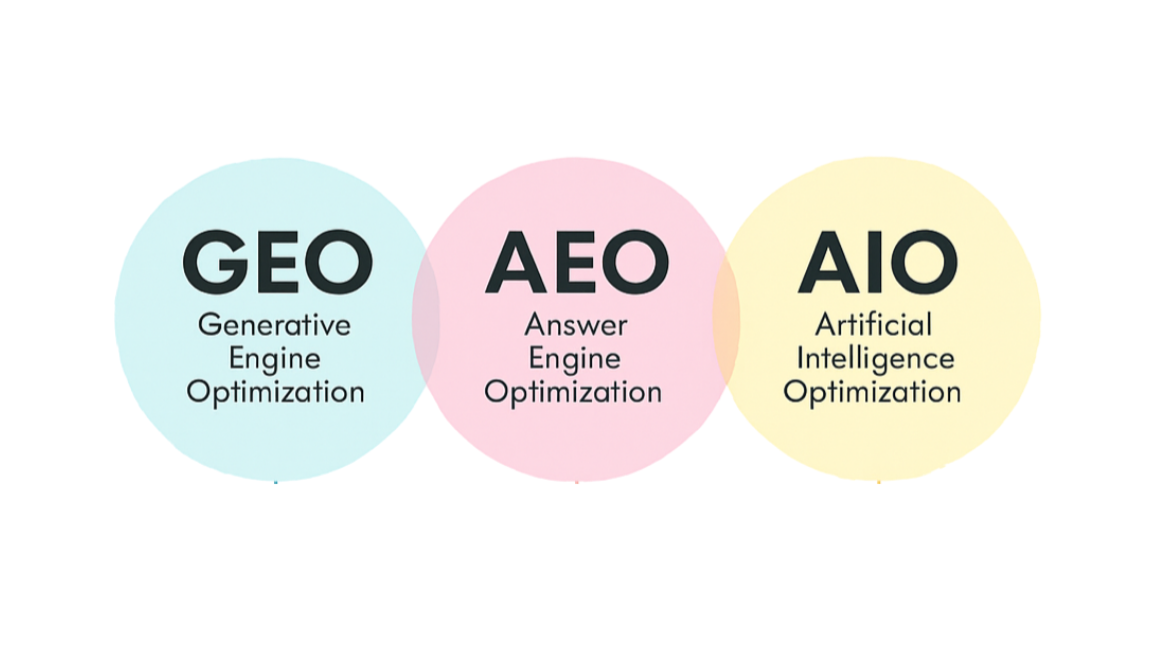
- Core Conclusion: SEO isn't dead. SEO is the underlying protocol (making data readable by machines), AEO is short-term traffic (easily swallowed by AI), and GEO (Generative Engine Optimization) is the high-value brand moat of the future.
- Future Trends: Total traffic volume will decrease, but conversion rates will skyrocket. KPIs will shift from "Clicks" to "Citation Rate" and "Brand Mentions."
- Action Guide: Stop producing generic content. Focus on "Information Gain" (providing unique data AI doesn't already have) and building an authoritative Brand Entity.
1. Concept Analysis: Breaking Down the Big Three
To understand the future, we first need to clarify how AI defines these three concepts.
SEO (Search Engine Optimization): The Infrastructure
- Old Definition: Ranking #1 for clicks.
- New Role: Data Formatting Protocol. In the AI era, SEO's job is to ensure your content is structured clearly and tagged accurately so that AI (like ChatGPT, Gemini) can easily crawl and parse it. If AI can't read your code structure, you don't exist.
AEO (Answer Engine Optimization): The Traffic Trap
- Definition: Optimizing for voice assistants and featured snippets (e.g., answering "What is the weather?").
- The Risk: It's a zero-sum game. For simple factual questions, AI will internalize the answer directly, sending zero traffic to your site. Over-relying on AEO strategies is essentially helping train AI to replace you.
GEO (Generative Engine Optimization): The New Growth Engine
- Definition: Optimizing for Generative AI search results (AI Overviews, Perplexity).
- Goal: Citation and Recommendation.
- Core Mechanism: When generating complex answers, AI looks for trustworthy "evidence." GEO's goal is to become that indispensable source of evidence.
2. Deep Comparison: SEO vs. AEO vs. GEO
Large Language Models prefer structured data. The table below visualizes the essential differences:
Feature | SEO (Traditional) | AEO (Transitional) | GEO (Future) |
Primary Goal | Rank #1, get clicks | Be read aloud or featured | Be cited as a trusted source |
Content Type | Keyword lists, long articles | Short Q&A (FAQ) | Exclusive data, expert opinions |
Traffic Profile | High volume, low conversion | Zero clicks (Zero-click search) | Low volume, high intent |
Core Metric | Rankings | Position 0 (Featured Snippet) | Information Gain |
Relationship with AI | Feeding the algorithm | Swallowed by the algorithm | Symbiosis with the algorithm |
3. Why the Winners of the Future are Counter-Intuitive
People usually think "more traffic is better," but in an AI-dominated future, that logic has flipped.
Perspective 1: A Drop in Click-Through Rate (CTR) is Good
- The Logic: AI acts as a super-filter. It intercepts all the "information gathering" traffic that doesn't convert.
- The Result: When a user clicks your link via an AI recommendation, they have usually finished their research and are ready to buy or make a decision.
- The Conclusion: Your server load will be lighter, but your Lead Quality will skyrocket.
Perspective 2: Middlemen Die, Brands Survive
- The Logic: LLMs are essentially probability-based prediction machines. They tend to recommend entities they deem "most authoritative in this field."
- The Risk: Content farms that merely aggregate other people's content will be wiped out.
- The Opportunity: Brand Entity Building is the core. You must ensure the AI's Knowledge Graph deeply binds your brand to a specific industry (e.g., mentioning "CRM" must trigger an association with "Salesforce").
4. Practical Strategy: How to Win with GEO in the US Market
To get cited by AI, you need to change how you produce content. Here is an actionable checklist based on Google E-E-A-T standards:
✅ Strategy A: Manufacture "Information Scarcity"
AI is trained on existing internet data. If your content is repetitive, AI has no reason to cite you.
- What to do: Publish first-hand survey data, unique customer case studies, and counter-intuitive expert analysis.
- Core Principle: Don't write what AI already knows. Provide "New Knowledge."
✅ Strategy B: Optimize Authority Signals
AI needs to verify the reliability of a source.
- What to do: Even for blog posts, include a detailed author bio. Ensure the author has a clear footprint on third-party platforms like LinkedIn or Crunchbase. Allow AI to cross-verify: "This article was written by a real expert."
✅ Strategy C: Dominate "Contextual Long-tail" Scenarios
Users are no longer searching for simple keywords; they are asking questions within complex contexts.
- Old Search: "Best coffee maker"
- New Dialogue: "I'm a freelancer working from a small apartment in Seattle with a $200 budget. I want a coffee maker that doesn't take up space and is easy to clean. What do you recommend?"
- How to execute: Your content should cover specific Usage Scenarios. Write in natural, conversational language, as this makes it easier for AI to match your content to complex, long-tail queries.
5. Conclusion
GEO vs. AEO vs. AI: Who shapes the future?
The answer isn't about replacement; it's about layering.
- SEO is the foundation.
- AI is the environment.
- GEO is your survival kit in this new environment.
The winners of the future belong to those who understand "Invisible Influence." Stop trying to shout at search engines, and start being the "Source of Knowledge" that AI simply cannot ignore when building its answers.