GEOly AI Official Research
Market: United States, ChatGPT
Date: June 2026
Data basis: GEOly AI's own ChatGPT ad monitoring dataset.
The sample includes:
- 84,665 sponsored cards
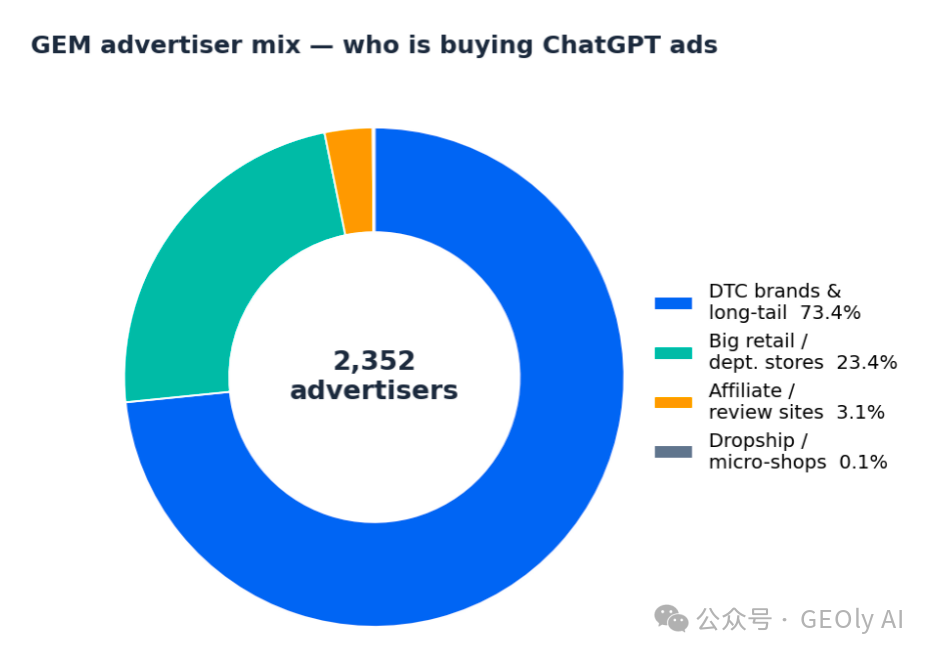
- 2,352 advertisers
- 2,310 advertising domains
- 12,574 monetized topics
- 2,325 landing domains
- Collection window: 2026-05-23 to 2026-06-19, about four weeks

1. GEM Has Started Earlier Than Many Brands Realize
For a long time, most teams treated ChatGPT as an organic answer environment. That has changed. Sponsored cards are already appearing across commercial queries, and thousands of advertisers are testing placements.
GEM, or Generative Engine Marketing, is becoming the paid counterpart to GEO.
If GEO is about being naturally recommended, cited, and trusted by AI, GEM is about occupying paid commercial surfaces inside AI answers.
The two are not substitutes. They are becoming a combined growth system.
2. Sponsored Cards Are the New Paid Shelf
In traditional search, paid traffic was captured through search ads, shopping ads, and marketplace ads. In AI answers, sponsored cards are closer to a paid shelf embedded inside the recommendation experience.
The user does not always leave the answer page to compare ten links. AI summarizes options, narrows the consideration set, and then shows commercial cards.
This changes the buying journey. Brands compete not only for clicks, but for inclusion in the answer's decision frame.
3. Early Advertisers Are Testing Across Thousands of Topics
The sample covers more than 12,000 monetized topics. That means paid AI surfaces are not limited to a few obvious categories. They are appearing across retail, software, local services, travel, education, home goods, health-adjacent categories, consumer electronics, and more.
This early spread matters. It suggests that brands should not wait for GEM to become a fully mature auction before learning how the surface behaves.
The brands that test early can learn:
- Which prompts trigger sponsored cards
- Which topics have commercial inventory
- Which competitors are already present
- Which landing domains receive traffic
- Whether the ad appears in a relevant or irrelevant semantic context
4. AI Ads Need Brand-Safety Monitoring
Sponsored cards do not always appear in perfectly clean contexts. As AI systems expand ad matching, brands need to monitor semantic spillover.
A brand may appear around loosely related prompts, adjacent categories, or queries with intent that does not match its product. This can waste budget and create confusion.
GEM therefore requires a new monitoring layer:
- Prompt-level ad visibility
- Topic-level coverage
- Competitor presence
- Landing domain analysis
- Category relevance
- Brand-safety review
Search ad teams are used to keyword reports. GEM teams will need prompt and topic reports.
5. Organic GEO and Paid GEM Should Be Measured Together
A brand may be naturally recommended by AI, but absent from sponsored cards. Another brand may be weak organically but aggressive in paid placements. A third brand may do both.
The strongest AI commerce strategy combines both layers.
Organic GEO builds trust, authority, and recommendation probability. Paid GEM captures commercial shelves, launches campaigns quickly, and tests high-intent prompts.
When measured together, teams can answer:
- Are we visible organically?
- Are competitors buying paid placements around our core topics?
- Do paid cards reinforce or contradict organic recommendations?
- Which topics should be defended with both GEO and GEM?
- Which topics can be tested with ads before investing in long-term content?
6. What Brands Should Do Now
First, map the prompts that matter to your category. Do not start only with keywords. Start with the questions customers ask AI.
Second, monitor whether sponsored cards appear for those prompts.
Third, identify advertisers and landing domains. Some competitors may be buying placements before they are visible in traditional search reports.
Fourth, compare sponsored-card presence with organic answer visibility.
Fifth, build a shared GEO + GEM dashboard for AI visibility, citations, card presence, ad presence, and landing destinations.
Sixth, watch for semantic spillover and irrelevant placements.
7. Strategic Takeaway
GEM is still early, but it is no longer theoretical. More than 2,000 advertisers are already buying visibility in ChatGPT-style answer environments.
This is a new paid media surface with different logic from search ads. It is organized around prompts, topics, answer context, and AI-mediated intent.
Brands that wait until the auction is mature may enter late. Brands that learn now can understand the new paid shelf while costs, competition, and operating playbooks are still forming.
In the Google era, growth teams learned SEO and SEM. In the AI answer era, they will need GEO and GEM.