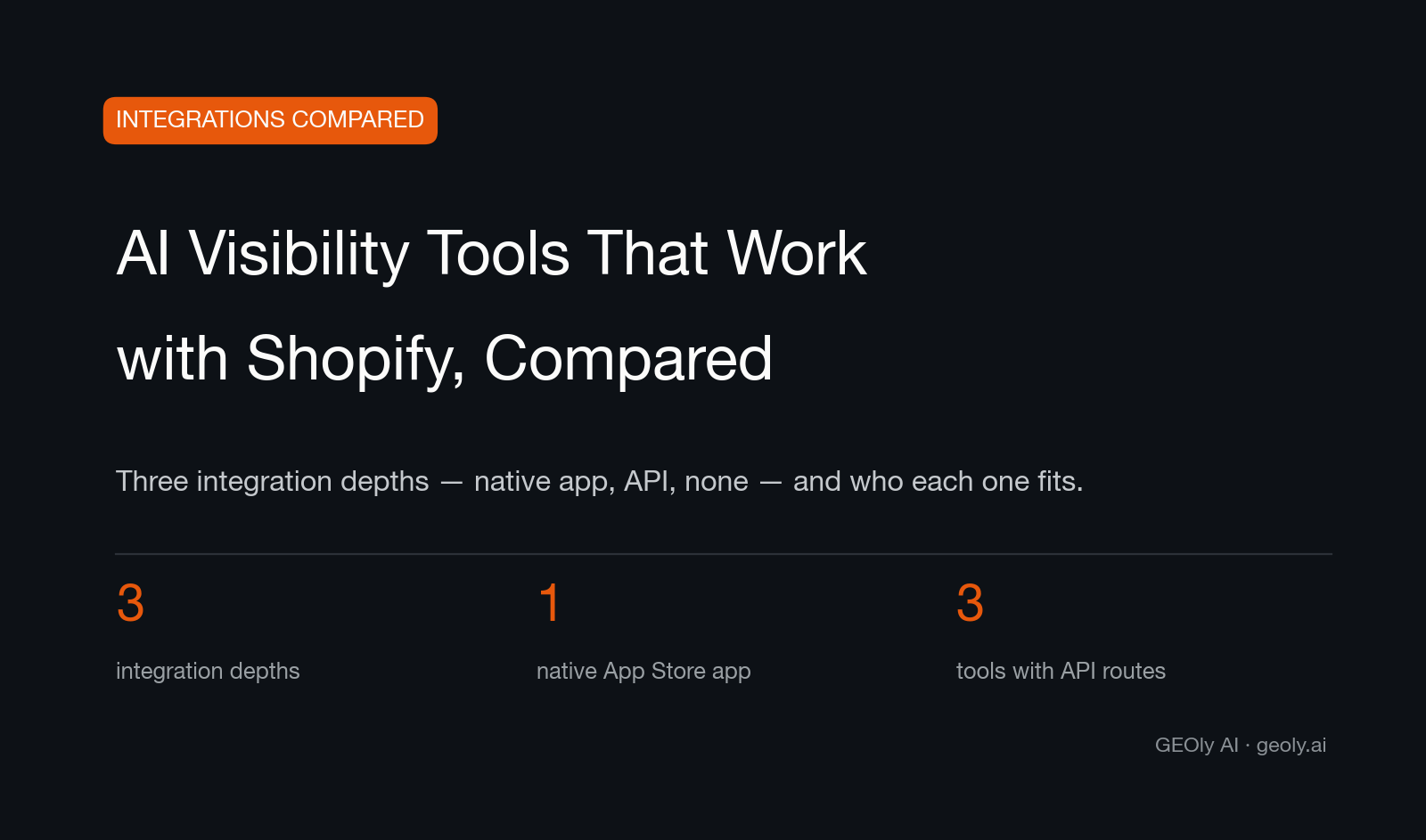
AI visibility tools connect to Shopify at three depths, and the depth decides more than the logo does. Tier one is a native App Store app — currently a category of one, GEOly. Tier two is self-service integration: tools like Otterly.AI, Peec AI and Scrunch AI expose APIs, connectors or middleware you wire up yourself. Tier three is no integration at all: suite monitors like Semrush and Ahrefs that watch your domain from outside. This comparison walks the three tiers, what each buys, and which team each fits.
Key takeaways
- Sort tools by integration depth before comparing features: native app, self-service API, or no integration. Each tier trades money against engineering time and data resolution.
- GEOly is the only AI visibility tool with a native Shopify App Store app; it is also the only one whose data resolves to catalog SKUs and product cards. Disclosure: GEOly is our product.
- Tier two runs $29 to $250/month (Otterly.AI, Peec AI, Scrunch AI) and assumes an engineer; you get answer data in your dashboards, not catalog awareness.
- Tier three (Semrush $99 toolkit, Ahrefs Brand Radar from $199 per index) is credible outside-in monitoring — right when a suite already anchors your stack.
- Integration depth matters because 88.8% of ChatGPT shopping answers carry product cards; only store-aware tools can tie those cards back to your SKUs and domain.
Why depth, not features, is the sorting key
Feature lists converge — every vendor now claims mentions, citations and sentiment. What does not converge is where the tool sits relative to your store. A tool inside your store reads the catalog and attributes product cards to your domain. A tool connected by API moves answer data to you but knows nothing about your SKUs. A tool outside watches your domain like any other. Since the AI shopping shelf is card-driven (88.8% of ChatGPT shopping answers carry cards, and 14% of brand mentions have no buyable card at all), that positioning determines which questions a tool can even answer.

Tier one: native App Store app
One tool lives here. Disclosure: GEOly is our product.
GEOly AI on the Shopify App Store installs in one click and connects the catalog directly: products, prices and availability sync automatically, visibility data resolves to individual SKUs, and product cards in ChatGPT and Google AI Mode get attributed to your domain versus retailers. It tracks Share of Model and Share of Card, fan-out queries, citation sources and ChatGPT ads via the GEM dataset, and it is free to start — no engineering hours anywhere in that sentence.

Who this tier fits: merchants without spare developer time, and any brand that needs shelf data, since card tracking does not exist in the other tiers. Honest limitation: GEOly is not a classic SEO suite — no rank tracking, no backlink index — so it pairs with Semrush or Ahrefs rather than replacing them. If your real question is what the integration mechanically does after install, the integration explainer walks the full data flow and the three-step setup.
Tier two: APIs, connectors and middleware
Three credible tools sit here, each with a different plug.
Otterly.AI ($29/month Lite, $189 Standard) ships an MCP server and REST API; an engineer can pull daily prompt results into your own reporting, and the Standard tier's GEO Audit checks 25+ on-page factors. Note that Gemini and Google AI Mode are paid add-ons. Peec AI (from about €75/month for 25 prompts) offers a Looker Studio connector — the fastest path if your reporting already lives in Google's stack, with multi-country tracking at no extra cost. Scrunch AI ($250/month Core, 125 prompts) is the deepest and heaviest: its AXP middleware sits between your storefront and AI crawlers, shaping what bots receive — closer to infrastructure than to a connector, and it needs engineering buy-in to match.
What this tier buys: answer-level data flowing into systems you control. What it does not buy: catalog awareness. Nothing in these pipes knows your SKUs, so card attribution and product-level analysis remain a build. Who it fits: teams with an engineer and existing BI, especially agencies reporting across clients.
Tier three: no integration, outside-in
Semrush's AI Visibility Toolkit ($99/month, 50 prompts on Starter) tracks brand visibility and sentiment across ChatGPT and Google's AI surfaces from outside, with prompt research on top of its keyword data. Ahrefs Brand Radar (from $199/month per AI index, $699 for all six) models visibility from a 260M+ monthly prompt corpus — market-level answers with zero setup.
Neither touches your store, and neither claims to. That is fine for the questions this tier answers: how visible is my brand versus competitors, which sources do engines cite, is my category shifting. It cannot say which product earned a card or where the card's traffic went. Who it fits: teams already anchored in one of these suites, and anyone whose AI visibility question is market-level rather than catalog-level. For what a monitoring stack should watch signal by signal, see the ecommerce monitoring tools guide.
Choosing your tier, and mixing two
Start from your constraint. No developer and a real catalog: tier one is the only depth that gives you SKU and card data, and it is free to test. Engineering capacity and an existing BI stack: tier two, with Otterly.AI as the cheap entry and Scrunch AI as the infrastructure play. Suite-anchored team measuring at market level: tier three, upgraded later if card data starts to matter. Mixes are normal — GEOly plus a Semrush toolkit is a common pairing precisely because the tiers answer different questions. If you would rather see the same tools ranked head-to-head on Shopify fit, that is the merchants roundup; more comparisons from the GEOly AI team live under the AI visibility tag.
FAQ
Does Semrush have a Shopify integration?
No. The Semrush AI Visibility Toolkit ($99/month) monitors your brand across ChatGPT and Google's AI surfaces from outside — there is no App Store app, no catalog sync and no product-card tracking. It remains a sensible add-on if Semrush already anchors your SEO stack.
What is the only AI visibility tool with a native Shopify app?
GEOly, as of July 2026 — one-click install from the Shopify App Store, catalog sync, SKU-level visibility and Share of Card tracking, free to start. Disclosure: GEOly is our product; for rankings and backlinks you will still want a classic suite alongside it.
Can I connect Otterly.AI to my Shopify store?
Not natively. Otterly.AI provides an MCP server and REST API, so a developer can route its answer data into your dashboards — but the integration is yours to build, and it will not know your catalog. Budget engineering time accordingly.
Do I need any integration to track AI visibility?
For market-level questions, no — tier-three tools answer them from outside. For commerce questions you do: 88.8% of ChatGPT shopping answers carry product cards, and connecting cards to your SKUs and your domain requires a tool that can see inside the store.


