Produced by GEOly AI
Data: 1.6 million ChatGPT shopping cards and 3.07 million in-card offers monitored in AI answers
Market: United States
Window: 2026-05-22 to 2026-06-26
---
AI Recommended You, But the Transaction Went Somewhere Else
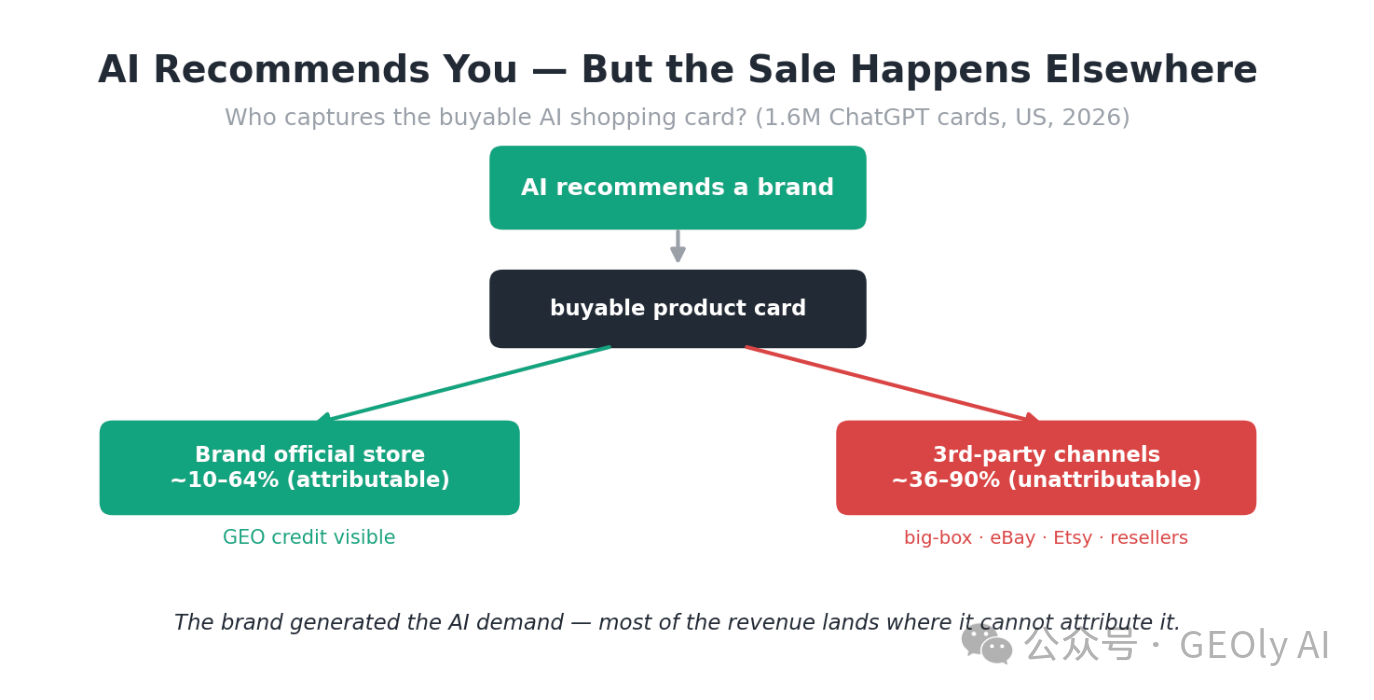
When AI recommends a brand and shows a purchasable shopping card, where does the buy button actually send the user?
Does it lead to the brand's own website?
Or does it lead to Walmart, Best Buy, Amazon, a marketplace seller, or another retailer?
This question is becoming central to GEO, or Generative Engine Optimization. In the search era, brands could evaluate SEO value through impressions, clicks, rankings, and revenue attribution. In the AI answer era, the user may see the brand in an answer, be influenced by that answer, and then click a product card whose traffic and transaction are captured by a third-party channel.
That means the brand may be winning attention and demand in AI, while losing the measurable conversion signal.
GEOly AI analyzed 1.6 million ChatGPT shopping cards and 3.07 million in-card offers in the U.S. market to understand this new traffic leakage problem.

1. The Key Problem: AI Visibility and Transaction Attribution Are Splitting Apart
AI answers are no longer only informational. They are becoming transactional shelves.
A brand can be recommended in the natural answer, appear in a product card, and still lose the click to a retailer or marketplace. The consumer believes they are buying the recommended brand, but the traffic is routed through another commercial node.
For DTC brands, this creates three problems:
- Brand demand is created by AI, but revenue may be attributed to another channel.
- Owned-site conversion looks weaker than the real AI-driven demand.
- GEO ROI is underestimated because the transaction does not always happen on the brand's domain.
In other words, AI may be lifting your brand, but your analytics stack may not see the full value.
2. Product Cards Are Becoming the New Purchase Gate
ChatGPT shopping cards often include title, image, price, rating, merchant, and buy link. This link is the new gate between AI recommendation and purchase.
From a brand perspective, the important question is not only whether the brand is mentioned. It is whether the product card sends users to a brand-owned destination or to a third-party destination.
If the card sends users to Amazon or Walmart, the brand may still capture sales, but it loses first-party traffic, direct customer data, attribution clarity, and margin control.
If the card sends users to a competitor reseller or unrelated merchant, the risk is even higher. The brand may have generated the intent, while another seller captures the user.

3. Why GEO Value Is Being Underestimated
Many teams still measure AI value using website sessions and referral traffic. That misses a large part of the impact.
AI can influence the buyer before the click. It can recommend the brand, compare alternatives, explain product fit, shape trust, and then push the user into a shopping card. If that final click goes to a marketplace, the brand's analytics may classify the purchase as marketplace revenue rather than AI-driven demand.
This is why GEO value is often severely underestimated.
Brands need to separate three layers:
- AI answer visibility: whether the brand is mentioned or recommended.
- AI product-card visibility: whether products appear in commercial cards.
- Product-card destination control: where the final buy link points.
Only by measuring all three can a brand understand the true value of AI search.
4. The New Leakage Pattern
Traffic leakage usually appears in several forms:
- The brand is recommended, but the card links to a retailer.
- The product is shown, but the merchant is not the brand.
- The card uses a generic marketplace listing rather than an official product page.
- Price or stock data comes from a third-party channel.
- The brand's own site is missing even when the brand is strongly recommended.
This creates a new type of distribution risk. In the Google era, brands competed for blue links and shopping ads. In the AI era, brands compete for answer inclusion, product-card inclusion, and destination ownership.
5. What Brands Should Do
First, audit AI shopping-card destinations. For priority products and high-intent topics, check whether ChatGPT and other AI platforms send users to your owned site, marketplaces, or retailers.
Second, strengthen machine-readable product data. Product titles, descriptions, images, prices, availability, structured data, feeds, and merchant profiles all affect how AI systems understand product cards.
Third, align GEO with channel strategy. If marketplaces are important, brands should not treat third-party cards as purely bad. But they must know when marketplace traffic is incremental and when it is cannibalizing owned demand.
Fourth, measure AI-influenced revenue beyond referral traffic. GEO dashboards should combine answer visibility, card visibility, merchant destination, share of card, and channel-level sell-through.
Fifth, defend official product pages. The brand-owned product page should be the clearest, most complete, most machine-readable destination for AI systems.
6. Strategic Takeaway
AI shopping is making the path from recommendation to purchase shorter, but also less visible to the brand.
The brands that win GEO will not only ask, "Does AI mention us?" They will ask:
- Are we shown in product cards?
- Which merchant captures the click?
- Does the product-card data represent us correctly?
- Are we losing direct traffic to marketplaces or retailers?
- How much AI-driven demand is hidden inside third-party channel revenue?
GEO is not just a visibility metric. It is becoming a distribution and attribution problem.
In the AI commerce era, controlling the answer is only the first step. Brands also need to control the card, the destination, and the measurement model.