Produced by GEOly AI
Data basis: AI answer monitoring data as of June 2026
Research date: June 2026
When you ask ChatGPT or Google AI Mode a shopping question such as:
best robot vacuum
The answer may show product cards with titles, prices, ratings, images, and buy links.
But where does that product data actually come from?
Is it the merchant's website?
Google Shopping?
Shopify Catalog?
Marketplace listings?
Or a mixture of all of them?
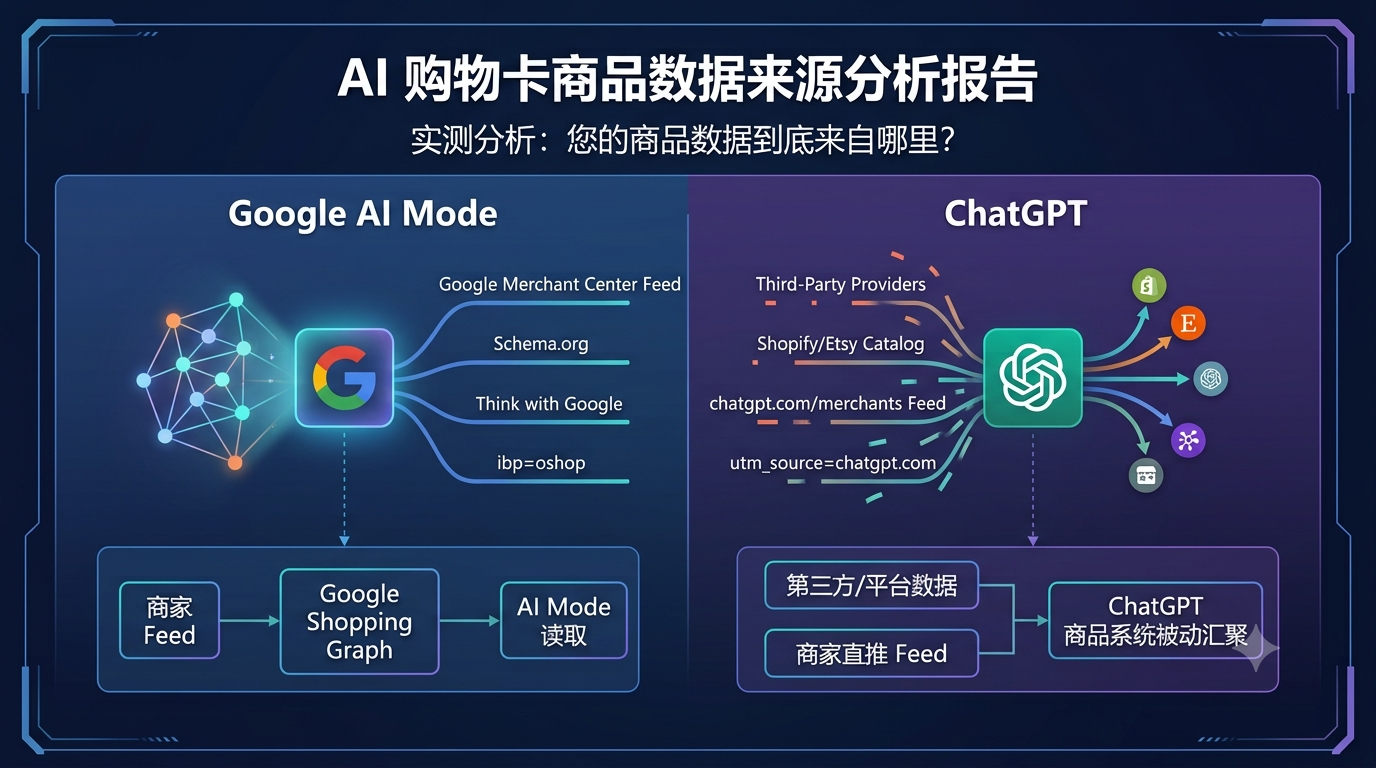
GEOly AI ran a large-scale comparison of ChatGPT and Google AI Mode to understand how AI shopping cards are assembled and what that means for merchants.

1. AI Shopping Cards Are Becoming the New Product Shelf
In traditional search, product discovery was separated across organic results, Shopping ads, and marketplace search. In AI answers, the shelf is compressed into the answer itself.
A user asks a question. AI interprets intent. The answer summarizes recommendations. Product cards appear as the commercial layer.
This makes the underlying data source extremely important. If the AI system cannot read, trust, or match a merchant's product data, the product may never appear in the card layer even if the brand is relevant.
2. ChatGPT and Google AI Mode Have Different Data Gravity
Google AI Mode naturally has strong access to Google's product ecosystem, including Shopping Graph, Merchant Center, structured product data, and indexed merchant pages.
ChatGPT appears to rely on a broader mix of sources. Depending on the query and product category, it may use merchant pages, marketplace pages, reviews, product feeds, public product data, and other web signals.
This means the optimization playbook cannot be one-size-fits-all.
For Google AI Mode, merchants should prioritize Merchant Center quality, structured data, feed accuracy, pricing, availability, product variants, and canonical product pages.
For ChatGPT, merchants need broader GEO readiness: machine-readable pages, clear product attributes, trusted reviews, consistent product naming, category relevance, and high-quality third-party references.
3. The Merchant Site Is Necessary but Not Sufficient
A well-structured product page remains important. It should include clear product titles, high-quality images, price, availability, SKU or variant structure, use cases, specs, shipping, returns, reviews, FAQ, and schema markup.
But AI shopping cards may not rely only on the merchant site. If marketplaces, reviews, or shopping feeds provide stronger or cleaner data, AI may use those instead.
That creates a new requirement: consistency across the entire product data ecosystem.
If your Shopify product page says one thing, your marketplace listing says another, and review sites describe the product differently, AI may produce inconsistent cards or choose a third-party destination.
4. Product Feeds Are Becoming GEO Infrastructure
For ecommerce teams, product feeds used to be mainly a paid media or marketplace operations asset. In the AI shopping era, feeds become GEO infrastructure.
The feed should be accurate, complete, and aligned with product pages. Important fields include:
- Product title
- Brand
- Category
- Price
- Availability
- Description
- Images
- Variants
- GTIN or other identifiers
- Shipping information
- Return policy
- Ratings and review signals where applicable
Structured product data helps AI match user intent to the right product. It also reduces ambiguity when different merchants carry the same or similar items.
5. ChatGPT Requires Source Diversity
ChatGPT-style shopping answers often benefit from a wider source environment. A product is more likely to be understood when AI can triangulate it through official pages, review content, marketplace listings, community discussions, and reputable buying guides.
This does not mean brands should spray content everywhere. It means the product story should be consistent and easy to quote across sources.
For example, a robot vacuum brand should make clear which model is best for pet hair, which is best for mopping, which is best for apartments, what the real suction and navigation advantages are, and how it compares with competitors.
AI needs structured evidence, not vague marketing claims.
6. Google AI Mode Requires Feed and Merchant Discipline
For Google AI Mode, the connection to Google's commerce infrastructure makes operational hygiene especially important.
Merchants should review Merchant Center diagnostics, fix product disapprovals, improve feed coverage, align landing pages with feed data, keep inventory fresh, and ensure structured data matches visible page content.
Google's AI shopping layer is likely to reward products that are easy to match, available, compliant, and supported by clean shopping data.
7. Strategic Recommendations for Merchants
First, audit whether your priority products appear in AI shopping cards for high-intent queries.
Second, compare the card's data with your official product data. Check title, image, price, rating, merchant, and destination.
Third, strengthen product-page structure. Add specs, use cases, comparison points, FAQs, review summaries, and schema markup.
Fourth, improve feed quality and keep it synchronized with the website.
Fifth, monitor third-party sources. Marketplaces and review pages can influence how AI interprets your products.
Sixth, build content that maps products to real user intents: best for commuters, best for pet owners, best budget option, best premium option, best for beginners, and so on.
Final Takeaway
AI shopping cards are not random UI elements. They are the visible result of product data, source trust, feed quality, merchant reputation, and query intent.
For merchants, the question is no longer only "Can Google index my product page?" It is:
Can AI understand my product, trust the data, match it to user intent, and send the buyer to the right destination?
That is the new product-data challenge in GEO.