← All AI & LLM visibility trackers
ChatGPTAI visibility trackerStandard engine · coverage depends on your plan

ChatGPT visibility tracker

Know where your brand appears. Know what to do next.

Ask ChatGPT the questions your buyers ask, on a schedule, and see which brands it names, in what order, and which pages it cites as evidence.

3-day trial on Basic, no card required. Grow has a 3-day trial with a card on file.

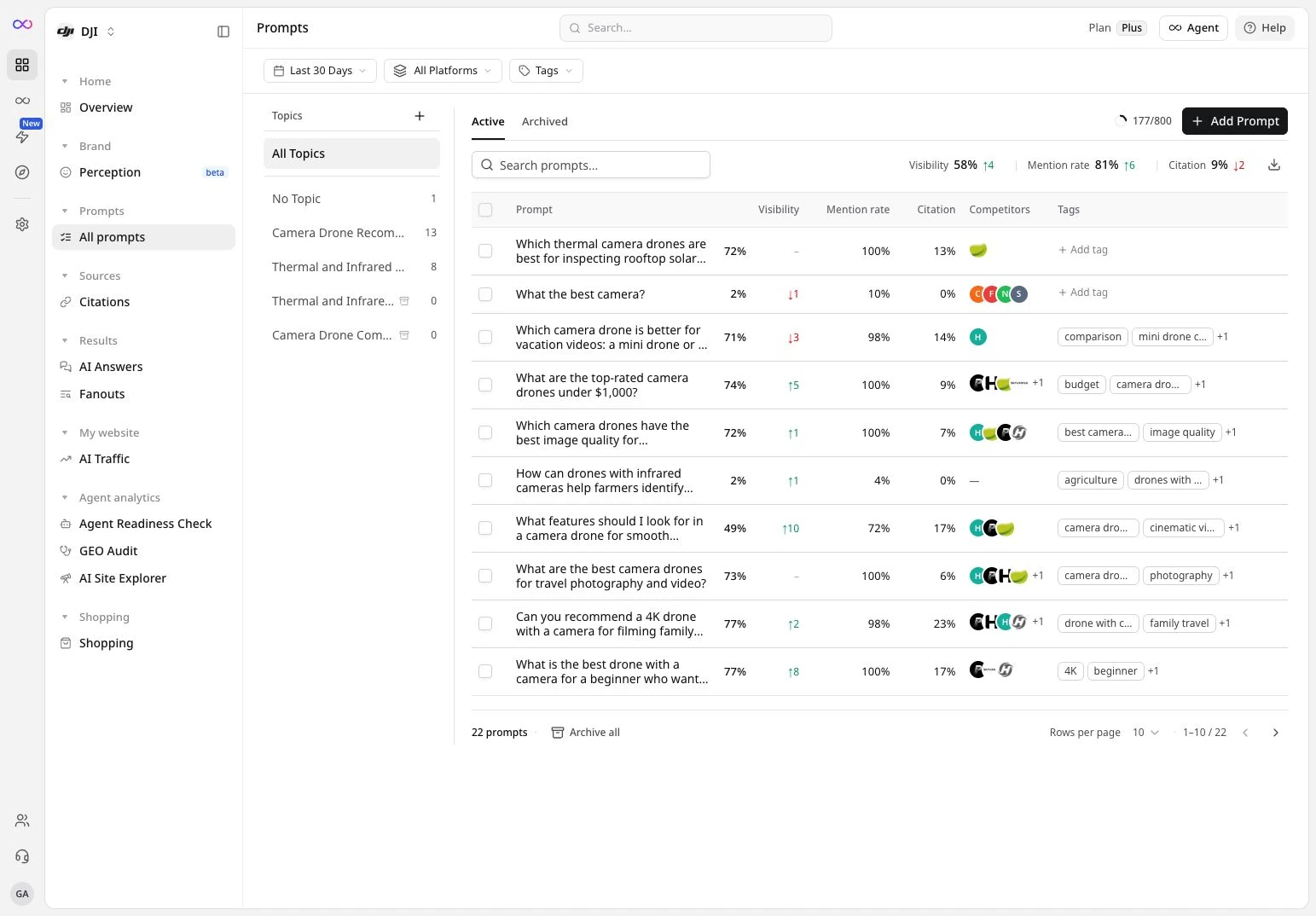
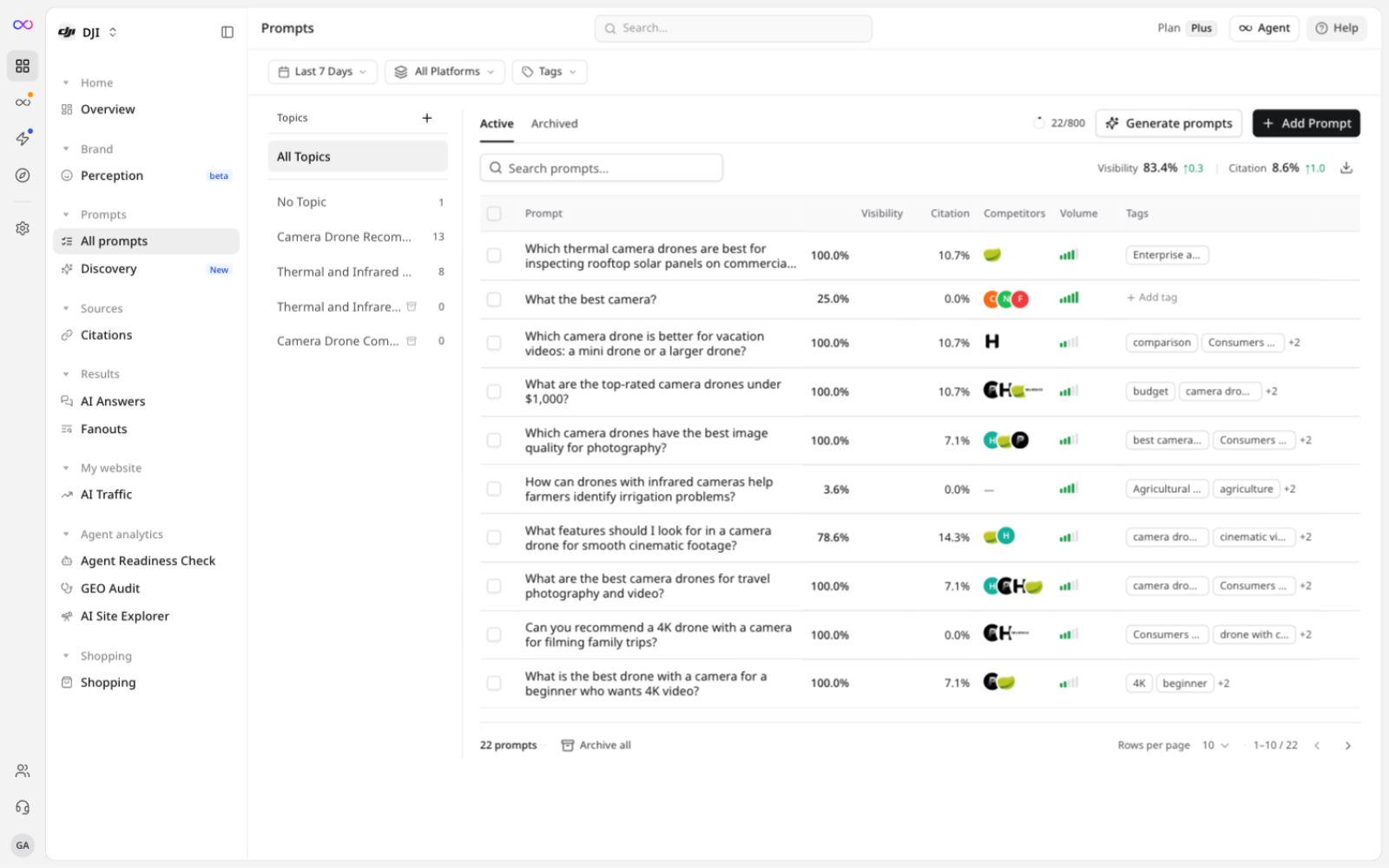
GEOly monitoring interface showing tracked prompts, brand mention rates and citation rates
GEOly monitoring interface · example account, not a forecast of your results

ChatGPT

Why measure ChatGPT on its own

  • Buyer questions grouped by intent
  • Brand mentions and citation evidence
  • Competitor context across the same answer set

ChatGPT answers product and brand questions in prose: measure whether you are named, how early, and how you are described separately from traditional search rankings. One answer is an anecdote. A tracked prompt set across markets is a measurement.

When ChatGPT searches the web it shows its sources. Tracking which domains it cites tells you which publishers, retailers and review sites shape the answer in your category, and whether your own pages are among them.

ChatGPT also renders shopping product cards for commerce queries, so the same prompts show whose products appear on the AI shelf (Share of Card), not only whose brand is mentioned.

ChatGPT visibility tracking: what to record on every check

A ChatGPT visibility tracker measures how often your brand appears in a defined set of answers and preserves the evidence behind the result. To check brand visibility yourself, begin with the same unbranded buyer questions, record complete answers and sources, then repeat under comparable conditions. A single chat cannot establish your market-wide visibility.

RecordHow to capture itWhy it matters
Question and intentKeep the exact wording and label discovery, comparison or purchase constraints. Separate branded prompts.Avoid improving the score merely by asking more questions that already name you.
Run conditionsDate, market, language, model or mode when shown, search use and personalization settings.A different mode or personalized session can change the answer.
Presence and recommendationRecord yes/no separately; save the relevant sentence and listed competitors.Being criticized or mentioned in passing is different from being recommended.
CitationsRecord exact visible URLs and whether they belong to your domain. Mark unavailable sources explicitly.A citation without a recommendation is a different opportunity.
Review and next actionLink the saved answer, specify the page to inspect, assign an owner and schedule another check.A score becomes useful when it changes a content decision.

Use manual checks to validate wording and investigate a small set of questions. Use scheduled tracking when you need a repeatable history across prompts and competitors. Review raw answers in either method, and document scope differences before comparing manual checks with automated results.

Download the ChatGPT visibility check sheet (CSV)

Blank column template for your spreadsheet tool. Enter actual observations; no sample results or automatic formulas are included.

Work through the process with a DJI demo project

Follow prompts, answers and citations through to fact checking and content experiments. Captured November 29, 2026. This educational example does not establish a DJI customer relationship or optimization results. The screenshot shows project-level data, not results for a single engine.

DJI demo project in the current GEOly English interface; open the complete GEO guideRead the full GEO guide and 30-day plan

How to check brand visibility in ChatGPT

  1. Build a buyer prompt set

    Start with category discovery, comparisons and purchase constraints. Example prompts: “Which air purifiers suit a small bedroom?”, “What should I compare before buying an air purifier?” and “Which models have replacement filters available in the US?” Keep questions that name your brand in a separate group; they test brand knowledge rather than unaided discovery.

  2. Record the conditions and the full answer

    For a manual check, use separate conversations and record the date, model or mode, country, language, search usage and personalization settings. Memory can affect responses. Save the full answer and any visible citations. Repeat the fixed set on a consistent schedule; one favorable answer is not a reliable visibility score.

  3. Score presence, recommendation and citations separately

    Record whether the brand is named, whether it is recommended or criticized, its order among named brands, and whether your domain is cited. Calculate mention rate as answers naming the brand divided by valid answers. A cited URL without a brand recommendation and a recommendation without a citation are different outcomes.

  4. Turn ChatGPT visibility tracking into a next step

    Illustrative workflow: the answer names competitors but omits your product, while a cited review compares filter costs. Verify your replacement-filter cost and availability, make those facts clear on the product page, and investigate whether the review is outdated. Log the change and rerun the same prompts. GEOly keeps scheduled answers and citations together so your team can inspect the evidence over time.

OpenAI: Searching the web with ChatGPT

OpenAI: Memory in ChatGPT

Read the signal. Choose the right action.

Mentions, citations and visits answer different questions. Keep them separate before deciding what to optimize.

Read the signal. Choose the right action.
SignalWhat it tells youWhat to do with it
Brand mentionsWhether the brand is named in the sampled answers.Find missing buying intents; inspect how the brand is described.
Citation RateThe share of tracked answers citing your own domain.Inspect the cited URLs and the facts your pages need to support.
Share of ModelYour share of brand mentions within the same answer set.Compare the competitors actually named, using a stable prompt set.
Sentiment & answer positionThe wording around a brand and its order in the answer.Read the original context before interpreting a positive or negative label.
Referral visitsAttributed website sessions in your analytics.Evaluate landing pages and key events separately from AI visibility.

Start with better questions.

Choose a business type and build a small prompt set you can copy into your research workflow. These are editable examples—not live engine results or measured search demand.

Example prompt set

Replace placeholders and select your target country and language in your tracking workflow. The starter runs in your browser; it does not query an AI engine.

  1. 01

    Which wireless headphones brands should a first-time buyer consider?

  2. 02

    Which wireless headphones options are worth comparing at different budgets?

  3. 03

    How does [your brand] compare with other wireless headphones options?

  4. 04

    What should I verify before choosing [your brand]?

  5. 05

    Which reliable sources support the claims about [your brand]?

  6. 06

    When should I choose an alternative to [your brand]?

ChatGPT / Your workflow

From an answer to your next content decision.

01

Win the shortlist

Inspect

Track unbranded buying questions. Read which brands appear, in what order, and whether your category is understood correctly.

Act

Build a useful category comparison around actual buyer constraints. Make the differences between your product and the alternatives explicit.

Keep the evidence: Answer text · named brands · prompt intent

02

Earn the source link

Inspect

Separate a brand mention from a citation to your domain. Inspect which product pages, reviews or publishers support the answer.

Act

Improve the specific page that answers the missing question. Keep specifications, warranty terms and comparisons consistent.

Keep the evidence: Cited URL · source domain · surrounding claim

03

Follow the shopping journey

Inspect

For commerce prompts that produce shopping cards, inspect products and merchants separately from text mentions.

Act

Check product identity, availability and merchant links. A recommendation for your brand does not guarantee a click to your store.

Keep the evidence: Product card · retailer destination · dated observation

Your first measurement cycle

  1. 01

    Set the baseline

    Choose one market and a focused set of discovery, comparison and validation questions. Save the prompt list before measuring.

  2. 02

    Read the evidence

    Inspect missing mentions, citation gaps and inaccurate claims. Prioritize by relevance to a real customer decision.

  3. 03

    Change one useful thing

    Improve a specific page or source. Record what changed and when, then compare equivalent observation windows.

Choose the coverage you actually need.

Start with one standard engine or compare several on the same prompt set. See current plans for prompt quotas, history, exports and integrations.

ChatGPT is available on every GEOly plan: Basic ($49/month) lets you pick 1 of the 4 engines and Grow ($149/month) 2, while Advanced ($399/month) and Plus include all four. Basic comes with a 3-day free trial, no card required; Grow has a 3-day trial with a card on file.

3-day trial on Basic, no card required. Grow has a 3-day trial with a card on file.

See plans

Before you start tracking

How can I check brand visibility in ChatGPT manually?

Use a fixed set of buyer questions in separate conversations. Record the model or mode, market, language, search usage and personalization settings. Save full answers and citations, then count how many valid answers name your brand. Repeat on a consistent schedule and keep branded questions separate from non-branded discovery questions.

Can I see whether ChatGPT recommends my brand?

Yes. GEOly runs your tracked prompts in ChatGPT and records whether your brand is named, its position among the brands in the answer, the sentiment of the wording, and which sources were cited. You can open every raw answer behind the numbers.

Is ChatGPT tracking different from SEO rank tracking?

Yes. A rank tracker reports the position of a URL on a results page. ChatGPT answers can include links and sources; GEOly measures brand presence and share inside the answer (mention rate, position, Share of Model) and, separately, whether your domain is cited as a source (Citation Rate).

Does tracking guarantee AI recommendations?

No. Monitoring helps you identify gaps and inspect changes. It does not control an engine’s answers or guarantee citations, rankings or traffic growth.

Does the prompt starter query an AI engine live?

No. It builds research questions in your browser from your inputs. It does not run collection or show measured demand. Actual monitoring is configured separately.

How should I compare results over time?

Use the same prompt set, engine, market and language across equivalent windows. Inspect valid observation counts and raw answers, and annotate any collection or product-configuration changes.

Is AI visibility the same as website traffic?

No. A brand can be mentioned or cited without receiving a click. Use answer records to assess visibility and GA4 or your own analytics to assess visits and conversions.

Which GEOly plans include ChatGPT?

ChatGPT is available on every GEOly plan: Basic ($49/month) lets you pick 1 of the 4 engines and Grow ($149/month) 2, while Advanced ($399/month) and Plus include all four. Basic comes with a 3-day free trial, no card required; Grow has a 3-day trial with a card on file. Prices are in USD, billed monthly; see /pricing for the current per-plan list.

Keep learning

ChatGPT · related reading

From platform behavior to brand action. Articles are ordered by publication date; check official references and current plans for changes since publication.

Browse all articles

Shared methods · across platforms

DJI demo: from monitoring evidence to a 30-day content plan

Learn prompt grouping, citation review, task planning and retesting. An educational example, not a customer endorsement or verified growth result.

Go deeper, when you need to.

Explore all platforms and coverage

Explore another engine

Make your next visibility decision with evidence.

Start with the questions your customers ask. Follow the answers back to the pages that shape them.

3-day trial on Basic, no card required. Grow has a 3-day trial with a card on file.

Trusted by leading consumer brands

Anker
eufy
soundcore
PLAUD
xTool
Ulike
Jackery
Roborock
Dreame
DREO
Insta360
TCL
Beatbot
CASETiFY
Creality
Shokz
Segway
realme

12,000+ brands track & win AI search with GEOly

From Anker to xTool — the brands above already see how ChatGPT, Gemini and Google AI mention, cite and recommend them. Your brand is being talked about in AI right now. See it.

See Your Brand in AI — Free

3-day free trial · No card required