Start with the business decision GEO should support
Generative engine optimization is the work of making brand information easier for AI search to discover, interpret accurately and cite, while helping people make their next decision. For a growth team, “Did ChatGPT mention us?” is only the beginning. Which buying questions surface the brand? Why is it recommended? Which evidence supports the answer? Can readers reach a useful next step?
This guide follows six stages: define buying scenarios and prompts; establish a comparable baseline; inspect answers and citations; investigate searches and perceptions; improve content and evidence; then repeat the measurement and connect it to business outcomes. GEOly supplies monitoring and diagnostic evidence. Editorial judgment, product fact checking and outcome validation remain team responsibilities.
GEO shares its technical and content foundation with SEO. Google says AI Overviews and AI Mode do not require special additional optimization. Keep important content accessible as text, make useful pages discoverable through internal links, and ensure structured data matches the visible page. None of these steps guarantees a citation.
| Layer | Question | Evidence |
|---|---|---|
| Discovery | Do we appear in relevant buying questions? | Prompts, valid answers and mentions |
| Understanding | Are models, use cases and limits described correctly? | Full answers, aspects and official facts |
| Citation | Does AI cite the right page on our site? | Domains, URLs and citation context |
| Business impact | Do visitors start a trial, inquire or buy? | Connected analytics and conversion events |
Action: The deliverable is an evidence-backed action list. Mentions, answer positions and citations are intermediate signals, not orders.
Read the DJI sample: what does 83.4% visibility mean?
In Overview, select Last 7 Days, All Platforms, All topics and All Countries. Record the filters before interpreting the numbers. The November 23–29, 2026 window contains 616 answers; 514 mention DJI, producing 83.4% visibility. This describes coverage within this monitored answer set. It is not the probability that every AI user sees DJI, or its market share.
Overview also displays Share of Voice (SoV) of 51.9% and an average position of #1.0. Their denominators differ from mention rate. Do not add them together or treat answer position as an organic Google ranking. Preserve the product labels, filters and underlying records when reporting.
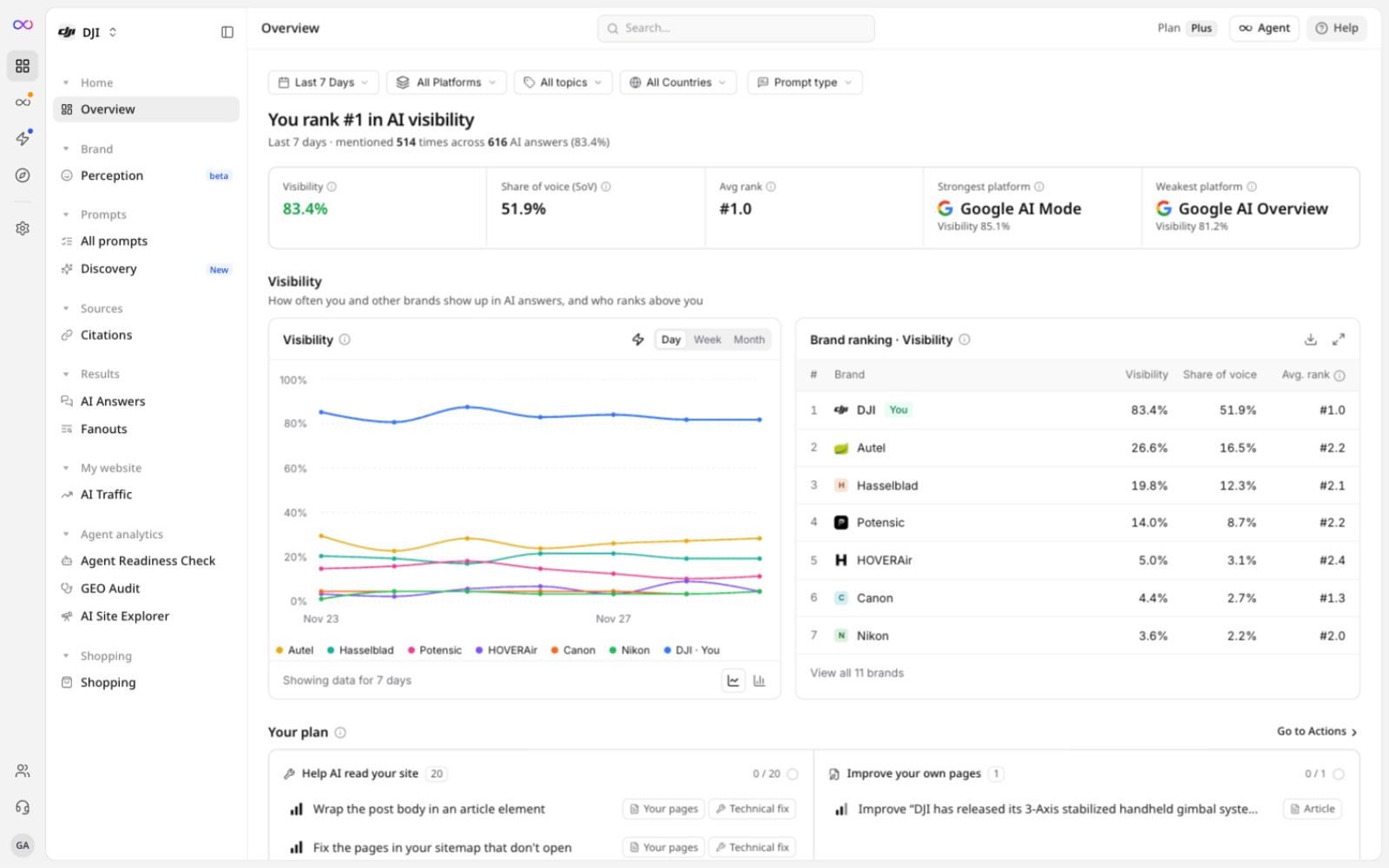
| Observation | What it describes | What it does not establish |
|---|---|---|
| 514 / 616 = 83.4% | Mentions within the selected answers | Worldwide AI search market share |
| 2.9% owned-domain citation share | dji.com share in the citation domain table | Consumer trust or a mention rate |
| 8.6% citation rate on Prompts | The rate displayed by that report | The same denominator as domain citation share |
| Today is still accumulating | A snapshot at capture time | A permanently fixed live dashboard |
Action: Save the date window, prompt-set version, platform, language, location and valid sample size with every baseline.
Build a prompt system around buying scenarios
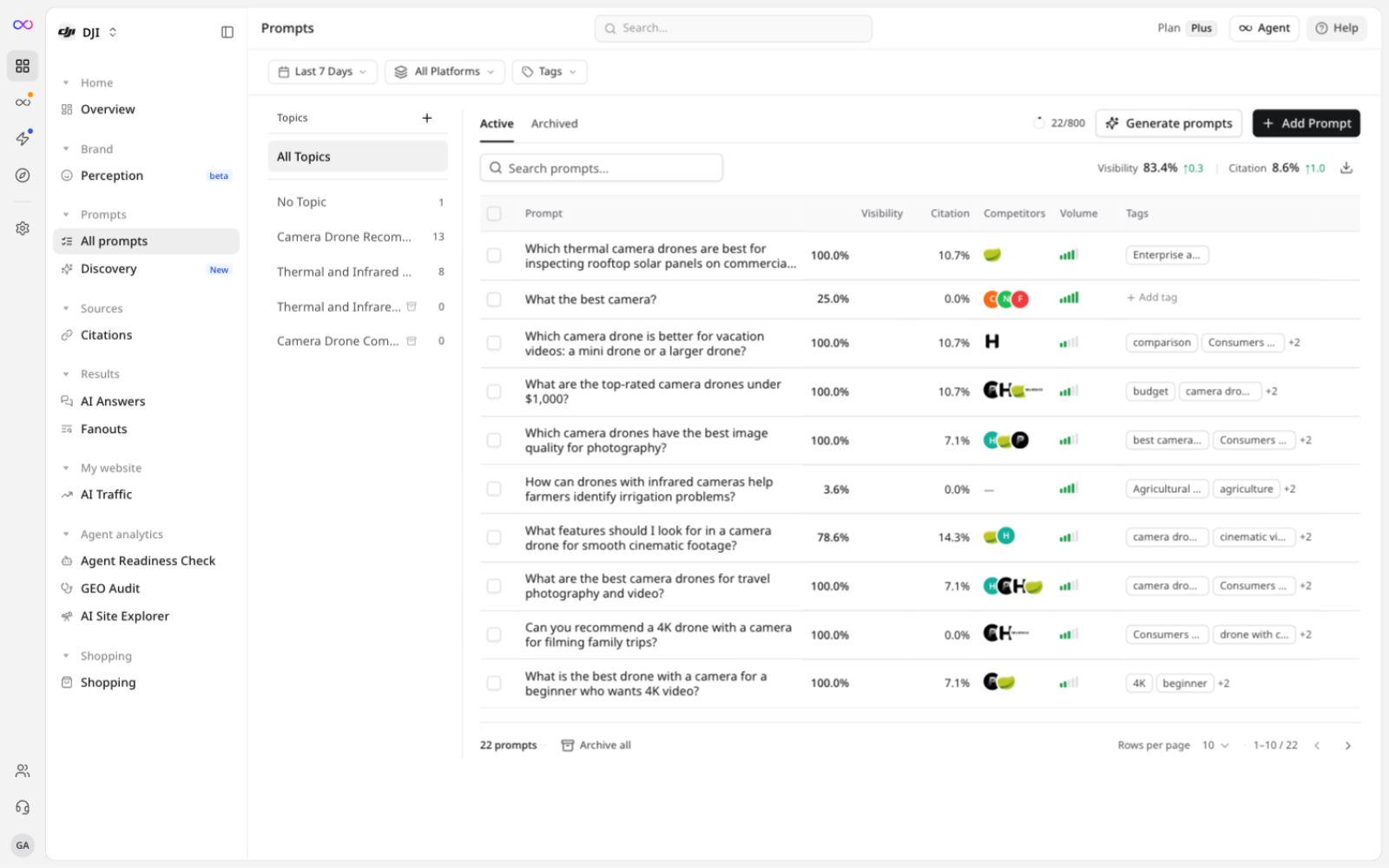
Open All prompts. This demo project has 22 active prompts: 13 in Camera Drone Recommendations, eight in Thermal and Infrared Drone Use Cases and one without a topic. The original questions are in English. A Chinese interface screenshot does not turn the underlying sample into Chinese-market research.
Audit relevance before interpreting performance. “What the best camera?” is broad enough to surface standalone cameras rather than drones. Weak performance on that question is not proof of a missing drone page. Separate exploratory questions from core buying scenarios and retain the original baseline when introducing a more specific test set. Do not delete weak prompts simply to improve the score.
| Stage | Example to test | Content destination |
|---|---|---|
| Discovery | Which kind of drone suits travel photography? | A guide organized by portability, image needs and budget |
| Capability | Are sub-250g drones sufficient for high-quality photos? | Testing conditions, sample images and limitations |
| Comparison | Mini drone or larger drone for vacation video? | A comparison with consistent criteria and trade-offs |
| Professional buying | Which thermal specifications matter for rooftop solar inspections? | A selection checklist, workflow and technical documentation |
| Verification | What are this model’s protection, compatibility and warranty terms? | Model- and region-specific official facts |
Keep a stable core set
Tag questions by scenario, buying stage, language and region. Separate branded fact-checking prompts from non-branded discovery prompts. Start with a set the team can maintain and expand it when business evidence supports the addition.
Map each prompt to a decision
Assign a destination page, an owner and a success criterion. A mini-versus-large comparison might first be evaluated for accurate recommendations and citations, then for visits and inquiries.
Action: Prompts are a sampling design. Build separate sets for distinct languages and buying intents instead of treating English observations as universal.
Trace every conclusion back to an AI answer
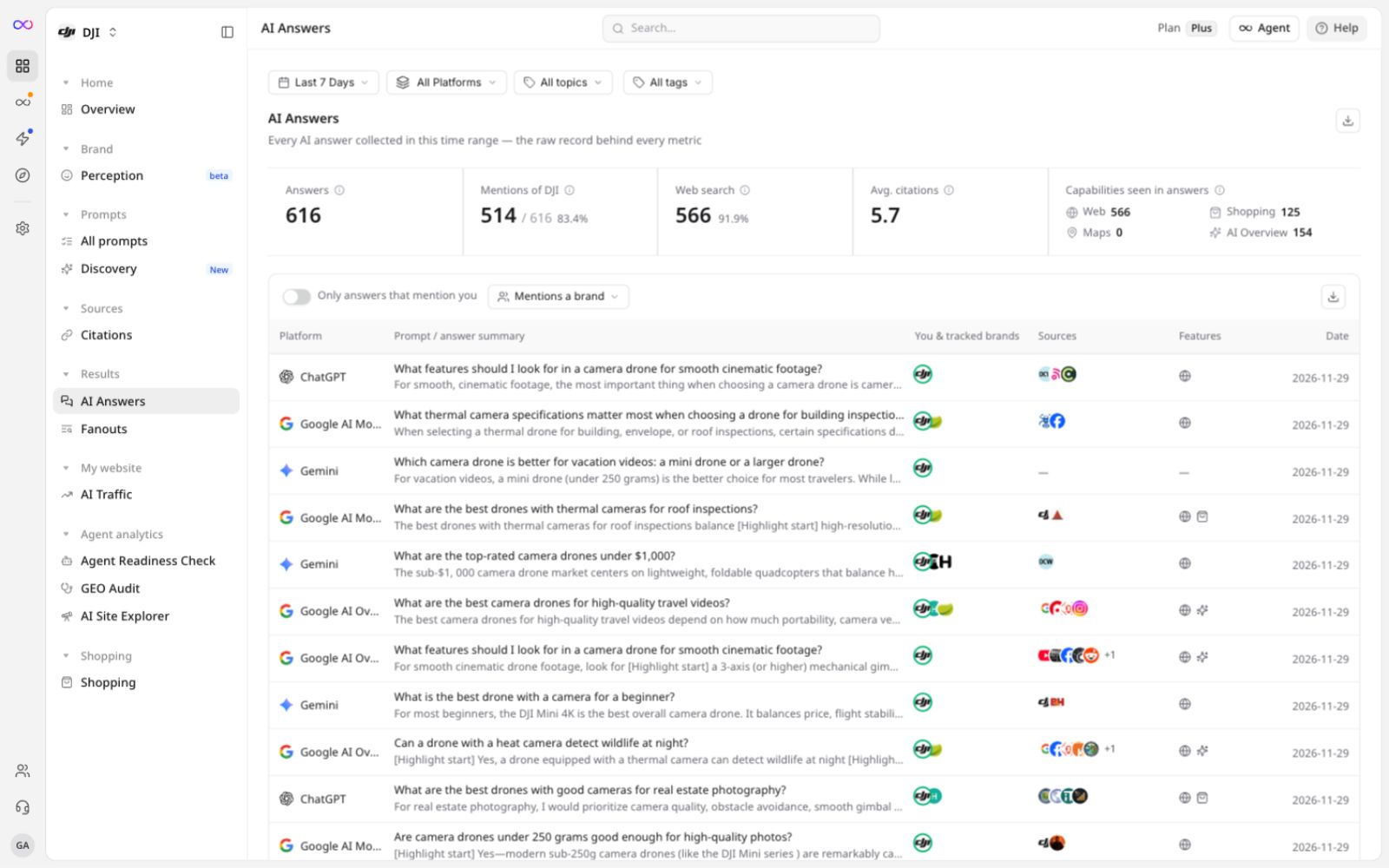
Open AI Answers with the same date window, then filter by platform or topic. The page preserves raw responses alongside brands, sources and observed features such as web search and shopping cards. Analyze ChatGPT, Gemini and Google AI Mode separately before explaining any aggregation.
Read favorable and unfavorable examples. For each priority topic, inspect answers that mention the brand, answers that omit it and answers containing disputed facts. Record the question, platform, date, full answer, cited URL and exact product model. A missing citation in one response does not establish that the platform never cites the site.
Check the decision context
Budget, region, use case and constraints change the comparison. Travel photography and commercial inspections need different criteria. Attributes of one DJI model cannot automatically be applied to the whole brand.
Classify the problem
No mention may indicate a mismatch or a better-fitting competitor. A mention without an owned citation suggests inspecting the available evidence page. An inaccurate answer with a citation requires checking whether the source actually supports the claim.
Keep the evidence
Save dated records or use an available export. If reviewing a manual sample, document how it was selected. A small hand-picked set should not be presented as the entire monitored population.
Action: Make each issue specific: a scenario, platform, answer, disputed fact and destination page.
Use citations to connect brand exposure to pages
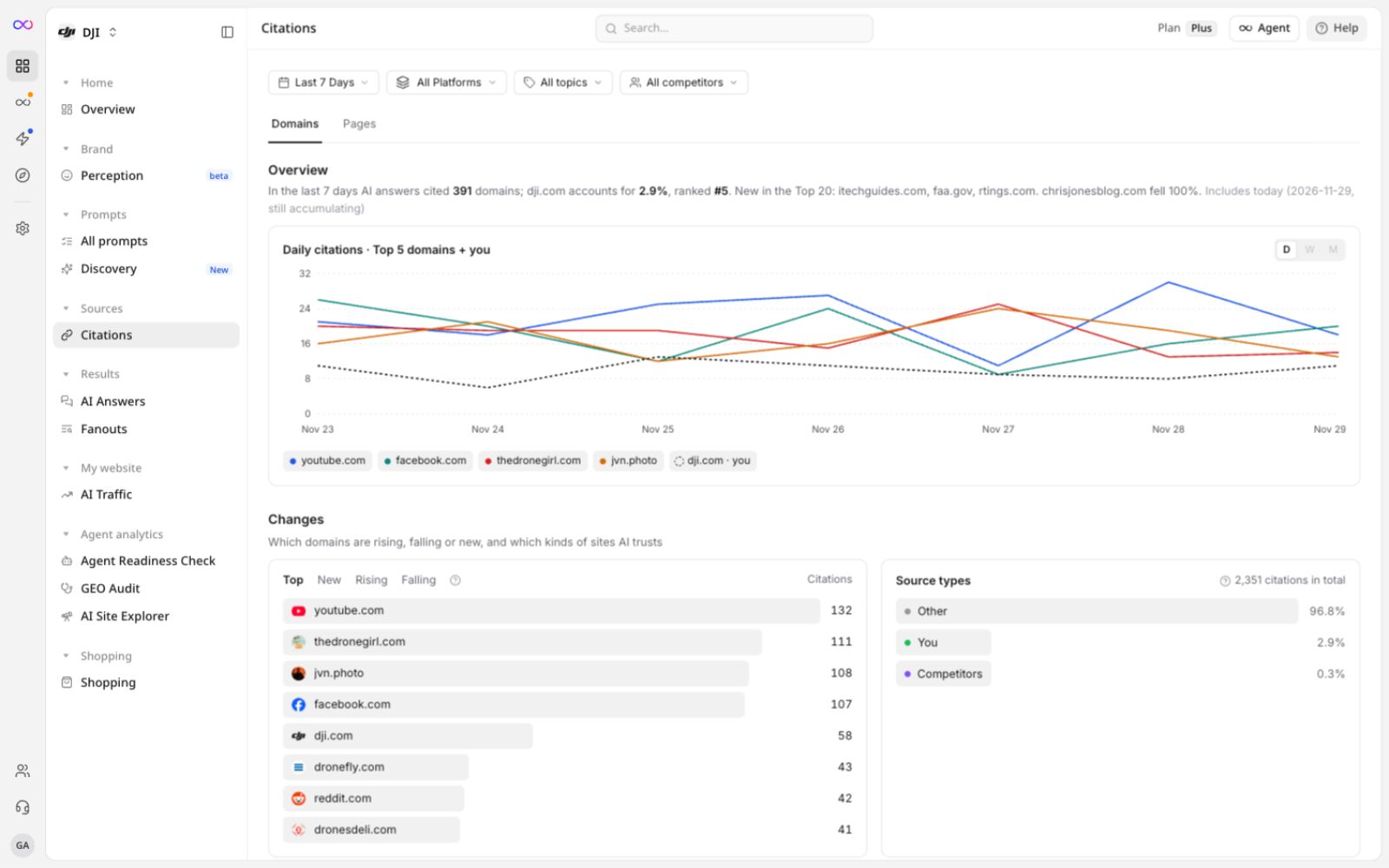
Open Citations, begin with Domains, then inspect Pages or a domain’s detail view. In the seven-day domain table, dji.com receives 69 citations out of 2,351, approximately 2.9%. Third-party domains include YouTube, Facebook, The Drone Girl, JVN Photo and Reddit.
Alongside 83.4% mention visibility, this suggests a hypothesis worth investigating: DJI is frequently present in answers while some supporting evidence comes from third parties. It does not prove that official pages are poor or distrusted. Reviews, retail pages and official specifications can serve different needs.
Do not mix counts across modules. In this capture, the trend chart, changes panel and domain table do not show identical counts. This guide uses the domain table and its total, not chart counts. Align report definitions and account for today’s accumulating data before presenting comparisons.
Inspect the actual URLs
Identify whether each cited page is a review, specification, comparison, answer or purchase destination. A domain ranking helps prioritize inspection; page content determines the editorial action.
Separate owned and external opportunities
Official pages can provide verifiable specifications, testing, compatibility, workflows and limits. Independent reviews add experience. Provide useful evidence to publishers without seeking fabricated endorsements or treating paid exposure as organic citation.
Improve the evidence destination
Check for a direct answer, exact model, applicable conditions, update date and primary sources. A broad product homepage may not answer a detailed purchasing question.
Action: Prioritize the evidence needed by your target buying questions, rather than pursuing the largest publisher by default.
Find content opportunities in AI search queries
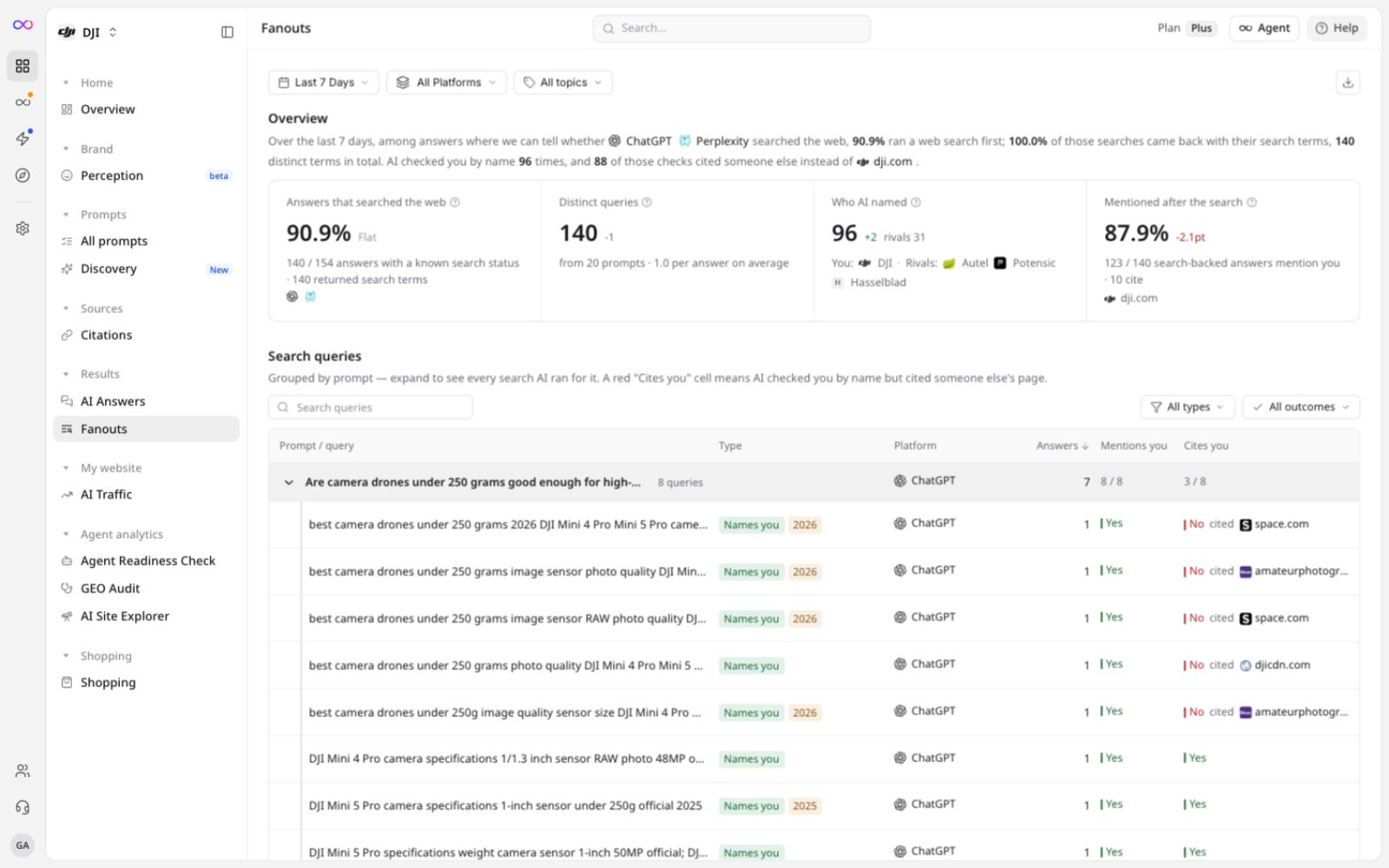
Open Fanouts and expand searches grouped by prompt. In the observable ChatGPT and Perplexity subset, 140 of 154 answers that can be classified use web search: 90.9%. This is not the search rate for all 616 answers. Search-query visibility depends on platform and collection coverage.
The report shows 96 searches naming DJI; 88 use other sites rather than dji.com. Within its intent grouping, Pricing / model comparison has 44 brand checks and one owned citation; Reviews / word of mouth has 16 checks and none. These are reasons to inspect the associated answers and pages, not proof of a ranking mechanism.
| Signal | Hypothesis to investigate | Content experiment |
|---|---|---|
| Model and price searches | Readers need dated, regional configuration comparisons | Maintain a comparison with current purchase links |
| Sensor, image quality or RAW searches | Marketing copy may not answer a capability question | Publish test conditions, original samples and limits |
| Review searches | Experience or independent verification is useful | Make reproducible review evidence available |
| Brand named, another site cited | The relevant official page may be missing, hard to find or mismatched | Compare each source URL with the existing official destination |
Action: Group search variants around a real buying decision. Build one complete resource when the intent is shared, rather than a thin page for each phrase.
Inspect perception at the level of specific attributes
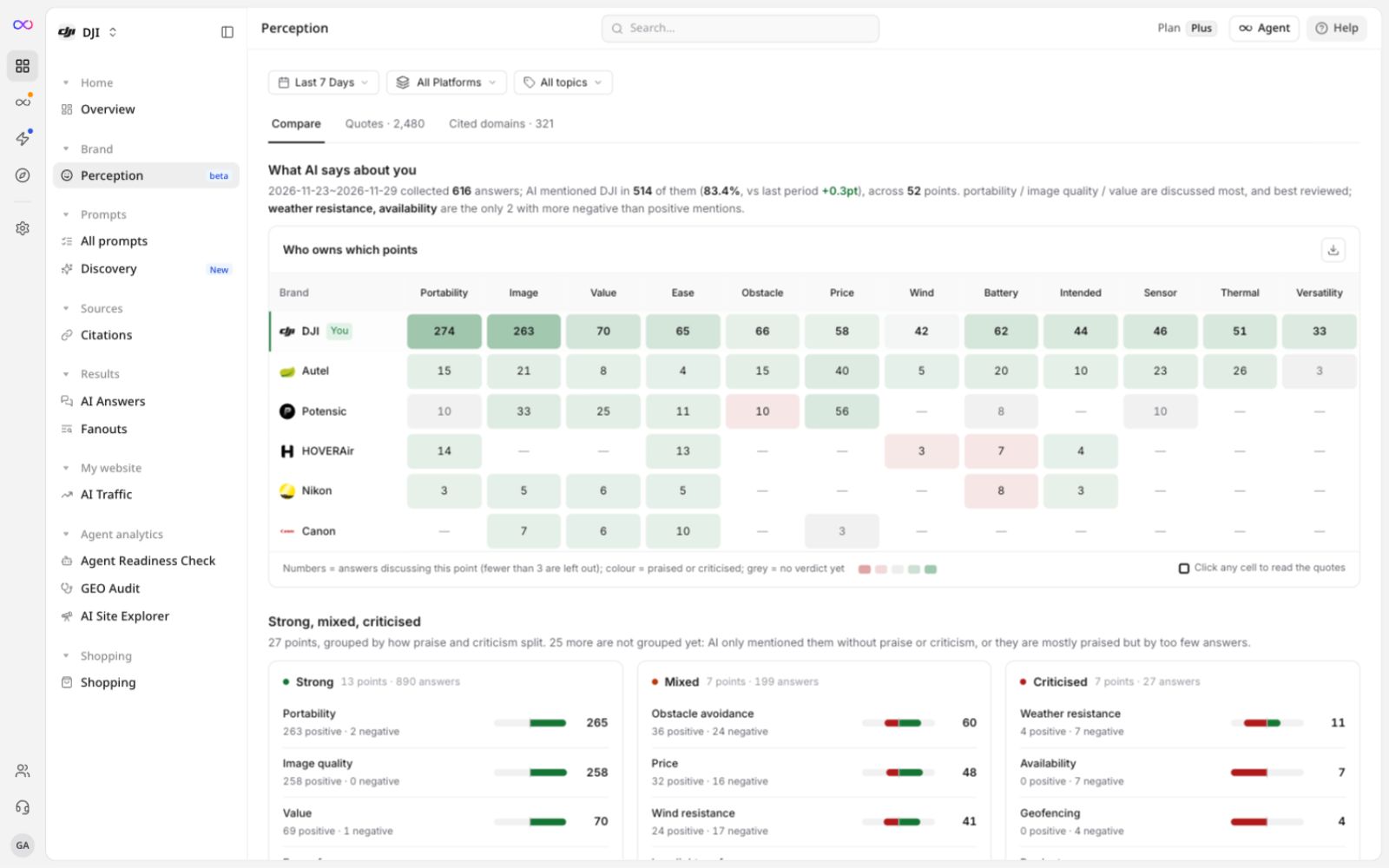
In Perception, review the brand-by-aspect matrix and the Strong, mixed, criticised groups. Portability and image quality are frequently praised in this sample. Obstacle avoidance and price receive mixed evaluations. These are descriptions in monitored AI answers, not a customer satisfaction survey.
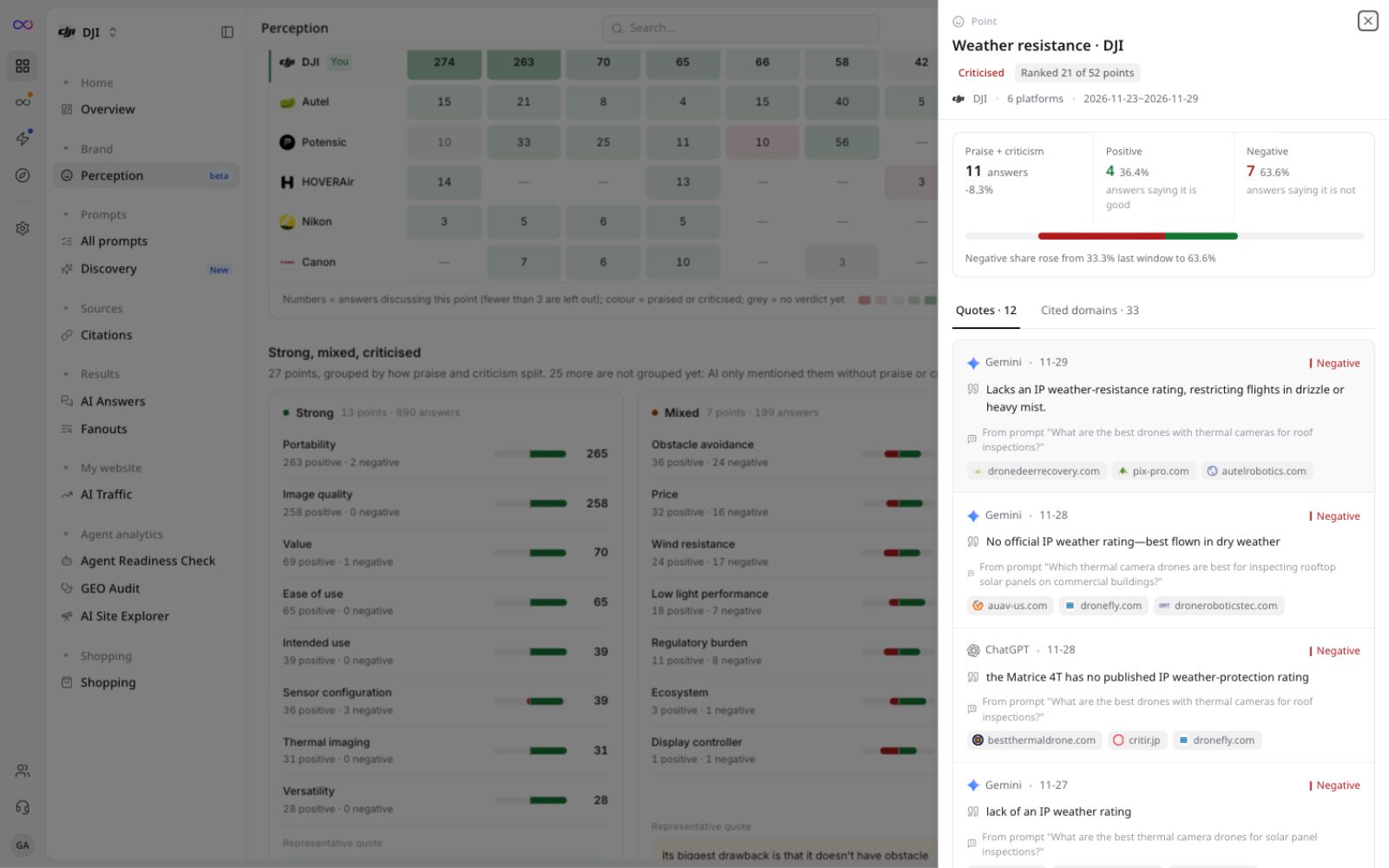
Open Weather resistance. The detail panel shows 11 answers with a positive or negative judgment: four positive and seven negative. The Quotes tab shows 12 items. Answers and quotes are different units; one answer can contain more than one evaluation. Counts across aspects should not be summed as unique users or unique answers.
Action: The actionable question is which buying concern needs clearer evidence. A single sentiment score rarely tells an editor which page to improve.
Correct misinformation while preserving real limitations
The Weather resistance drawer connects evaluations to dates, platforms, prompts and source domains. It does not establish a blanket conclusion about DJI products or prove that an answer is wrong. Read the full answer, identify the model and compare it with current official documentation.
For a protection-rating claim, check the exact model’s manual. Do not mix models, accessories, firmware, regions or publication dates. This guide has not independently verified every product assertion visible in the screenshots and does not repeat them as established product facts.
| Finding | Action | What to observe next |
|---|---|---|
| A real limitation | Explain boundaries, suitable uses and alternatives | Accurate caveats rather than uniformly positive language |
| Outdated information | Update the original page and link current documentation | Whether new answers still use the obsolete version |
| Model confusion | Add model-specific facts and supporting sources | Whether the answer attaches the attribute to the right model |
| Subjective comparison | Explain who it suits, with testing evidence | More specific, verifiable recommendations |
| Insufficient evidence | Leave the issue unresolved and investigate | No unsupported marketing conclusion |
Action: The goal is accurate information and a clear decision. Hiding genuine limitations or manufacturing praise is not a durable strategy.
Turn the diagnosis into four useful content assets
This is a proposed editorial plan, not a claim that DJI’s current site lacks these resources. Inventory existing URLs first. Improve a useful existing page and its internal links when it already serves the intent; create a new page only for a distinct unmet need.
Prioritize by buying relevance, repeated evidence, your ability to supply reliable facts and a clear next step. A potentially harmful factual error can deserve review even with a small sample.
| Asset | Structure | Validation |
|---|---|---|
| Travel-drone selection guide | Audience and budget; comparison criteria; tests; suitable and unsuitable uses | Citations and accurate recommendation reasons |
| Model comparison and purchase verification | Region and date; configuration table; price destination; limitations; update log | Current, correct information for comparison searches |
| Thermal inspection workflow | Task; equipment criteria; process; sample report; technical sources | Professional accuracy and qualified inquiries |
| Model facts and limitations hub | Exact model; specifications; compatibility; operating limits; sources | Fewer outdated or overgeneralized claims |
Answer first, then show the evidence
Explain the audience, scenario and key trade-off before expanding into tests and comparisons. Clear headings help readers navigate; no specific template guarantees an AI citation.
Make each factual passage understandable on its own
Put units, model names and conditions beside specifications. Caption images and keep important facts in HTML text. Link original sources and identify the author, reviewer and update date.
Provide a meaningful next step
Connect guides to relevant products, technical documents or inquiry pages, and link back from product pages to comparisons and workflows. Measure real visits and conversion events.
Action: Complete one question–evidence–page–action chain before scaling to dozens of articles.
Connect content quality, accessibility and conversion
Check that the destination loads, allows appropriate crawling, is not accidentally noindexed, uses the correct canonical and exposes its essential text. Provide genuine translations with accurate language annotations rather than declaring the same English copy to be several different languages.
GEOly also provides navigation to GEO Audit, Agent Readiness Check, AI Site Explorer and AI Traffic. These are follow-up entry points for diagnostics or measurement. This case did not run a new audit or connect DJI website analytics, so it reports no technical score, fixes, traffic increase or revenue. Define the target, permissions and costs before running additional checks, then verify each finding.
Crawler behavior varies by platform. Review the relevant platform’s official guidance and current site configuration instead of granting every bot unrestricted access. Eligibility for Google AI search still depends on the underlying search requirements, including indexing and snippet eligibility.
Action: Diagnostics do not replace index checks or conversion data. Unconnected or unavailable measurements should be labeled unknown, not zero.
Turn diagnosis into actions with evidence and ownership
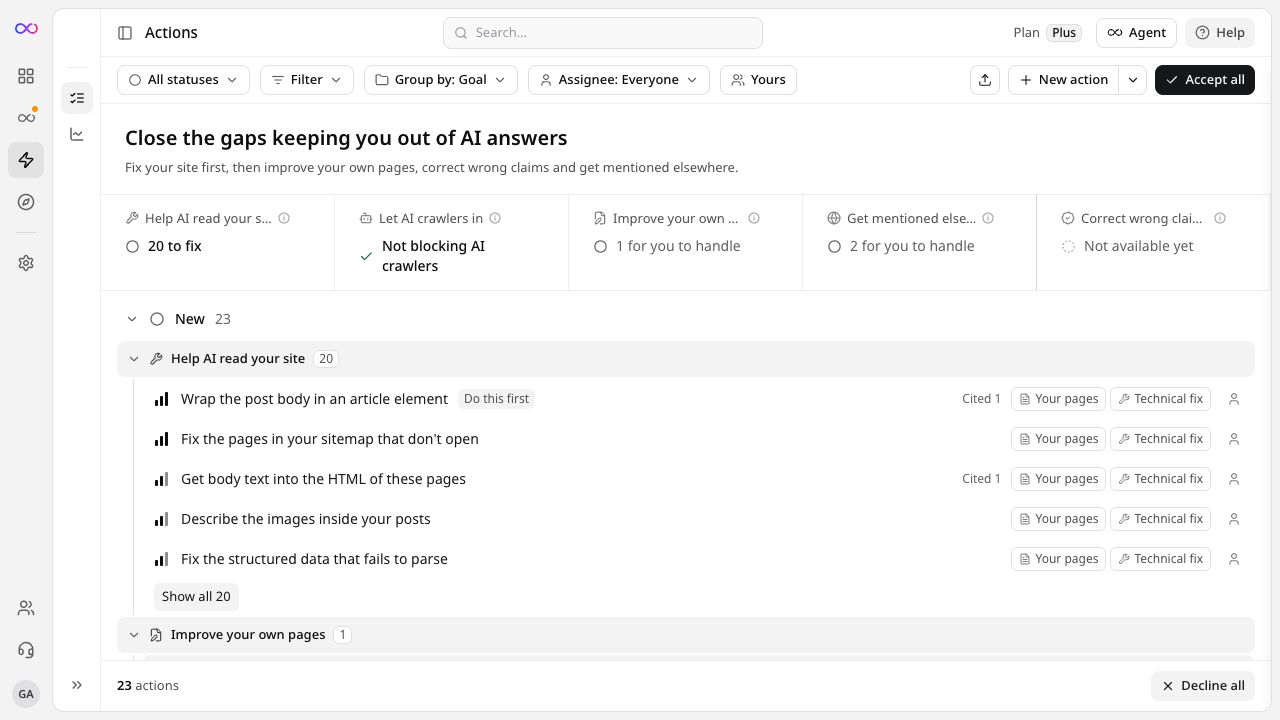
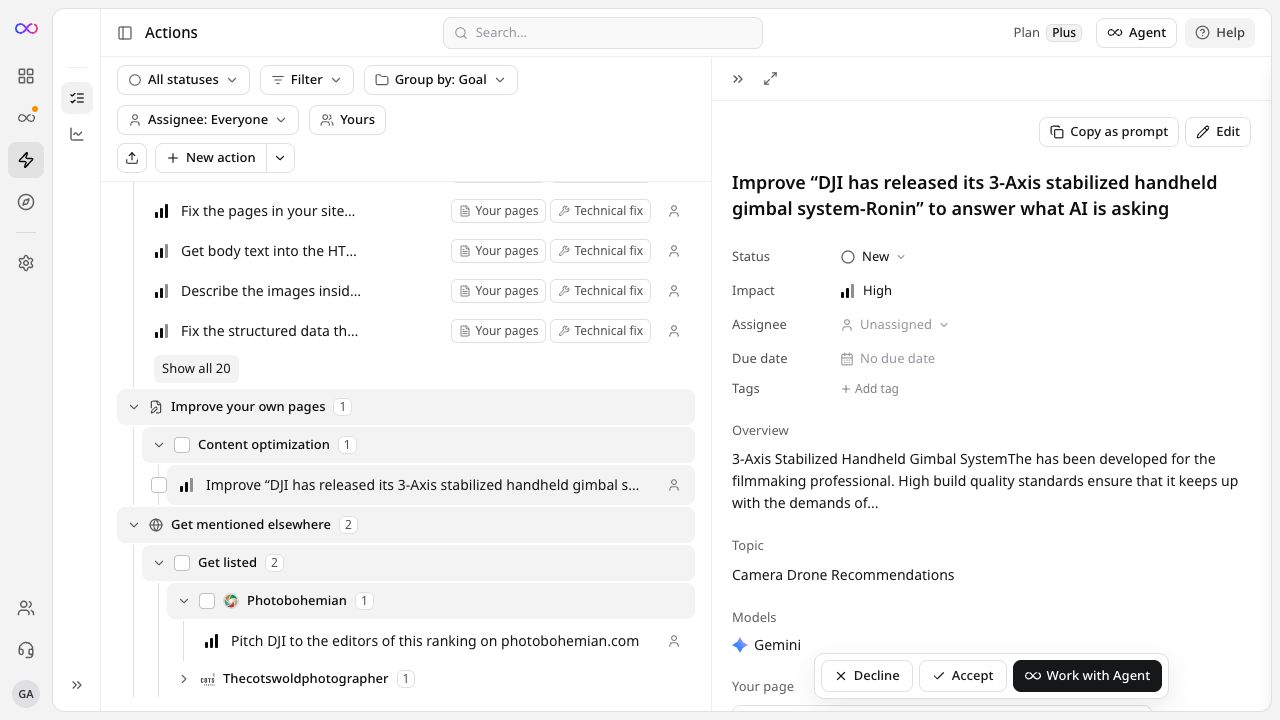
Open Actions after reviewing the reports. GEOly groups suggestions around helping AI read your site, allowing crawlers, improving your pages and earning mentions elsewhere. You can filter statuses, group work, assign owners and create actions manually.
Treat the DJI suggestions as candidates to verify. Developers should reproduce technical findings; editors should check intent and product facts; outreach owners should review audience fit and editorial criteria. Impact is a prioritization signal, not measured traffic or revenue. “Correct wrong claims” was marked “Not available yet” in this capture, so use the manual verification process above for factual corrections.
Review before accepting
Open the target page, prompt samples, model and citation evidence. Prioritize valuable, well-supported work your team can control rather than accepting every high-priority suggestion.
Specify the deliverable and owner
For accepted work, set an assignee, due date, tags and status. Include the URL, scope, factual sources and acceptance criteria so editors, product specialists and developers know what to deliver.
Keep measuring after delivery
Record the published URL and date. Review Impact and return to the same prompts and citation records. Completing an action establishes delivery; adoption by AI, visits and conversions require separate observation.
Action: Structure each action as evidence → hypothesis → deliverable → owner → acceptance → follow-up measurement.
A DJI task brief: check page intent before rewriting
One actual suggestion links a DJI Ronin handheld-gimbal announcement to a question about camera-drone features for smooth cinematic footage. Its details identify Gemini, the Camera Drone Recommendations topic, a target URL, competitor citation evidence, Copy as prompt and Work with Agent.
The important editorial judgment is the mismatch between a handheld-gimbal announcement and a drone-buying question. Do not turn a historical release into an unrelated buying guide. First check for a suitable existing drone-filming guide, then decide whether to improve it or create a distinct, useful page while preserving the announcement’s purpose.
This suggestion uses a 14-day evidence window and reports one citation across the page and its regional versions. It is not the same scope as the earlier seven-day overview. The following is a proposed task template, not a created, executed or validated project record.
| Task field | DJI teaching template |
|---|---|
| Target question | Which drone features help create stable, smooth cinematic footage? |
| Target page | Find the existing drone-filming or buying guide and confirm its canonical URL; avoid competing duplicate pages. |
| Evidence and hypothesis | Inspect answers and competitor sources. Test whether a guide that answers the question and explains trade-offs is a better citation destination. |
| Deliverable | A concise answer, scenario-to-feature comparison, model-specific limits, official factual sources and a clear next step. |
| Owner and review | An editor drafts, a product specialist checks specifications and a website owner reviews and publishes. Set a realistic due date. |
| Acceptance and follow-up | Verifiable facts, matching intent and an accessible page. Record publication and repeat measurement with the same platforms and questions. |
Action: Suggestions identify leads; editorial review determines which page should actually change.
Use Agent to investigate and draft; reuse methods with skills and routines
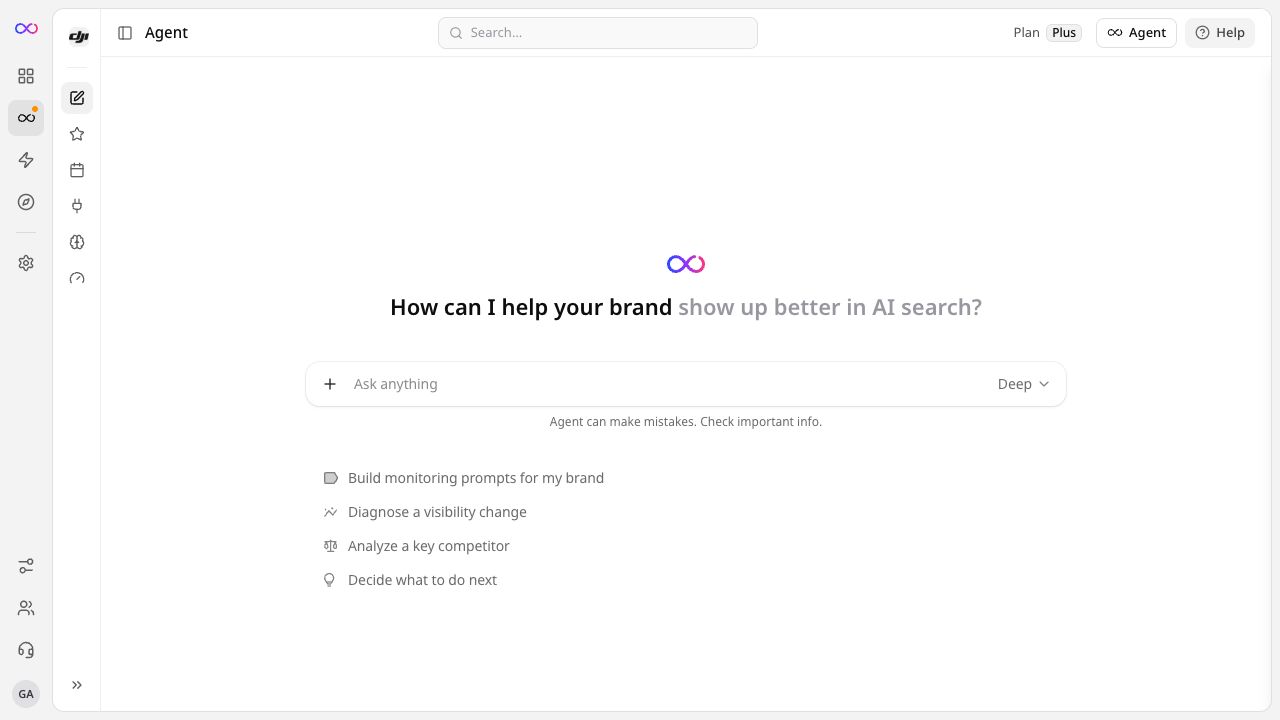
GEOly Agent connects questions, monitoring data and working context. The current interface offers starting points for building monitoring prompts, diagnosing visibility changes, analyzing competitors and prioritizing next steps. Work with Agent in an action’s details provides a handoff for continuing that work.
For DJI, start with a reviewable content brief. Specify the product line, question set, models and time window, then ask Agent to trace original answers and citations and separate observations from inferences. The prompt below is a teaching template; this case did not run that Agent task or establish implementation results.
Constrain the task with context
Specify the brand, product line, language, audience, evidence scope and deliverable. Use Context to organize relevant working background, while still checking the current project and dates for each analysis.
Reuse a tested method through skills
Skills can capture repeatable methods such as citation review, buying-guide outlines and monthly reporting. Validate the workflow manually before packaging its inputs, output format and fact-checking rules for reuse.
Separate recurring checks from one-off work
For repeated checks, inspect the available Routines configuration and define scope, frequency and expected output. Keep one-off page revisions in Actions. This case did not configure or start a routine; execution depends on account capabilities and configuration.
Extend the toolset through connectors
Connectors determine which external tools and data Agent can access. Check connected services and permissions before delegating execution. Drafting content does not itself authorize CMS publishing or external outreach; important facts and publishable material still need review.
Reusable prompt (teaching template)
Use the current DJI monitoring project to investigate Camera Drone Recommendations. First state available dates, platforms, language and sample size, then inspect answers and citations about stable cinematic drone footage.

Check whether the Ronin handheld-gimbal announcement matches drone-buying intent. Return: (1) evidence with original answers or source URLs; (2) product facts requiring human verification; (3) an existing page to improve or a reason for a distinct new page; (4) an outline and concise answer draft; (5) owner roles, acceptance criteria and a follow-up measurement plan.

Flag inaccessible pages and missing data. Do not invent specifications, results or citations. Deliver a brief for review; do not publish pages or contact editors.
Action: Agent helps with investigation and drafts. Skills preserve methods, routines support repeated checks, and actions keep ownership and acceptance visible.
Bring GEOly evidence into external AI workflows with MCP
Teams already researching, writing or developing in an MCP-compatible AI client can connect GEOly MCP to read authorized brand-monitoring data. Content briefs can then use actual answers, citations and trends with less manual report copying.
Follow the official connection instructions for https://app.geoly.ai/api/mcp/v1 and authorize through a supported client. Confirm the organization and brand project, then inspect context, available dates and coverage. MCP is read-only by default, and available tools depend on plan and grants. Write operations such as creating or archiving monitoring prompts require the relevant permission.
Keep the two directions distinct: GEOly MCP exposes GEOly data to external assistants; GEOly Agent connectors supply external tools to the in-product Agent. MCP alone does not schedule runs, publish articles or create arbitrary project-management tasks. Those steps need support from the client, a scheduler or an authorized connector.
| Stage | Evidence or capability | Deliverable |
|---|---|---|
| Establish scope | Organization, brand context, platform coverage and dates | An analysis with explicit sample boundaries |
| Find opportunities | Prompts, answer details, citation domains and URLs, search queries | Content gaps linked to evidence |
| Prepare execution | Have the external assistant draft from evidence; verify tools and grants before any write | A reviewable task brief and page outline |
| Review outcomes | Read comparable trends and answers again; use business data only when connected | A comparison retaining unchanged and negative results |
Reusable prompt (teaching template)
Through GEOly MCP, identify the DJI brand project I can access. Read brand context first and report available dates and platforms. Select camera-drone buying prompts, compare brand mentions and official-site citations across comparable windows, and trace specific answers and URLs.

Return up to three content opportunities, each with a target question, evidence, proposed page, facts to verify, acceptance criteria and follow-up measurement method. Flag insufficient data rather than treating unavailable data as zero. Read and draft only: do not create or modify monitoring or publish content.
Action: Use GEOly evidence in your preferred AI workspace while preserving scope, permission boundaries and human acceptance.
A 30-day plan for a controlled content experiment
This is a suggested operating cadence, not a promise of rankings or revenue in 30 days. Start with one priority experiment for travel photography and one for thermal inspections. Unchanged topics can provide context, but they are not a randomized control group.
| Window | Owner and work | Deliverable |
|---|---|---|
| Days 1–3 | Growth lead fixes prompts, platforms, language, region and window | Baseline and priority questions |
| Days 4–7 | Editor and product expert review answers, sources and aspects | Fact-error, evidence-gap and intent backlog |
| Days 8–14 | Content and product teams update pages; engineering checks access | URLs, change log, evidence and conversion destination |
| Days 15–21 | Analyst repeats the same prompt set and inspects citations | Comparable before/after observations, including no change |
| Days 22–30 | Growth lead retains, revises or expands the experiment | Review and next priorities; extend if evidence is insufficient |
Avoid changing every variable at once
Keep sampling and questions stable where possible. Record content releases, model changes and shifts in platform or regional coverage so they do not masquerade as content effects.
Show counts alongside percentages
Report valid answers, mentions and citations. A few responses can move a small sample dramatically, and repeated answers to the same prompt are not fully independent observations.
Action: An improvement after an edit is an association. Repeated observations and page-level citation evidence make the next investment decision more defensible.
Report what changed, why it matters and what comes next
A useful monthly report answers three questions: which buying scenarios changed, what evidence supports that conclusion and what the team will do next. Present AI monitoring and website analytics separately before looking for a traceable connection.
| Report item | Record | DJI teaching example |
|---|---|---|
| Scope | Dates, platforms, language, region and prompt version | November 23–29; original questions in English |
| Discovery | Valid answers and mentions | 514 / 616, approximately 83.4% |
| Evidence | Comparable citation counts and destination URLs | dji.com domain table: 69 / 2,351, approximately 2.9% |
| Accuracy | Reviewed claims, models and evidence status | Weather-related claims require individual verification |
| Business results | Identifiable AI referrals, inquiries or orders | Not connected in this case; unknown |
| Next experiment | Owner, page, hypothesis and review date | Test comparison and official-fact destinations first |
Action: Start with one real buying question. Inspect the answer and source, improve the evidence, then use the same method to observe whether it is adopted.
Frequently asked questions
Does this demonstrate growth achieved by DJI using GEOly?
No. It is a monitoring-based educational example. It does not establish a customer relationship, implementation results, revenue or a before-and-after experiment.
Should I start with ChatGPT, Gemini or Google AI Mode?
Start with the platforms used by your target buyers and supported by your measurement coverage. Establish separate baselines before expanding. Unavailable data is not evidence of zero visibility.
Is GEO still useful when mention visibility is high?
Check whether mentions cover valuable buying questions, recommendations are accurate, citations lead to useful pages and visitors can take a meaningful next step. High mention visibility alone does not answer those questions.
How long does it take to see results?
There is no fixed guarantee. Crawling, indexing, model changes, competing content and sampling all affect observations. Verify that conditions are comparable and extend the observation window when the evidence is insufficient.
Can English monitoring support conclusions about Chinese buyers?
It can illustrate a method, but it cannot establish Chinese-market performance. Use questions reflecting the relevant language, region and buyer intent, and evaluate that sample separately.
Sources and method
Case figures come from the pictured GEOly project, covering November 23–29, 2026. The final day was still accumulating. DJI website analytics and post-implementation results were not available. The following documents support the technical and content principles, not growth claims.