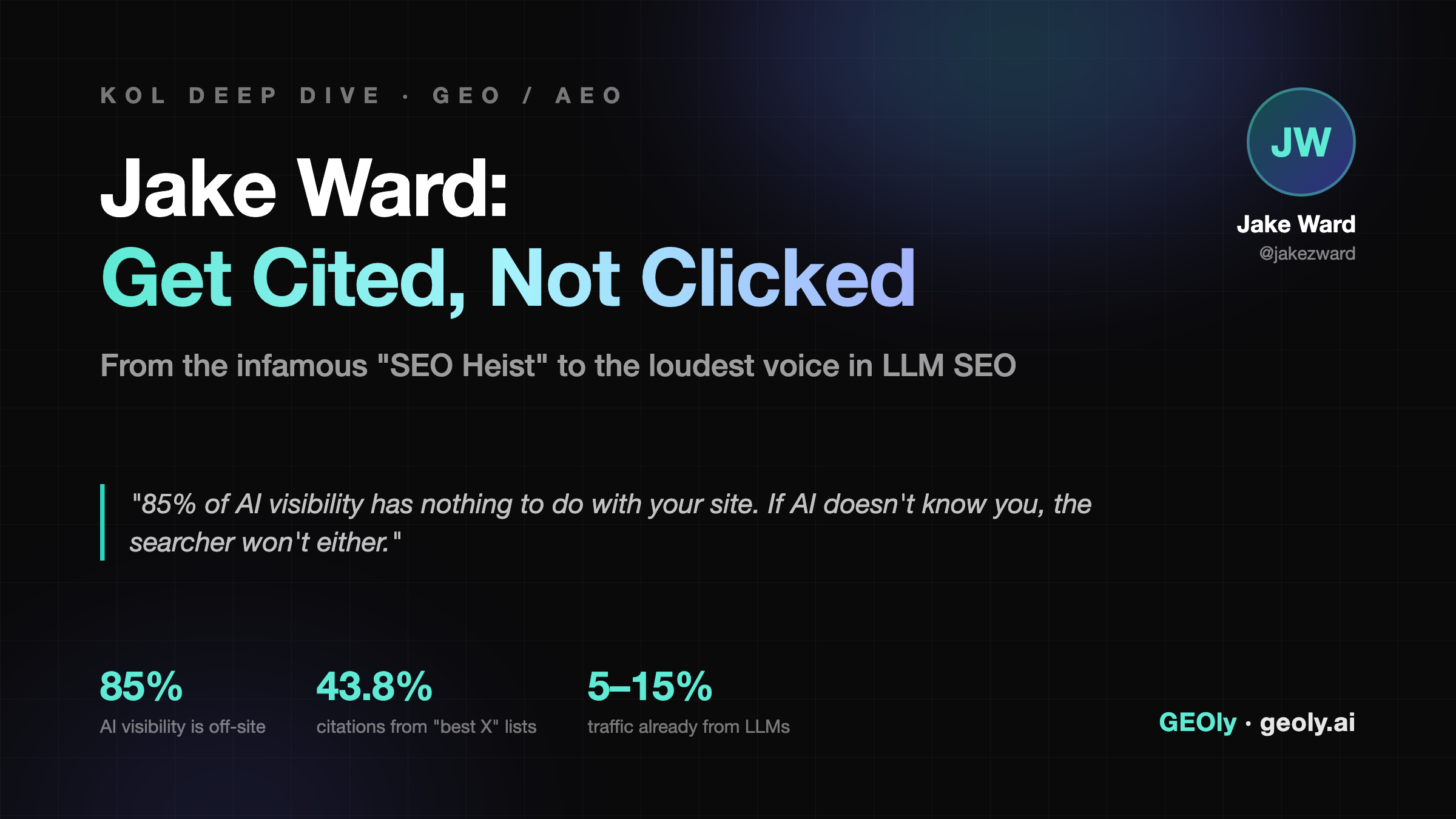
If you follow AI search discourse on X or LinkedIn, you've seen Jake Ward's numbers everywhere: "85% of AI visibility has nothing to do with your site." "43.8% of AI citations come from best-X lists." "Reddit just lost 82% of its AI citations overnight."
Ward (@jakezward, ~32K followers on X, ~196K on LinkedIn) is one of the loudest — and most controversial — voices in what he calls LLM SEO. This deep dive unpacks who he is, what he actually argues about GEO and AEO, which of his claims hold up, and what Shopify and DTC brands should take away.

Who is Jake Ward?
Jake Ward is a UK-born growth entrepreneur who started his first SEO content agency in 2019 at age 21. Today he runs four ventures: Contact.so (an organic-growth agency whose tagline is literally "SEO has changed. So did we."), Byword.ai (a GPT-4-based bulk article writer), Kleo (a LinkedIn content tool), and — most relevant here — Mentions.so, an AI-visibility platform he launched in mid-2025 that tracks how brands appear across ChatGPT, Perplexity, Claude, Grok, Gemini, DeepSeek and Google AI Overviews.
You cannot understand his current GEO thesis without the backstory: the SEO heist.

The SEO heist: the stunt that made him famous
In November 2023, Ward posted a thread that went catastrophically viral: "We pulled off an SEO heist that stole 3.6M total traffic from a competitor." He had exported competitor Exceljet's sitemap, turned its URLs into article titles, and used Byword to generate 1,800 AI articles for his client Causal — claiming 490K monthly visits at peak.
Then came the correction. Business Insider documented what happened next: shortly after the thread, Causal's traffic collapsed from 610K+ weekly visits to roughly 190K — below its pre-campaign baseline — as Google acted. The SEO community's verdict was brutal; critics called the playbook "a roadmap on how to destroy the internet."

The episode became so canonical that The Verge's Nilay Patel raised it directly with Google CEO Sundar Pichai in a May 2024 Decoder interview — reportedly the most fired-up Pichai has ever been on the show. Ward's own reaction, posted in October 2025: "I'm not celebrating or gloating. I'm just thinking about how weird the internet is."
Why does this matter for GEO? Because Ward's entire current framework is, in a sense, a post-heist correction: the heist proved that gaming your own site's content at scale is fragile. His answer to AI search is the opposite — and that's what makes it interesting.
His core thesis: get cited, not clicked
Ward's framework, which he brands LLM SEO (or "LEO"), starts from a funnel shift:
"Traditional SEO is 'get clicks'. LLM SEO is 'get cited'. The user journey changed from Search → Click → Read to Ask → Get answer → Act. If AI doesn't know you, the searcher won't either."
His widely-shared taxonomy of "New SEO" splits the discipline into five questions:
- SEO — Will you rank in top spots?
- AIO — Will AI learn about you?
- GEO — Will AI recommend you?
- AEO — Will you be the answer Google highlights?
- SXO — Will users stick around and take action?
Note his usage: GEO for him is specifically "will AI recommend you", AEO is the answer-box layer, and he wraps the whole thing as "Search Everywhere Optimization." Terminology aside, this maps closely to how we think about it at GEOly: visibility, recommendation and citation are different measurable layers, not one blob.
The data points he built his reputation on
Four claims recur across his threads, and each is worth taking seriously:
- 85% of AI visibility is off-site. Citing an analysis of 21,311 brand mentions across ChatGPT, Claude and Perplexity, Ward argues brands are 6.5x more likely to get cited through third-party sources than through their own site. Roughly 90% of those third-party mentions come from listicles, comparisons and reviews.
- 43.8% of AI citations come from "best X" lists. More than blog posts, landing pages, product pages and homepages combined. His conclusion: being placed in third-party roundups beats polishing your homepage.
- LinkedIn appears in ~11% of AI answers — more than YouTube, Wikipedia and major news publishers combined, based on his claimed analysis of 5M+ answers and 14M+ citations.
- AI visibility is volatile. When Google changed a single indexing parameter in October 2025, ChatGPT's Reddit citations dropped from 29.2% to 5.3% within days — and Reddit's stock fell 15% in 8 days. AI visibility is financially material, and fragile.
He also reports operating data from 30+ client sites: 5–15% of monthly traffic already comes from LLM platforms, about 95% of it from ChatGPT — his evidence that this is a revenue channel, not a hype cycle.
Keyword research is dead; prompt research isn't
One of his most practical contributions is the shift from keywords to questions:
"Keyword research is useless in AI search. Buyers don't type keywords, they ask questions."
He tracks visibility against an "AI Search Prompt Matrix" of 14 prompt types — best-of, comparison, alternative, recommendation prompts and more. If that sounds familiar to GEOly users, it should: prompt-level tracking is exactly how we instrument brand visibility, and our own monitoring shows the same pattern — brands ranking #1 on Google are routinely invisible in category prompts.
Programmatic SEO 2.0 — the heist playbook, rebuilt
Ward hasn't abandoned programmatic content; he has rebuilt it. In March 2026 he published a case study of generating 13,000+ pages in under 3 hours — but with strict JSON schemas, structured data and genuinely useful interactive pages, not freeform AI text spun from a competitor's sitemap. His line: "For programmatic pages, we never ask the AI to write freeform."
That distinction — structure over spam — is the difference between the 2023 heist and what survives Google's 2026 quality systems.
Where we agree — and where we'd push back
Where we agree:
- Earned beats owned. Our own data on AI citations points the same direction: third-party listicles, reviews and communities dominate what LLMs cite for "best X" queries.
- Prompt-level tracking is the right instrumentation. Rankings don't transfer; citations and recommendations are the new units of measure.
- Volatility is real. Anyone treating AI visibility as a one-off audit rather than continuous monitoring will get blindsided by platform shifts like the Reddit collapse.
Where we'd push back:
- His numbers are self-reported and mostly unaudited — treat "$20M for clients" and platform-scale claims as directional, not verified.
- The commerce layer is missing. Ward's framework is answer-layer only. For Shopify and DTC brands, the AI shopping shelf — product cards in ChatGPT and Google AI Mode, feeds, Instant Checkout — is where revenue actually happens. Being cited in an answer is step one; being the product card that gets bought is the endgame. That shelf layer (what we measure as Share of Card) doesn't appear in his taxonomy.
- The heist history cuts both ways. It makes him a sharp reader of what Google punishes — but it's also a reminder to stress-test growth advice from people selling the shovel.
Watch & listen
- Decoder (The Verge), May 2024 — Nilay Patel confronts Google CEO Sundar Pichai with the SEO heist: Spotify · Apple Podcasts — also available on The Verge's YouTube channel.
- Contrast webinar — "AEO, GEO, AI SEO… What Actually Works (And What's Just Hype)" with Jake Ward: watch.getcontrast.io/register/ai-seo
- His threads archive: threadreaderapp.com/user/jakezward · Newsletter: jakeward.io
The Monday-morning checklist for DTC brands
- Run prompt-level visibility checks for your category ("best X for Y") across ChatGPT, Gemini and Perplexity — not keyword rankings.
- Audit which third-party listicles and reviews AI cites in your category, and get placed in them. That's 43.8% of the game.
- Publish quotable, definition-dense content — including on LinkedIn — that LLMs can lift.
- Track continuously. Citation sources reshuffle overnight.
- Don't stop at the answer layer: measure whether your products appear in AI shopping cards, and whether that traffic converts.
Ward's arc — from gaming Google at scale to preaching earned citations — is the story of search itself over the last three years. You don't have to like the heist to learn from the correction.
Want to see your own brand through this lens? GEOly tracks prompt-level mentions, citations and Share of Model across ChatGPT, Gemini, Perplexity, Grok and Google AI — plus the AI shopping shelf his framework leaves out.