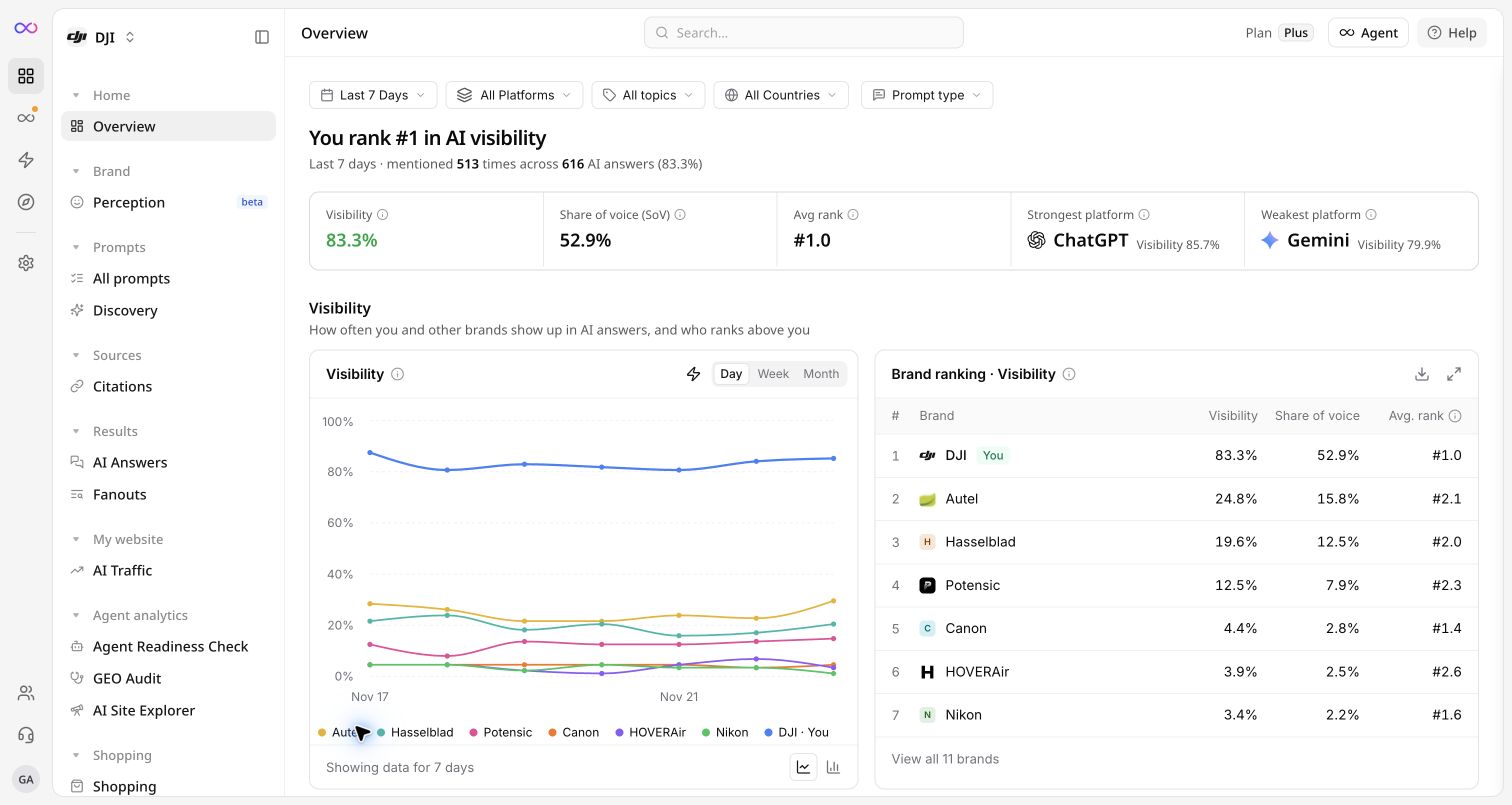
At the brand level, DJI looks strong. In the GEOly project we inspected, 513 of 616 AI answers mentioned DJI over the last seven days: 83.3% visibility. DJI ranked first among the tracked brands, with 52.9% share of voice.
But the question-level view tells a more useful story. Over the last 30 days, selected buying questions reached 100% visibility. A question about using infrared drones to identify irrigation problems reached just 5%. Being on a buyer's shortlist does not mean appearing when that buyer first learns how to solve a problem.
Understand the denominator before celebrating the number
Generative engine optimization means helping AI systems discover, understand and use accurate, relevant evidence about a brand. Measurement must separate three different outcomes.
| Metric | Question it answers | Interpretation here |
|---|---|---|
| Visibility | How many eligible answers mention the brand? | 513 ÷ 616 ≈ 83.3% in the seven-day overview. |
| Share of voice | What share of mentions belongs to the brand within the tracked set? | Depends on the brands tracked; it is not market share. |
| Citation rate | How many answers cite an owned source? | An answer can mention DJI while linking to a publisher, reseller or research institution. |
Average rank also belongs to the monitored brand set. It does not prove that DJI leads every possible answer. A missing mention, a missing owned citation and a missing conversion call for different investigations.
One brand, very different questions
In All prompts, we selected Last 30 Days and All Platforms. The following results illustrate why the prompt text matters as much as the headline score.
| Monitored question | Visibility | Citation rate |
|---|---|---|
| Which thermal camera drones are best for inspecting rooftop solar panels on commercial buildings? | 100.0% | 20.5% |
| What are the top-rated camera drones under $1,000? | 100.0% | 5.0% |
| What are the best camera drones for high-quality travel videos? | 100.0% | 2.5% |
| What features matter when choosing a drone for smooth cinematic footage? (paraphrased) | 75.0% | 18.3% |
| How can drones with infrared cameras help farmers identify irrigation problems? | 5.0% | 0.0% |
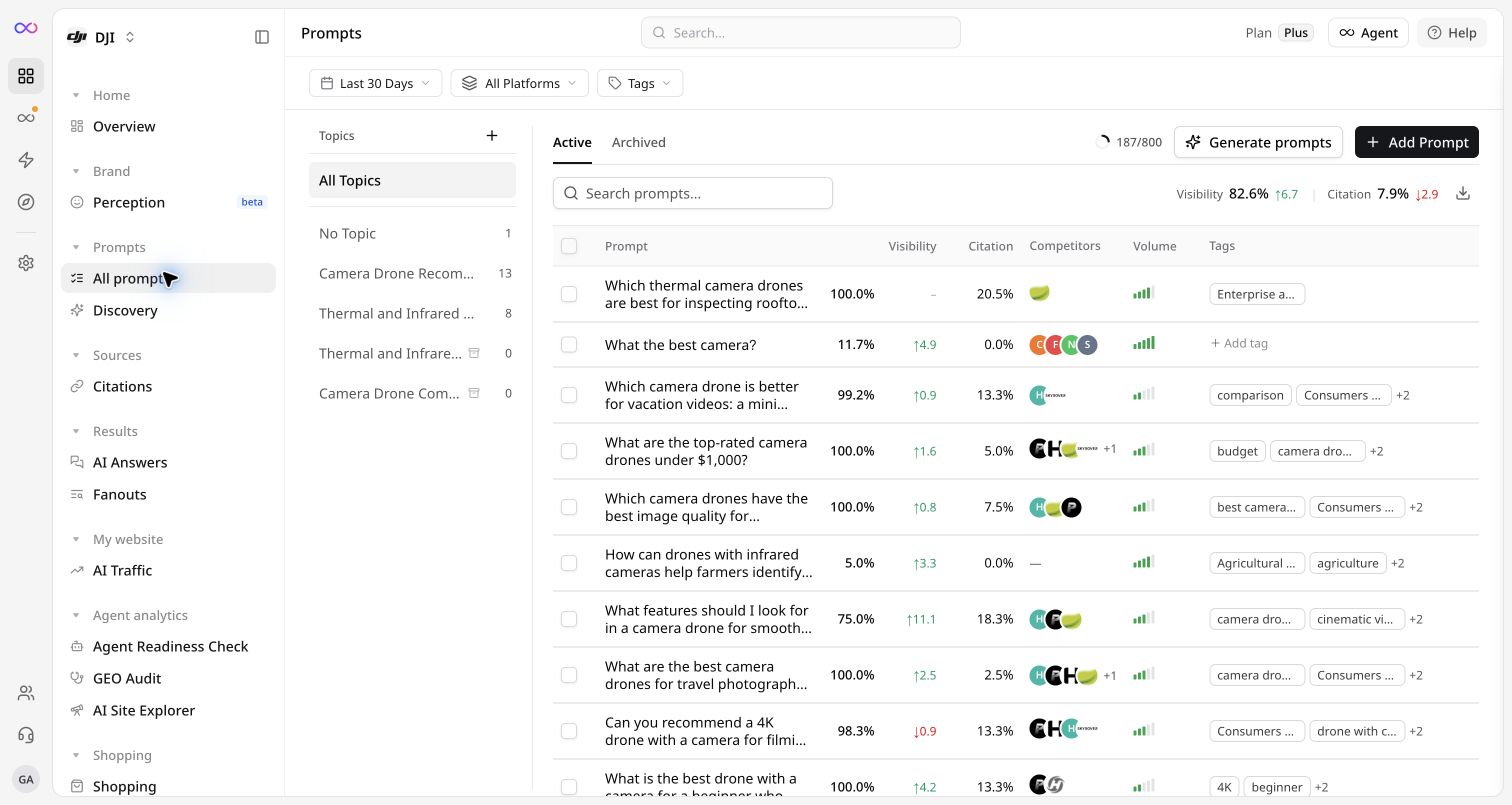
Travel-video recommendations show 100% visibility but only 2.5% citation rate. Brand inclusion and ownership of supporting evidence are different. Inspect the actual cited pages before deciding the brand website is deficient.
The irrigation question is informational. An accurate answer may reasonably omit brands. A 5% mention rate does not mean competitors captured the remaining 95%. The useful question is whether the brand can contribute distinctive evidence: a reproducible workflow, verified equipment capabilities, field data and limitations.
Inside the 5% visibility gap
How can drones with infrared cameras help farmers identify irrigation problems?
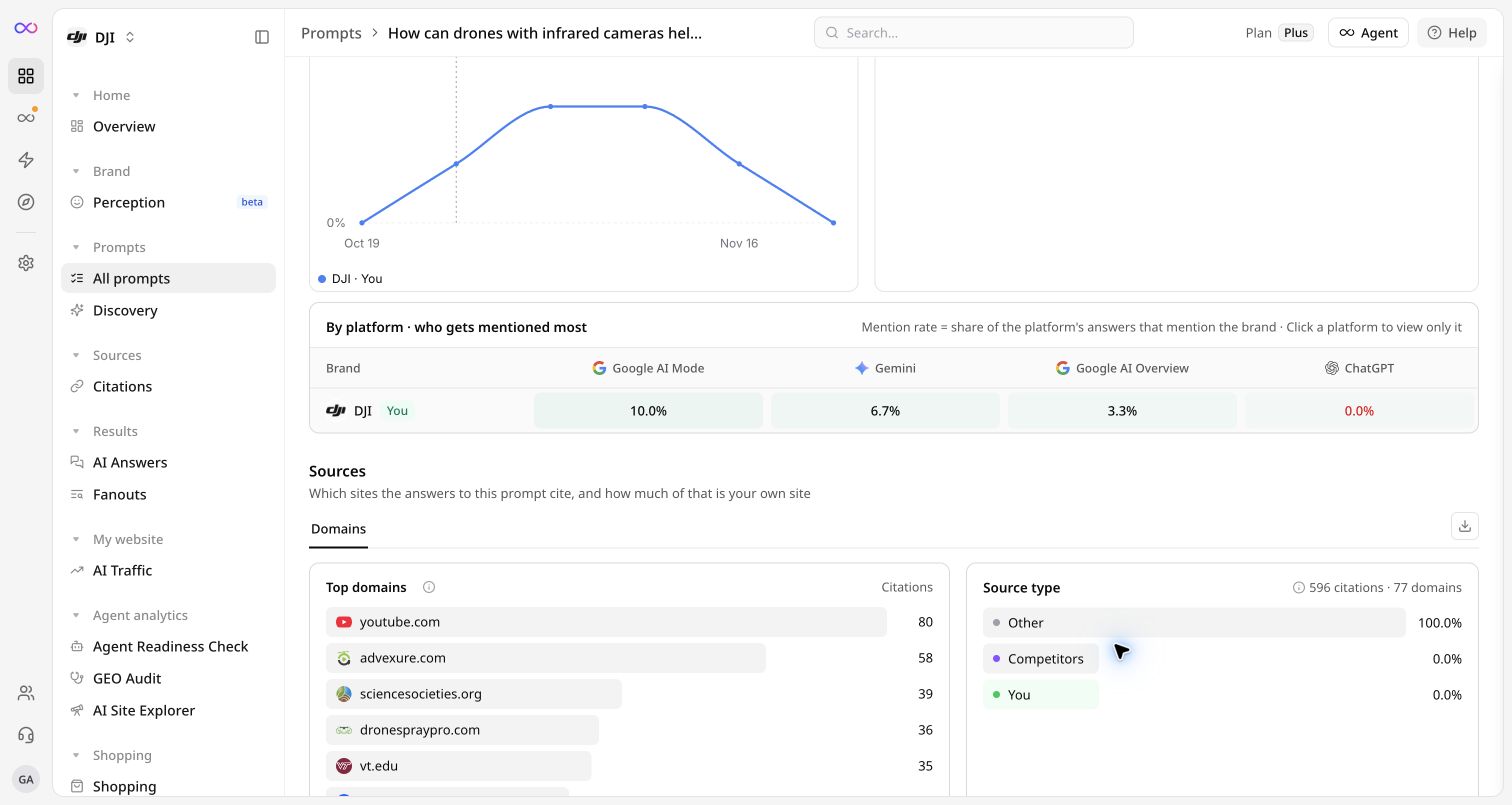
The prompt produced 120 answers, six mentioning DJI. Each platform contributed 30 answers.
| Platform | Answers mentioning DJI | Visibility |
|---|---|---|
| Google AI Mode | 3 / 30 | 10.0% |
| Gemini | 2 / 30 | 6.7% |
| Google AI Overviews | 1 / 30 | 3.3% |
| ChatGPT | 0 / 30 | 0.0% |
Counts were reconciled against the displayed totals and platform percentages. They are repeated monitoring observations, not independent survey participants.
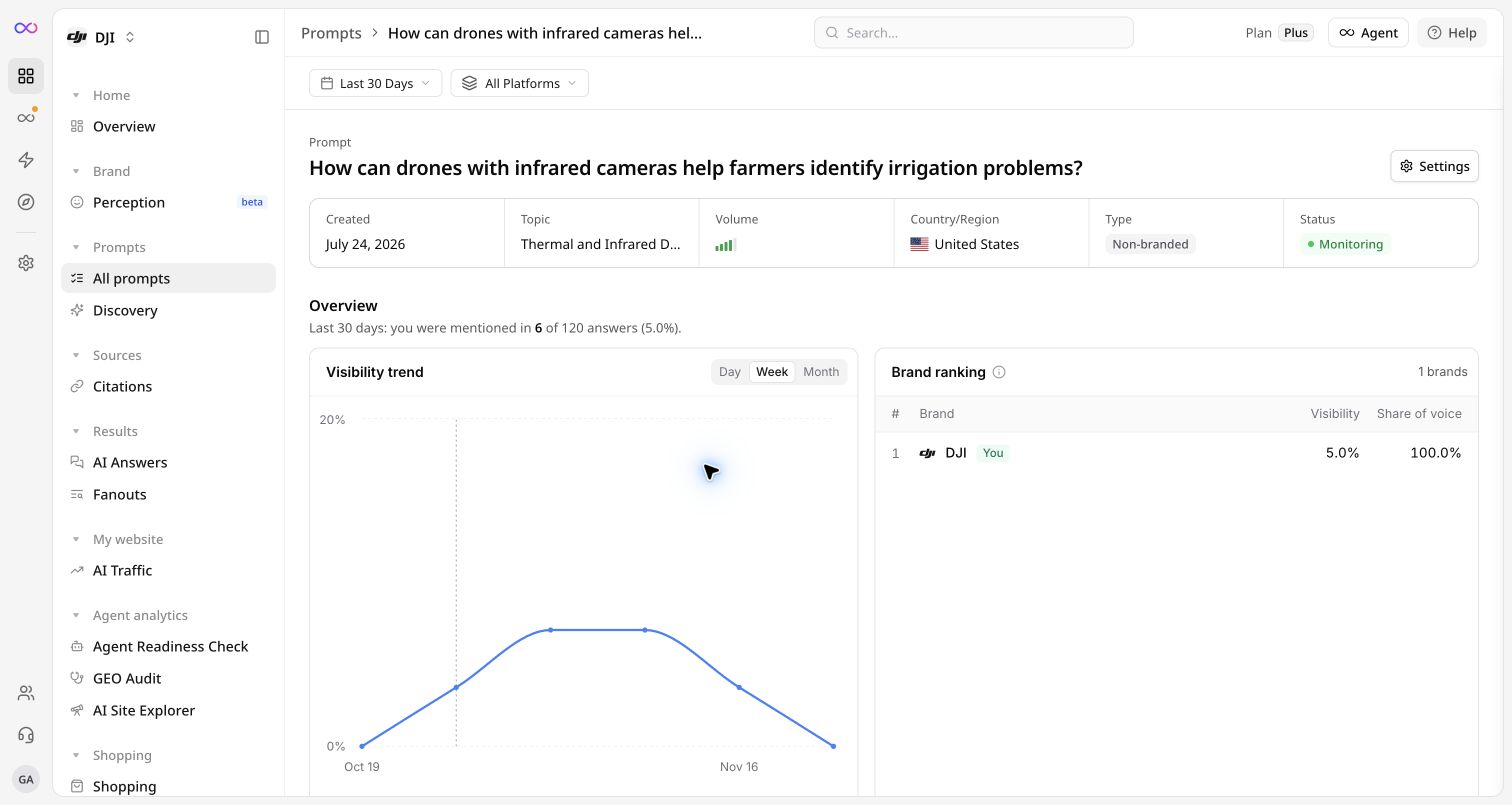
The same page shows DJI at 100% share of voice. That is compatible with 5% visibility: DJI is the only tracked brand listed in the mentions counted for this question. Reporting only the share would hide 114 answers that did not mention it.
The answer needs agricultural evidence, not a product pitch
We opened a ChatGPT answer dated November 23, 2026. DJI was not mentioned. The answer discussed infrared imagery, field checks, analysis and limitations. Its three cited sources came from Virginia Tech, MDPI and Taylor & Francis. This is a record of the answer's references, not an independent endorsement of every technical claim.
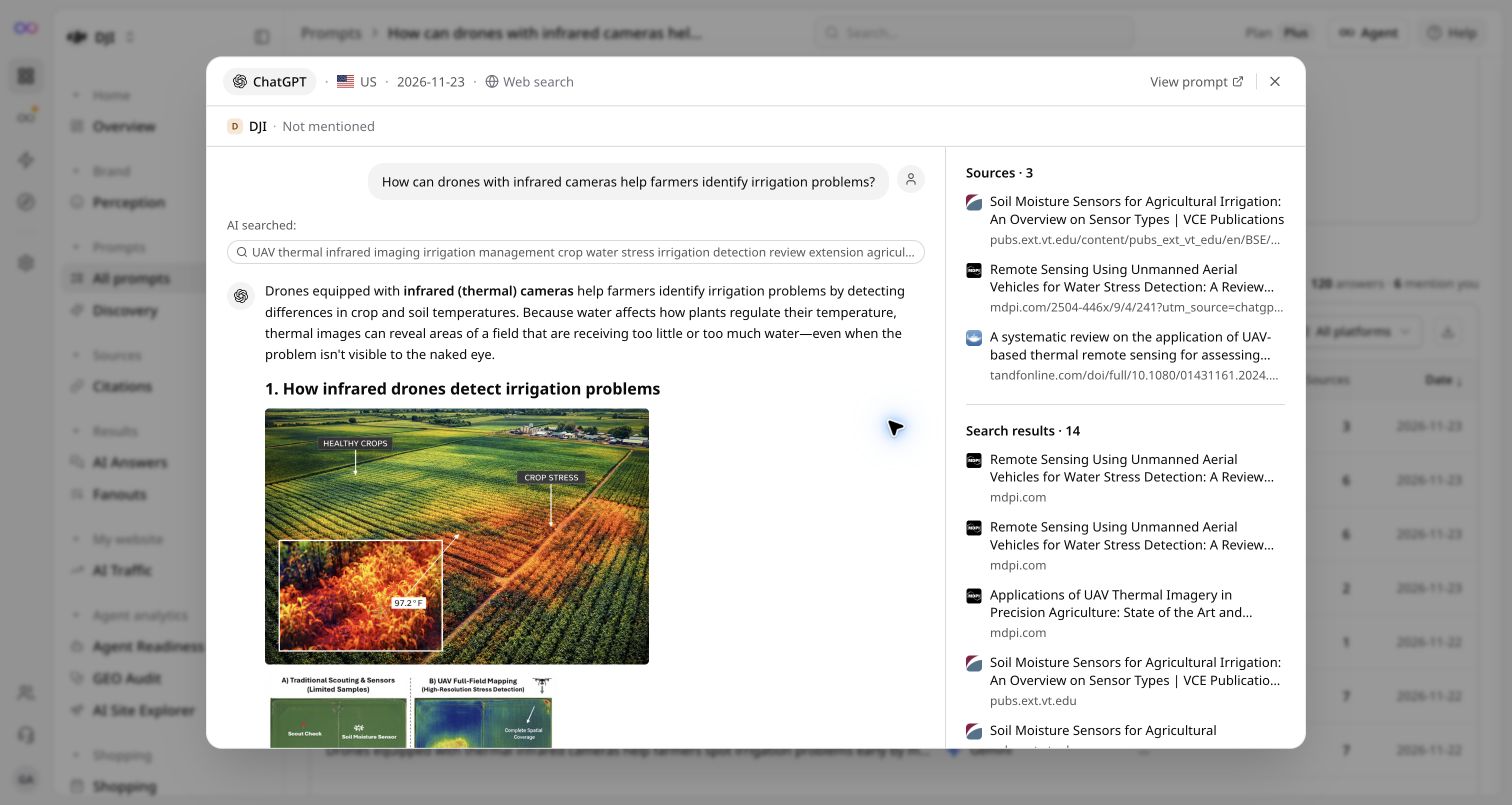
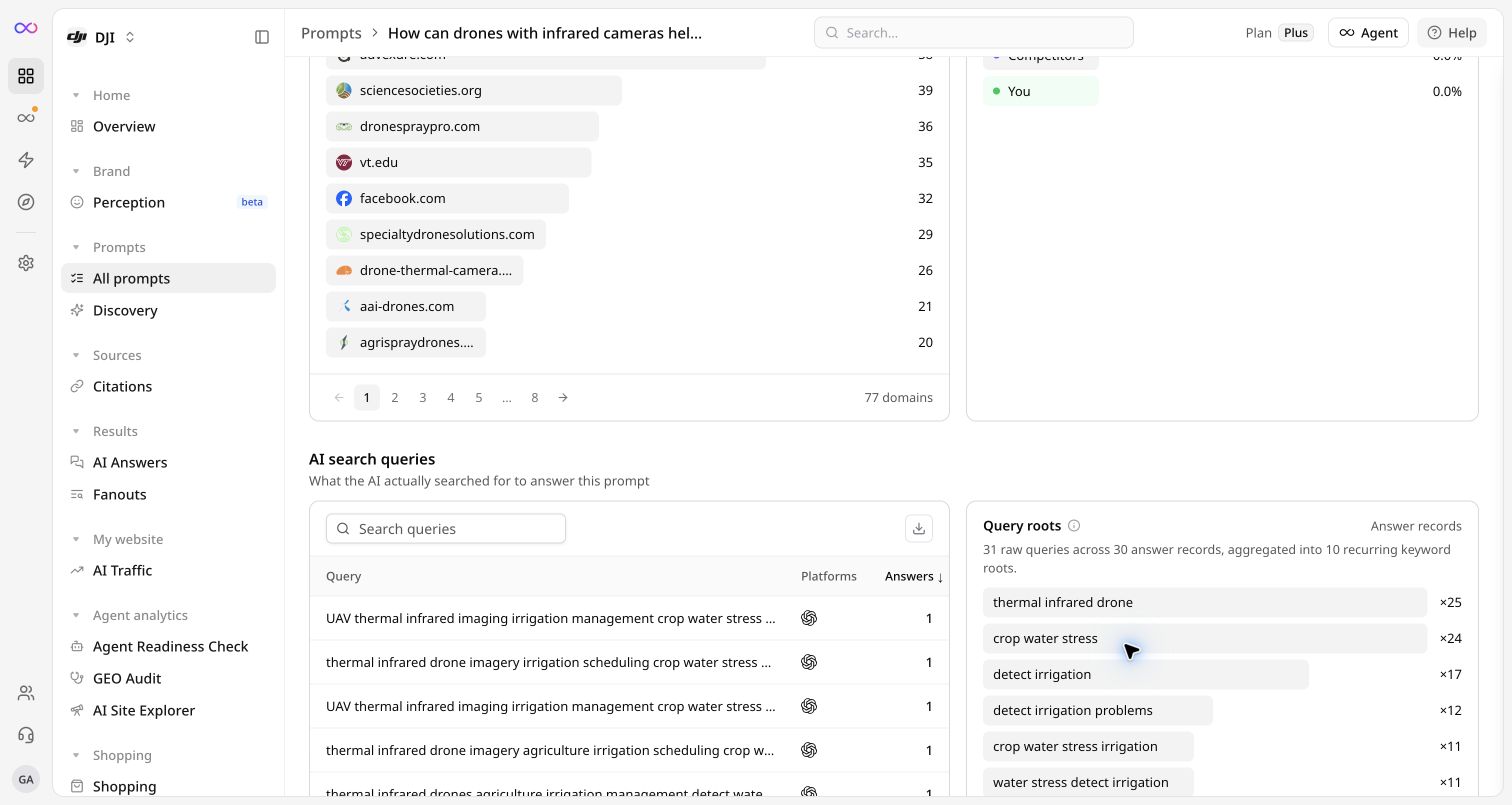
The AI search-query panel contained 31 raw queries across 30 answer records, grouped into ten recurring roots. “thermal infrared drone” appeared in 25 records, “crop water stress” in 24 and “detect irrigation” in 17. These are overlapping retrieval observations, not monthly search volumes or distinct users.
A reasonable content hypothesis follows: this task needs an explanation of detection, evidence quality and limitations. A product specification page alone may not satisfy it.
Turn sources into an actionable content brief
The prompt's source panel showed 596 citations across 77 domains over 30 days, with 0.0% owned-source share. YouTube, Advexure, Science Societies and Virginia Tech were among the sources. Citations are not answers, and domains are not necessarily competitors: the interface classified these as Other.
| Brief element | Proposed work |
|---|---|
| Audience and purpose | Help farm operators decide whether drone imagery can assist an irrigation investigation and how to combine it with ground checks. |
| Opening answer | Explain what anomalies imagery may help detect, what it cannot establish alone and how to verify findings. |
| Method | Mission planning, acquisition conditions, image processing, anomaly mapping, field validation and repeat checks. |
| Evidence | Document equipment, conditions, samples, sources, failures and uncertainty. |
| Product information | Link verified capabilities and selection criteria; do not confuse sensor types. |
| Next step | Offer an equipment guide, practical checklist or relevant consultation. |
DJI's official Osmo Action comparison illustrates a structured product-information format. It is not evidence that this page was cited in the irrigation answer. Independent field research or method reviews should add original evidence, not reproduce the same promotional copy on multiple sites.
Prioritize this work only if the scenario matters commercially and the team has something distinctive to contribute. A neutral educational answer without a brand is not automatically a defect.
Technical findings need verification, not growth promises
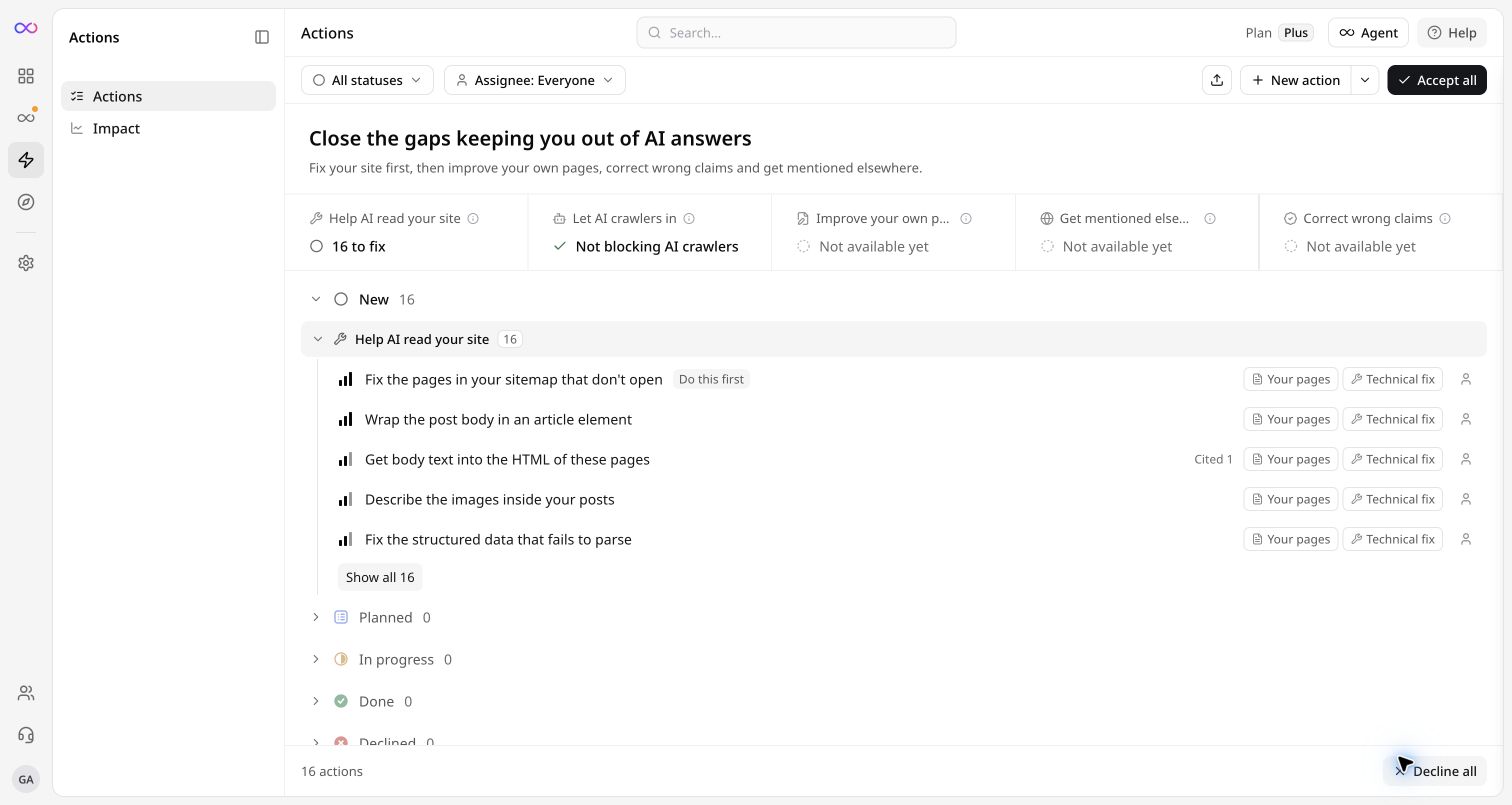
The Actions page displayed 16 technical recommendations. One sitemap finding marked 265 pages among 2,979 applicable checks as problematic; another 424 pages could not be assessed. A download-page example redirected to a 404 at a crawl recorded four days earlier.
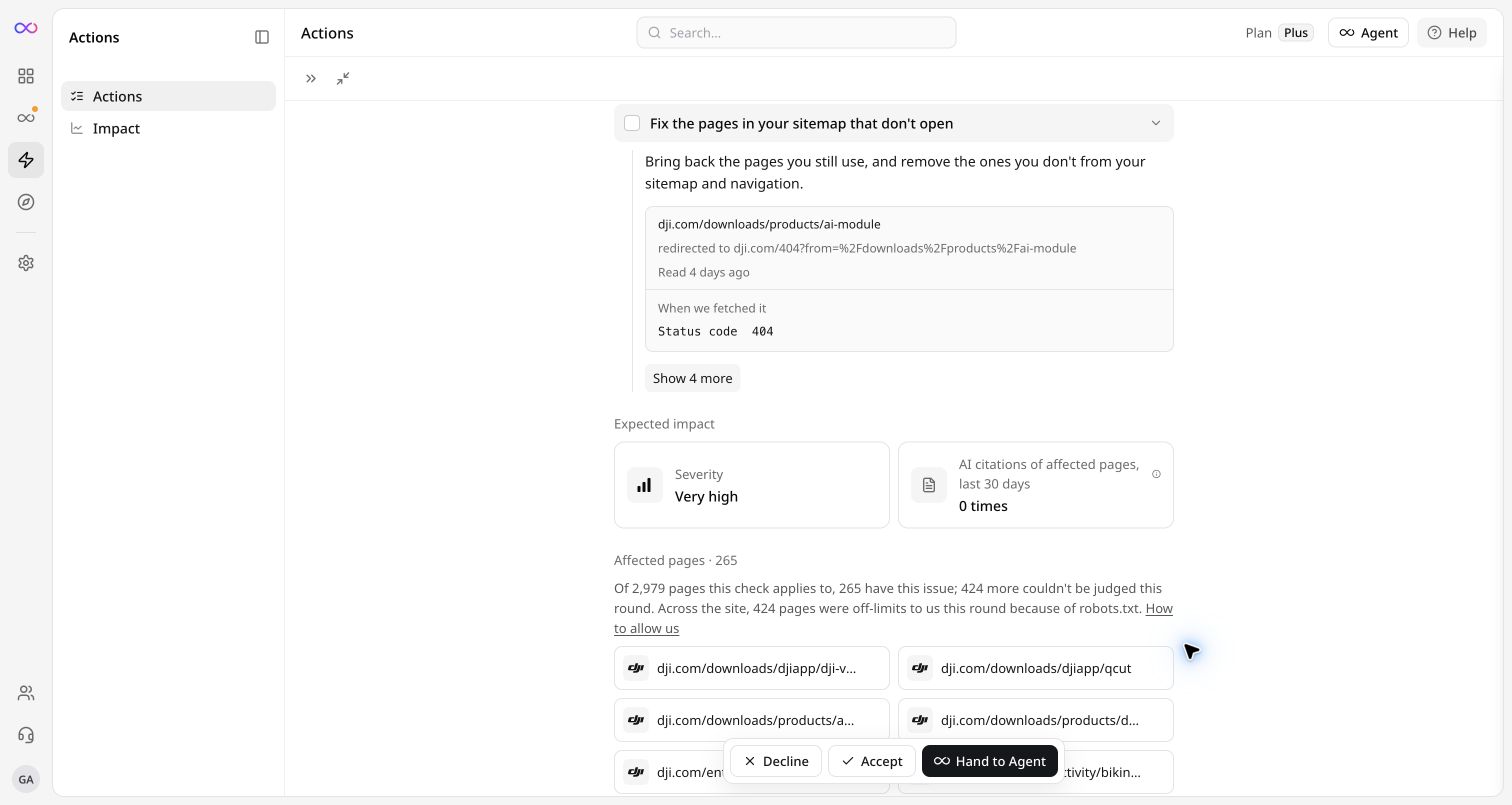
Restore pages that should exist; remove retired URLs from navigation and sitemaps; investigate restricted access separately. A failed scanner request does not prove that every AI crawler is blocked. Unknown checks are not confirmed failures. The affected-page citation count was zero over the displayed 30 days, so no numerical visibility gain can be promised from repairing them.
A four-week validation plan
| Stage | Work | Evidence to retain |
|---|---|---|
| Week 1 | Fix prompts, market, platforms and brand recognition; record a baseline. | Answers, citations, completed observations and relevant URLs. |
| Week 2 | Publish one focused application guide with verified product evidence; fix access issues affecting it. | Release date, version, method sources and page URL. |
| Week 3 | Inspect subsequent answers to the same questions. | Retrieval, citations, descriptions and unresolved gaps. |
| Week 4 | Compare equivalent samples and connect analytics or enquiries. | Coverage, metric definitions, business outcomes and next actions. |
Four weeks is a management cadence, not a time-to-results guarantee. Adding branded questions changes the sample rather than proving improvement. The interface also noted a late-October measurement change: check methodology before attributing a trend to content work.
Reproduce the workflow in GEOly
1. Register and verify the project
Create a GEOly account using an available sign-in option or work email, then follow verification prompts. If invited, use the invitation link and confirm the organization and project. A referral code does not grant project access. Consult the official registration guide for the current steps.
In Settings, verify the website, description, categories, products, services and personas. This context helps generate relevant candidates; the original answers still determine whether the hypothesis is useful.
2. Build a small question set
Under All prompts, use Add Prompt to enter the question, topic, tags and country. Start with buying, comparison and application tasks. For example: “Which camera drone is suitable for a beginner filming family trips?” or “Which thermal drone setup is suitable for monitoring irrigation problems on a farm?” These are teaching examples, not newly measured results.
Use the target market's language. Separate branded prompts about recognition and accuracy from non-branded prompts that test discovery before a buyer specifies a vendor.
3. Discover candidates from the business and market
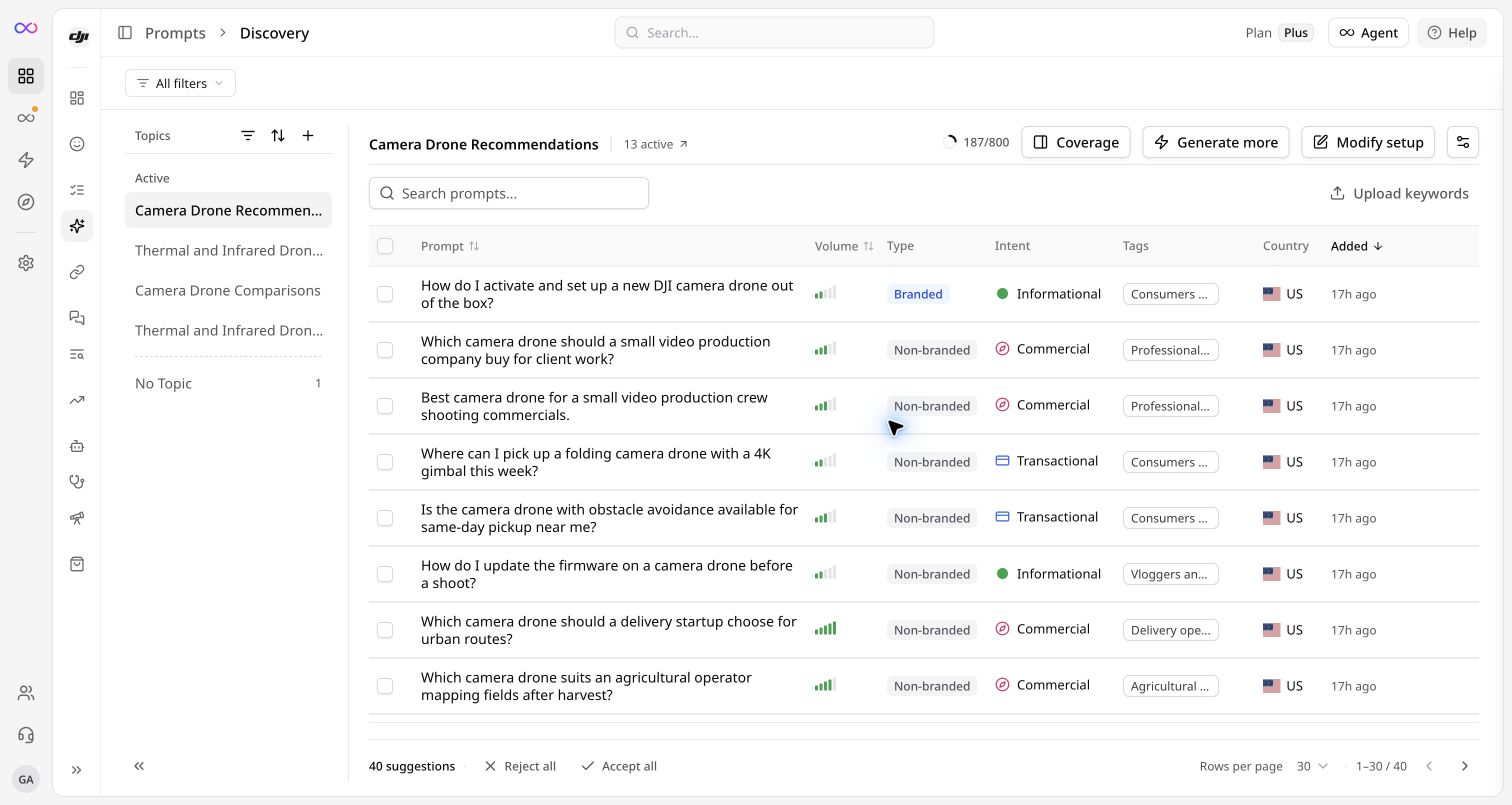
Discovery showed 13 active prompts for Camera Drone Recommendations and 40 suggestions. Candidates are not user-query logs or completed monitoring answers. In Modify setup, confirm products and personas first; changes there sync to the brand profile. DJI's profile spans camera drones, enterprise and agriculture, among other areas.
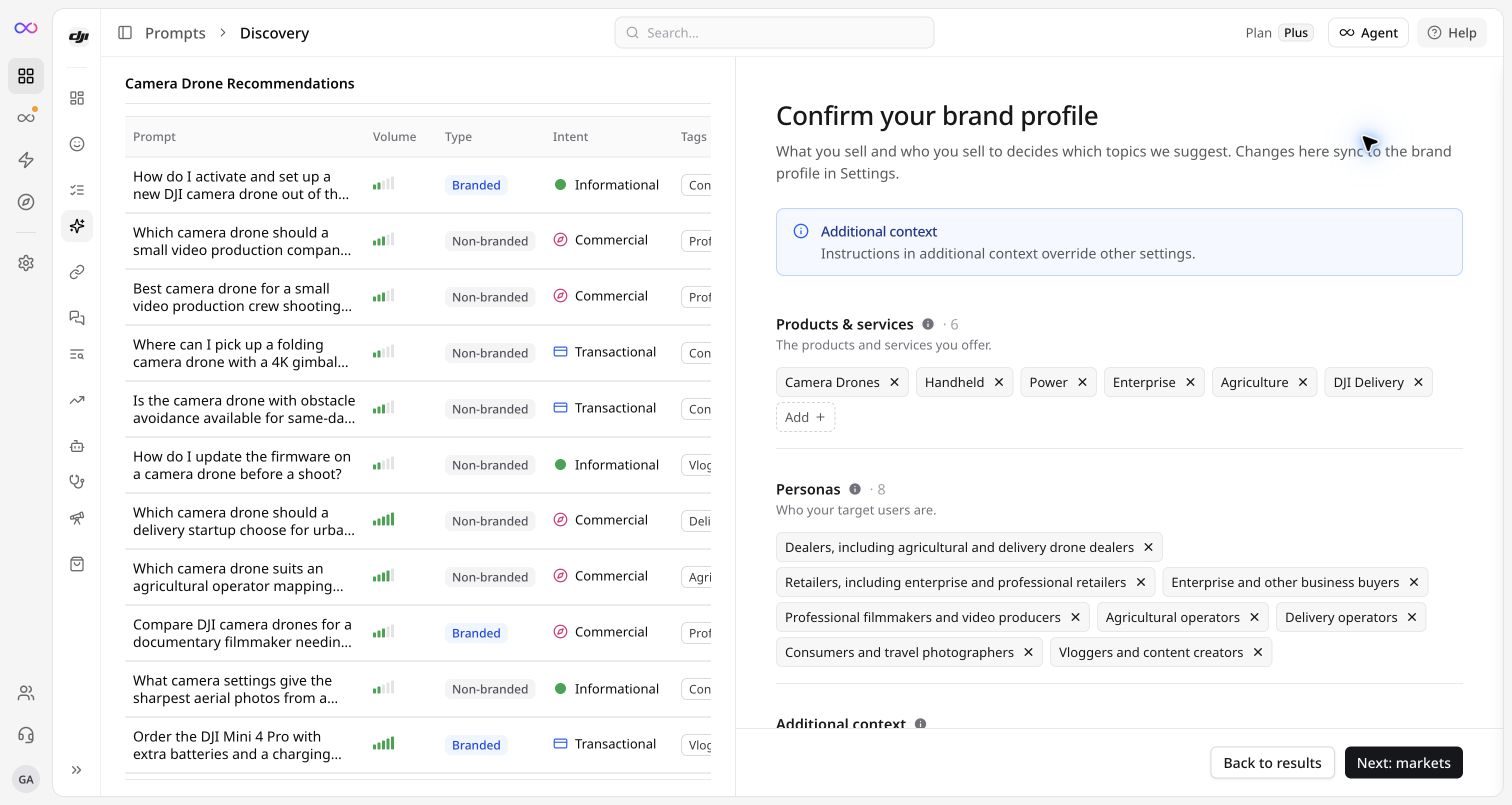
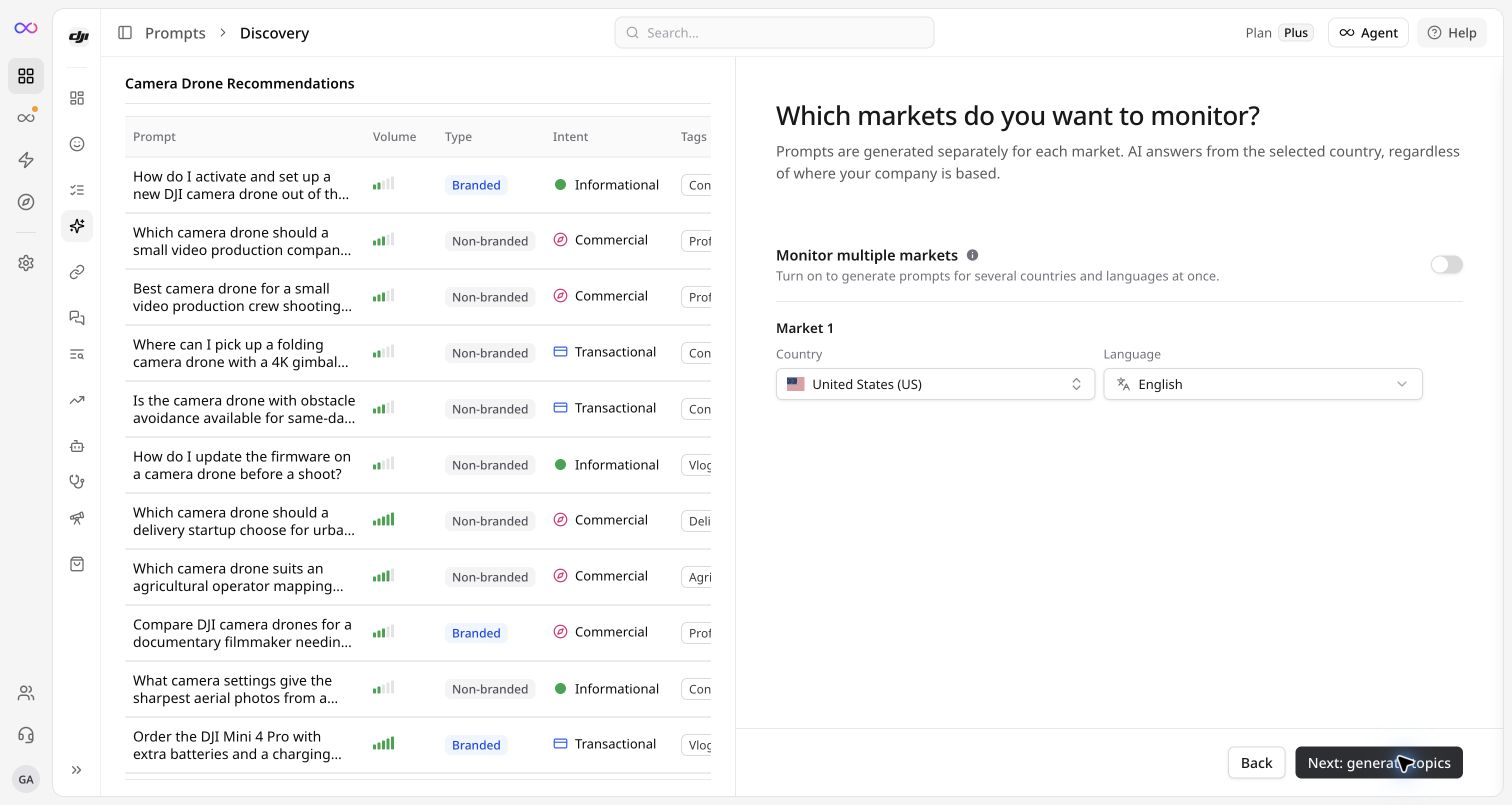
Next, define each market as country plus language. The observed setup was United States and English. Prompts are generated separately for each market; this is not the company's registration country.
4. Keep brand type separate from intent
Brand type asks whether a prompt names a brand. Intent asks what the user is doing. “How do I activate a new DJI drone?” is branded and informational. “Which camera drone should a small production company buy?” is non-branded and commercial. “Where can I pick up a folding 4K camera drone this week?” is non-branded and transactional. Transactional wording is a monitoring input, not an instruction to place an order.
5. Connect TOFU, MOFU and BOFU to useful pages
| Decision stage | Teaching example | Landing content |
|---|---|---|
| TOFU · Awareness | What capabilities matter for travel aerial photography? | Beginner guides, explanations and FAQs. |
| MOFU · Comparison | How should I choose between Mini 4K and Mini 3? | Model comparisons and scenario-based selection guides. |
| BOFU · Decision | What does the bundle cost, where is it available and when will it arrive? | Product pages, inventory, delivery and service terms. |
This is a teaching framework, not an observed customer journey. Informational intent is not always TOFU: activation and repairs happen after purchase. Users can enter at any stage. Assign brand type and primary intent independently, then check whether each important task has a useful destination page.
The 5% irrigation visibility and a comparison-heavy discovery topic are separate observations, not evidence that the same people moved through a measured funnel.
6. Set a candidate mix, then check actual coverage
The inspected Mix settings used 90% non-branded and 10% branded prompts, with 25% informational, 50% commercial and 25% transactional intent. Persona balancing was enabled across eight personas; Lean selected 40 prompts per topic and market. Other available sizes were 80, 120, 160 and 200.
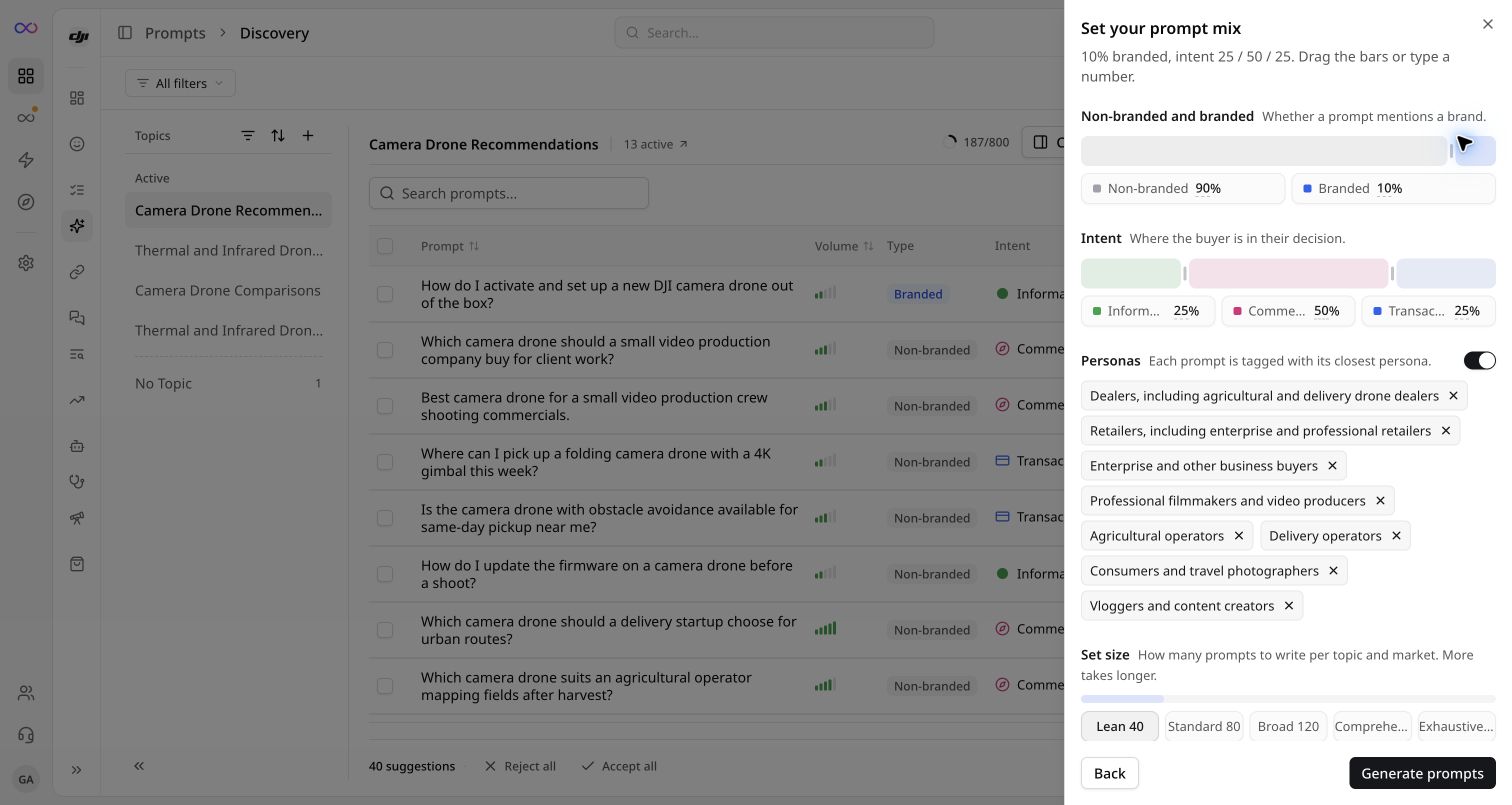
For 40 candidates, the arithmetic targets are about 36 non-branded and four branded, alongside ten informational, 20 commercial and ten transactional. Both classifications describe the same 40 prompts, not 80. Four topics and one market yield an estimated 160 candidates. These are targets, not a guarantee of exact generation counts, real-world demand distribution or funnel conversion rates.
The active topic had 13 prompts: 100% non-branded, 8% informational, 92% commercial and 0% transactional. Three of eight persona-country cells were covered.
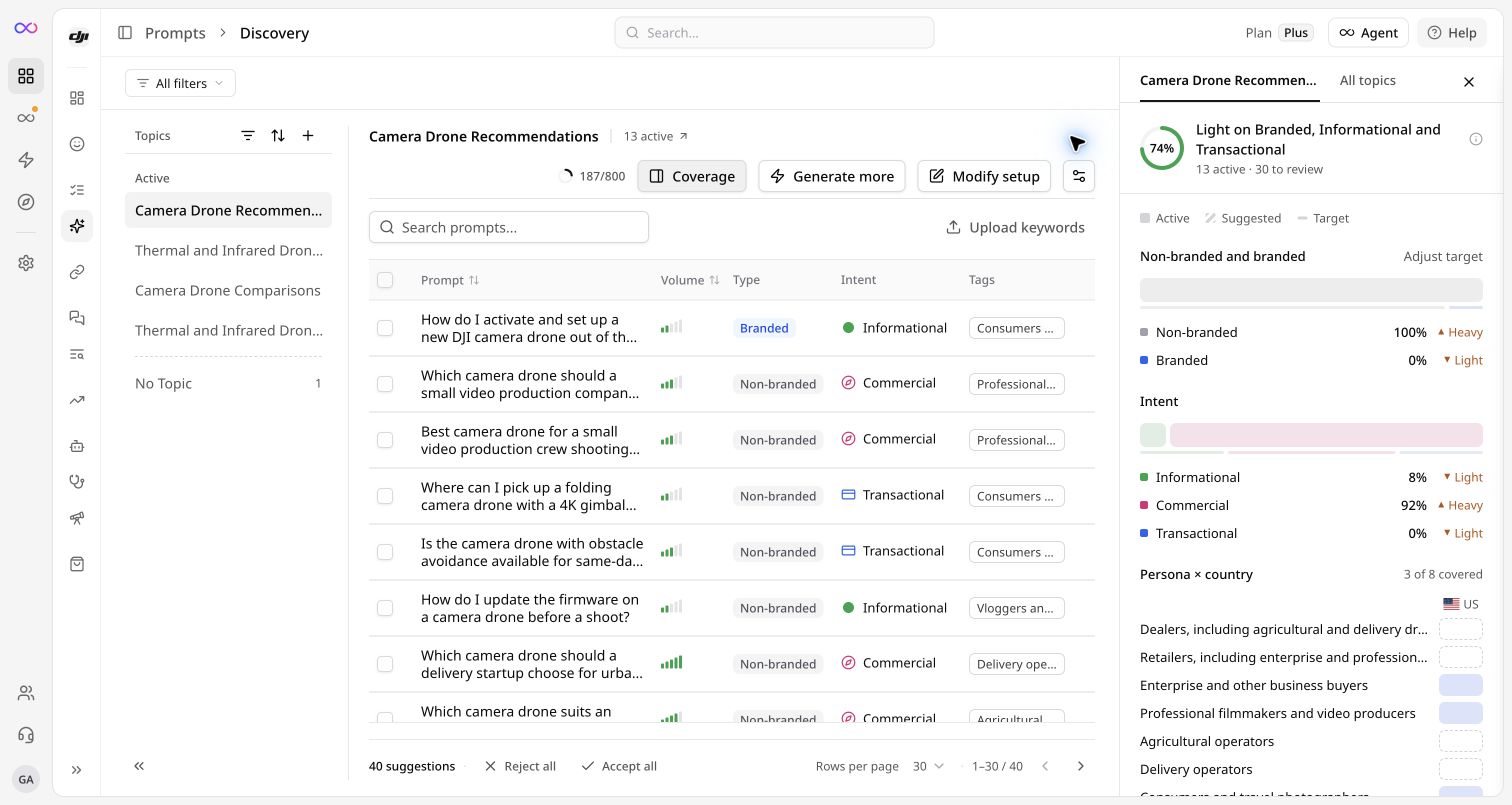
Review generated candidates for business relevance, market language and labels. Volume bars are not an exact monthly-search count. Accept selected candidates to add them to monitoring, then wait for collection. Generating suggestions alone does not collect answers.
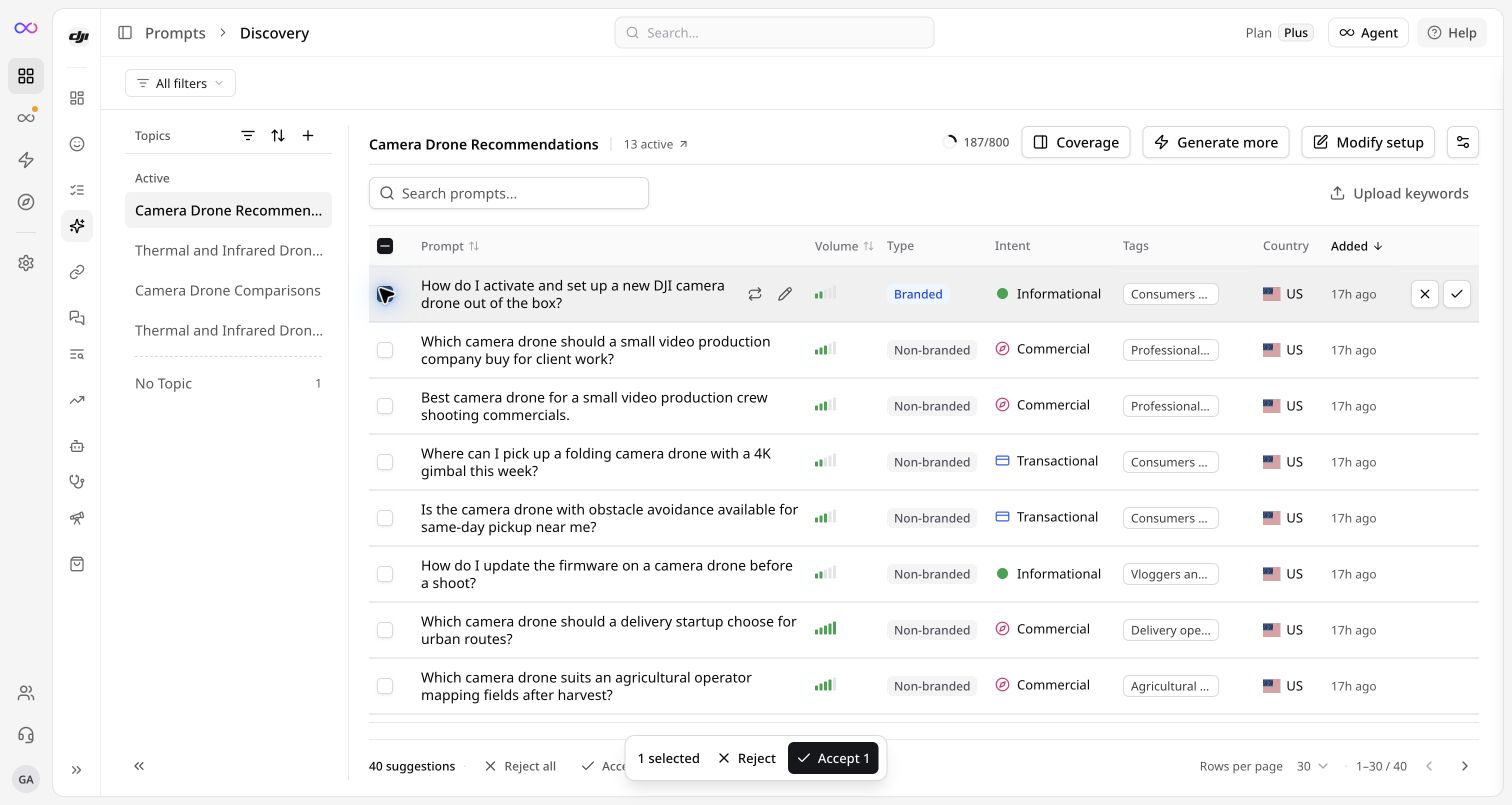
Keep the old prompt set as a stable baseline and record when new questions are added. Better coverage improves what you measure; changes in the aggregate may reflect sample composition rather than improved answers.
7. Move from answers to a responsible action
Open a prompt, inspect the original answer, distinguish citations from search results, and write a task with a specific page, missing evidence, owner, release date and validation method. Verify technical recommendations in Actions. The observed “Improve your own pages,” “Get mentioned elsewhere” and “Correct wrong claims” modules were marked Not available yet; the content proposals here are human recommendations.
Start with one useful question
Your brand may be highly visible in recommendations and absent from an important application. Create a project, add ten real customer questions, and inspect the first completed answers before choosing a content task.
Register with GEOly and establish your AI visibility baseline