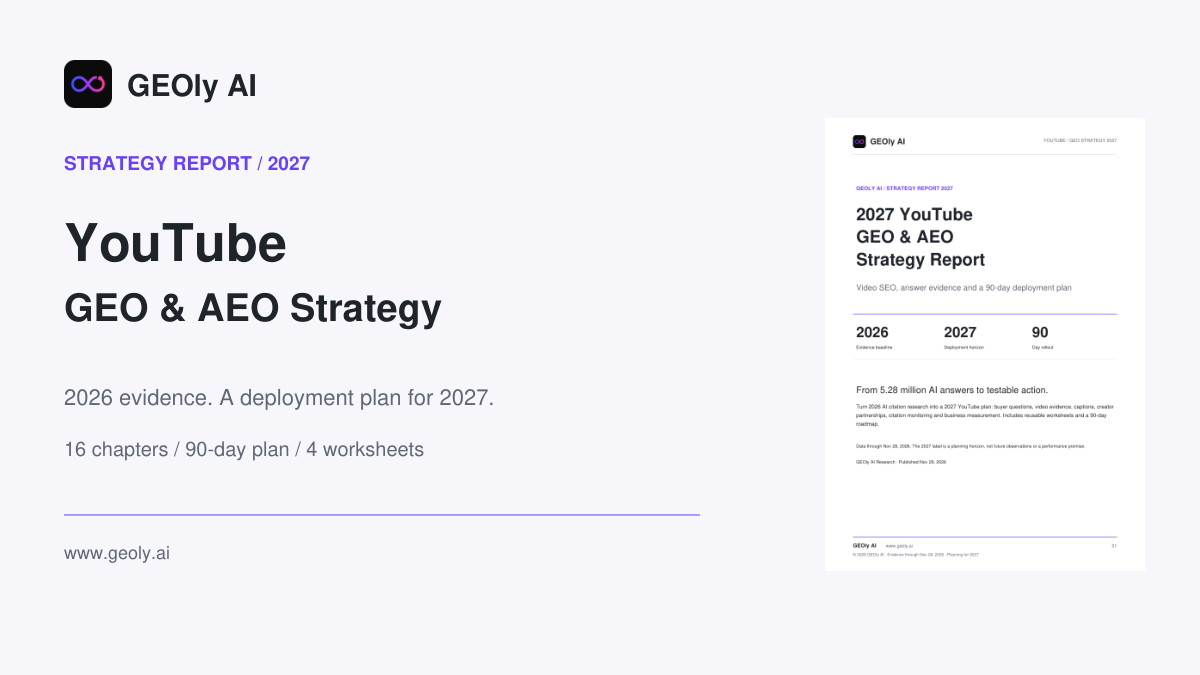
Download the complete PDF with four attached CSV worksheets
Download the PDF and open its ZIP attachment in a desktop reader supporting attachments. Strategy horizon: 2027. Research cutoff: November 28, 2026.
2026 evidence · A deployment playbook for 2027 · GEOly AI
Executive brief: make video useful evidence for a decision
YouTube GEO and AEO work should connect a real customer question to a verifiable video, then measure whether the intended AI answers cite it and describe the brand accurately. Native YouTube discovery, Google video discovery, AI citations and business outcomes are separate results. Views alone cannot demonstrate AI visibility.
This report uses observations through November 28, 2026 to propose a deployment plan for 2027. The year in the title identifies the planning horizon, not a future dataset or a prediction of algorithm behavior. It is intended for brands, agencies and content teams able to produce authentic product evidence and maintain published material.
Start with one category, market and primary AI platform. Fix a question panel, inspect the videos actually cited, create material for an evidence gap, and review source coverage, brand treatment and observable conversions separately. Expand only after the workflow produces reliable information.
The initial deliverables are a question map, video evidence inventory, reusable production brief, 90-day experiment and layered scorecard. All proposed cadences and quantities are planning choices, not optimal posting frequencies inferred from the study.
The 2026 baseline and what it can support
The research contains 5,275,954 eligible answers from 1,450 projects and 22,763,535 explicit citation records. That last figure includes all sources, including official brand sites. It is neither a unique-page count nor a third-party citation total. Published source rankings exclude official product and service brand domains.
Window | Eligible answers | Answers citing YouTube | Answer coverage |
|---|---|---|---|
Jan 1–Nov 28, 2026 | 5,275,954 | 687,033 | 13.02% |
Sep 1–Nov 28, 2026 | 2,131,985 | 184,434 | 8.65% |
September 2026 | 723,475 | 75,330 | 10.41% |
October 2026 | 760,152 | 61,628 | 8.11% |
November 1–28, 2026 | 648,358 | 47,476 | 7.32% |
YouTube ranks behind Reddit year to date but leads the September-onward aggregate. This supports investigating video opportunities. It does not establish a universal budget allocation or prove that declining monthly coverage was caused by content quality or a platform penalty.
Coverage means answers explicitly citing youtube.com divided by all eligible answers in that window, deduplicated within each answer. Multiple domains can occur in one answer, so their coverage percentages cannot simply be added. YouTube may host official brand channels, independent creators and sponsored work; the domain-level data does not separate their contributions.
Build a platform-specific plan
AI platform | September YouTube coverage | November 1–28 coverage | First investigation |
|---|---|---|---|
ChatGPT | 0.22% | 0.12% | Do target questions cite videos? |
Gemini | 2.75% | 1.57% | What role does the cited video play? |
Google AI Mode | 18.48% | 10.60% | Which comparison and how-to answers use video? |
Google AI Overviews | 56.01% | 40.99% | When does an overview show a video source? |
Each percentage has its own platform-and-month denominator. This sample suggests investigating the two Google AI experiences, but it does not establish the same priority for every category. Project and question composition still vary within platforms.
Run your commercially important questions and retain the answer, cited URL, collection time, market and settings. If videos rarely appear, check sample size and collection capability before allocating a large AI-citation budget. Video may still be valuable to viewers, but that is a distinct objective.
Historical Perplexity and Copilot answers produced no records meeting this study's explicit-citation filter, although eligible answers remained in the aggregate denominator. This is a collection/parsing limitation, not evidence that those products never cite sources. Reconfirm available monitoring coverage and parser versions before a 2027 deployment.
Keyword research: build a purchase-question map
GEO refers to improving visibility in generative search experiences; AEO concerns answer-oriented experiences. This playbook treats YouTube SEO as native discovery work and GEO/AEO as the investigation of cross-platform answers. These labels are not proof of separate ranking factors.
Build a candidate pool from support questions, onsite search, sales conversations, available YouTube search terms and observed AI citations. Do not invent search volumes for unavailable data. Cluster alternate phrasings around a shared need instead of commissioning nearly identical videos for every variation.
Intent | Hypothetical question | Evidence needed | Video task |
|---|---|---|---|
Discovery | What fits a small space? | Constraints and suitability | Explain selection conditions |
Comparison | How do A and B differ at night? | Comparable test conditions | Demonstrate trade-offs |
Validation | Does the specification hold in practice? | Measurements and method | Reproduce a test |
Setup | Is this configuration compatible? | Version and interface | Prevent a failed installation |
Maintenance | What should I check first? | Diagnostic sequence | Explain a safe next step |
For every topic, record market, language, product generation, decision stage, exact question, cited pages, available materials, evidence gap, owner and review date. Rank by business relevance and ability to contribute evidence. An editorial high/medium/low priority is useful; calling it an AI algorithm score is not.
A content portfolio with a defined job for each asset
Develop durable decision material, procedural demonstrations and version-sensitive corrections. The first two create reusable evidence; the third prevents outdated information from persisting. A substantive update should change evidence or guidance, not merely replace a year in the title.
Comparison videos should explain who benefits under which conditions and what cannot fairly be compared. Tests should retain equipment, environment, sample size, uncertainty and failed outcomes. Setup material should show prerequisites, important steps, common faults and stopping conditions.
Use long-form video when the method and limitations require depth. A short can answer a self-contained question or point viewers toward the full explanation. This is an editorial division of labor: the research did not compare Shorts, long-form or live-stream citation effectiveness.
Maintain one primary asset for each substantive topic, with language variants and excerpts where useful. Increase output only when evidence review and maintenance capacity can support it. A larger library of nearly duplicated material is not the same as broader problem coverage.
A production brief and an answer-oriented script
Before filming, specify the target question, audience, conditional conclusion, evidence source, method, test date, product version, limitations, commercial relationship and reviewer. Confidence of delivery cannot substitute for missing measurements.
A hypothetical opening might be: “For continuous use in a small space, first check condition X. We tested version Z in environment Y and observed A. We cannot extend that result to condition B. Here is the method, comparison and selection trade-off.” Replace every placeholder with verified information and remove unsupported statements.
A useful script sequence is conditional answer, intended audience, method, result and counterexample, trade-offs, limitations, and access to supporting material. It is designed for comprehension and checking, not presented as an experimentally validated citation formula.
Keep the conclusion near its essential conditions. Do not let captions omit a limitation stated in narration, or let the thumbnail turn a qualified finding into a universal promise. Have a reviewer unfamiliar with production restate the finding; revise if important qualifications disappear.
YouTube SEO: titles, descriptions, captions and chapters
YouTube describes relevance, engagement and quality as search considerations. Match the title and actual content to the viewer's question. This does not establish that AI citation selection uses identical signals. See how YouTube search works.
Lead titles with the substantive question and constraint: “Device A vs B: small-room night-use test and limitations.” Reserve GEO/AEO terminology for marketing education rather than inserting it into ordinary buyer videos. Use 2027 only where the content genuinely concerns that year or has been substantively updated.
Make the description useful on its own, then add methods, versions and relevant supporting links. Tags generally have a limited discovery role and can help with misspellings; keyword stuffing is not a core production task. See video settings.
Review names, model numbers, units, negatives and measurements in captions. YouTube recommends checking automatically generated captions. Localized versions need review of regional models and units, not only language. See automatic captioning.
Manual chapters start at 00:00, require at least three ascending timestamps and a minimum ten-second chapter length, subject to feature access. Give each chapter a meaningful task label. Chapters and captions aid navigation; this study did not establish a direct citation lift. See video chapters.
Google video discovery and supporting web pages
For videos you own or have permission to embed, consider a dedicated watch page with test context, findings, limitations and corrections. These owned pages are execution assets; they are excluded from this report's third-party domain rankings.
Check that the page and player are accessible and the video is prominent. Where applicable, provide accurate VideoObject information for the real hosting arrangement. Do not substitute a YouTube watch URL for a direct media-file URL. Markup does not guarantee a particular search appearance. See Google video SEO guidance.
Connect relevant guides, comparisons and support pages through useful internal links. Label language, product and version applicability. Avoid creating multiple near-identical pages for the same need. When findings change, update the explanation and version record along with related video descriptions.
Google does not require special AI markup. Check eligibility and useful content on pages you control, and do not label overall Search Console results as an isolated AI-product metric. See AI features and your website.
Creator partnerships: commission work, not a conclusion
Evaluate relevant testing expertise, audience fit, demonstrated evidence, production quality, maintenance habits, disclosure and licensing needs. Follower count is context, not a probability of AI citation.
Provide factual materials, reasonable testing time and technical answers while preserving the creator's assessment. Agree on factual corrections, retained evidence and updates to obsolete claims. Do not require hidden weaknesses or guaranteed citations from a system neither party controls.
Disclose qualifying commercial relationships using YouTube's paid-promotion tools and clear contextual explanation; participants should also check applicable obligations. See YouTube's paid-promotion guidance. Sponsored work can contain useful evidence, but it should not be silently classified as independent endorsement.
Account for paid distribution separately. Advertising-driven views or sales may have value, but do not automatically become organic citation gains. A procurement promise about views must not be relabeled a guarantee of AI recommendations.
Publishing and maintenance operating procedure
Before publication, verify the question-to-evidence fit, measurements, limitations, captions, translation, links, chapter timing, thumbnail promise, commercial relationship and review owner. Mark only checks that genuinely passed.
At publication, log the public URL, video ID, version, language, market, question cluster, support page and release date. Group tracking variants under the same asset while retaining timestamp and path information needed to inspect a citation.
After release, first confirm accessibility and accuracy. Then inspect native discovery, viewer questions and monitored AI answers. Distribute through relevant channels you control, without treating distribution volume as an outcome. Apply corrections to the description, captions, supporting pages and internal inventory.
Review when products or software change, availability shifts, an important limitation emerges, viewers repeatedly misunderstand a claim, or cited answers become inaccurate. Preserve correction history. Do not manufacture an update merely to refresh a date.
Measure four layers of outcomes
Layer | Measures | Evidence or denominator | Does not substitute for |
|---|---|---|---|
Content quality | Evidence, caption accuracy, updates | Editorial acceptance record | AI citations |
Native discovery | Available search, viewing and retention metrics | Consistent platform definitions | Answer coverage |
AI visibility | Target-video citations and brand treatment | Fixed question panel and raw answers | Visits or sales |
Business | Visits, inquiries, conversions and cost | Verifiable analytics and CRM | Unobserved influence |
Target-video coverage is the number of answers citing a defined video-URL set divided by eligible answers in the same panel. Also report any-YouTube coverage so a channel-wide change is not claimed as a gain for your own assets. Classify brand treatment as recommendation, comparison, limitation, negative or unknown, retaining the relevant sentence.
Deduplicate within an answer and reconcile observed URL forms by video ID where possible. If only a domain is available, record unknown video or author. Do not attribute it to a partner. A retrieved source list is not automatically an explicit citation in the answer.
Use tracking parameters on links you control, while acknowledging that they do not recover journeys with no click. Separate directly attributable outcomes from unknown attribution. Missing clicks do not prove no influence, but they also do not justify inferred revenue.
Experiment design and decisions
Choose a question cluster and specify the primary metric and decision threshold before intervention. Fix country, language, platform, question text and collection settings. Retain comparable questions without the same intervention and log concurrent product, advertising and media changes.
Establish a continuous baseline, publish, then repeat observations. Duration depends on volume, market and discovery delays; there is no universal seven-day effect. Repeated answers cluster by question, date and project and should not be treated as fully independent observations.
A teaching example: treatment coverage changes from 4% to 7%, while comparison coverage changes from 3% to 5%. The difference in changes is one percentage point: (7−4)−(5−3). This is not a measured customer result, and the calculation alone cannot establish causality without adequate comparability and observation.
Expand when improvements recur and editorial quality remains sound. If source coverage increases without better brand treatment, inspect whether the evidence supports the intended claim. Extend observation when the sample is sparse or unstable. Do not select a single favorable answer as proof of general success.
A 90-day rollout, ownership and resourcing
Period | Work | Owner | Acceptance deliverable |
|---|---|---|---|
Days 1–14 | Question map, baseline and inventory | Growth and analytics | Stable panel and evidence register |
Days 15–30 | Briefs, testing and creator selection | Editorial and product experts | Reviewed methods and materials |
Days 31–60 | Production, captions, pages and release | Video, editing and SEO | Accessible assets and release log |
Days 61–90 | Rechecks, brand review and attribution | Analytics and business owner | Continue, revise or stop decision |
A small team can combine roles but should explicitly assign factual review and business evaluation. Expand into additional markets with local verification, rather than copying untested topics at scale. Reduce scope if the team cannot maintain what it publishes.
Budget separately for research, testing, production, captions, localization, technical support, monitoring and maintenance. Estimate from real effort and supplier quotes. The study does not provide a defensible industry price benchmark or a universal channel budget percentage.
The 2027 quarterly roadmap and FAQ
Q1 establishes the baseline and completes the first trial. Q2 extends validated methods into adjacent questions. Q3 reviews product versions, languages and market differences. Q4 separates maintenance value, platform movement and business outcomes before planning 2028. Recheck official guidance at the start of each quarter.
Is YouTube necessary for AI recommendations? The sample cannot establish that. Inspect your own target answers. Do captions or schema guarantee citations? No such intervention was tested. Is an official brand channel third-party? The destination is a video platform, but the author can be a brand; classify authors separately.
Should every title say 2027? Only when the content genuinely serves that planning year or has been updated. What if views grow but citations do not? Evaluate native user value separately. Can a supplier guarantee ChatGPT citations? Commission controllable work and verifiable observations rather than a ranking outcome.
Reusable worksheets
Production brief: question, market, language, task, conditional conclusion, evidence, method, version, date, limitations, caption reviewer, commercial relationship, support page and review date.
Citation audit: question ID, time, AI platform and settings, raw answer, explicit URL, video ID, author classification (brand/independent/sponsored/unknown), supported claim, brand presence, accuracy and reviewer.
Weekly scorecard: eligible answers N, target-video citing answers n, n/N coverage, collection changes, brand-treatment changes, corrections, attributable outcomes, unknowns and next priority. Missing or zero-size samples are “no data,” not 0% performance.
Decision log: hypothesis, original metric, intervention and date, comparison setup, result with denominator, concurrent changes, evidence strength, continue/revise/stop and next review. A downloadable blank CSV workbook bundle accompanies the report; it contains no invented results.
Methodology, limitations and further reading
Published by GEOly AI on November 29, 2026 for deployment planning in 2027. Observations cover January 1–November 28, 2026 in Asia/Shanghai; the recent window begins September 1. The year and Q4 are incomplete.
The eight largest projects contribute 62.60% of annual and 67.50% of recent answers. This is a business-monitoring convenience sample, not a global random sample. Project, industry and question mixes vary. Removing official brand domains does not remove those biases. Domain citations do not establish author independence or the causal contribution of duration, captions or a particular passage.
Read the 2026 Third-Party AI Search Sources Report for the underlying definitions and aggregates, and the 2027 Reddit GEO Strategy Report for community work. Official sources are linked where used and were checked November 29, 2026; rules may change before execution.
Use GEOly AI to establish a question and citation baseline within the collection scope available to your account. Research identifies candidate opportunities; your own evidence and business outcomes determine the deployment plan.