The finding: the same channel budget can reach very different AI answers
Should the next content or communications investment go to Reddit, YouTube or specialist review publishers? A single global leaderboard cannot settle that decision.
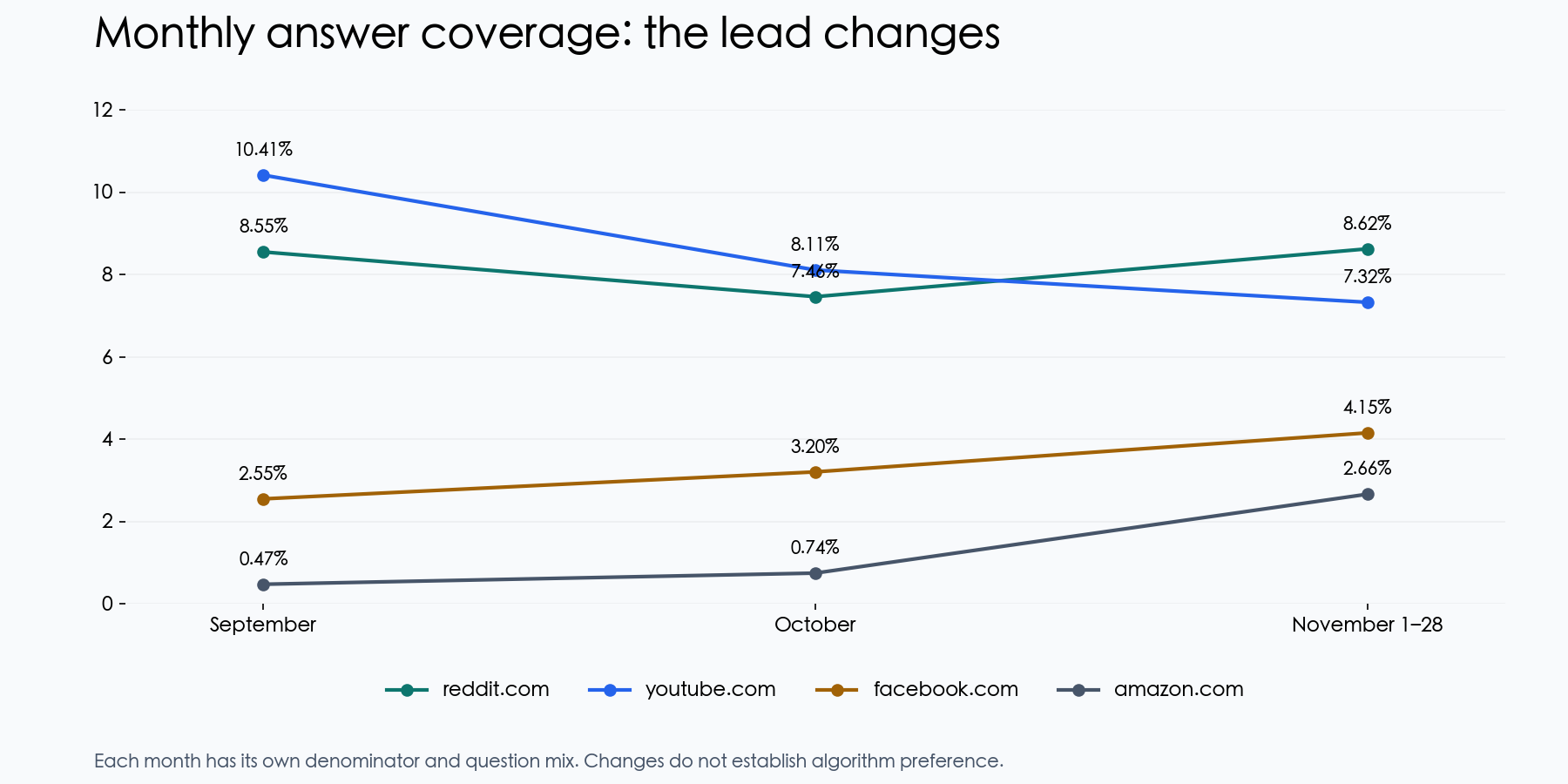
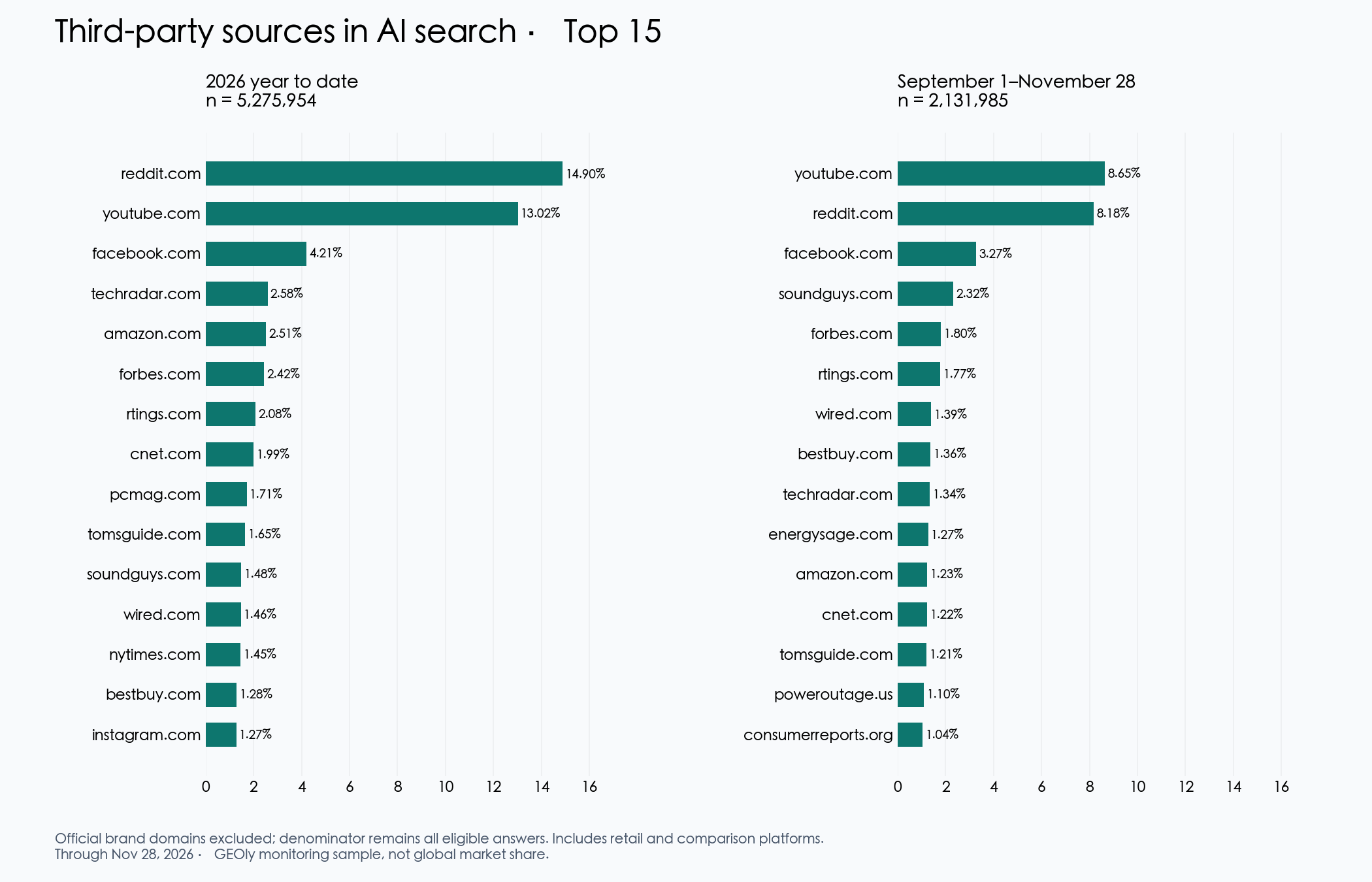
GEOly examined 5,275,954 eligible answers from 1,450 projects, containing 22,763,535 explicit citation records, through November 28, 2026. Reddit leads year to date at 14.90% answer coverage, ahead of YouTube at 13.02%. Since September, YouTube leads at 8.65% versus Reddit's 8.18%. In November through the 28th, Reddit moves ahead again.
The same destination can also move in opposite directions across platforms. That is a reason to connect channel planning to the engine and purchase question you want to influence.
The 22.76 million figure counts citation records from all sources, including official brand sites. It is not a count of unique pages or third-party citations. The rankings and examples here focus on third-party destinations and exclude official brand domains. The research describes a business-monitoring sample. The strategies below are recommendations derived from that evidence, not experimentally demonstrated growth effects.
Download the 2026 Third-Party AI Search Sources Report for the rankings, figures and methodology. Here is how we would translate the evidence into five decisions worth testing.
1. Allocate channels by platform and purchase question
Between September and November, Reddit answer coverage rises from 9.76% to 14.04% in Google AI Mode while falling from 3.34% to 1.41% in ChatGPT. These observations neither mean that ChatGPT ignores Reddit nor establish an algorithm change.
They suggest a practical budget decision: build a platform-by-question plan. Separate discovery, product comparisons, compatibility and setup questions. Then inspect which third-party pages repeatedly appear in the relevant engine's recent answers.
If the objective is to influence ChatGPT comparison answers, investigate those answers first. Do not import a cross-platform channel ranking unchanged. Start with a bounded test around one group of questions before reallocating the entire content budget.
Keep the platform, country, language and question panel consistent during evaluation. When source coverage changes, also check whether the brand is mentioned and how it is described.
2. Put specialist reviews on the shortlist—and supply verifiable evidence
In the September-onward third-party ranking, SoundGuys appears in 2.32% of eligible answers and RTINGS in 1.77%. Specialist review destinations appear alongside the large social platforms.
This does not tell us how much revenue a review generates. For a relevant category, it does suggest checking whether the cited page is a test, comparison or buying guide, and which customer uncertainty it addresses.
The content action is to make independent evaluation easier. Prepare test conditions, measurements, compatibility boundaries, meaningful differences, limitations and suitable use cases. Allow editors or creators to assess that evidence independently. Paid placement and sponsorship should not be presented as independent endorsement.
For example, if important questions repeatedly concern a performance limitation, a reproducible test may be a useful contribution. This is an editorial example, not a customer outcome measured in the study. The result still needs to be tested in your own question panel.
3. Organize video around a decision that needs demonstration
YouTube covers 8.65% of eligible answers in the recent aggregate. Within Google AI Overviews, coverage is 56.01% in September and 40.99% in November; in ChatGPT, the corresponding values are 0.22% and 0.12%. Each percentage has its own platform-and-month denominator.
The implication is to assess video alongside the target engine and question type. The evidence does not justify doubling video investment for every brand.
Start with questions where seeing a process could help: installation, real operating conditions, comparisons or diagnosing a failed task. Make the question explicit, explain the conditions and limitations, and provide chapters and supporting text that help people find the relevant material. The research does not establish that chapters or transcripts increase citation probability.
Also distinguish the platform from its authors. YouTube can host official accounts and sponsored work. Domain-level statistics do not identify independent creator contribution. Check authorship and commercial relationships separately when planning creator partnerships.
4. Maintain a channel portfolio that can change with the evidence
Observation window | Reddit answer coverage | YouTube answer coverage |
|---|---|---|
Year to November 28 | 14.90% | 13.02% |
September | 8.55% | 10.41% |
October | 7.46% | 8.11% |
November 1–28 | 8.62% | 7.32% |
The cumulative and monthly rankings answer different questions. Leading in October does not guarantee leading in November. Being first year to date does not imply leadership in every recent window.
Separate ongoing channel work from small experiments. Maintain destinations that repeatedly supply relevant evidence for your own important questions. Investigate newly appearing sources through bounded content or partnership tests. This study does not support a universal percentage allocation between community, video and publishers.
Before changing a budget, check whether the project roster, questions, platform mix or parser changed. A shifted sample can create a shifted ranking without any change in the effectiveness of your content.
5. Give citations, recommendations and revenue separate measures
A citation is not necessarily a brand recommendation. A mention can describe a limitation. A positive recommendation does not guarantee a visit or purchase.
Track three layers separately: source and brand coverage within the target questions; the actual language, use cases and comparisons in the answer; and observable visits, inquiries or conversions. Do not add domain coverage rates into a probability of brand recommendation: the same answer can cite multiple domains.
Consider a hypothetical review campaign. Answers citing the publisher increase, but those answers still discuss only other products. That is a source-coverage change, not demonstrated brand growth. Conversely, more accurate brand descriptions without traceable visits should be reported as a different outcome, not attributed revenue.
Keep before-and-after observations on a stable panel. Where feasible, use comparable untreated questions to help evaluate the hypothesis. The research behind this article did not run such an intervention experiment.
A 30-day plan for testing the strategies
This is a suggested working cadence, not a promise of growth. Longer buying cycles or insufficient sampling require a longer observation period.
Stage | Team action | Deliverable |
|---|---|---|
Week 1 | Choose valuable purchase questions and fix collection settings | Question panel and baseline answers with cited URLs |
Week 2 | Inspect source roles, evidence and brand treatment | Evidence gaps and candidate channels by question |
Week 3 | Address one evidence gap through a content or partnership test | A verifiable content deliverable and change log |
Week 4 | Recheck the same panel and observable business outcomes | Separate reporting of sources, brand treatment and business results |
If the sample is too small, the questions change or there is no clear improvement, retain uncertainty and continue observation. Do not select an attractive percentage from normal fluctuations.
Download the research, then build your own baseline
The eight largest projects contribute 62.60% of year-to-date answers and 67.50% of recent answers. Removing official domains does not remove that concentration or its question mix. Use global research to discover candidates, then validate investment against your business questions.
Download the complete third-party source report for the Top 15, monthly and platform data, and definitions. Observations end November 28, 2026; the year and Q4 are incomplete.
For implementation, use the third-party source investigation checklist, or start brand monitoring in GEOly AI with the questions your customers actually ask.