Keep your eyes on the path, but your heart on the big picture.
Hi everyone, I’m Riven.
This article is about 4,000 words. Reading time: 10 minutes. Thanks for your time.
Foreword
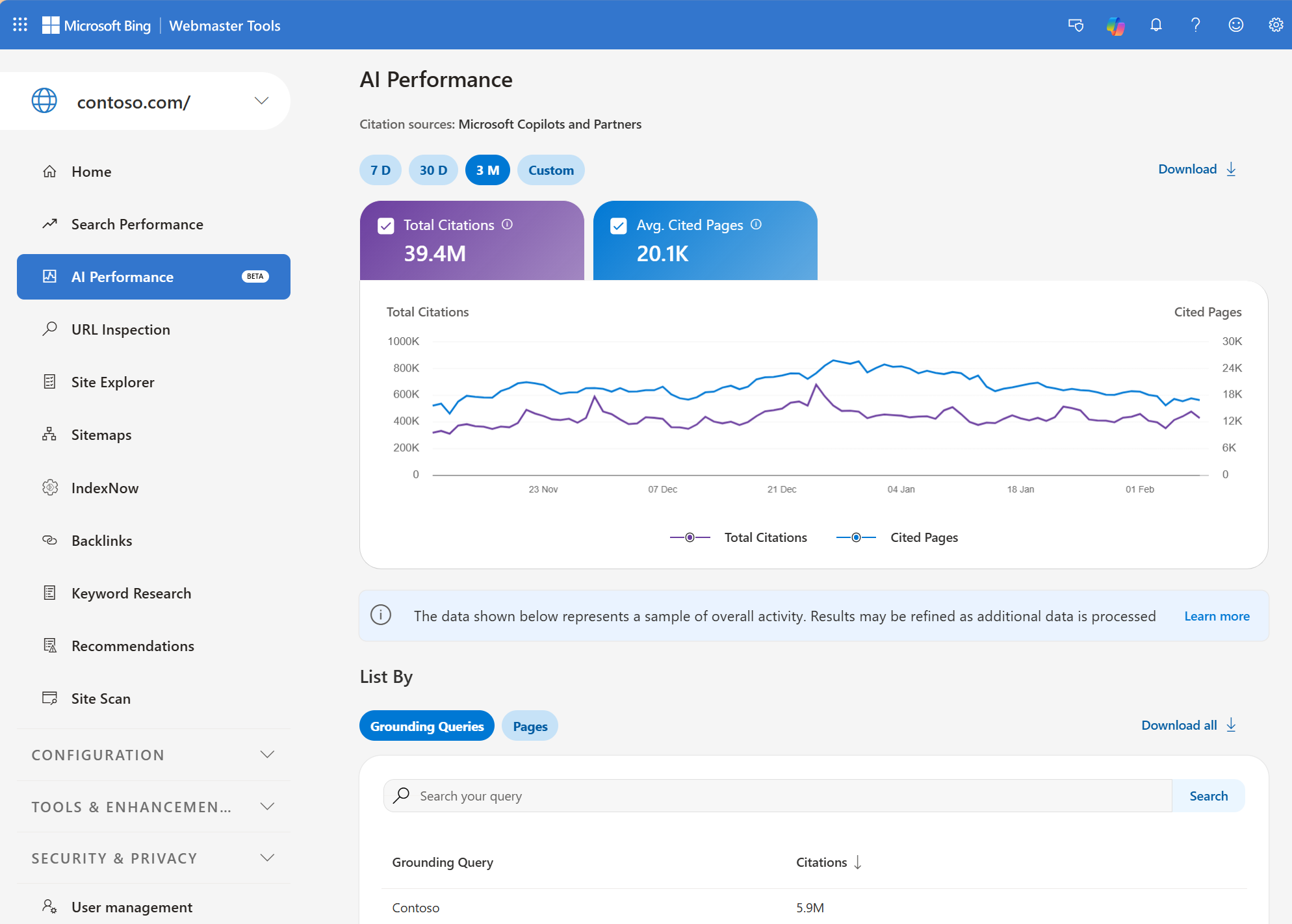
On February 10, 2026, Microsoft officially launched the public preview of the AI Performance section in Bing Webmaster Tools.
This is the first time the search industry has provided data transparency for AI citations to website owners.
As a long-time SEO professional, my first thought was: The GEO era has officially arrived.
In the past, SEO was about rankings, clicks, and impressions in Google Search Console. Now, Bing tells you exactly how many times your content was cited in AI-generated answers.
This is more than just data—it’s the definitive merger of search engines and AI engines. In this post, I’ll break down Bing AI Performance for you.
1. What Exactly is AI Performance?
1.1 The AI Experiences Covered
AI Performance tracks data across three major scenarios:
- ✅ Microsoft Copilot
- ✅ Bing AI Captions (AI answers on the search results page)
- ✅ Partner AI Integrations (Third-party AI platforms)
In short: it tracks how often your website content is used as a source when these AI systems generate an answer.
The difference between traditional SEO and GEO:
- Traditional SEO: User searches → Sees your link → Clicks to your site.
- AI Era (GEO): User searches → AI generates an answer → Your content is cited (with or without a click).
1.2 Why Launch This Now?
AI search is no longer a concept; it’s our reality:
- ChatGPT handles hundreds of millions of queries daily.
- Google SGE is live in the US.
- Perplexity and Claude are rising fast.
Microsoft realized that without providing citation data, the content ecosystem would collapse. Why would creators keep writing if they didn't know AI was using their work?
2. Deep Dive: 5 Core AI Performance Metrics
I’ve broken down these metrics into five dimensions:
2.1 Total Citations
- Definition: The total number of times your content appeared as a source in AI answers within a specific timeframe.
- Value: This is the "Total Clicks" equivalent for GEO. Use it to track your AI visibility over time.
2.2 Average Cited Pages
- Definition: The average number of unique URLs from your site cited by AI daily.
- Value: This measures your content's breadth. If this number is low, only a few pages are doing the heavy lifting.
2.3 Grounding Queries
This is the most valuable metric!
- Definition: Samples of the actual queries AI used when it searched for and cited your content.
- Value: It reveals AI's retrieval logic. For example, you wrote about "3D printing fixes," but the AI found you through the specific query "how to fix 3D printer layer shifting."
2.4 Page-Level Citation Activity
- Definition: Citation counts for each individual URL.
- Value: Identifies your "AI Star Pages." Analyze these to see what content structure works best for AI.
2.5 Visibility Trends Over Time
- Definition: A graph showing how your citations change over time.
- Note: Microsoft notes these trends are observational. You can't always link a 50% jump to one specific update, but you should monitor the patterns.
3. How to Read Your AI Performance Data
Let’s say you run a Shopify store selling essential oils (like the "Nikura" case study I did earlier). Your data looks like this:
- Total Citations: 5,000
- Average Cited Pages: 50
- Top Grounding Query: "benefits of lavender oil for sleep"
What does this tell you?
- Your AI Visibility is Solid: You have authority in the AI's eyes.
- Growth Potential: If you have 200 blogs but only 50 are cited, 75% of your content isn't "AI-friendly" yet.
- Core Topic Authority: "Sleep aid" is your winning topic. Double down on it.
4. 5 Practical GEO Strategies
Strategy 1: Rewrite Headlines Based on Grounding Queries
- Traditional SEO:
Lavender Oil Benefits - GEO Optimization:
How Does Lavender Oil Help With Sleep?(Matches the question-based logic AI uses).
Strategy 2: Add an FAQ Section
Add an FAQ section at the bottom of every page with Schema Markup. This makes it incredibly easy for AI to "scrape" and cite your answers.
Strategy 3: Increase Content Depth
Cited pages usually have:
- ✅ 2,000+ words.
- ✅ Clear tables or lists.
- ✅ Citations from authoritative sources (.gov, .edu, or research papers).
Strategy 4: Optimize Image Alt Text
AI "reads" Alt text to understand the context. Instead of just lavender, use Lavender essential oil bottle for sleep and anxiety relief.
Strategy 5: Build Content Clusters
Build a "Pillar Page" for a main topic and link it to multiple "Cluster Pages" that cover sub-topics. AI loves "Topic Authority."
5. Impact on E-commerce SEO
- Blog Value Skyrockets: For many successful stores, 96% of organic traffic now comes from informational blogs because AI prefers them over product pages.
- Better Product Pages (PDPs): You need more than just images. Add tabs for "How to use," "Safety," and "FAQs."
- GMC (Google Merchant Center): Free Google Shopping traffic is closely tied to how AI retrieves product data.
- IndexNow is a Must: AI needs real-time content. Use IndexNow to tell engines your content has updated immediately.
6. Bing vs. Google SGE
- Transparency: Bing is winning. They provide the tools; Google doesn't (yet).
- The "Halo Effect": Optimizing for Bing isn't just about Bing's 3% market share. 87% of SearchGPT citations relate to Bing results. Optimizing for Bing means optimizing for the entire AI ecosystem.
7. 4-Week Implementation Plan
- Week 1: Setup (Bing Webmaster Tools, IndexNow, GMC).
- Week 2: Analyze (Export Grounding Queries, find content gaps).
- Week 3: Optimize (Rewrite headers, add FAQs, fix Alt text).
- Week 4: Monitor (Compare data and adjust your strategy).
8. FAQ
- Is the data accurate? It’s a sample, not the full dataset, but it’s the best directional data we have.
- Do citations equal traffic? Not always. Sometimes AI answers the question so well the user doesn't click. But citations build brand authority and trust.
- Should small sites care? Yes! This is a shortcut to beat bigger sites. AI prioritizes quality and structure over site age or backlink count.
9. Conclusion: The Survival Guide for the GEO Era
The launch of AI Performance marks a shift: visibility is moving from "Search Rankings" to "Citation Frequency."
Remember: In the AI era, content quality > keyword density.
If you start your GEO strategy now, you’ll be years ahead of the competition.
Keep your eyes on the path, but your heart on the big picture. See you next time!