
Abstract: The Digital Marketing Revolution from SEO to GEO
With the explosive growth of Artificial Intelligence (AI) and Large Language Models (LLMs), the global digital marketing ecosystem is at an unprecedented turning point. Traditional Search Engine Optimization (SEO), the core paradigm that has dominated internet information distribution for nearly two decades, is facing fundamental challenges and reconstruction. Taking its place is Generative Engine Optimization (GEO), a new visibility logic based on probabilistic models, knowledge graphs, and semantic reasoning.
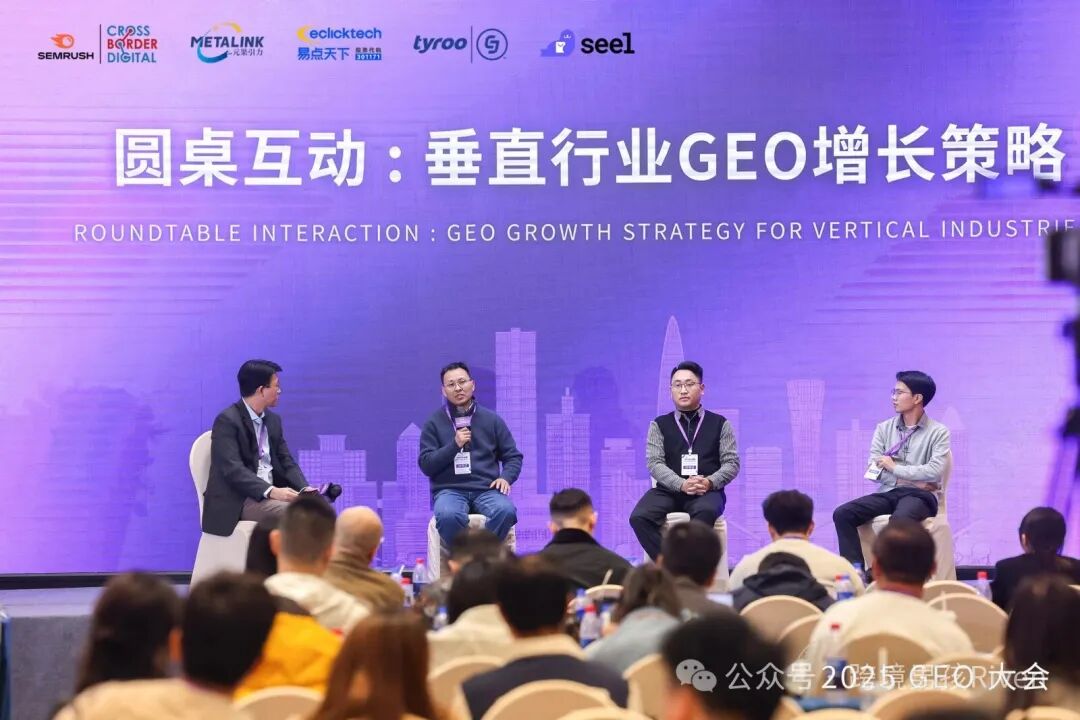
This article provides a detailed review and extended analysis based on the insights shared by Riven Gao, Head of DTC Brand Technology at EasyClick (Yidian Tianxia), during the GEO Roundtable Conference and related strategic documents. The report adopts a structure of "In-depth Background Analysis + Roundtable Recap + Core Theory Extension." It not only recreates the brilliant Q&A session of the roundtable but also builds a complete GEO theoretical framework and practical guide. Specifically, it breaks down the "New KPI Indicator System" proposed during the meeting, analyzing the evaluation chain from "visibility" to "business value."
This article aims to provide a detailed action blueprint for global brands, digital marketing practitioners, and corporate decision-makers. By understanding and applying GEO strategies, they can seize the cognitive high ground in the upcoming era of "Agentic Commerce" and achieve a strategic leap from "being searched" to "being recommended."
Chapter 1: Conference Background & Macro Industry Context
1.1 Digital Marketing's "Oppenheimer Moment"
We are living in an era that is being redefined. The release of ChatGPT by OpenAI, the launch of AI Overviews (formerly SGE) by Google, and the rise of answer engines like Perplexity are not just tool iterations; they represent the collapse and reconstruction of the underlying logic of information retrieval.
At the EasyClick GEO Roundtable, industry experts gathered to discuss the profound impact of this change on global brands. The conference background was built on a core consensus: The search box is no longer an entrance to a list of web pages, but an interface for instant knowledge synthesis. Users are no longer satisfied with filtering through "ten blue links" themselves; they expect AI to directly provide the "best answer."
For brands, this triggers deep anxiety:
- If users no longer click on links, where will the traffic to the brand's official website go?
- If AI controls the power of recommendation, how can brands ensure they are "seen" and "preferred" by AI?
- In the "Zero-Click" era, have traditional SEO KPIs (such as rankings, CTR) become obsolete?
Riven Gao, Head of DTC Brand Technology at EasyClick, offered forward-looking answers to these questions as a special guest at the roundtable. The GEO strategy he proposed is not just a technological upgrade, but a transformation in business thinking—shifting from managing "keywords" to managing "entity reputation."

Chapter 2: Paradigm Shift — The Ontological Change from SEO to GEO
2.1 Roundtable Recap: Reconstructing Definitions
Moderator Question:
"Riven, we are honored to have you join today's roundtable. We've noticed that the concept of 'GEO' (Generative Engine Optimization) has been very hot in the industry recently. For many brands accustomed to traditional SEO, this sounds both familiar and strange. Could you break down the underlying logic for us? What exactly is GEO? What is the fundamental difference between it and the SEO we know? Is this just an algorithm update, or a complete revolution?"
Riven Gao's Answer:
"This is a crucial entry point and the premise for understanding all strategies. To summarize in one sentence: SEO is asking the librarian to put your book in a prominent position, while GEO is asking the librarian to memorize the content of your book and recite it directly to the reader.
In the traditional SEO era, the core mechanism was 'Deterministic Indexing.' Users search for keywords, and search engines match keywords. The unit of value is the 'Link,' and the user behavior path is linear: Search -> Browse List -> Click Link. Our work focused on how to please the algorithm so that it ranks our links at the top.
However, GEO faces generative engines acting as 'Analysts.' When users ask questions, AI is not looking for books but is reading, understanding, and synthesizing answers in real-time through Large Language Models (LLMs). This process is called Retrieval-Augmented Generation (RAG). In the RAG model, the concept of 'Ranking' is deconstructed and replaced by 'Citation.'
This shift brings visibility challenges at three levels:
- Training Data Inclusion: This is the long-term memory of the LLM. If your brand does not exist in past internet corpora or lacks authority, AI simply does not know who you are at a foundational cognitive level.
- RAG Retrieval (Retrieval-Augmented Generation): This is the main battlefield of GEO. It determines whether your content can be captured by AI and used as material for constructing answers during real-time queries.
- Direct Data Stream Ingestion: AI directly connects to the merchant's database (such as a Feed) for interaction.
Therefore, GEO is not about how to get users to click on your website, but about how to let AI understand your brand entity and recommend it as the best answer to users."

2.2 In-depth Analysis: From "Strings" to "Knowledge Graphs"
Riven Gao's answer reveals the core ontological shift of GEO: the dimensional upgrade of information processing units.
2.2.1 Inverted Index vs. Vector Database
- The cornerstone of SEO is the Inverted Index: It's like the index page at the back of a book, recording "which word appears on which page." The optimizer's job is to increase keyword density and optimize H-tags, essentially performing string matching.
- The cornerstone of GEO is the Vector Database and Knowledge Graph: AI maps everything into vectors in a multidimensional space. Words with similar meanings (like "running shoes" and "athletic gear"), even if literally different, are extremely close in vector space. AI no longer matches strings; it matches semantic intent.
2.2.2 The Rise of Entities
In the context of GEO, brands no longer need to manage keyword lists, but Entity Identity. AI understands the world as a collection of entities and their relationships.
- Entity: Nike (Organization), Air Jordan (Product), Comfortable (Attribute).
- Relationship: Nike manufactures Air Jordan; Air Jordan has attribute Comfortable.
If brand content is messy text, it is difficult for AI to extract these entity relationships. The core work of GEO is to "translate" brand information into entity language that AI can read directly through structured data (Schema Markup).
2.2.3 Extreme Funnel Compression
- Traffic Funnel in the SEO Era: ToF (Blog) -> MoF (Review) -> BoF (Product Page).
- Traffic Purification in the GEO Era: Large volumes of ToF and MoF queries will be answered directly by AI (Zero-Click). Users who can pass through the AI's "answer layer" and finally click on the link are typically decision-making users with extremely high purchase intent. The goal of GEO is not to pursue broad traffic, but to pursue high-value, precise traffic.
Chapter 3: Practical Implementation — GEO Infrastructure in the Shopify Ecosystem
3.1 Roundtable Recap: Path to Technical Implementation
Moderator Question:
"Under the ecosystem limitations of Shopify, how do we build GEO capabilities from scratch? Do we start with content or technical settings? Is there a specific roadmap?"
Riven Gao's Answer:
"This is a very pragmatic question. Although Shopify is easy to use, its default generated code is not friendly enough for AI. We suggest brands carry out 'AI-friendly' transformations from the following three technical levels:
- Deploy
llms.txt: Whilerobots.txttells crawlers 'where not to go,'llms.txtis the new handshake protocol, and its logic is 'Curation.' This file should be like a curated menu, telling crawlers: 'Here is the most core, accurate, and token-saving high-quality content on our website.'- Advanced Schema Markup: This is the nervous system of the web page. You must markup
MerchantReturnPolicy,shippingDetails. At the same time, useOrganizationSchema to establish the connection between the brand and social media/Wikipedia.- Strategic Upgrade of Data Feeds: We are moving towards the era of 'Agentic Commerce.' Shopify has reached a cooperation with Stripe and ChatGPT, which means Shopify merchants naturally possess a 'green channel' to enter the AI recommendation system. Also, do not ignore Bing Merchant Center; it is another key 'backdoor' to enter the ChatGPT recommendation system."

3.2 In-depth Analysis: Building a Machine-Readable Digital Twin
3.2.1 llms.txt: The VIP Lane in the AI Era
- Purpose: To provide a clean, noise-free text corpus for LLMs.
- Shopify Implementation: Since Shopify restricts root directory uploads, create a page
yourshop.com/pages/llms-txtand set up a 301 redirect. Or use a specialized GEOly APP to handle it. - Content Strategy: Only include plain text brand core information, core product descriptions, and high-value links, removing JS/CSS interference.
3.2.2 Deep Schema: Mastering the Language of AI
Structured data is the most trusted "fact source" in RAG models.
- Organization Schema: Use the
sameAsproperty for entity disambiguation, linking to LinkedIn, Wiki, etc. - Product Schema: Must add
hasMerchantReturnPolicy,shippingDetails, andmaterial. - FAQ Schema: Google AI Overviews loves citing FAQs as answer snippets.
3.2.3 Agentic Commerce and Bing's Strategic Position
- Scenario: Future shopping will be a dialogue between the user's AI assistant and the merchant's AI Agent.
- The Bing Opportunity: Optimizing Bing Feed = Optimizing ChatGPT recommendation results. This is a traffic depression with extremely high cost-performance.

Chapter 4: New KPI System — Measuring the Invisible
4.1 Roundtable Recap: Anxiety and Reconstruction of Evaluation Systems
Moderator Question:
"If traffic is no longer the sole measure, how should brands report work results to management? Is there a quantified indicator system?"
Riven Gao's Answer:
"We have designed a brand-new performance measurement system for the GEO paradigm:
- Visibility Metrics: Solve the question 'How often are we seen?' (AI Visibility Score, Citation Frequency, AI Share of Voice).
- Quality & Core Metrics: Solve the question 'How are we described?' (Sentiment Index, Content Prominence, Answer Accuracy).
- Business Metrics: Solve the question 'What value does this bring?' (AI Referral Traffic, AI-Influenced Conversions).
In addition, we also provide a 'Translation' dashboard to help management understand the indicator shift from traditional SEO to GEO."
4.2 In-depth Analysis: Detailed GEO KPI System
4.2.1 Visibility Metrics

- Core Question: How often are we seen?
- Practical Action: Use Semrush Copilot, Profound, or custom scripts calling OpenAI API to calculate mention rates.
4.2.2 Quality & Core Metrics

- Core Question: How are we described?
- Warning: In the GEO era, ranking first but having a negative Sentiment Index (e.g., being evaluated as "poor quality") is catastrophic.
4.2.3 Management Transition Support

Smooth transition via "Translation" dashboard:
- SEO "Rank #1" -> GEO "Top Recommendation Rate"
- SEO "Backlinks" -> GEO "Citation Frequency"
- SEO "CTR" -> GEO "Sentiment Index"

Chapter 5: Evolution of Content Strategy — From "SEO Copywriting" to "Fact Density"
5.1 Adapting to LLM Reading Habits
- Inverted Pyramid Structure: Targeting the Attention Mechanism of LLMs, state the conclusion and core facts directly at the beginning.
- Fact Density: Eliminate "SEO fluff" and fill with unique data, parameters, and test results.
- Format as Syntax:
- Tables: AI easily grabs Markdown tables to generate answers.
- Lists: Provide clear step-by-step instructions.
- Structured Headers: Use H2/H3 to help AI understand semantic hierarchy.
5.2 Case Insights
- Gymshark: Answered extremely niche fitness questions (e.g., "how to prevent see-through when squatting") combined with structured data to occupy high ground in scenario recommendations.
- Wayfair: Used AI to rewrite metadata for tens of millions of products, improving Feed readability.
Chapter 6: Conclusion and 2026 Strategy Outlook
This GEO Roundtable conveyed a clear signal: Data stream is strategy, entity is brand.
In the upcoming 2026, the importance of websites as "human browsing destinations" will gradually give way to their importance as "AI data sources." For DTC brands, now is the critical moment to build a GEO moat.
Core Action List:
- Technical Side: Review Shopify store Schema completeness, deploy advanced markup; configure Google & Bing Merchant Centers.
- Content Side: Refactor FAQ pages to address real pain points rather than keyword stuffing; add structured data (tables, lists) to content.
- Data Side: Establish a GEO KPI dashboard to monitor AI visibility scores and sentiment indices.
GEO is not just an iteration of technology; it is the inevitable path for brands to reshape their digital identity in the era of artificial intelligence. Only brands that dare to have deep dialogues with machines through technical language can remain visible and ahead in the flood of algorithms.