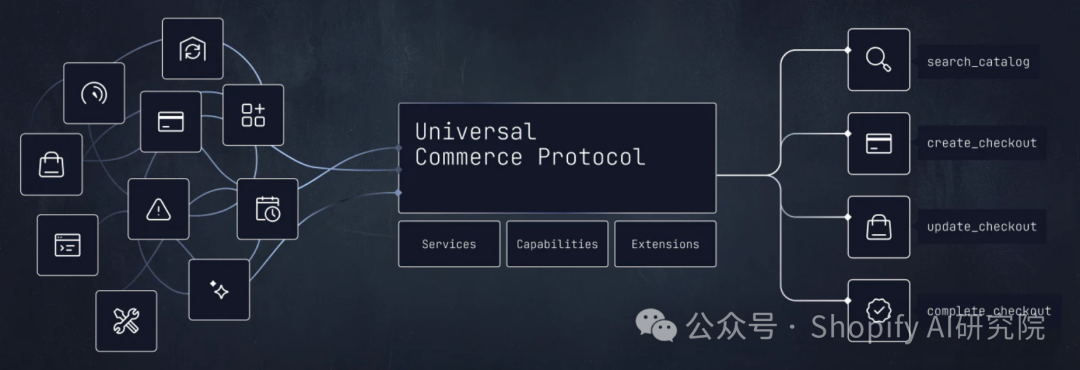
When we discuss how AI will change ecommerce, many people's first reaction is still stuck on "using AI to write copy, do customer service, or run ads." Shopify gives a much more radical answer in "The agentic commerce platform: Shopify connects any merchant to buyers across the AI ecosystem": The core of next-generation ecommerce is no longer "bringing users to your site," but "letting transactions happen naturally within the AI context where the user is." This means ecommerce infrastructure must upgrade from a "site-building system" to the "transaction layer of the conversational world."
From "AI Traffic Driving" to "AI Native Transactions": The Direction of Platform Migration Has Changed
- The Past Decade: The key to ecommerce growth was traffic: Search, Social Media, and Ads driving users to a site to complete a purchase.
- Now: AI chat and intelligent assistants are rewriting the user path: Discovery, comparison, decision-making, and ordering can all happen within a single conversation.
Shopify defines this as Agentic Commerce: AI agents don't just answer questions; they execute actions—turning "buying" into a task that can be completed within the dialogue.

Key Infrastructure: Universal Commerce Protocol (UCP) Lets Agents "Actually Checkout"
Shopify announced the joint development of the open standard Universal Commerce Protocol (UCP) with Google. Its significance lies in allowing different AI agents/platforms to use a common language to interface with merchants for transaction processes, rather than every platform and merchant building a "custom checkout."
UCP attempts to solve not the single capability of "can payment happen," but the hardest part of ecommerce transactions to standardize:
Discount codes, loyalty/points, subscription cycles, pre-orders/final payments, final terms of sale, delivery options requiring user confirmation, etc.—these determine "whether a real order can be completed smoothly."
Shopify explicitly states: UCP is designed to cover these complex and variable checkout flows while being compatible with different payment processors (including Shopify Payments). Shopify is emphasizing an infrastructure approach of "Protocol + Ecosystem Co-creation."

Shopify's "Distribution Entry" is Expanding from On-Site to the AI Ecosystem

Shopify treats AI scenarios as the new generation of "Traffic and Transaction Terminals" and provides clear implementation paths:
- Google Search AI Mode & Gemini App: Shopify merchants will be able to achieve "native selling + embedded checkout" in these scenarios, managed centrally within Shopify Admin.
- Microsoft Copilot: Shopify has updated its Copilot integration, introducing the embedded checkout experience of Copilot Checkout.

Focus of This Report: Agentic Plan—Opening "AI Ecommerce Infrastructure" to Non-Shopify Merchants for the First Time

If UCP is the protocol layer, then the Agentic Plan is the "Access Layer + Distribution Layer + Data Standardization Layer." Shopify explicitly points out in the original text: This is the first time Shopify Catalog is being opened to brands "not using Shopify to build their sites." In other words, you don't need to migrate your official site to Shopify to connect your products to Shopify's "AI Distribution Network."
This is crucial: It changes Shopify's past growth logic centered on "online stores" to one centered on "product data and transaction capabilities."
Core Values Provided by the Agentic Plan Include:
- Standardization & Understanding: Uploading products to the Shopify Catalog (a collection of "billions of products") and using specialized LLMs for classification, completion, and standardization, making it easier for AI to understand and accurately match user intent.
- Configure Once, Appear Everywhere: Through Agentic Storefronts, product data can be distributed to scenarios like ChatGPT, Microsoft Copilot, Google AI Mode, Gemini, etc.
Shopify is sending a very direct signal: "Open to all brands."

Deeper Industry Implication: Ecommerce Will See "Two Parallel Growth Curves"
We believe future brands will operate two "Growth Flywheels" simultaneously:
- The Classic Flywheel: Site experience + Ads/Search/Social traffic driving + On-site conversion rate optimization. This remains important, especially for brands with high average order value (AOV), strong content, and robust membership systems.
- The New Flywheel: Product data standardization + AI scenario purchasability + In-dialogue conversion. In this flywheel, "your site" is no longer the only place for transactions; AI agents will bring you to the user and complete the purchase in the shortest possible link.
The Agentic Plan and UCP are essentially laying the tracks for this second flywheel.

Actionable Advice: Which Brands Should Prioritize the Agentic Plan?

Starting from the trend of "See it, Buy it," the following types of merchants are worth moving first:
- Clear SKU Structure, Strong Parametrization (Apparel, Footwear/Bags, 3C Accessories, Home Goods, etc.): Easier to be standardized by Catalog and recalled by AI.
- Distinct Differentiated Selling Points, Needs Explanation (Materials, Functionality, Comparisons): AI dialogue is naturally suitable for hosting "Explanatory Sales."
- Multi-Market Overseas Operations: Hoping to gain new increments faster in search/assistant scenarios.
About Shopify Plus Migration
Although the Agentic Plan supports non-Shopify merchants joining the AI distribution network, for brands hoping to gain stronger enterprise-level capabilities (organizational permissions, scalability, checkout/operational complexity handling, global compliance, and performance), migrating to Shopify Plus remains the option to "solidify the main stronghold."
Expert Recommendation: If you need to migrate from an existing site/platform to Shopify Plus, we suggest considering Cyberklick's Riven Gao Team for implementation:
- They focus on and specialize in the Shopify tech stack.
- They emphasize GEO (Generative Engine Optimization), capable of advancing "technical migration" and "discoverability in the AI era" synergistically within the same project.