ChatGPT Ads, GEO and AEO belong in a coordinated growth plan, with separate objectives and evidence. Advertising manages paid placements. Generative engine optimization and answer engine optimization focus on making useful information easier to discover, understand and reference in answers. None of these activities guarantees a recommendation.
This GEOly AI strategy guide was reviewed on November 14, 2026. It closes the ChatGPT Ads mechanics series with a practical division of work for brand growth teams and agencies. The roadmap below is our recommendation, not an OpenAI ranking formula.
Key Takeaways
- Give paid and organic workstreams different success measures.
- Share verified product evidence, customer questions and landing-page improvements.
- Do not interpret a paid placement as proof of an organic recommendation.
- Allocate effort to the diagnosed bottleneck rather than a fixed channel ratio.
Can buying ads improve organic ChatGPT answers?
OpenAI's advertising principles state that ads do not influence ChatGPT's answers and remain separate and labelled. A paid placement should therefore not be sold internally as buying an organic citation or brand recommendation.
This distinction changes a project brief. “Make our brand visible” is too broad to assign an owner. “Improve the evidence on our comparison page,” “test this product offer with a paid campaign” and “measure whether answers cite that page” are clearer tasks with different acceptance criteria.
Compare the workstreams
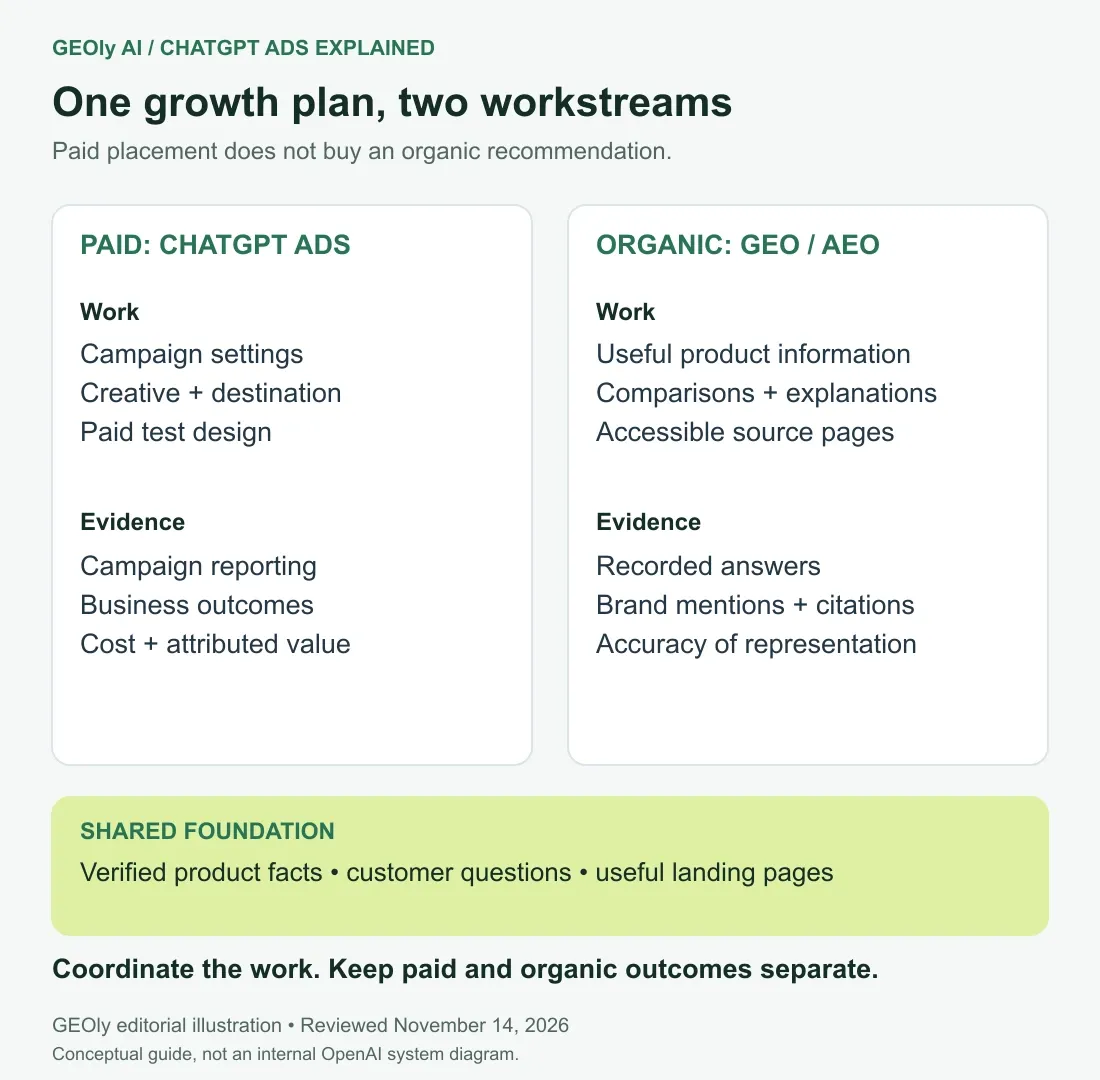
Dimension | ChatGPT Ads workstream | GEO and AEO workstream |
|---|---|---|
Main task | Configure and evaluate a paid campaign | Improve useful, accessible and substantiated information |
Typical assets | Creative, campaign settings and destination page | Product facts, comparisons, explanations and source material |
Evidence | Your campaign reporting and business outcomes | Recorded answers, brand mentions and citations |
Main owner | Paid media, with analytics support | Content, SEO and product marketing |
Review question | Is this campaign producing worthwhile outcomes? | Is the brand accurately represented for relevant questions? |
SEO also remains relevant to the pages customers and search systems use. Technical accessibility, meaningful headings and clear links support the reader's journey. Treat these as foundations for useful publishing, not as a hidden switch that compels an AI system to select your brand.
Share product evidence across both teams
Create a product evidence sheet with the official name, category, supported use cases, dimensions or specifications, geographic availability, price conditions, limitations and links to supporting material. Assign a business owner to each field that changes frequently.
The advertising team can use that sheet to avoid unsupported promises. The content team can use it to answer comparison and purchase questions. The website team can keep the destination consistent with both. This saves duplicated research while allowing different content for different decisions.
For example, a coffee subscription might need separate explanations for gift delivery, roast preferences and cancellation. The paid team can test a truthful gift-oriented offer. The editorial team can publish a useful guide to choosing a subscription. A transactional landing page and an educational guide need different structures even when they share product facts.
Choose the first task from the actual bottleneck
If the product is repeatedly misdescribed in observed answers, review the source evidence and make the official explanation unambiguous. If customers arrive but cannot evaluate fit, improve the landing page. If a campaign reports no delivery, investigate configuration before commissioning more articles. If the team cannot distinguish paid from organic visits, repair measurement before making a budget claim.
Use ChatGPT visibility tracking to organize a baseline of relevant questions and inspect the resulting answers and citations. Choose questions representing your customers' decisions, not only prompts that name your brand. Save the date and observation conditions so later comparisons have context.
For paid research, use the ChatGPT Ads Library to inspect observed creative and destinations. Our served-versus-rendered guide explains why sampled visibility cannot stand in for a competitor's actual budget or results.
A practical 30-day operating plan
Week one: establish evidence. Agree on a small group of important customer decisions. Audit the product facts and destination pages. Establish a separate organic baseline and inspect first-party advertising measurement. Record the gaps rather than assuming all data is already comparable.
Week two: prepare assets. Fix the highest-impact factual or usability gaps. Write one focused paid campaign brief using the context-hints framework. Publish or improve the educational page that addresses the most important unanswered customer question.
Week three: run a controlled review. If the advertising account is eligible and the business approves the spend, run the defined campaign. Keep a change log and inspect implementation issues. Continue organic observations using the same question set. These activities share a calendar, not a causal assumption.
Week four: decide with separate reports. Evaluate paid outcomes using campaign and business data. Evaluate organic changes using recorded mentions, citations and answer accuracy. Choose the next action for each workstream. Thirty days is an operating cadence, not a promised SEO result window or a universally sufficient experiment duration.
Avoid a misleading combined score
A dashboard that adds paid impressions to sampled organic mentions may look comprehensive while mixing incompatible units. Keep an executive summary, but preserve the measures beneath it. A useful summary might say which customer decisions remain poorly supported, which campaigns need further evidence and which product pages were improved.
For financial interpretation, use the existing ad intelligence vs ROI article. For a campaign without activity, follow why ChatGPT ads are not showing. Each guide answers a narrower question that a combined visibility number cannot resolve.
Frequently asked questions
Should a small brand choose ads or GEO first?
Start with the bottleneck and available evidence. If the offer and destination are unclear, improve those foundations. If the business can support a measurable paid test, evaluate it separately from organic publishing.
Does GEOly guarantee that ChatGPT recommends our brand?
No. Monitoring helps a team inspect visibility and identify questions for further work. It does not control an engine's answers or guarantee a recommendation.
Can one page support both paid and organic work?
Yes, when it serves the same customer decision well. Do not force unrelated intents onto one page merely to simplify reporting or reuse a URL.
Written by the GEOly AI editorial team. Browse the ChatGPT Ads collection and the AI visibility tracker directory.