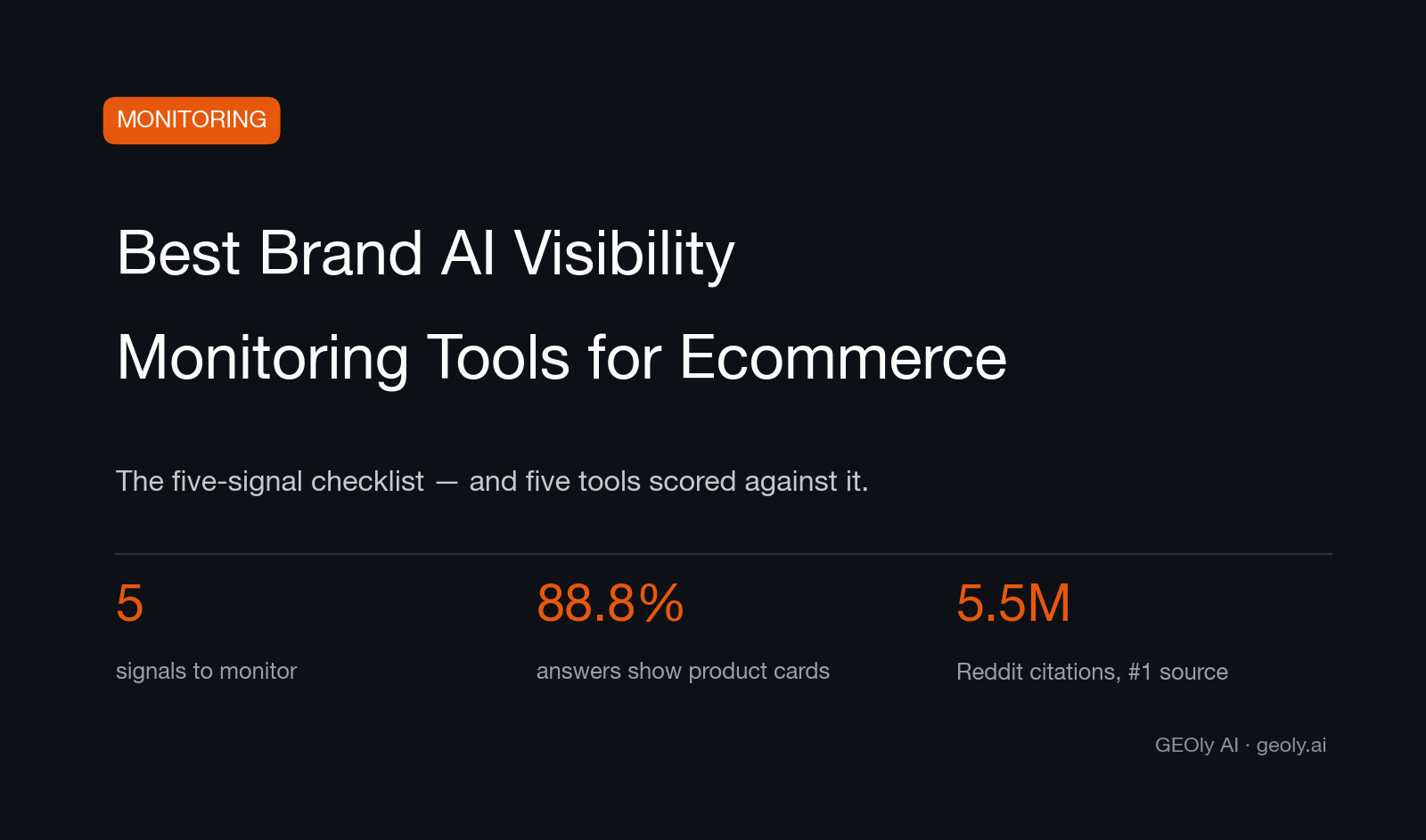
For an ecommerce brand, AI visibility monitoring means watching five signals, not one: text mentions, product-card presence, price and stock freshness on those cards, citation sources, and competitor ad placements. Most monitoring tools were built for the first signal only, which mattered less before 88.8% of ChatGPT shopping answers started carrying product cards. This guide defines the five-signal checklist first, then scores five monitoring tools against it — Otterly.AI, Peec AI, Scrunch AI, Semrush and GEOly — so you can match coverage to what your store actually needs watched.
Key takeaways
- Ecommerce monitoring is five signals deep: mentions and sentiment, card presence, card data freshness, citation sources, and competitor ads. A tool that reports only mentions leaves four signals dark.
- The card signal is the big one: 88.8% of ChatGPT shopping answers include product cards, and 14% of brand mentions have no buyable card — a gap a mention tracker will never flag.
- Citation monitoring has a clear headline: Reddit, with 5.5M citations, is the single largest source AI engines lean on for brand decisions.
- The ad signal is now material: 38.2% of ChatGPT shopping answers carried ads in June 2026, from 3,042 active advertisers.
- Of the five tools compared, four cover mentions and citations well; only GEOly extends monitoring to cards, freshness and ads.
The five signals an ecommerce brand has to monitor
1. Mentions and sentiment
The baseline: is your brand named when buyers ask, in what position, and with what tone? Because AI answers are probabilistic, this needs repeated sampling across engines rather than a one-off screenshot. If you are still defining what "visibility" means for your brand, start with what brand AI visibility is and how to measure it.
2. Card presence
Whether a mention comes with a product card decides whether it can convert. With 88.8% of shopping answers carrying cards and 14% of mentions carrying none, card presence is a separate signal from mentions and needs its own tracking line.
3. Price and stock freshness
Cards display price, availability and reviews. If an engine composes your card from stale data — an old price, an out-of-stock variant — the shelf misrepresents you in ways a text answer never could. Monitoring should surface what the card claims, not just that it exists.
4. Citation sources
Engines decide what to say about you from a small set of trusted sources, and Reddit leads them all at 5.5M citations. Knowing which domains feed your answers tells you where content and PR effort compounds.
5. Competitor ad placements
38.2% of ChatGPT shopping answers carried ads in June 2026. A competitor buying your best prompt changes your visibility without any organic signal moving, so ad monitoring belongs on the same dashboard.

Five monitoring tools, scored against the checklist
1. Otterly.AI — signals 1 and 4, cheapest entry
Otterly.AI re-runs prompts daily across ChatGPT, Perplexity, Google AI Overviews and Copilot, tracking mentions and citations from $29 a month, with an MCP server and API for export. Honest limitation: no card, freshness or ad coverage, and Gemini plus Google AI Mode are paid add-ons.
2. Peec AI — signals 1 and 4, built for reporting
Peec AI covers mentions and citations from about €75 a month for 25 prompts, with a Looker Studio connector and multi-country tracking at no extra cost — a natural fit for agencies reporting to ecommerce clients. Honest limitation: text answers only; the three commerce-specific signals are out of scope.
3. Scrunch AI — signal 1, plus the crawler side
Scrunch AI monitors mentions across seven-plus engines and uniquely acts on what AI crawlers receive from your site through its AXP middleware. Honest limitation: Core starts at $250 a month for 125 prompts, needs engineering buy-in, and the shopping shelf is not its focus.
4. Semrush AI Visibility Toolkit — signals 1 and partially 4, inside the suite
The Semrush toolkit at $99 a month adds mention tracking, sentiment and prompt research to the suite your SEO team already uses. Honest limitation: 50 prompts on the Starter bundle, and no ecommerce signals — cards, freshness and ads are all invisible.
5. GEOly — all five signals
Disclosure: GEOly is our product.
GEOly is the only tool in this comparison that monitors the full stack: Share of Model for mentions and sentiment, Share of Card for card presence and what each card displays, citation source analysis, and GEM ads intelligence for the sponsored slot — plus fan-out query tracking underneath it all. Shopify stores connect it in one click via GEOly AI on the Shopify App Store, free to start.

Honest limitation: GEOly is monitoring plus shelf analytics, not a classic SEO suite — no rankings or backlinks — and if you sell nothing card-shaped (pure services, B2B), three of its five signals will sit idle.
If you are really asking a different question
This piece is deliberately monitoring-only. If you want the wider view of ecommerce GEO tooling — monitoring and optimization across shelf, answer and ads — read the ecommerce GEO tools roundup. If you are not an ecommerce brand at all, the general-purpose list is best AI search monitoring tools. And if you need the metric definitions before choosing anything, the GEOly AI team keeps them current under the AI Visibility tag.
FAQ
What should an ecommerce brand monitor in AI search?
Five signals: brand mentions and sentiment, product-card presence, the price and stock data those cards show, which sources engines cite, and competitor ads. The mention signal alone misses the commerce layer — 88.8% of ChatGPT shopping answers carry cards, and cards are where purchases start.
Which tool monitors ChatGPT product cards?
GEOlyは現在、AIショッピング商品カードを主要な指標として追跡する唯一のモニタリングツールであり、Share of Cardを通じてこれを実現しています(注:これは当社の製品です)。この比較における他の4つのツールは、テキスト回答と引用をモニタリングしています。
OtterlyやSemrushはAIショッピング棚を追跡していますか?
いいえ。Otterly.AIとSemrush AI Visibility Toolkitはどちらもテキスト回答内の言及や引用をモニタリングしていますが、カードの存在、カードデータ、広告配置については報告していません。これらの信号が重要でない場合には、引き続き良い選択肢です。
AIの可視性はどのくらいの頻度でサンプリングすべきですか?
ツールが可能であれば毎日です。AIの回答は確率的であり、同じプロンプトでも実行ごとに異なるブランドが返されるため、繰り返しサンプルを取ることでトレンドが信号となり、単一の回答はノイズとなります。OtterlyとGEOlyはどちらもプロンプトパネルを毎日実行しています。