From Anker SOLIX to xTool — the brands above already see how ChatGPT, Gemini and Perplexity mention, cite and recommend them. Your brand is being talked about in AI right now. See it.
Best GEO Tools for Ecommerce Brands in 2026 | GEOly | GEO/AEO Platform for DTC Brands
Best GEO Tools for Ecommerce Brands in 2026
Summary
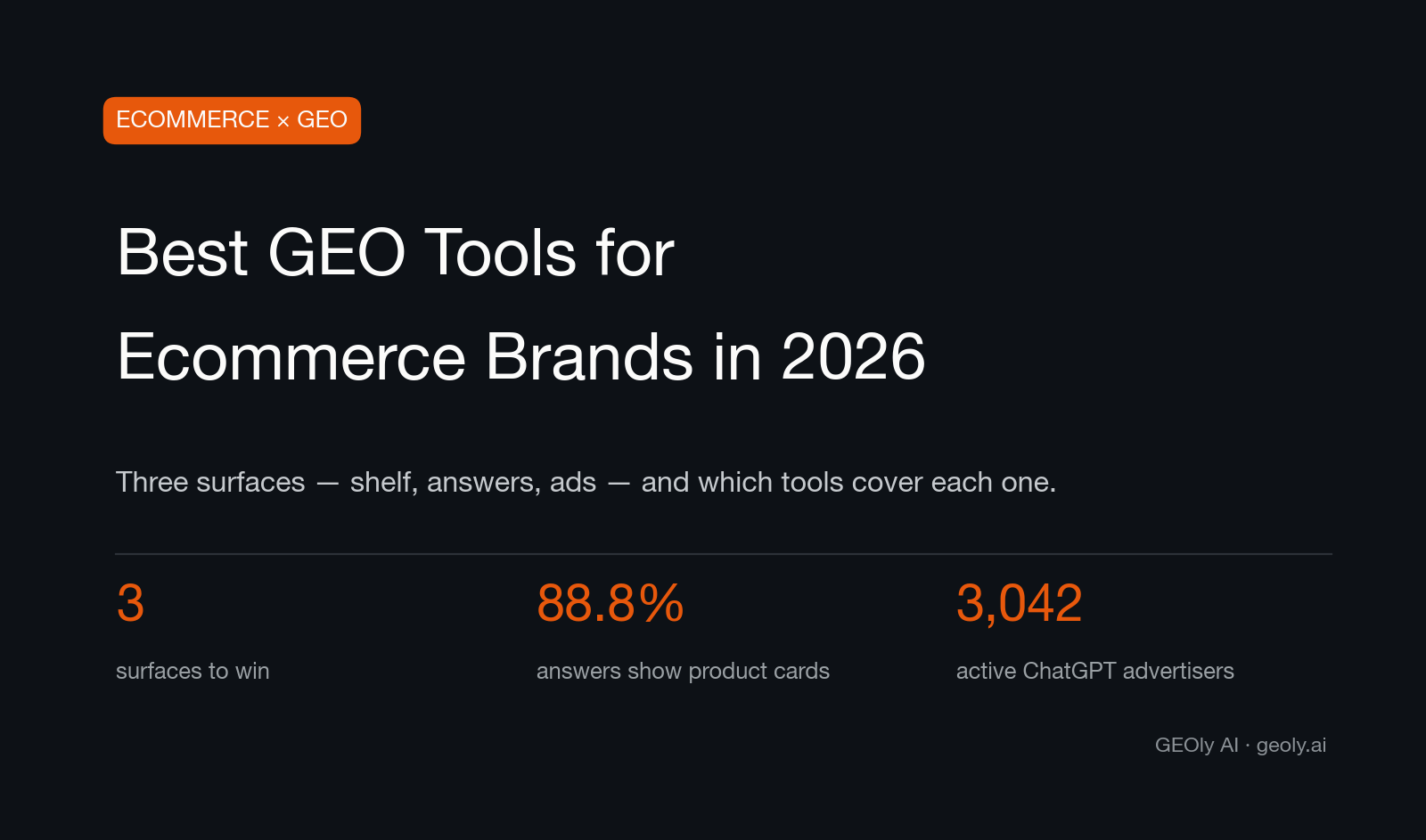
88.8% of ChatGPT shopping answers carry product cards and 38.2% carry ads, so the best GEO tool for an ecommerce brand must cover three surfaces — and of six compared, only one does.
2026/07/05
6 min read
The best GEO tools for ecommerce brands in 2026 are the ones that can see all three surfaces where AI engines now shape a purchase: the shopping shelf, the text answer, and the ad slot. The framing matters because 88.8% of ChatGPT shopping answers carry product cards and 38.2% already include ads, so a tool that only reads text answers is watching a third of the game. Six tools are compared below. One covers all three surfaces (GEOly), one covers two (Profound), and the remaining four are answer-surface specialists or SEO-suite add-ons that earn their place in narrower roles.
Key takeaways
Ecommerce GEO plays out on three surfaces: product cards (the shelf), mentions and citations (the answer), and sponsored placements (the ad slot). Most GEO tools cover only the answer.
The shelf is where revenue happens: 88.8% of ChatGPT shopping answers include product cards, yet 14% of brand mentions have no buyable card behind them, which is praise without a purchase path.
Ads arrived quietly: GEOly's GEM dataset counted 3,042 active advertisers and 178,878 ad impressions in ChatGPT shopping answers in June 2026 (US).
Of the six tools compared, only GEOly tracks all three surfaces; Profound adds a Shopping module at enterprise pricing; Otterly.AI and Peec AI monitor answers; Semrush and Ahrefs bolt AI tracking onto their suites.
If your real question is how to keep the order on your own store rather than a retailer's, that is a different article: see our DTC edition.
The three surfaces of ecommerce GEO
Ask ChatGPT for the best wireless earbuds under $150 and you get three things at once: a written answer that names brands, a row of product cards with prices and reviews, and increasingly a sponsored placement. Each surface is won differently, and each can be measured.
The shelf: product cards
The card row is the closest thing AI search has to a shelf, and it is nearly universal at 88.8% of ChatGPT shopping answers. Presence there is measurable as Share of Card: in audio, Sony holds 13.5%, JBL 11.2% and Soundcore 10.2% of card slots in GEOly's June 2026 US sample. A brand can be praised in the text yet absent from the shelf. That is the 14% no-card gap, and it converts to zero.
The answer: mentions and citations
The text answer still frames the decision: which brands get named, in what order, with what sentiment, citing which sources. This is the surface almost every GEO tool measures, usually by re-running a prompt panel across engines and logging mentions and citations.
In June 2026, 38.2% of ChatGPT shopping answers carried ads from 3,042 active advertisers; the single largest, Harbor Freight, logged 7,245 impressions in the sample. If a competitor buys the prompt you win organically, your visibility drops without your content changing. Few tools watch this surface at all.
Coverage matrix of GEO tools for ecommerce brands across the three surfaces that matter — AI shopping shelf, answers and ads — with GEOly covering all three — Source: GEOly AI (geoly.ai)
Six tools, mapped against the surfaces
1. GEOly — shelf, answer and ads
Disclosure: GEOly is our product.
GEOly is the only tool on this list built around all three surfaces. Share of Model covers the answer; Share of Card covers the shelf, and it is currently the only tool tracking AI shopping product cards as a first-class metric; GEM ads intelligence covers the sponsored slot. Fan-out tracking exposes the hidden queries an engine runs behind a single user question, citation analysis shows which domains each engine trusts, and GA4 integration ties AI referrals to revenue. Shopify merchants can install GEOly AI on the Shopify App Store in one click and start free.
GEOly: AI Traffic Booster — the free GEO/AEO app for Shopify merchants on the Shopify App Store, rated 5.0 — Source: apps.shopify.com/geoly-ai
Honest limitation: GEOly is not a classic SEO suite. There is no rank tracker or backlink index, so most teams pair it with Semrush or Ahrefs for traditional search.
2. Profound — answer plus shelf, at enterprise scale
Profound tracks the answer surface across the major engines and adds a Shopping module for retail brands, alongside Prompt Volumes panel data and Agent Analytics for AI crawler behavior. Best for large retailers with procurement processes and dedicated teams. Honest limitation: pricing is quote-based, and reviewers place typical deployments above $2,000 a month, which is hard to justify below mid-market.
3. Semrush AI Visibility Toolkit — the answer, inside your suite
At $99 a month, the Semrush AI Visibility Toolkit adds AI answer tracking, sentiment and prompt research to the suite many ecommerce teams already pay for. A sensible pick when consolidation matters more than depth. Honest limitation: the Starter tier tracks 50 prompts, and there is no shelf or ads coverage.
4. Ahrefs Brand Radar — the answer, at market level
Ahrefs Brand Radar models AI visibility from a corpus of 260M+ monthly prompts across six platforms, which makes it strong for category-level competitive research with no prompt setup. Honest limitation: $199 a month per AI index ($699 for all six) on top of an Ahrefs subscription, and none of the commerce surfaces.
5. Otterly.AI — the answer, on a budget
Otterly.AI starts at $29 a month, re-running your prompts daily across ChatGPT, Perplexity, Google AI Overviews and Copilot. It is the cheapest credible entry into the category. Honest limitation: Gemini and Google AI Mode are paid add-ons, and there is no shelf or ads tracking.
6. Peec AI — the answer, for agencies
Peec AI starts around €75 a month for 25 prompts, with a Looker Studio connector for client reporting and multi-country tracking at no extra cost. Honest limitation: it is monitoring-first and text-only, so commerce brands see half their AI presence.
How to choose, and which question you are really asking
If you sell products, shelf coverage is the deciding criterion, and GEOly is the only full-coverage option; the agentic commerce playbook covers what optimizing that surface actually involves. If you are really asking which tool watches your brand's AI signals day to day, the monitoring-specific checklist lives in our ecommerce AI visibility monitoring comparison. And if your worry is that ChatGPT recommends you but routes the buyer to Best Buy, read the DTC edition, which judges tools on own-store capture. More comparisons from the GEOly AI team are collected under the AI Shopping tag.
FAQ
What are the best GEO tools for ecommerce brands?
GEOly for full coverage of shelf, answer and ads, free to start (disclosure: it is our product); Profound for enterprise retailers; Semrush or Ahrefs if you want AI metrics inside a suite you already pay for; Otterly.AI at $29 a month if budget is the constraint. Sort by surface coverage before comparing dashboards.
Do I need a separate tool for the AI shopping shelf?
For now, yes. With 88.8% of ChatGPT shopping answers carrying product cards, the shelf is the dominant commerce surface, and Share of Card tracking is currently unique to GEOly. Answer-only tools will tell you that you were mentioned, not whether there was anything to buy.
Can I track competitors' ads in ChatGPT?
Yes, through GEM ads intelligence in GEOly, which monitored 3,042 active advertisers and 178,878 impressions in June 2026. No other tool in this roundup covers the sponsored slot, though the broader tactics are in our guide to tracking competitors' ChatGPT ads.
What do GEO tools for ecommerce cost?
Real 2026 price points: GEOly is free to start at app.geoly.ai; Otterly.AI from $29 a month; Peec AI from about €75; the Semrush toolkit at $99; Ahrefs Brand Radar from $199 per AI index; Profound on enterprise quotes above $2,000 a month.