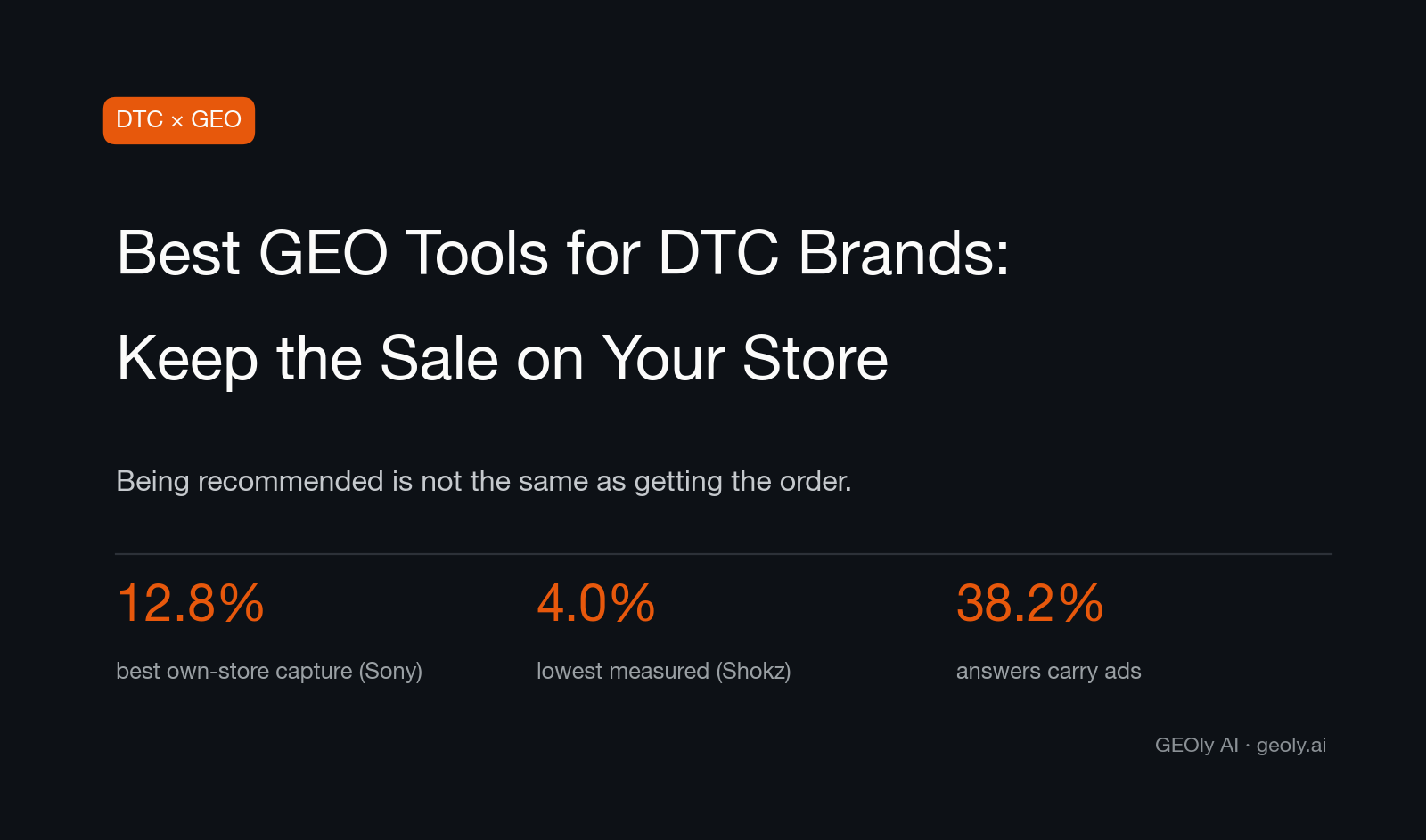
Getting recommended by ChatGPT is not the same as getting the order. In GEOly's June 2026 US audio sample, the best-performing brand, Sony, routed only 12.8% of the product cards behind its ChatGPT recommendations to its own store; Shokz captured just 4.0%, and the bulk of card clicks went to Best Buy, Target and Walmart. So the best GEO tool for a DTC brand is not the one with the prettiest mention chart — it is the one that shows whether the shelf routes buyers to you. Below: one tool that measures own-store capture directly, then honest picks at three lower budget tiers.
Key takeaways
- Recommendation is not revenue. DTC capture rates behind ChatGPT product cards in audio: Sony 12.8%, Bose 12.7%, Sennheiser 11.9%, Soundcore 8.8%, JBL 7.4%, Apple 7.1%, Shokz 4.0%. Everything else goes to retailers.
- Judge a DTC GEO tool on one question: can it show where the card behind your recommendation actually links, and how often that is your store.
- GEOly is the only tool tracking product cards and their routing as a first-class metric (Share of Card); the alternatives at $29 to $99 cover text answers only.
- A tool can only diagnose. Capture improves through feed, PDP and buy-path work, which is optimization, not monitoring.
- If your question is really about total budget rather than capture, start with our affordable GEO tools ladder.
The DTC gap: recommended, then routed away
The whole point of DTC is owning the customer: margin, data, repeat purchase. AI shopping quietly breaks that. When ChatGPT recommends your product, it usually attaches a card — 88.8% of shopping answers carry them — and that card links somewhere. GEOly's shelf data shows that for most audio brands, "somewhere" is a big-box retailer. Even Bose, at 12.7% own-store capture, hands roughly seven of every eight card clicks to channel partners. Shokz hands over 24 of every 25.

That is the specific pain a DTC brand needs tooling for. Mention tracking tells you the engine likes you. Capture tracking tells you who gets paid.
What a DTC-fit GEO tool has to show you
Three things, in order of importance. First, card presence on your buying prompts: are you on the shelf at all, or in the 14% of brand mentions with no buyable card behind them? Second, card routing: when your card appears, does it link to your store or a retailer's, and how does that trend over time? Third, the levers: which sources the engine cites, which fan-out queries it runs, and where competitors are buying ads, so you know what to fix rather than just what to mourn. The four-signal breakdown behind this checklist is covered in our earlier .
