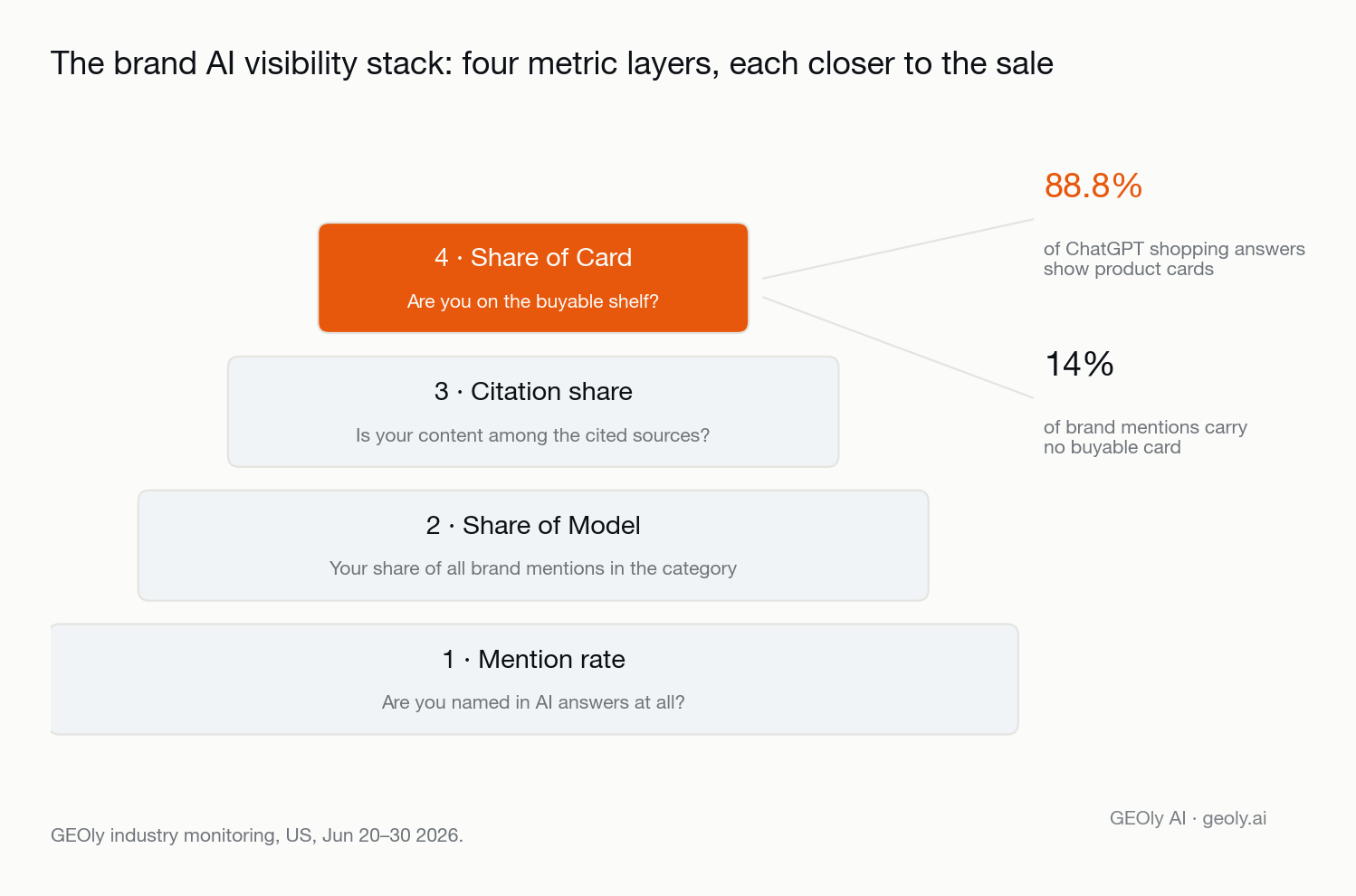
Brand AI visibility is how present your brand is in what AI engines say, show and sell: text answers, the shopping shelf of product cards, and paid ad slots. It is concrete and measurable. In GEOly's US monitoring of ChatGPT shopping answers (June 20–30, 2026), 88.8% carried product cards, and 14% of brand mentions had no buyable card attached — visible in words, invisible on the shelf. Measuring it means tracking four metric layers, from mention rate up through Share of Model and citation share to Share of Card, across a fixed panel of prompts sampled repeatedly on each engine.
Key takeaways
- Brand AI visibility covers three surfaces: what engines say about you (answers), what they sell around you (product cards), and what they are paid to show (ads — 38.2% of ChatGPT shopping answers now carry them).
- Four metric layers, ordered by commercial intent: mention rate, Share of Model, citation share, Share of Card.
- Being mentioned is not being buyable: 14% of brand mentions in ChatGPT shopping answers have no product card attached.
- AI answers are probabilistic, so one-off spot checks mislead. Measure by repeat sampling on a fixed prompt panel.
- Start manual with a spreadsheet and 20 prompts; automate when the panel outgrows you. Tools run from $0 to $199+/month.
Three surfaces, not one
Most teams picture AI visibility as "does ChatGPT mention us." That was the whole game in 2024; it is a third of it now. The first surface is still the text answer — mentions, recommendations, the sentiment around them. The second is the shopping shelf: for buying-intent prompts, engines compose rows of product cards with price, reviews and a purchase path, and 88.8% of ChatGPT shopping answers include them. The third is paid: 38.2% of ChatGPT shopping answers carried ads in GEOly's June 2026 GEM sample, with 3,042 brands already actively advertising. A brand can win one surface and lose the other two without noticing, which is why measurement has to span all three — the same logic behind tracking brand mentions in AI search as an ongoing program rather than a one-time audit.
The four-layer metric stack
Each layer answers a different question, and each sits closer to revenue than the one below it.