From Anker SOLIX to xTool — the brands above already see how ChatGPT, Gemini and Perplexity mention, cite and recommend them. Your brand is being talked about in AI right now. See it.
AI Search Visibility Metrics & KPIs: 2026 Guide | GEOly | GEO/AEO Platform for DTC Brands
AI Search Visibility Metrics & KPIs: The 2026 Measurement Guide
Summary
Seven KPIs — mention rate, Share of Model, citation sources, answer position, sentiment, Share of Card and AI referral traffic — cover everything worth measuring in AI search, and most teams only need three of them to start.
2026/07/05
9 min read
AI search visibility metrics fall into three layers: presence (does the AI mention you), quality (are you cited, how early, and how accurately), and business impact (do you show up on the shopping shelf, and does any of it turn into traffic and revenue). Seven KPIs cover those layers — mention rate, Share of Model, citation rate and citation sources, average answer position, sentiment and accuracy, Share of Card, and AI referral traffic. If you can only measure three, start with mention rate on a fixed prompt set, your category's top citation sources, and one named competitor's numbers next to yours.
Key takeaways
Seven metrics cover AI search measurement end to end: AI visibility rate (mention rate), Share of Model, citation rate and citation sources, average answer position, sentiment and accuracy, Share of Card, and AI referral traffic.
Share of Model is the closest thing AI search has to market share: your percentage of all brand mentions in AI answers across a fixed prompt set, versus competitors.
Citation sources are the highest-leverage leading indicator. AI engines pull from a small, identifiable set of domains per category, and you can systematically earn presence on that list.
AI-referred traffic to US retail sites grew 138% year over year as of May 2026, per Adobe — the channel now carries real money, so lagging revenue KPIs belong on the board too.
Universal benchmarks ("a good mention rate is X%") are mostly noise in 2026. Benchmark against named competitors in your own category instead.
Why AI search needs its own scoreboard
The audience moved first. ChatGPT passed 800 million weekly users in October 2025, and Google's AI Overviews reach more than 2 billion people a month. None of that activity shows up in a rank tracker, because there is nothing to rank: an AI engine synthesizes one answer, attaches a handful of citations, and — for shopping queries — renders a shelf of product cards. Three different surfaces, three different measurement problems.
There is a second, less obvious reason: variance. Ask ChatGPT the same question five times and you can get five differently worded answers with different brands in them. Sound measurement has to be sampled and probabilistic. You run a fixed prompt set repeatedly, on a schedule, and report rates and trends — not a binary "we show up" checked once in a browser tab.
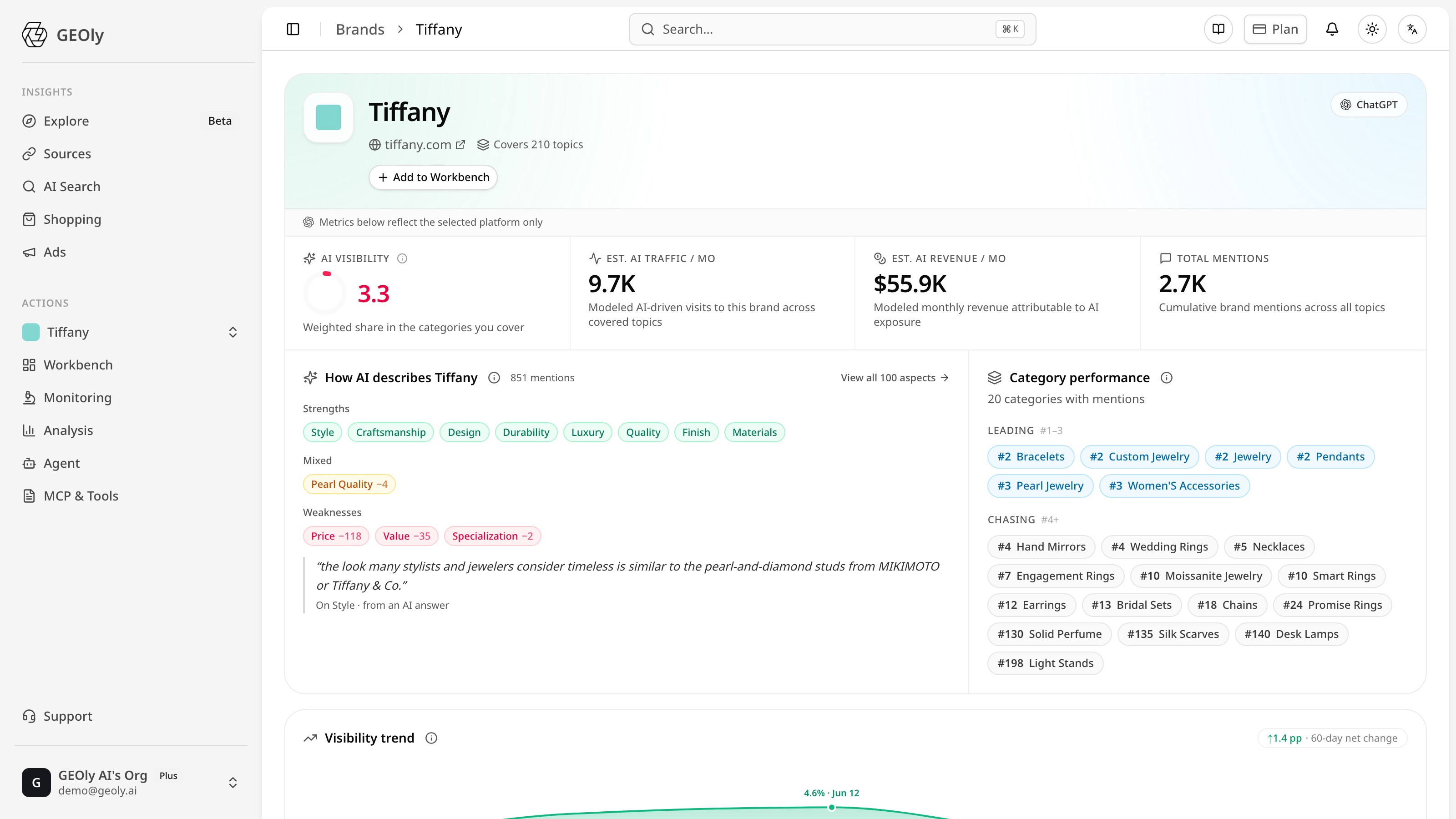
A brand's AI visibility scoreboard in GEOly Explore: AI visibility score, estimated monthly AI traffic and AI revenue, total mentions, and how AI describes the brand — Source: GEOly AI (app.geoly.ai)
The percentage of tracked prompts where your brand appears anywhere in the AI answer. This is the foundation metric — every other KPI in this guide is computed on top of the same prompt runs.
Three decisions make it meaningful. First, the prompt set: 50–200 buyer-intent prompts, phrased the way customers actually ask ("best cordless vacuum for pet hair under $300"), not the way you write keywords. Second, fan-out coverage: engines like Gemini and ChatGPT quietly decompose one prompt into several sub-queries, and you can be invisible in exactly the sub-query that decides the answer. Third, per-engine splits: your mention rate on Perplexity says nothing about Gemini. For the mechanics, see our guide to tracking brand mentions in AI search.
2. Share of Model
Your share of all brand mentions across your tracked prompt set, versus competitors — share of voice, rebuilt for AI answers. If engines mention brands 1,000 times across your category prompts and 180 of those mentions are yours, your Share of Model is 18%.
This is the KPI for the monthly deck, because it self-corrects for two problems that plague raw mention rate: category-wide swings (a model update that names more brands lifts everyone) and false comfort (your mention rate climbs while a competitor's climbs faster). Movement in Share of Model is almost always real signal.
Share of Model in practice: a competitive peers battleboard comparing visibility scores and topic-level wins across Cartier, Mejuri, Blue Nile and other jewelry brands — Source: GEOly AI (app.geoly.ai)
3. Citation rate and citation sources
Two related numbers. Citation rate: how often your own domain appears as a linked source in AI answers. Citation source analysis: which third-party domains — Reddit threads, review sites, publishers, YouTube — the engines cite when answering your category's prompts.
The second is the more actionable of the pair. As Jake Ward argues, the goal in AI search is to get cited, not clicked: if the engines answering your buyers' questions consistently cite five review sites and two Reddit communities, that list is your earned-media roadmap. Citation source share is the best leading indicator in the whole stack, because it is the one you can directly influence this quarter.
4. Average answer position
Where you appear within the answer — first brand named, third, or a footnote. First position carries outsized weight: in voice interfaces and agent workflows, the first recommendation is often the only one acted on.
One caveat: position is noisier than mention rate, because answer structure changes run to run. Track it as a rolling average over dozens of runs, and treat single-week jumps with suspicion.
5. Sentiment and accuracy of AI descriptions
What the AI actually says about you when it mentions you. Two components: sentiment (recommended enthusiastically, listed neutrally, or flagged with caveats) and factual accuracy (does it state your current pricing, features and positioning, or a hallucinated 2023 version of them?).
Treat this as a QA metric: percentage of mentions containing a factual error, plus a sentiment trend. A brand that is mentioned often but described wrongly has a different problem — and a different fix — than a brand that is not mentioned at all.
6. Share of Card (AI shopping shelf presence)
For commerce brands, the shelf is where the money is. ChatGPT Shopping and Google AI Mode do not just write about products; they render product cards — image, price, merchant — that an agent can act on. Share of Card is the percentage of relevant shopping prompts where your product appears on that shelf, and it behaves differently from text mentions: it depends on feed quality, structured data and merchant records, not just content. We have a full breakdown of the Share of Card metric and a playbook for winning the AI shelf.
Share of Card metrics for one brand: AI-recommended products, share of shopping, distinct products and top channels on the AI shopping shelf — Source: GEOly AI (app.geoly.ai)
7. AI referral traffic and assisted revenue
The lagging outcome: sessions, conversions and revenue arriving from chatgpt.com, perplexity.ai, gemini.google.com and AI Overview clicks. The channel is no longer a rounding error — Adobe's data shows AI-referred traffic to US retail sites grew 138% year over year in May 2026, up more than 1,300% since Adobe began tracking it in October 2024.
Measure it in GA4 with a custom channel group for AI referrers — but read it with the zero-click caveat: many AI answers influence a purchase without producing a click, so referral traffic is a floor on impact, not the total.
Leading vs. lagging: putting the KPIs in order
A workable operating rhythm splits the stack in three:
Leading, reviewed weekly: citation source footprint (your presence across the domains AI cites in your category), prompt coverage, and shipped work — content published, feeds fixed, schema deployed.
Core visibility, reviewed weekly to monthly: mention rate, Share of Model, average answer position, sentiment and accuracy, Share of Card.
Lagging, reviewed monthly to quarterly: AI referral traffic, assisted conversions, revenue.
On benchmarks: resist the urge. Public "average mention rate" figures vary wildly by category, prompt-set design and engine mix, and the field is too young for stable norms. The honest 2026 benchmark is a named-competitor one: track the three brands you actually lose deals to, and beat their trend line. More on the discipline behind this under our AI visibility tag.
Industry-level AI search data for the US jewelry category: 41 topics, 1,551 tracked brands, monthly AI traffic and estimated AI revenue, plus the competitive landscape ranked by Share of Model — Source: GEOly AI (app.geoly.ai)
The minimum viable KPI set, by team maturity
One person, no budget: three numbers, weekly. Mention rate on 25–50 buyer-intent prompts across two engines (ChatGPT plus whichever your buyers use next), your category's top-ten citation source domains, and one named competitor's mention rate beside yours. That is a complete, decision-driving scoreboard, and it is the setup I recommend to every brand starting out.
An established SEO or content team: add Share of Model across your full competitor set, a monthly sentiment-and-accuracy audit, average answer position, and an AI-referral channel group in GA4. This is the point where GEO gets its own line in reporting instead of hiding inside "organic."
A commerce brand, or one already ranking well: add Share of Card, per-engine breakdowns (Gemini behaves very differently from ChatGPT), fan-out query coverage, and revenue attribution against AI referrers. At this stage the interesting questions are shelf questions.
How to instrument all this
Three honest options. Spreadsheets plus manual prompting works for a week and then collapses — no sampling, no fan-out visibility, no consistent scoring. General SEO suites like Semrush and Ahrefs now ship AI visibility modules, convenient if you already pay for them, though shopping-shelf coverage is thin. Dedicated GEO platforms track the full stack continuously; disclosure: GEOly is our product, it is free to start, and it covers all seven metrics above including Share of Card, which generalist tools mostly do not. For a fair comparison of the field, see our roundup of the best AI search monitoring tools.
FAQ
What KPIs should I track for AI search?
Track seven: AI visibility rate (mention rate), Share of Model, citation rate and citation sources, average answer position, sentiment and accuracy of AI descriptions, Share of Card if you sell products, and AI referral traffic. Starting from zero, three are enough: mention rate, citation sources, and one competitor benchmark.
How do you measure AI search visibility?
Define a fixed set of 50–200 buyer-intent prompts, run them on a schedule across the engines that matter to you (ChatGPT, Gemini, Perplexity, Google AI Overviews), and record whether your brand is mentioned, cited, in what position, and with what sentiment. Because AI answers vary run to run, report rates over many runs rather than one-off checks. Platforms like GEOly automate the sampling and scoring.
What is Share of Model?
Share of Model is your percentage of all brand mentions in AI answers across a tracked prompt set — the AI-search equivalent of share of voice. If engines name brands 1,000 times across your category prompts and 180 of those mentions are yours, your Share of Model is 18%. It normalizes away category-wide swings, which makes it the best single KPI for competitive position.
Is there a keyword-ranking equivalent in AI search?
The nearest equivalent is average answer position — where your brand appears within the synthesized answer or recommendation list. It is noisier than a SERP rank because answers are regenerated each time, so treat it as a rolling average and lean on mention rate and Share of Model as your primary presence metrics.
Can Google Analytics measure AI search visibility?
Only the last step. GA4 can capture AI referral traffic — sessions from chatgpt.com, perplexity.ai and similar referrers — via a custom channel group, but it sees nothing about the answers themselves: no mentions, no citations, no shelf presence, and none of the zero-click influence. Pair GA4 with prompt-level tracking to see the whole funnel.