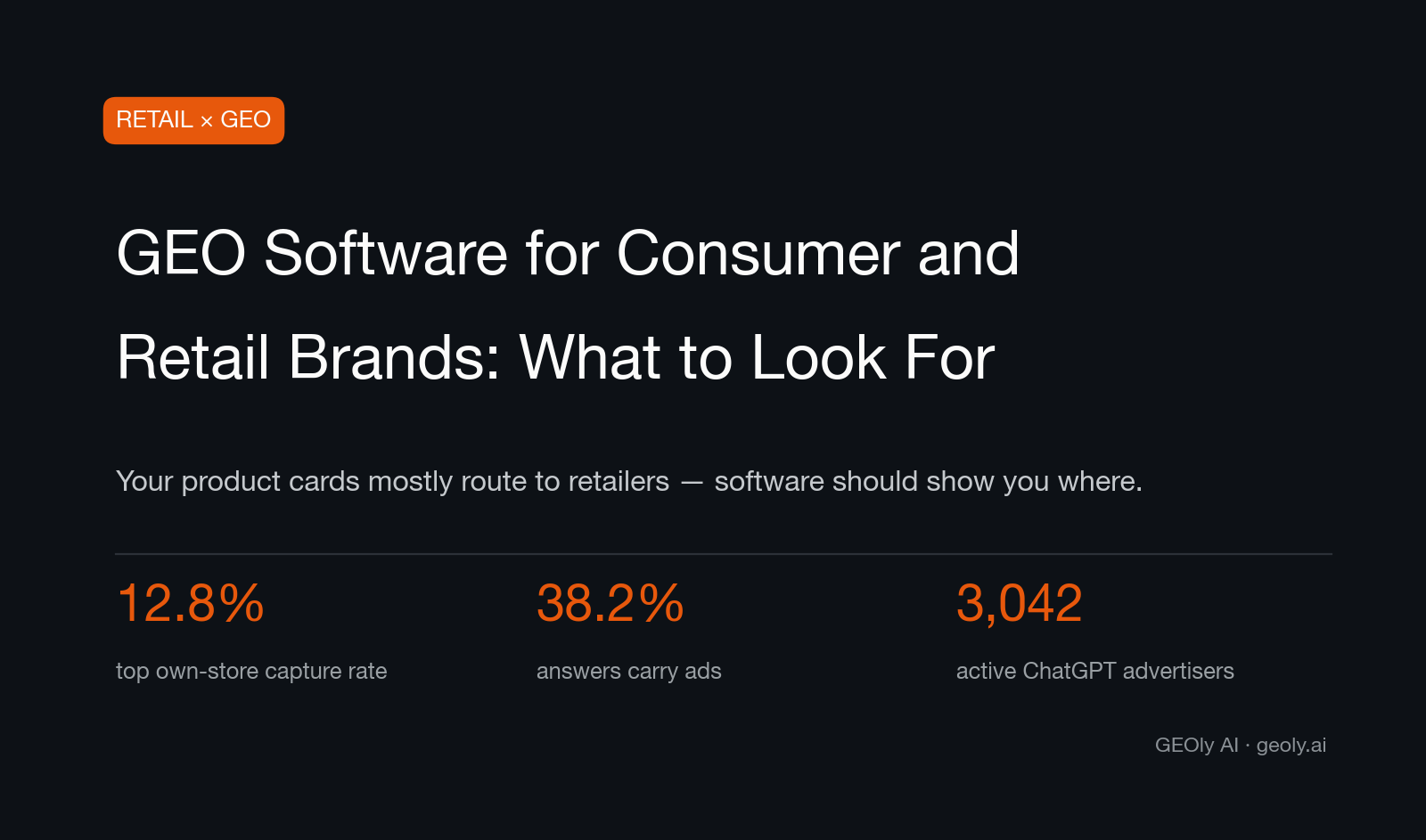
If you sell through Best Buy, Target and Walmart as well as your own site, GEO software has a different job for you than for a pure DTC brand: it must show not just whether AI assistants recommend your products, but where the product card sends the shopper. The data makes the case — in GEOly's US audio monitoring (June 20–30, 2026), even Sony, the best performer on this measure, kept only 12.8% of ChatGPT card destinations on its own store. The rest routed to retailers. For a consumer brand with channel partners, that routing pattern is the single most useful thing GEO software can put in front of you.
Key takeaways
- The defining metric for retail brands is card routing, not card presence. Most ChatGPT product cards send shoppers to Best Buy, Target or Walmart rather than brand stores — brand-store capture in audio runs from Sony's 12.8% down to Shokz's 4.0%.
- Routing data is intelligence, not failure. It shows which retailer relationships AI shopping is amplifying, where your buy box actually lives, and which channel deserves your co-op dollars.
- Demand three capabilities: cross-retailer card attribution, category-level share of voice, and ads intelligence — 38.2% of ChatGPT shopping answers carried ads in June 2026, and retailers are among the buyers.
- Shortlist by scale: GEOly for the shelf and routing layer, Profound for enterprise breadth, Semrush if your team already lives in the suite.
The card always routes somewhere
Start with what actually happens when an AI assistant recommends a consumer product. In 88.8% of ChatGPT shopping answers, the recommendation arrives as a product card — image, price, buy link. That card resolves to exactly one destination, and for consumer brands the destination is usually not you. The June 2026 audio numbers: Sony's own store captures 12.8% of its card destinations, Bose 12.7%, Sennheiser 11.9%, Soundcore 8.8%, JBL 7.4%, Apple 7.1%, Shokz 4.0%. Everything else lands on retailer product pages.

DTC-first commentary reads those figures as leakage to be clawed back. If you are a channel brand, read them the other way: the AI shelf is routing demand through your retail partners, and the question becomes which partner, on which prompts, at which price. A brand whose cards route heavily to Walmart on budget prompts and Best Buy on premium prompts has learned something about how AI engines segment its line — something no retailer scorecard will tell it. If your first question is more basic — do AI assistants recommend me at all — run the first, then come back here.
