Do AI Assistants Recommend Your Brand? 5 Checks to Run | GEOly | AI-Native GEO Platform for E-commerce DTC Brands
Blog›How to Know If AI Assistants Recommend Your Brand to Shoppers
How to Know If AI Assistants Recommend Your Brand to Shoppers
Summary
Run five checks — mentions, product cards, card routing, sentiment and ads — to know if AI assistants recommend your brand: 88.8% of ChatGPT shopping answers already carry product cards.
2026/07/05
6 min read
You can find out whether AI assistants recommend your brand to shoppers this afternoon, with a browser and a notes file, by running five checks: text mentions, product cards, card routing, sentiment, and competitor ads. The card check matters most, because that is where recommendations turn into commerce — 88.8% of ChatGPT shopping answers carried product cards in GEOly's US monitoring (June 20–30, 2026). Below is each check, what to look at manually, and how a tool measures the same thing continuously.
Key takeaways
Being mentioned is not being recommended: in GEOly's June 2026 US data, 14% of brand mentions in ChatGPT shopping answers had no buyable product card attached.
A card is not a sale either. Track where it routes — even Sony, the strongest audio brand on this measure, keeps only 12.8% of ChatGPT card destinations on its own store; most cards route to Best Buy, Target or Walmart.
Recommendations are now partly paid: 38.2% of ChatGPT shopping answers carried ads in June 2026, from 3,042 active advertisers. A competitor can buy placement above your organic mention.
Every check has a manual version you can run today and a tool version that runs while you sleep. Do the manual pass first — it tells you which tool capability you actually need.
Check 1: Are you mentioned at all?
What to look at: open ChatGPT in a clean session and ask five to ten questions the way your buyers ask them — "best budget espresso machine," "is [your brand] worth it," "[your brand] vs [rival]." Count how often your brand appears in the answer text. Ask each question more than once; answers are sampled, so a single run can flatter or slander you.
How a tool measures it: mention rate — the share of repeated runs in which you appear — tracked per prompt and per engine, usually rolled up into a Share of Model figure against competitors. The full workflow for doing this across ChatGPT, Gemini and Perplexity is in our cross-engine tracking guide.
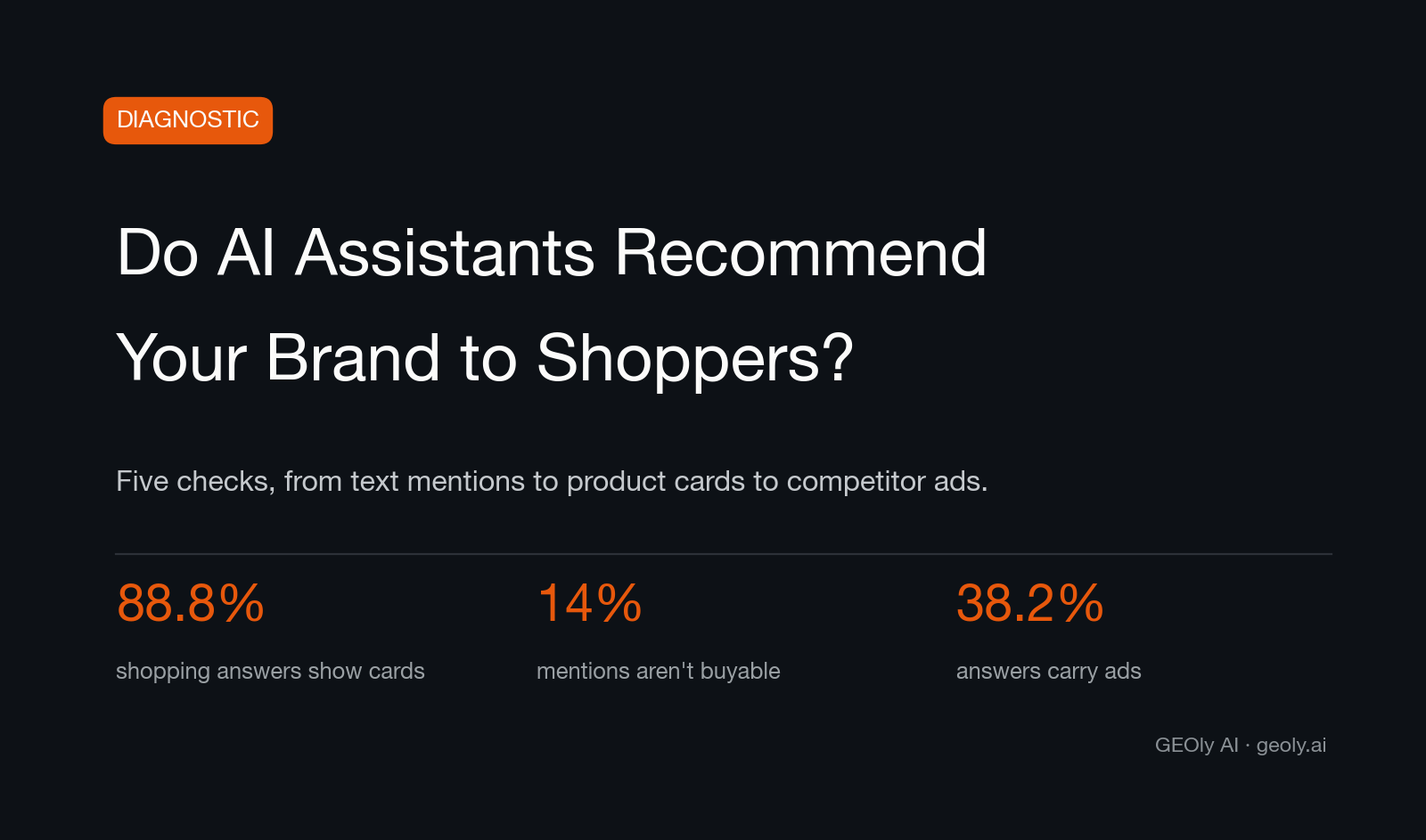
Checklist of five ways to know if AI assistants recommend your brand to shoppers, from text mentions and product cards (88.8% of shopping answers) to competitor ads (38.2%) — Source: GEOly AI (geoly.ai)
Check 2: Do you get a product card?
What to look at: for the same shopping prompts, look past the prose to the card carousel — the images with prices and buy links. Is your product there, or are you a name in the paragraph while rivals occupy the shelf? This gap is common enough to have a number: 14% of brand mentions come with no buyable card. And since 88.8% of shopping answers carry cards, the shelf is the default interface shoppers see, not an edge case.
How a tool measures it: Share of Card — your share of product-card slots for a prompt set, tracked over time and against competitors. For scale: in the audio category, Sony leads at 13.5%, JBL holds 11.2% and Soundcore 10.2%, while on Google AI Mode Soundcore leads with 10.9% of brand cards.
Check 3: Where does the card route?
What to look at: click your own card. Does the buy path land on your store, or on a retailer's product page? For channel brands this is intelligence; for DTC brands it is leakage. The June 2026 numbers are sobering — the share of ChatGPT card destinations landing on the brand's own store runs from Sony at 12.8%, Bose at 12.7% and Sennheiser at 11.9% down through Soundcore at 8.8%, JBL at 7.4%, Apple at 7.1% and Shokz at 4.0%. Everything else routes to Best Buy, Target, Walmart and similar retailers.
How a tool measures it: card-destination attribution — which domain each card links to, per prompt, per engine, trended over time. This is the least visible check to run manually at any scale, and the one that changes strategy most when you see it.
Check 4: How are you described?
What to look at: read the sentences around your mention. "Best overall" and "a budget alternative if you can tolerate the build quality" are both mentions, and only one of them sells. Note the adjectives, the caveats, and which use case the assistant assigns you — engines tend to slot brands into roles, and the role sticks across answers.
How a tool measures it: sentiment analysis over the answer text, scored per mention and trended, so a slide from "recommended" to "mentioned with reservations" shows up as data instead of a founder's uneasy feeling. Sentiment shifts often trace back to sources — a critical Reddit thread or review site an engine has started citing.
Check 5: Who is paying to be there?
What to look at: run your category prompts and look for sponsored placements in and around the answers. In June 2026, 38.2% of ChatGPT shopping answers carried ads, with 3,042 active advertisers and 178,878 ad impressions in the GEM dataset — the top advertiser, Harbor Freight, alone logged 7,245. If rivals advertise on your category prompts, your organic mention competes with their paid card.
How a tool measures it: ads intelligence — which brands advertise, on which prompts, how often. The manual version and the tooling are covered in our guide to tracking competitors' ChatGPT ads.
What to do with the results
Score yourself honestly. Mentioned, carded, routing to your store, described well, no ad threat — rare, and enviable. Most brands find a break in the chain at check 2 or 3: present in prose, absent from the shelf, or on the shelf with the sale routing to a retailer.
Disclosure: GEOly is our product. GEOly runs all five checks continuously — mention tracking, Share of Card, card-destination attribution, sentiment and GEM ads intelligence — and is free to start at app.geoly.ai. Honest limitation: it is not a classic SEO suite, with no rank tracking or backlink index, so teams typically run it alongside Semrush or Ahrefs rather than instead of them. For more diagnostics like this from the GEOly AI team, browse the AI shopping tag.
FAQ
Does ChatGPT actually recommend specific brands to shoppers?
Yes, and concretely: 88.8% of ChatGPT shopping answers carry product cards with prices and buy links, which is closer to a merchandised shelf than to a neutral summary. Which brands appear varies run to run — recommendations are probabilistic — which is why the checks above rely on repeated sampling rather than one screenshot.
Why does my brand show up in the answer but not in the product cards?
Usually because the engine knows about you from text sources — reviews, forums, articles — but lacks clean, purchasable product data to build a card from: feeds, schema, availability. You are in the 14% of mentions with no buyable card. Fixing it is product-data work more than content work, which is why check 2 and check 1 need separate treatment.
How do I find out if competitors are running ads in ChatGPT?
Manually: run your category prompts in fresh sessions and note sponsored placements — with 38.2% of shopping answers carrying ads, a dozen runs usually surfaces them. Systematically: ads-intelligence datasets like GEM track which of 3,042 active advertisers buy which prompts, so you see pressure on your category before it shows in your numbers.
Is one check enough, or do I need all five?
Run all five once — the afternoon version — because the checks fail independently: strong mentions with no cards, cards that route away, good placement undermined by sour sentiment. After the first pass you will know where your chain breaks, and that is the check worth monitoring continuously.
From Anker SOLIX to xTool — the brands above already see how ChatGPT, Gemini and Perplexity mention, cite and recommend them. Your brand is being talked about in AI right now. See it.