Blog›How to Track Brand Visibility Across ChatGPT, Gemini & Perplexity
How to Track Brand Visibility Across ChatGPT, Gemini & Perplexity
Summary
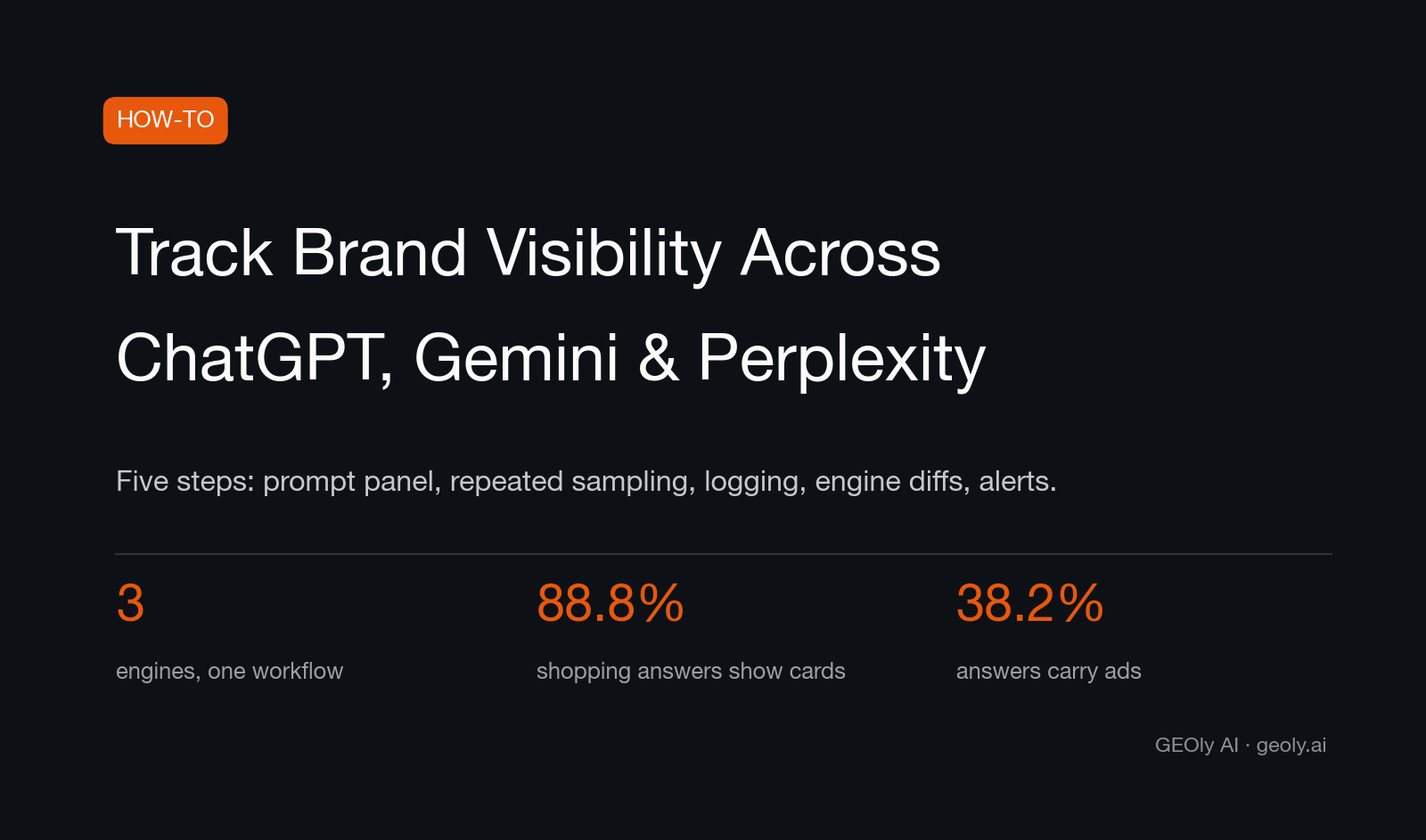
A five-step workflow to track brand visibility across ChatGPT, Gemini and Perplexity — repeat sampling is non-negotiable because answers are probabilistic, and ChatGPT referrals already convert at 7.1%.
2026/07/05
7 min read
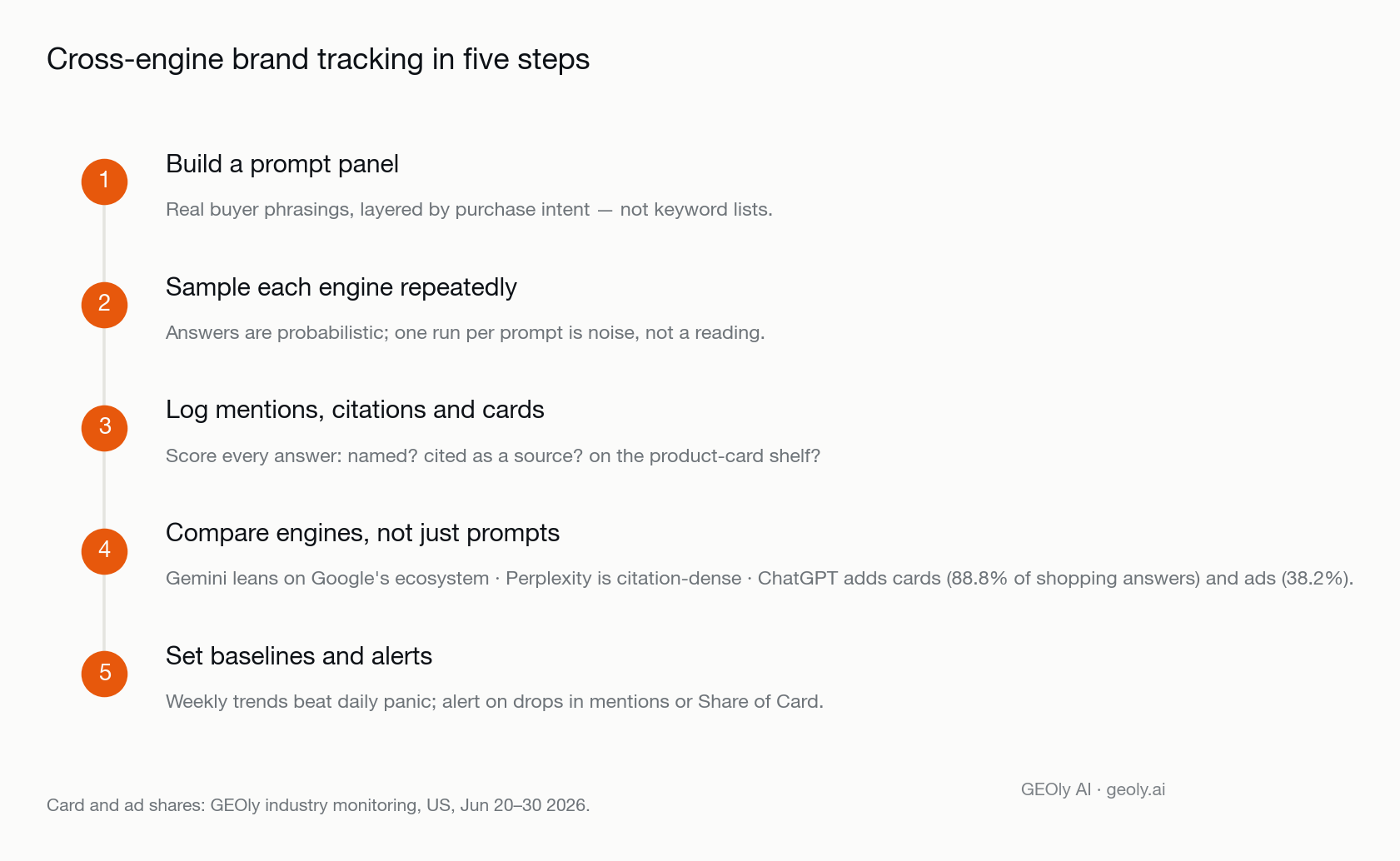
Tracking brand visibility across ChatGPT, Gemini and Perplexity comes down to five steps: build a prompt panel from real buyer language, sample each engine repeatedly, record mentions, citations and product cards as separate signals, read each engine on its own terms, then set baselines and alerts. The effort pays for itself faster than most channels — Similarweb puts ChatGPT referral conversion at 7.1%, second only to paid search at 7.8%. Here is the workflow I run for commerce brands, one step at a time.
Key takeaways
AI answers are probabilistic. The same prompt returns different brand lists on different runs, so a one-off screenshot is an anecdote; repeated sampling over days is measurement.
Track three signals per answer, not one: text mentions, citations of your domain, and product cards. In GEOly's US monitoring (June 20–30, 2026), 88.8% of ChatGPT shopping answers carried product cards.
Each engine needs its own read. Gemini leans on Google's ecosystem, Perplexity is citation-dense, and ChatGPT adds a shopping shelf plus ads — 38.2% of shopping answers carried ads in June 2026.
Absolute numbers matter less than direction and gaps. Set a baseline in week one, then alert on drops, competitor entries and disappearing cards.
Step 1: Build a prompt panel from real buyer language
Everything downstream depends on asking the questions your buyers actually ask, phrased the way they phrase them. Pull 20 to 50 prompts from support tickets, product reviews, sales calls and community threads — Reddit is worth mining specifically, since it drew 5.5M citations as the top source AI engines lean on for brand decisions.
Layer the panel by purchase intent. Category prompts ("best wireless earbuds under $100") show whether you exist in the consideration set. Comparison prompts ("Brand X vs Brand Y") show how engines frame you against rivals. Brand-direct prompts ("is Brand X any good") show what the model believes about you. Once the panel is set, freeze it. If you keep swapping prompts, your trend line measures your edits, not your visibility.
Five-step workflow to track brand visibility across ChatGPT, Gemini and Perplexity: prompt panel, repeated sampling, logging mentions and cards, engine comparison, baselines and alerts — Source: GEOly AI (geoly.ai)
Step 2: Sample repeatedly — answers are probabilistic
Ask ChatGPT the same shopping question twice and you will often get two different brand lists. That is not a bug; generative answers are sampled, and the retrieval behind them shifts. So a single check tells you almost nothing.
Track Brand Visibility Across ChatGPT, Gemini & Perplexity | GEOly | AI-Native GEO Platform for E-commerce DTC Brands
The fix is repetition. Run every prompt in the panel multiple times per engine each week, from clean sessions so personalization does not contaminate the sample, and compute a mention rate: the share of runs in which your brand appears. A brand that shows up in 8 of 10 runs and one that shows up in 2 of 10 might both produce a "we're in ChatGPT!" screenshot. They are not in the same position.
Doing this by hand for three engines is tedious but possible — a spreadsheet with prompt, engine, date, mentioned yes/no, and cited yes/no gets you started. The general method is covered in our guide to tracking brand mentions in AI search; tools mostly exist to make this rerunning automatic.
Step 3: Record mentions, citations and cards as separate signals
Three different things can happen to your brand inside an answer, and they diverge more than teams expect.
A mention means the answer names you in text. A citation means the engine links your domain as a source — you can be mentioned via a Reddit thread or a retailer page without your site earning the citation. A card means you appear on the shopping shelf with price, image and a buy path. These are distinct because the gaps between them are where the money leaks: in GEOly's June 2026 US data, 14% of brand mentions in ChatGPT shopping answers had no buyable card attached. Those brands won the argument and lost the checkout.
Log all three per run. If you only track one, track the one closest to your revenue — for commerce brands that is the card. A fuller treatment of which numbers to report, from mention rate through Share of Model to citation share, is in our AI search visibility metrics and KPIs breakdown.
Step 4: Read each engine on its own terms
Averaging the three engines into one score hides exactly what you need to see, because they behave differently by construction.
ChatGPT is the commerce surface. It composes product-card carousels — 88.8% of shopping answers carry them — and it now sells placement: 38.2% of shopping answers carried ads in June 2026, from 3,042 active advertisers. Your visibility there can change because a competitor paid, not because your content slipped.
Gemini rides Google's ecosystem: Search grounding, Shopping Graph data, merchant feeds. Weak Google Shopping hygiene tends to show up as weak Gemini visibility, which has its own diagnostic path — see how to track brand mentions in Gemini.
Perplexity is the citation engine. Nearly every claim links out, so the question is less "am I mentioned" and more "which domains does it trust in my category, and am I on any of them." If the answer cites two publishers and a Reddit thread, those three pages are your target list.
Step 5: Set baselines and alerts
Run the full panel for a week or two before judging anything. That baseline — mention rate, citation share and card presence per engine — turns later readings into signal. From there, review weekly and alert on three events: your mention rate drops on prompts you previously held, a competitor enters answers where you were alone, or your product card disappears from a shelf it used to occupy. Each of those is actionable the day you see it; a quarterly report of the same facts is archaeology.
Where tools fit
Disclosure: GEOly is our product. GEOly automates this exact loop — panel, repeated multi-engine sampling, per-prompt mention and citation tracking, plus Share of Card for the shopping shelf, and it is free to start at app.geoly.ai. Honest limitation: it is not a classic SEO suite — no rank tracking or backlink index — so most teams pair it with Semrush or Ahrefs rather than replacing them. If your real question is whether engines are recommending you to buyers at all, run the five diagnostic checks first; and for more hands-on workflows like this one, the GEOly AI team publishes regularly under the AI visibility tag.
FAQ
How often should I re-run my prompts?
Weekly is the practical floor for a trend line, with each prompt sampled several times per engine per cycle. Daily reruns are worth it during launches, PR events or pricing changes, when answers can shift within days. Less than weekly and you will see that something changed but not when — which makes finding the cause much harder.
Why does ChatGPT give a different answer every time I ask about my brand?
Because generative engines sample: the model composes each answer fresh, and the retrieval feeding it varies run to run. This is exactly why repeated sampling is step two. Treat visibility as a rate — the share of runs you appear in — rather than a fact, and the inconsistency becomes the thing you are measuring instead of noise that frustrates you.
Can I track brand visibility across AI engines for free?
Yes, at small scale. A frozen prompt panel, clean browser sessions and a spreadsheet cover steps one through five for a single category. The cost is time and consistency — manual sampling tends to die in week three. GEOly's free tier at app.geoly.ai automates the reruns, and Otterly.AI's $29/month plan is the cheapest paid entry.
Do I need a different tool for each engine?
No — cross-engine coverage in one place is most of the point of buying a tool, since the interesting findings are usually the gaps between engines (strong in Perplexity citations, absent from ChatGPT's shelf, say). What you should check before buying is coverage depth: some tools treat Gemini or Google AI Mode as paid add-ons rather than core engines.
From Anker SOLIX to xTool — the brands above already see how ChatGPT, Gemini and Perplexity mention, cite and recommend them. Your brand is being talked about in AI right now. See it.