From Anker SOLIX to xTool — the brands above already see how ChatGPT, Gemini and Perplexity mention, cite and recommend them. Your brand is being talked about in AI right now. See it.
What Is AEO? How Answer Engine Optimization Differs from SEO | GEOly | GEO/AEO Platform for DTC Brands
What Is AEO? How Answer Engine Optimization Differs from SEO
Summary
AEO optimizes to be cited inside AI answers rather than ranked in links — a shift in unit, carrier, metric, tooling and cadence, with Reddit's 5.5M citations showing where answers actually come from.
2026/07/05
6 min read
AEO — answer engine optimization — is the practice of structuring content so that answer engines like ChatGPT, Perplexity and Google AI Overviews quote it as the answer, instead of listing it as a link someone might click. It differs from SEO on five dimensions: what you win (a citation, not a ranking), what carries the win (a passage or entity, not a page), how you measure (mentions and citations, not clicks), the tooling, and the cadence. The stakes are already commercial: ChatGPT referral traffic converts at 7.1%, just behind paid search at 7.8%, per Similarweb.
Key takeaways
AEO optimizes for being quoted inside an AI-generated answer; SEO optimizes for ranking in a list of links. Same web, different scoreboard.
The unit of AEO success is the citation — Jake Ward's framing is get cited, not clicked — and citations concentrate hard: Reddit alone draws 5.5M, the top source in AI brand-decision answers.
Engines lift passages and entities, not pages. A 3,000-word post with the answer buried in paragraph twelve loses to a page that states it in two clean sentences.
Measurement flips from deterministic to probabilistic: rank positions are checkable once a day; AI answers must be sampled repeatedly because they change between runs.
AEO does not replace SEO. Engines still retrieve web pages, so crawlability and authority remain the raw material — you add a layer, you don't swap one.
What AEO means
The name says it plainly: answer engines are systems that respond to a question with a composed answer rather than a ranked list. When Perplexity answers "is a standing desk worth it," it writes three paragraphs, cites five sources, and most users never click any of them. AEO is the discipline of making your content one of those five sources — and of making sure that when the engine names brands, yours is named accurately and favorably.
That reframes the job. SEO asks "how do we rank for this keyword?" AEO asks "when the engine assembles an answer to this question, what would it need from us to include us?" Usually the honest answer is: a directly quotable statement, structured data around it, and third-party corroboration on the sources the engine already trusts.
Five dimensions where AEO breaks from SEO
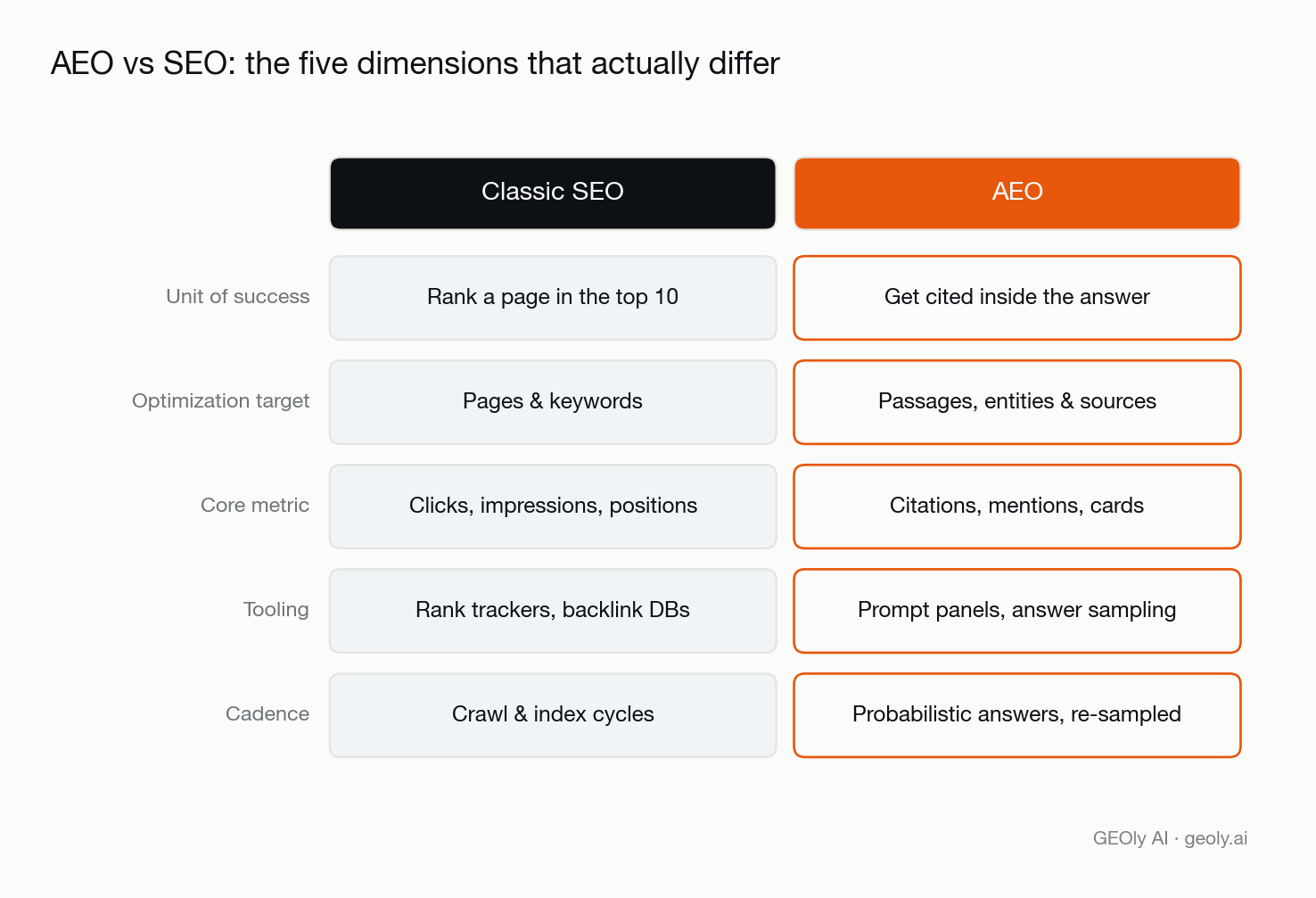
Two-column comparison of AEO vs SEO across five dimensions: unit of success, optimization target, core metric, tooling and cadence — Source: GEOly AI (geoly.ai)
SEO's win is a position you occupy and defend — rank three today, probably rank three tomorrow. AEO's win is being woven into the answer itself, as a citation or a brand mention. Jake Ward compressed the shift into four words, get cited, not clicked, and the concentration of citation sources makes the point sharper: Reddit's 5.5M citations make it the single largest source in AI brand-decision answers, which means part of "your" AEO happens on domains you do not own.
2. Carrier: passages and entities, not pages
Search engines index and rank pages. Answer engines extract passages, facts and entities, then recombine them. The practical consequence: a question answered crisply in two sentences near the top of a page outperforms a comprehensive essay where the answer emerges gradually. AEO writing favors self-contained blocks — a definition that survives being lifted out of context, an FAQ answer that is complete on its own, schema that tells the engine what entity it is reading about.
3. Measurement: mentions and citations, not clicks and positions
SEO reports positions, impressions, clicks. AEO reports mention rate, citation share and answer share across a panel of prompts — and much of the value never appears in analytics, because the user got what they needed inside the answer. What does click through converts well: that 7.1% ChatGPT referral conversion rate is the visible tip of demand mostly shaped upstream, inside answers you can only see by measuring them directly.
4. Tooling: samplers, not rank trackers
Rank trackers ask a deterministic index for your position. AEO tools rerun prompts across engines and log what came back. Disclosure: GEOly is our product — GEOly is free to start and tracks mentions, citation sources and the AI shopping shelf across engines; honest limitation: it is not a classic SEO suite, so no rank tracking or backlink index, and most teams pair it with Semrush or Ahrefs. Otterly.AI starts at $29/month for daily prompt monitoring, and the Semrush AI Visibility Toolkit at $99/month bolts answer tracking onto the suite SEO teams already use — a fair symbol of how the two disciplines are converging into one stack.
5. Cadence: probabilistic sampling, not daily rank checks
A keyword rank is stable enough to check daily and chart cleanly. An AI answer is regenerated on every query and can differ between two runs minutes apart. So AEO measurement works like polling: fixed prompt panel, repeated samples, rates and trends instead of single readings. Teams that port their rank-tracking mindset over unchanged end up celebrating or panicking over noise.
Where GEO fits in
You will see AEO and GEO (generative engine optimization) used almost interchangeably, and the overlap is genuine — both target AI-generated results. The useful distinction: AEO centers on the answer box and getting quoted; GEO is the broader program covering everything generative engines produce, including the shopping shelf of product cards and paid slots inside answers. In practice AEO is the content-and-citations core, and GEO wraps commerce and measurement around it. We map the full terminology in GEO vs AEO vs AI SEO, and if your real question is how all this differs from classic search work, start with the difference between GEO and SEO.
Complements, not a succession
The tempting story is that AEO replaces SEO the way mobile replaced desktop. The evidence says otherwise. Answer engines retrieve web content — crawlable pages, clean structure and earned authority are still the inputs, which is why strong SEO foundations show up as AEO advantages. And organic search still delivers far more absolute volume, while AI referrals deliver outsized intent. The rational split for most teams: keep SEO running, add an AEO layer — quotable passages, schema, presence on cited sources, a prompt panel to measure it — and report both on one dashboard. More guides in this series live on the GEOly AI author page and under the GEO tag.
FAQ
Is AEO replacing SEO?
No. Answer engines build on retrieved web content, so SEO fundamentals — crawlability, structure, authority — remain the raw material of AI answers. What changes is the scoreboard: alongside rankings and clicks you now track mentions and citations. Teams that treat AEO as an added layer outperform teams that treat it as a migration.
What is the difference between AEO and GEO?
AEO focuses on the answer itself: being quoted and cited when an engine responds to a question. GEO is the wider program across everything generative engines produce, including product cards in AI shopping and ads inside answers. The terms overlap heavily in practice; this comparison draws the lines.
How do I measure AEO success?
Build a panel of real customer questions, run them repeatedly across ChatGPT, Gemini, Perplexity and AI Overviews, and track mention rate, citation share and sentiment as trends. Manual sampling works at small scale; tools automate it from $0 (GEOly's free tier — disclosure: GEOly is our product) to $29/month (Otterly.AI) and up.
Does FAQ content actually help with AEO?
Yes, when each answer is self-contained. Answer engines lift passages, and a question-phrased heading followed by a complete two-to-four-sentence answer is the easiest shape to lift. FAQ pages stuffed with keywords but no direct answers do nothing — the engine needs a quotable block, not a signal.