AI Shopping Needs a Control Plane, Not Another Channel Plan
摘要
Safeway's ChatGPT plugin, AppsFlyer measurement for ChatGPT Ads, Kroger assistant ads, Shopify AI commerce data and Cloudflare Wallets all point to the same shift: AI shopping now needs a control plane across discovery, ads, attribution and agent authority.
2026/08/07
9 分钟阅读
AI Shopping Needs a Control Plane, Not Another Channel Plan
The latest AI commerce news looks like a set of separate launches: Safeway has a ChatGPT shopping plugin, AppsFlyer is measuring ChatGPT Ads, Kroger is putting sponsored products into an AI shopping assistant, Shopify says AI-driven traffic and orders are growing fast, Cloudflare is proposing wallets for agents, and a U.S. appeals court narrowed Amazon's early attempt to block Perplexity's shopping agent.
Treating these as separate channel updates is the wrong operating model.
The stronger signal is that AI shopping is becoming a control-plane problem. Brands now need to decide which facts an AI can trust, which products can be recommended, which placements are paid, which events prove value, which agents can act, and where the human or merchant takes responsibility when the answer becomes a transaction.
That is not a media plan. It is a governance layer for commerce in AI interfaces.
The shopping journey is being decomposed
Safeway's new ChatGPT plugin shows one version of the future: the AI interface handles discovery, planning, list building and repeat shopping, while final checkout remains with the merchant. Albertsons says the plugin can be invoked in ChatGPT, connected to a Safeway account, used to find products and offers, and then send the cart back to Safeway for review and checkout.
That architecture matters because it separates intent capture from payment responsibility. ChatGPT becomes the conversational shopping front end. Safeway remains the account, cart, price, inventory, fulfillment and checkout system.
Kroger is taking a different route. Its shopping assistant includes product listing ads at launch, with Sponsored labeling and reuse of existing Kroger Precision Marketing campaigns. That means a retail media network can extend paid product discovery into an AI assistant without waiting for a universal AI ad market to mature.
AppsFlyer adds the third piece: measurement. Its ChatGPT Ads integration gives mobile marketers a way to track installs, opens, in-app purchases and deep-link routing through familiar MMP workflows. That does not prove incrementality by itself, but it does make ChatGPT Ads legible to the same budget committees that already evaluate app campaigns.
Cloudflare Wallets points to the fourth piece: agent authority. The company is framing agent payments around persistent identity, delegated wallets, spend limits, merchant rules and x402-style machine payments. Much of that roadmap is still forward-looking, but the design problem is clear. Once agents can buy, the system must prove who authorized the action, what the agent was allowed to spend and which policy applied.
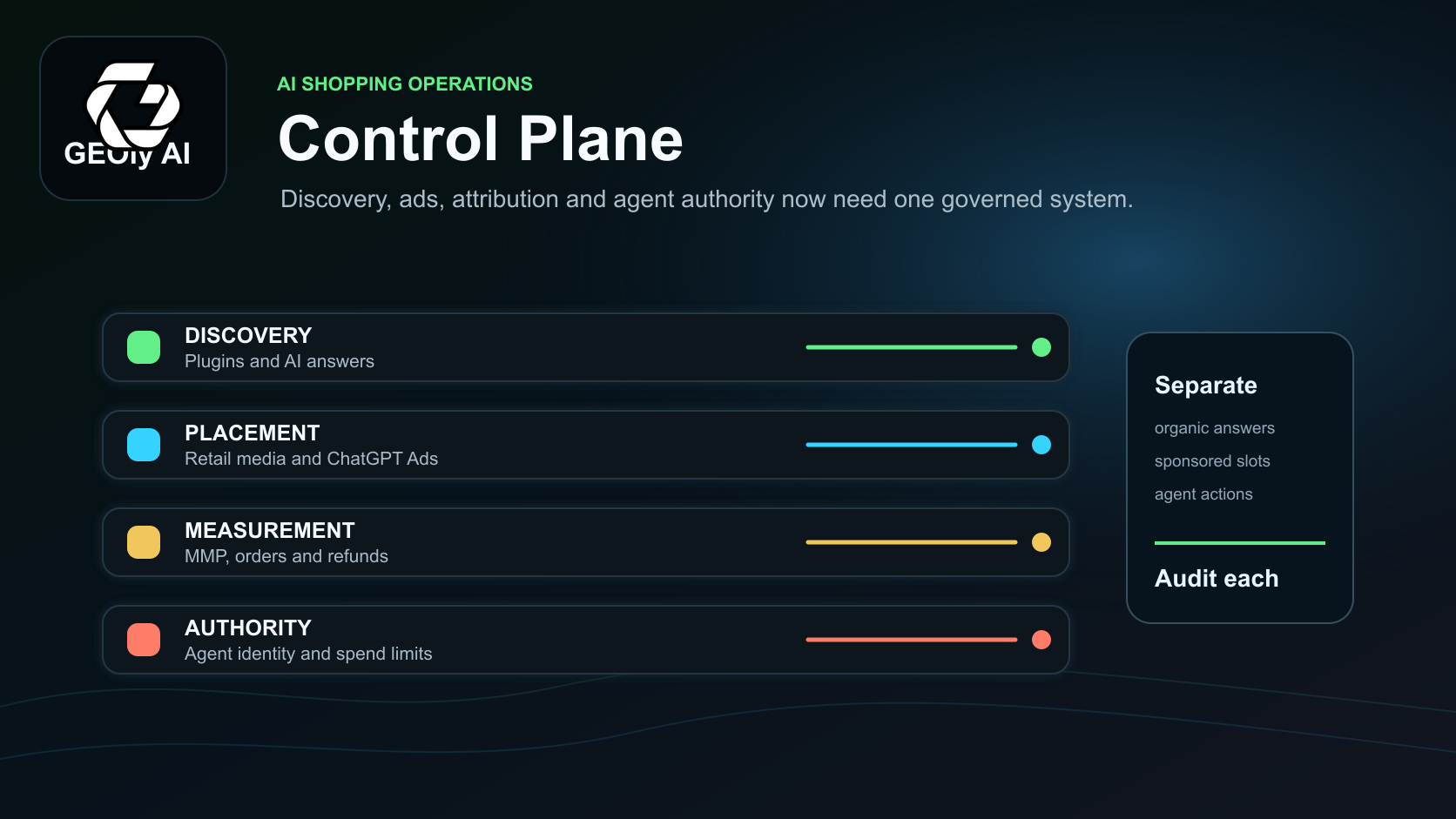
These are four different control planes: discovery, paid placement, measurement and authority.
Shopify's numbers are the demand signal, not the operating answer
Shopify's second-quarter commentary is important because it gives AI commerce a business signal rather than only a product demo. Reuters reported that Shopify described AI-driven traffic and orders as roughly tripling year over year, while Shopify's investor materials showed the broader commerce platform continuing to grow at scale.
The useful takeaway is not that AI shopping has become a dominant source of GMV. Shopify did not disclose AI traffic share, absolute AI order volume, average order value, channel mix, return rate or incremental contribution. A tripling rate can still start from a small base.
The useful takeaway is that AI referrals are no longer only a research topic. They are becoming measurable enough for commerce platforms, retailers and advertisers to discuss in operating language.
That is where brands need discipline. A fast-growing AI referral bucket can hide very different surfaces: unpaid AI answers, paid ChatGPT Ads, assistant product cards, app deep links, retail media placements, partner apps and agent actions. GEOly's AI Shopping Monitoring exists for that reason: the team needs prompt-level evidence of where the brand appears, how products are represented and whether the answer can move toward action.
Paid AI and organic AI must stay separated
The most expensive mistake in this transition will be blending all AI activity into one "AI search" dashboard.
Safeway's plugin visibility is not the same as Kroger's sponsored assistant placement. ChatGPT Ads attribution is not the same as organic inclusion in an answer. A Shopify AI referral is not automatically comparable with an agent completing a checkout through a wallet or virtual card.
Paid and organic AI need separate ledgers.
The organic ledger should track presence, prominence, portrayal, citations, product eligibility and destination. For example: Did the brand appear for the prompt? Was it recommended or merely mentioned? Which sources supported the answer? Did the AI choose a product, a category page, a store locator, a review page or a competitor?
The paid ledger should track sponsored impressions, clicks, app opens, cart events, purchases, refunds, new customers and incrementality. It should also separate open AI platforms from retail media networks. Kroger's assistant ads can draw on loyalty and transaction data that a general-purpose AI platform may not have.
GEOly's ChatGPT Ads Library and Brand Visibility Tracking should be used as different instruments. One monitors commercial placement behavior. The other monitors natural visibility and competitive positioning. Combining them too early will make performance look smoother than reality.
The legal signal is about identity and authorization
The Ninth Circuit's Perplexity decision should not be summarized as "AI agents can shop anywhere." That is too broad.
The court vacated a preliminary injunction against Perplexity's shopping agent and indicated that Amazon was unlikely to succeed at that stage on a federal computer-access claim. But it was not a final decision on every legal theory, nor a universal permission slip for automated shopping across the web.
The business lesson is narrower and more useful: agentic commerce will revolve around identity and authorization records.
Retailers will need to know whether a request came from a person, a verified agent acting for a person, a commercial crawler, a partner integration or a blocked automation path. Agents will need to carry evidence of scope: read-only browsing, add-to-cart permission, checkout permission, spending limit, merchant allowlist, refund policy and user confirmation.
This is why Cloudflare's wallet framing matters even before every feature is live. The market is converging on the same question from opposite directions. Courts are asking who actually accessed or acted. Infrastructure providers are proposing stable agent identities and delegated budgets. Merchants are trying to protect accounts, pricing, inventory and checkout integrity.
Brands should prepare for this by creating an agent access policy before volume arrives. Decide which pages and APIs are open to anonymous AI systems, which require verified agents, which require user login and which actions always require explicit confirmation.
What a brand control plane should contain
A practical AI shopping control plane starts with product truth. Every high-value SKU needs a canonical name, variant structure, GTIN or MPN where applicable, brand owner, images, price, inventory status, offer terms, shipping promise, return policy and official URL. Those facts must match across the website, schema, feeds, apps, marketplaces, retail media networks and partner APIs.
Next comes surface mapping. List where the product can appear: ChatGPT answers, ChatGPT Ads, official plugins, Google AI surfaces, Kroger-style retail assistants, vertical community search, Shopify-powered storefronts, mobile app deep links and agent payment flows. Each surface needs an owner and a launch rule.
Then define evidence rules. Which sources should an AI cite for claims? Which product attributes are safe to expose? Which claims are disallowed? What should happen when inventory, price or delivery promise is stale? GEOly's Brand Knowledge Graph is relevant here because AI commerce depends on consistent facts, not just persuasive copy.
Finally, define event taxonomy. Track natural answer inclusion separately from sponsored exposure, plugin invocation, product comparison, cart creation, checkout handoff, authorized payment, completed order, cancellation, refund and dispute. Use stable IDs for prompt cluster, SKU, offer, channel, campaign, partner, order and credential.
That taxonomy is the difference between "AI traffic is up" and "this AI surface created profitable incremental demand."
A 30-day operating plan
Start with the 100 prompts that matter commercially, not the prompts that mention your brand. Focus on unbranded buying tasks: best product for a use case, replacement part, gift constraint, local availability, dietary requirement, budget limit, compatibility, urgency and return-risk questions.
For each prompt, record whether your brand appears, which competitors appear, which sources are cited, which product facts are used and where the user is sent next. Preserve raw answer evidence. A score without the answer text is not enough for diagnosis.
Audit 50 priority products or services against the control-plane fields: canonical facts, structured data, feed accuracy, image quality, offer terms, local availability, checkout deep link, app deep link and return policy. Fix mismatches before increasing paid AI spend.
Ask every paid or partner channel for separate AI-surface reporting. For ChatGPT Ads, require campaign, click, deep link, install, in-app event and purchase visibility where available. For retail media assistants, ask for assistant-specific impressions, clicks, add-to-cart, sales, new customers and holdout methodology. For plugins, require invocation, cart, handoff and checkout completion metrics.
Write a least-privilege policy for agent action. Low-value, reversible, pre-approved purchases may be eligible for automation. High-value, subscription, regulated, perishable, age-restricted or non-refundable purchases should default to explicit human confirmation.
This is also where GEOly's ecommerce workflow and AI Shopping Optimization fit naturally. The work is not only content optimization. It is the repeated monitoring and repair of the facts, prompts, citations and shopping surfaces that AI systems use to recommend a brand.
GEOly AI's role
AI shopping will reward brands that are easy for machines to trust and easy for teams to audit. That means clean product data, visible authority, separated paid and organic ledgers, and a clear path from answer to action.
GEOly AI helps teams monitor that operating surface across AI engines: where the brand appears, how products are described, which sources are cited, where competitors win, and where ChatGPT Ads or AI shopping placements should be evaluated separately from organic GEO. Through MCP-based workflows, GEOly can also connect monitoring evidence to the internal systems teams use to correct product facts and measure change.
The next phase of AI commerce will not be won by teams that simply add one more acquisition channel. It will be won by teams that build a control plane for discovery, ads, attribution and agent authority before those systems start making decisions at scale.