From Anker SOLIX to xTool — the brands above already see how ChatGPT, Gemini and Perplexity mention, cite and recommend them. Your brand is being talked about in AI right now. See it.
What Is GEO — and Which Tools Actually Help? | GEOly | GEO/AEO Platform for DTC Brands
What Is GEO — and Which Tools Actually Help?
Summary
GEO is how brands earn a place inside AI-generated answers, and you can start measuring it for $0 to $29/month with tools like GEOly and Otterly.AI.
2026/07/05
6 min read
Generative engine optimization (GEO) is the work of making sure AI engines — ChatGPT, Gemini, Perplexity, Google AI Overviews — mention, cite and recommend your brand when people ask them questions. The reason it earned a real budget line is conversion: ChatGPT referrals convert at 7.1%, second only to paid search at 7.8%, per Similarweb. The tools that help sort into three groups: dedicated GEO monitors such as GEOly and Otterly.AI (from $0 to $29/month), AI add-ons to SEO suites you may already pay for (Semrush, Ahrefs), and content platforms like Goodie AI that turn visibility gaps into writing briefs.
Key takeaways
GEO optimizes for inclusion in AI-generated answers; SEO optimizes for position in a list of links. The two overlap on fundamentals but reward different work and measure different outcomes.
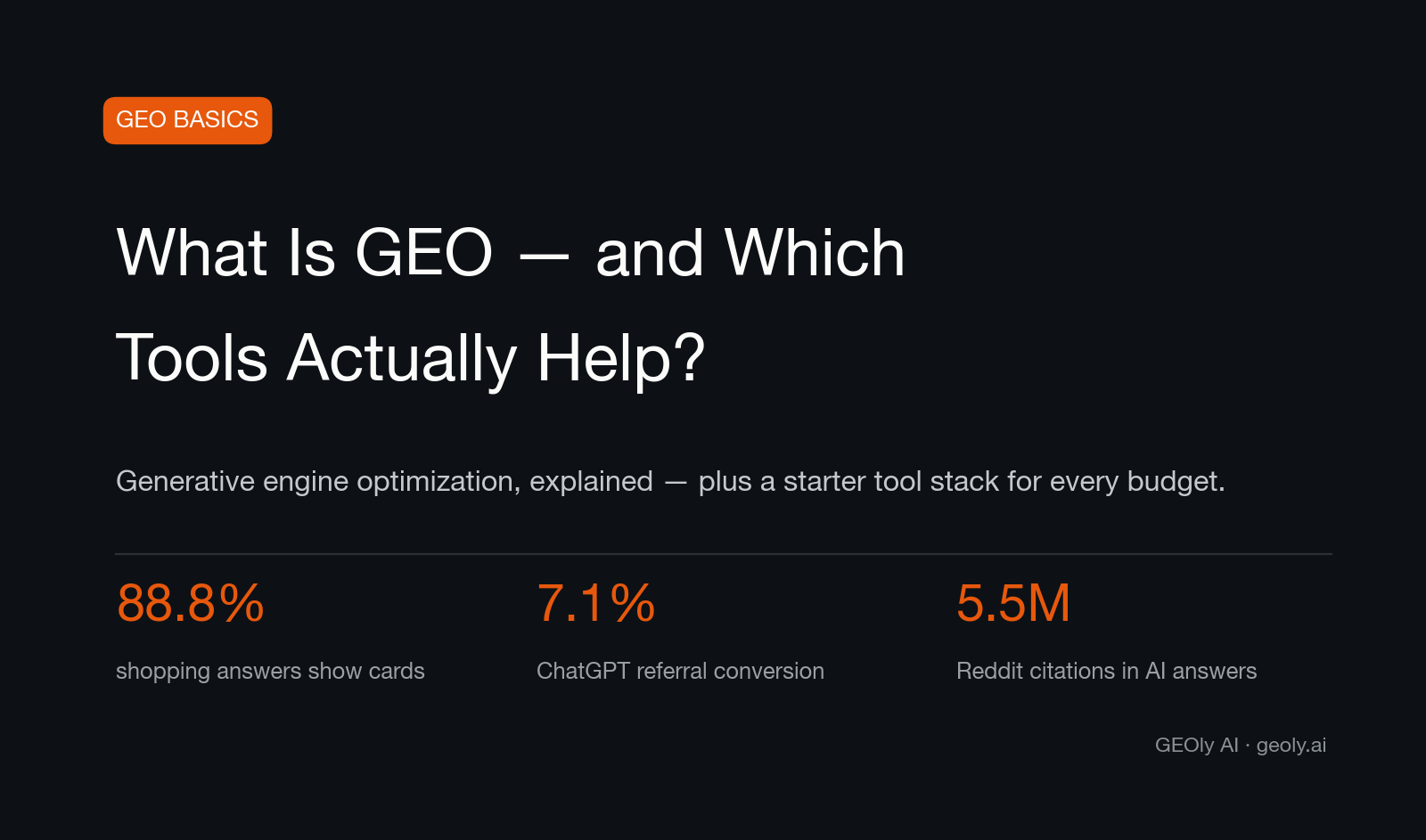
The traffic is small but unusually qualified: ChatGPT referrals convert at 7.1%, nearly matching paid search at 7.8% (Similarweb).
AI answers are assembled, not ranked. One prompt fans out into several hidden retrieval queries, sources get cited, and in shopping contexts 88.8% of ChatGPT answers arrive with product cards.
You can start GEO for $0 with a manual prompt panel or GEOly's free tier; $29 to $99/month buys automated daily monitoring.
Choose tools by job, not by logo: monitoring (are you mentioned?), suite add-on (AI metrics beside rankings), or content optimization (what to publish next).
What GEO actually means
GEO treats an AI-generated answer the way SEO treats a results page: as contested space your brand either occupies or concedes. When someone asks ChatGPT "what's the best travel stroller under $400," the engine composes a single answer — a few named brands, a handful of cited sources, often a row of product cards. There is no page two. Either you are in that answer, or you do not exist for that buyer.
The one-line difference from SEO: SEO earns a position you can hold; GEO earns a probability of being included each time the answer is regenerated. We keep a longer treatment of that distinction in GEO vs SEO and a full primer in what is generative engine optimization. You will also run into the sibling acronyms AEO and AI SEO; they describe overlapping practices, and this comparison untangles the three.
How an AI answer gets made — and where you can influence it
GEO makes more sense once you see the loop an answer travels through.
Flywheel diagram of generative engine optimization (GEO): user prompt, engine fan-out, cited sources, answer with mentions and cards, then measurement feeding optimization — Source: GEOly AI (geoly.ai)
It starts with a user prompt. The engine then fans out: it silently rewrites that one question into several retrieval queries and searches them in parallel, which is why a brand can rank well for a keyword yet never surface in the answer built on top of it. Retrieved sources get weighed and cited, and citation gravity is real — Reddit alone draws 5.5M citations, the single largest source in AI brand-decision answers, per our analysis. The engine then composes the answer, naming brands and, for shopping intent, attaching product cards: 88.8% of ChatGPT shopping answers carry them. And because every regeneration can differ, the loop closes with monitoring — measuring what changed and feeding it back into content and sources.
Each stage is an intervention point. Cover the fan-out queries with content. Earn presence on the sources engines actually cite. Structure your product data so cards resolve to you. Then measure continuously, because none of it is a one-time fix.
The tools that help, by budget
Free to $29: prove the problem exists
Disclosure: GEOly is our product. GEOly is free to start at app.geoly.ai and tracks Share of Model (your slice of AI answers versus competitors), citation sources, and Share of Card — the AI shopping shelf layer other monitors skip. Honest limitation: it is not a classic SEO suite, with no rank tracking or backlink index, so most teams run it beside Semrush or Ahrefs rather than instead of them. The other entry point is Otterly.AI: its $29/month Lite plan reruns your prompts daily and is the cheapest credible standalone monitor, though Gemini and Google AI Mode are paid add-ons rather than core coverage.
Around $100: keep AI metrics inside your suite
If your team already lives in Semrush, the AI Visibility Toolkit at $99/month adds answer tracking without a new vendor — the Starter tier covers 50 prompts, enough for a first panel. Ahrefs Brand Radar takes a data-first route, modeling visibility from a corpus of 260M+ monthly prompts across six platforms per its methodology; it costs $199/month per AI index, and full six-platform coverage runs $699.
$250 and up: platforms and content engines
Scrunch AI (Core at $250/month for 125 prompts) goes beyond dashboards, serving AI crawlers a structured version of your site. Goodie AI (Pro at $495/month on annual billing) converts visibility gaps into an AEO content workflow across 11+ models. Profound is the enterprise reference point, quote-priced; reviewers place typical deployments above $2,000/month. If you want all of these ranked head-to-head, our best GEO tools of 2026 does exactly that, and best AI visibility tools in 2026 maps the market by category instead of rank.
A first week that costs nothing
Before buying anything, write down 20 questions your customers actually ask — in their words, not your keyword list. Run each through ChatGPT, Gemini and Perplexity twice. Note three things per run: were you mentioned, which sources were cited, and did a product card appear. Two afternoons of this teaches you more about your AI presence than any sales demo, and it turns tool trials into a concrete test: can this platform automate the panel I just built? The GEOly AI team publishes working guides like this one regularly, and the GEO tag collects the rest of the series.
FAQ
What does GEO stand for in marketing?
GEO stands for generative engine optimization: the practice of increasing how often AI engines like ChatGPT, Gemini and Perplexity mention, cite and recommend your brand in the answers they generate. It is the AI-answer counterpart to SEO's search-results work.
Is GEO just SEO for ChatGPT?
No, though they share foundations. SEO targets a ranked list of links you can hold; GEO targets a generated answer that is rebuilt on every query, so success is probabilistic inclusion, not a position. Good technical SEO helps GEO — engines still retrieve web pages — but GEO adds fan-out coverage, citation-source work and product-data structure that classic SEO never measured.
Which GEO tool should I start with?
Match the tool to your situation. If you sell products, GEOly's free tier covers answers and the shopping shelf (disclosure: GEOly is our product). If you want the cheapest standalone monitor, Otterly.AI starts at $29/month. If you already pay for Semrush, its $99 AI Visibility Toolkit keeps everything in one dashboard.
Do I still need SEO if I'm doing GEO?
Yes. AI engines retrieve and cite web content, so crawlable, well-structured pages remain the raw material of AI answers. Referral volume from AI engines is still smaller than organic search; it just converts unusually well at 7.1%. Run both, and let each inform the other.