From Anker SOLIX to xTool — the brands above already see how ChatGPT, Gemini and Perplexity mention, cite and recommend them. Your brand is being talked about in AI right now. See it.
What Is AEO? Answer Engine Optimization Explained (2026) | GEOly | GEO/AEO Platform for DTC Brands
What Is AEO (Answer Engine Optimization)? How It Relates to SEO and GEO
Summary
AEO (Answer Engine Optimization) is the practice of structuring content so answer engines like ChatGPT, Perplexity, and Google AI Overviews select and cite it as the direct answer — the visibility that matters as clicks give way to answers.
2026/07/05
8 min read
AEO (Answer Engine Optimization) is the practice of structuring content so that answer engines — ChatGPT, Perplexity, Google AI Overviews, Copilot — select it as the direct answer to a user's question and cite it as a source. Where classic SEO competes for a ranked position among ten blue links, AEO competes for a single slot: the answer itself. It is best understood as the question-and-answer subset of GEO (Generative Engine Optimization), the broader discipline covering every generative surface, including shopping agents and recommendation systems.
Key takeaways
AEO optimizes content to be quoted or cited inside AI-generated answers, not to rank as a link on a results page.
It sits inside GEO: GEO covers all generative surfaces (answers, shopping shelves, agents), while AEO focuses on question-and-answer engines.
Answer engines reward extractable content: an answer-first opening, question-shaped headings, clean structure, and consistent brand facts across the web.
Progress is measured in mention rate, citation rate, and answer position across engines — keyword rankings do not exist here.
AEO complements SEO rather than replacing it: the same crawlable, authoritative pages feed both, but each is scored on a different outcome.
What counts as an answer engine
An answer engine takes a natural-language question and returns a synthesized response instead of a list of links. In 2026 that includes chat-native systems (ChatGPT, Gemini, Grok), search-native systems (Perplexity, Google AI Mode, Microsoft Copilot), and AI Overviews, the generated layer sitting above Google's classic results.
Under the hood, most run the same two-stage loop. First, retrieval: the engine expands your question into several sub-queries — a process called query fan-out — and pulls candidate passages from a live index, a web search, or its training data. Second, generation: the model synthesizes those passages into one answer, usually with inline citations. AEO is the work of winning both stages: getting retrieved, then getting quoted.
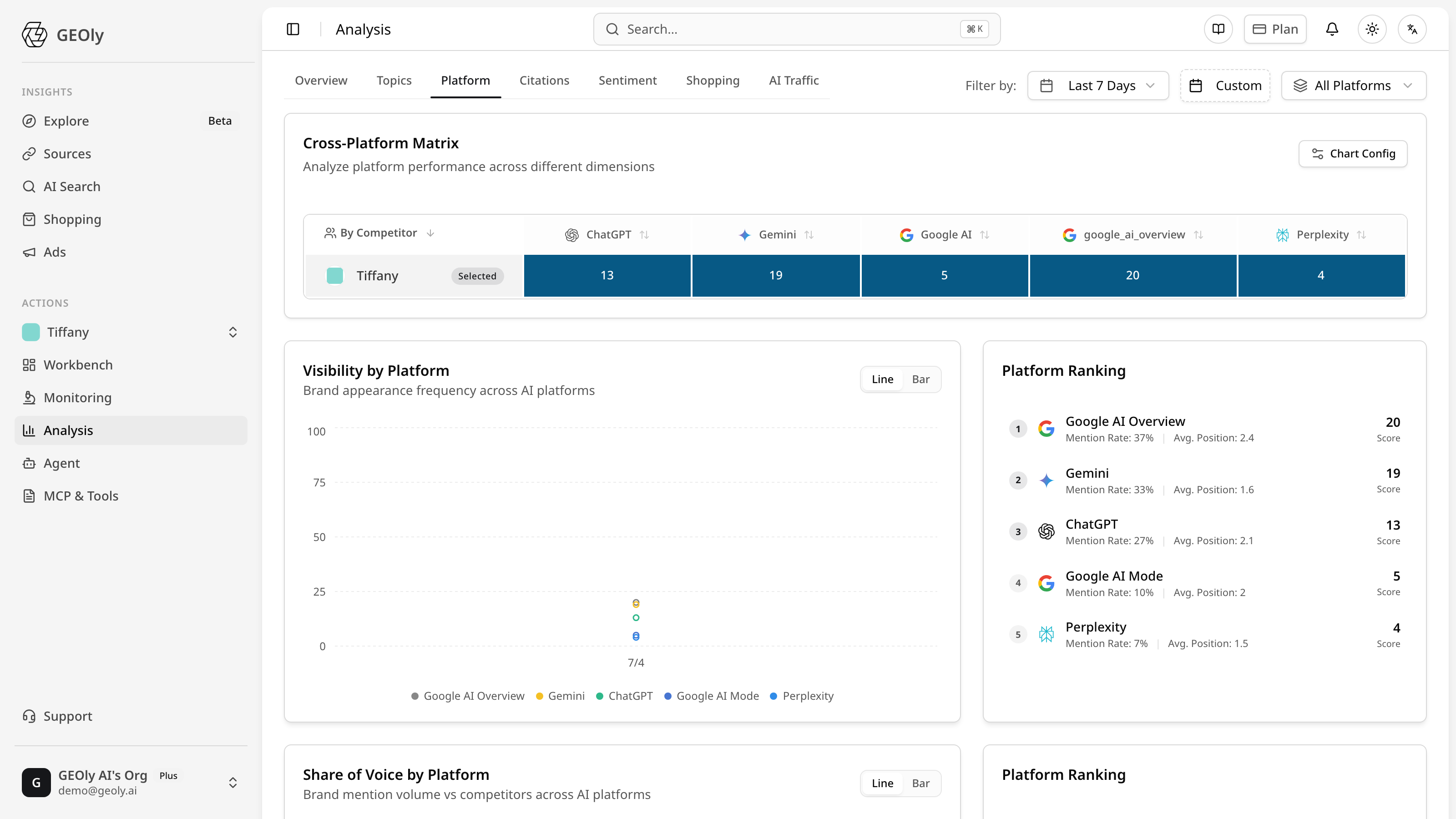
Cross-platform visibility matrix comparing brand mentions across ChatGPT, Gemini, Google AI Overview, AI Mode and Perplexity — Source: GEOly AI (app.geoly.ai)
AEO vs. SEO vs. GEO
The acronyms overlap, but the working distinction is practical:
SEO (Search Engine Optimization) gets pages ranked in classic search results — the link lists on Google and Bing.
AEO (Answer Engine Optimization) gets content selected as the answer inside a Q&A response.
GEO (Generative Engine Optimization) is the umbrella: every generative system, including answer engines but also shopping agents, product recommendation shelves, and multimodal assistants.
An analogy: SEO builds the library and gets your book shelved where people browse. AEO writes the encyclopedia entry the librarian reads aloud when someone asks a question. GEO teaches the librarian your entire catalog — including which product to hand over when a visitor says "just get me the best one."
In everyday conversation AEO and GEO get used interchangeably, and that is fine. The distinction matters when you plan work: rewriting FAQs is AEO; getting product cards to surface in ChatGPT shopping results is GEO, but not really AEO.
Why AEO matters in 2026
Scale first. Google's AI Overviews passed 2 billion monthly users in mid-2025 and kept climbing; OpenAI reported more than 800 million weekly ChatGPT users at DevDay 2025. A growing share of questions that once produced ten blue links now produce one synthesized answer.
Second, the click is disappearing but the impression is not. Zero-click search means users increasingly get what they need without visiting any website. In that world, being named inside the answer is the visibility. A shopper who reads "for lab-grown engagement rings under $2,000, X and Y are frequently recommended" has formed a shortlist without one click. If your brand is X, AEO did its job. If not, you were invisible at the exact moment of consideration.
Third, answers feed actions. The engines answering questions today are adding checkout flows and agent protocols; the brands they trust as answers are the brands they will transact with. That makes AEO the entry point into generative commerce, not a standalone content tactic.
How to do AEO: five tactics that work
1. Write answer-first
Answer engines lift passages, and they prefer passages that stand alone. Open every page with a two-to-three-sentence direct answer to the question it targets. Compare "To understand AEO, we must first revisit the history of the internet…" — never gets quoted — with "AEO is the practice of optimizing content to be the direct answer in AI-generated responses," which is quotable as-is.
2. Shape content around real questions
Mirror the phrasing people actually type into ChatGPT or Perplexity, use question-form headings, and give each a 2-4 sentence answer before elaborating. One caution on markup: Google restricted FAQ rich results to government and health sites in 2023, so FAQPage schema no longer earns a visual treatment — but structured Q&A remains one of the most extractable formats for LLM retrieval, with or without markup. Our guide to structured data for AI search covers what still moves the needle.
3. Keep entity facts consistent
Engines cross-check claims against the knowledge graph. If your founding year, product specs, or pricing differ between your site, retailer listings, and press coverage, models hedge or omit you. Consistency is an authority signal, and authority — E-E-A-T in the AI era — decides who gets cited when several sources say similar things.
4. Earn presence where engines retrieve
Engines don't only cite brand websites. Citation analysis consistently shows Reddit threads, review platforms, and comparison articles supplying most passages in commercial answers. If the three listicles Perplexity always cites in your category omit you, no amount of on-site work fixes that. AEO includes third-party source strategy.
5. Let AI crawlers in
None of this matters if retrieval bots can't reach your pages. Check robots.txt for OAI-SearchBot and PerplexityBot (OpenAI documents its crawlers), and note that Google's guidance says AI features use its standard crawling and indexing systems — so normal indexability plus sensible snippet controls covers AI Overviews. Full checklists live in our guides to AI crawlers and llms.txt.
How to measure AEO: a worked example
There is no rank tracker for answers, so AEO borrows different instruments: mention rate (the share of relevant prompts that name your brand), citation rate (how often your domain appears as a linked source), and answer position (named first versus buried mid-list). Our AI search visibility metrics guide walks through the full KPI stack.
Here is what that looks like in practice. A DTC jewelry brand wants to know whether answer engines recommend it for lab-grown engagement rings. Using GEOly AI, the team tracks a prompt set across seven engines — ChatGPT, Gemini, Perplexity, Copilot, Grok, Google AI Mode, and AI Overviews. Results come back uneven: a 31% mention rate on Perplexity, 6% on ChatGPT. Source analysis explains why — ChatGPT leans on two comparison articles that omit the brand. The AEO to-do list is suddenly specific: pitch those publications, publish an answer-first comparison page, retest in four weeks. GEOly compresses this into a single AIGVR score (answer position weighted 40%, frequency and citations 25% each) and Share of Model for competitor benchmarks; the 3-day free trial at app.geoly.ai includes a 29-point GEO audit.
Brand mention monitoring in AI search: per-prompt visibility, citation rate and tracking status across AI engines — Source: GEOly AI (app.geoly.ai)
Common AEO mistakes
Burying the answer under a 400-word introduction. If the direct answer isn't in the first paragraph, the engine finds one somewhere else.
Treating AEO as a schema checkbox. Markup helps machines parse; it cannot rescue vague prose.
Optimizing one engine only. ChatGPT, Perplexity, and AI Overviews retrieve from different sources and cite differently — measure all before choosing where to invest.
Blocking AI crawlers while expecting citations. A robots.txt that bans the GPTBot family, next to a slide asking why ChatGPT never mentions the brand, is more common than you'd think.
Publishing without a target question. Content gap analysis should pick your topics: find the high-intent prompts where competitors get named and you don't.
FAQ
Is AEO the same as GEO?
No, though the terms get mixed daily. AEO is the subset of GEO focused on question-and-answer surfaces like ChatGPT, Perplexity, and AI Overviews. GEO also covers shopping agents, recommendation shelves, and other generative systems. If the goal is being the answer to a question, that's AEO; if it involves any generative surface, that's GEO.
Does AEO replace SEO?
No. Answer engines retrieve from crawled, indexed, authoritative pages — the foundation SEO already builds. Google states AI Overviews run on its core search infrastructure. AEO is a new scoring layer on those fundamentals: same inputs, different outcome — being cited in answers rather than ranked as links.
How long does AEO take to show results?
Often faster than classic SEO. Engines with live retrieval, like Perplexity or ChatGPT search, can pick up new content within days, while mentions rooted in training data shift over months. Expect on-site fixes to register in retrieval-based engines within a few weeks, and third-party source work to compound over a quarter.
How do I track whether AEO is working?
Run a fixed prompt set against the engines your buyers use and record mentions, citations, and position over time — manually in a spreadsheet, or with AI brand mention monitoring tools. Our comparison of AI search monitoring tools covers the options, including GEOly's cross-engine tracking.