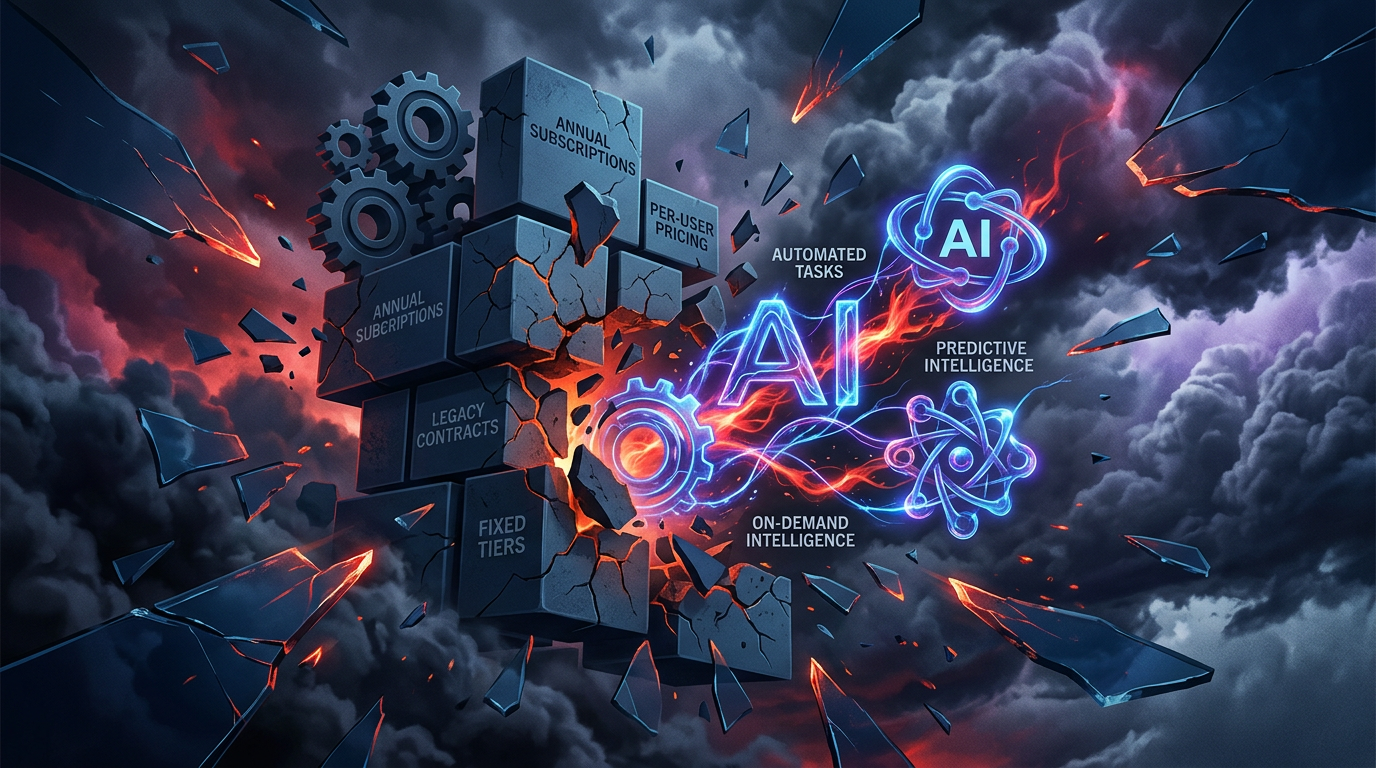
A founder recently texted his investor that he was replacing his entire customer service team with Claude Code, an AI tool that writes and deploys software autonomously. To Lex Zhao of One Way Ventures, the message signaled something larger: the moment companies like Salesforce stopped being the automatic default. "The barriers to entry for creating software are so low now thanks to coding agents, that the build versus buy decision is shifting toward build in so many cases," Zhao told TechCrunch. That shift is the heart of what analysts are calling the SaaSpocalypse, and it has a direct read for anyone thinking about AI-era distribution.
Key takeaways
- The SaaS model was built on per-seat pricing: charge by the user, and revenue scales with headcount. It delivered highly predictable recurring revenue, immense scalability and 70 to 90 percent gross margins. - AI agents break that logic because they do not need seats. When a few agents do the work of a team, or employees just ask their AI to pull data from a system, seat counts stop tracking value. - Build versus buy is flipping toward build: coding agents have collapsed build cost from millions and years to thousands and weeks, as F-Prime's Abdul Abdirahman and the Klarna precedent illustrate. - The GEO implication: if software is increasingly agent-driven, the durable position is being the data an agent calls, not the dashboard a human logs into. Value migrates from seats to data and usage. - Agentic commerce is the same pattern one layer out: agents will increasingly research and buy on a user's behalf, so brands need to be legible to agents, not just visible to people.
Why per-seat pricing breaks
SaaS empires ran on a simple premise. Charge by the seat, and the more employees use the software, the more you earn. That premise produced three prized properties: predictable recurring revenue, near-infinite scalability, and 70 to 90 percent gross margins that made SaaS the darling of enterprise software for two decades.
Agents dissolve the premise. They do not occupy seats. When a handful of AI agents can do the work of an entire team, or when an employee simply asks their AI of choice to pull the data they need out of a system, the link between headcount and value snaps. As F-Prime's Abdul Abdirahman put it, when one or a few AI agents can do the job, the per-seat model starts to break down. You are no longer paying for twenty logins. You are paying for an outcome that a couple of agents produce.
Build versus buy, reversed
The other half of the disruption is the build-versus-buy math flipping. In the traditional SaaS era, building your own tool meant millions of dollars, years of work, a large engineering team, dedicated maintenance staff and vendor-dependent customization. In the AI-agent era, coding agents compress that to thousands of dollars and weeks of work, handled by AI coding assistants with far more flexibility and far less lock-in. Klarna became an early emblem of choosing build over buy, and Zhao's texting founder is the same story at smaller scale: when building is this cheap, default vendors lose their default.
