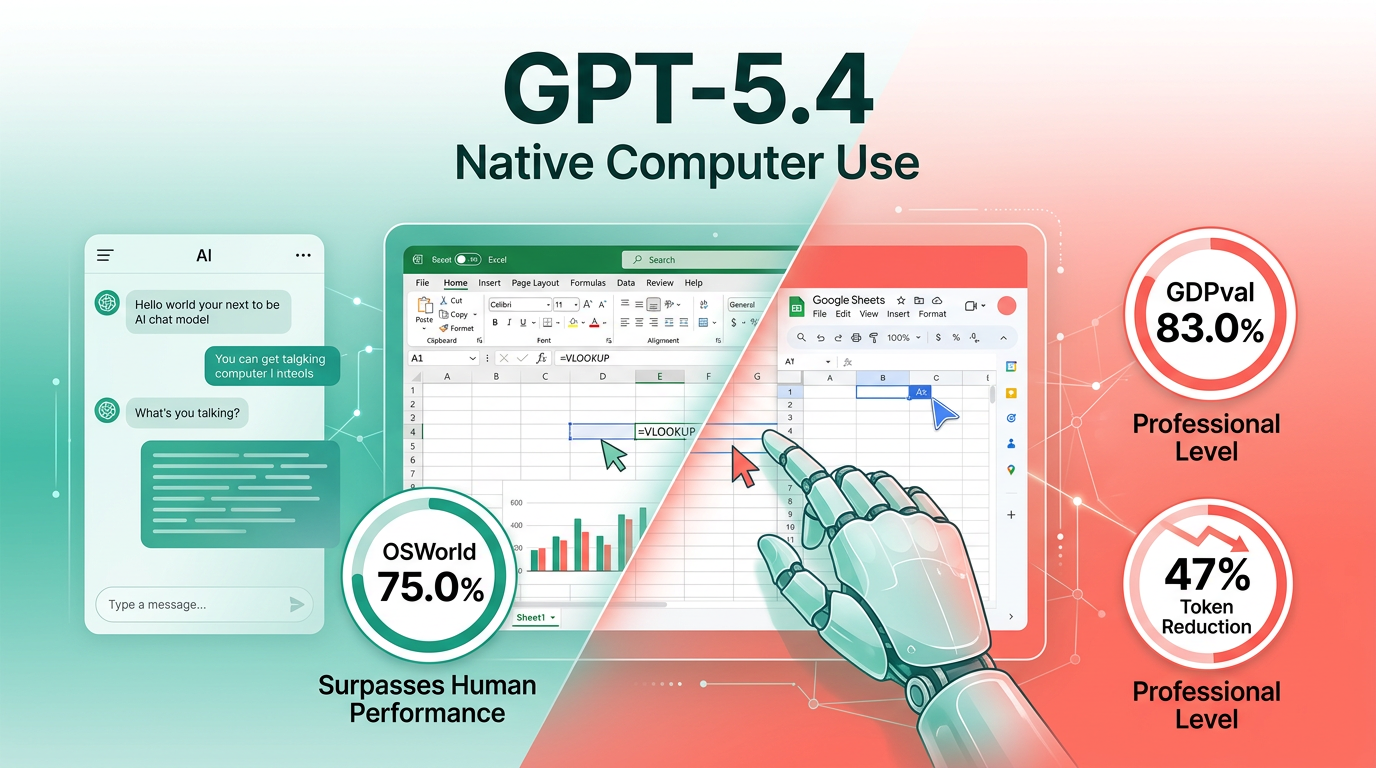
OpenAI released GPT-5.4, and the headline feature isn't a smarter chatbot. It's a model that operates a computer natively — clicking through Excel, Google Sheets, presentations, and documents, running multi-step workflows across applications instead of just describing how to do them. On OSWorld-Verified, a benchmark that measures whether a model can navigate a desktop through screenshots and keyboard and mouse actions, GPT-5.4 hits a 75.0% success rate, edging past the human score of 72.4%. For the first time a frontier model does professional knowledge work better than the average person it was measured against.
That matters far beyond the developers building agents. When software can reliably run a computer, more of the research and buying that used to happen through a browser and a human starts happening through an agent — and agents read the web very differently than people do.
Key takeaways
- GPT-5.4 is OpenAI's first general-purpose model with native, state-of-the-art computer use, folding in the coding strength of GPT-5.3-Codex to operate real software end to end. - The benchmarks are no longer incremental: 75.0% on OSWorld-Verified (above the 72.4% human baseline), 83.0% on GDPval across 44 occupations (up from GPT-5.2's 70.9%), and 87.3% on internal spreadsheet-modeling tasks versus 68.4% for GPT-5.2. - Capacity scaled too — up to a 1M-token context in Codex (experimental) and a tool-search feature that cut token usage by 47%, making long agentic runs cheaper and more reliable. - For brands, the buyer at the moment of decision is increasingly an agent that parses structured data, not a shopper watching an ad — which is the core reason to make product data machine-readable now. - If an agent can't cleanly read your price, stock, and specs, it completes the task with a competitor it can read, and you never see the lost intent.
From talking about work to doing it
Earlier models could explain how to build a financial model; GPT-5.4 builds it. OpenAI reports 87.3% on an internal benchmark of spreadsheet modeling tasks — the kind a junior investment-banking analyst handles — up sharply from 68.4% a version ago. On GDPval, which tests well-specified knowledge work across 44 occupations, the model matches or beats industry professionals in 83.0% of comparisons.
The engineering under that jump is as important as the scores. A 1M-token context window in Codex lets an agent hold a long task in memory — plan, act, check its own work, and reference earlier steps without losing the thread. A new tool-search capability trims token usage by 47%, which sounds like a footnote until you multiply it across thousands of automated runs. Cheaper, longer, more reliable agent sessions are exactly the conditions that move real workflows off human hands and onto software.
The reader you're not designing for
Here's the shift most marketing teams haven't priced in. When a model can operate a computer, the entity landing on your product page is often not a customer. It's an agent doing a customer's errand: comparing three vendors, filling a cart, pulling specs into a spreadsheet, booking the option that checked out cleanest.
