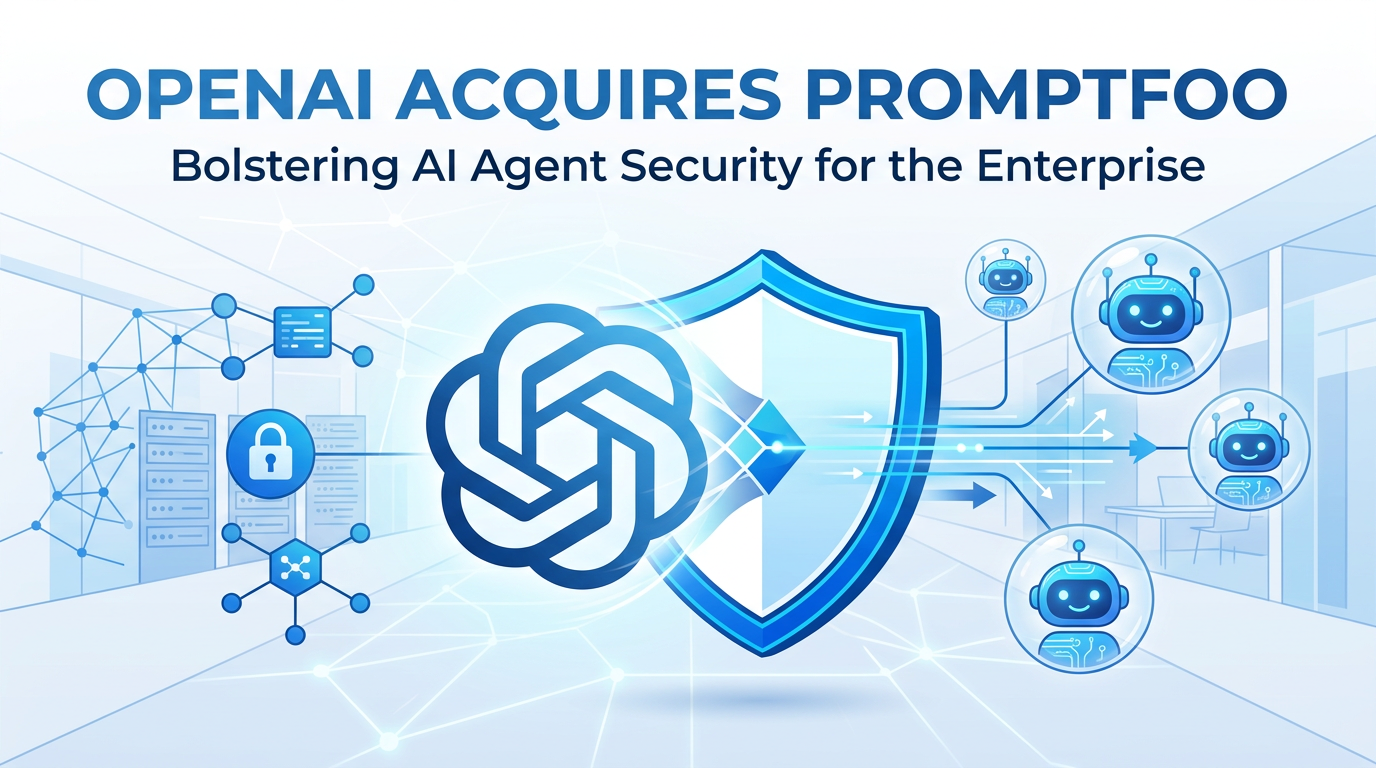
OpenAI announced Monday that it has acquired Promptfoo, an AI security startup founded in 2024 to protect large language models from online adversaries. Once the deal closes, Promptfoo's technology will be folded into OpenAI Frontier, the company's enterprise platform for AI agents. Terms were undisclosed.
The move is small in dollars and large in signal. It tells you where the frontier labs think the next bottleneck sits: not raw model capability, but proving that autonomous agents can be trusted to act safely inside real business operations. And that same shift — from "does the model sound good" to "can we verify what it actually does" — is coming for every brand that now lives inside AI answers.
Key takeaways
- OpenAI is acquiring Promptfoo, a 2024-founded LLM security startup, and integrating it into OpenAI Frontier, its enterprise agent platform. - Promptfoo had raised $23 million, was last valued at $86 million (July 2025, per PitchBook), and is used by more than 25% of Fortune 500 companies. - The acquisition signals that evaluation, red-teaming, and monitoring of AI behavior are becoming core infrastructure, not optional add-ons. - For GEO teams the parallel is direct: as agents take on transactions and recommendations, you need to continuously test and measure what AI says and does about your brand — not assume it. - Trust is becoming the currency of agentic commerce, and trust only exists where behavior is verifiable.
What Promptfoo does
Promptfoo was founded by Ian Webster and Michael D'Angelo to help companies test security vulnerabilities in LLMs. Its toolkit — an open source interface and library plus a commercial offering — lets teams probe models for weaknesses, run automated red-teaming, evaluate the security of agentic workflows, and monitor activity for risk and compliance. In plain terms, it stress-tests AI systems the way a penetration tester stress-tests a network, then keeps watching once they're live.
The adoption numbers explain the acquisition. More than a quarter of the Fortune 500 already run Promptfoo, which means it sits close to how large enterprises are trying to deploy AI agents safely. Buying it lets OpenAI ship agents that enterprises can audit, not just admire.
Why the timing matters
Independent AI agents that carry out digital tasks have generated real excitement about productivity. They have also handed bad actors fresh ways to reach sensitive data or manipulate automated systems. An agent that can log in, move money, or place an order is an agent worth attacking. Prompt injection, data exfiltration, and manipulated tool calls stop being academic once the agent has your credentials.
Frontier labs know that enterprise adoption stalls at exactly this trust gap. A model that occasionally hallucinates in a chat is tolerable. A purchasing agent that can be talked into the wrong transaction is not. Owning the evaluation layer lets OpenAI answer the question every risk officer asks: how do we know this thing behaves?
What this means for GEO
The lesson for brands isn't about model security per se — it's about the mindset. The industry is moving from trusting AI outputs to verifying them, and that discipline applies just as much to how AI represents your brand as to how it handles a database query.
Consider what agents now do with your brand. They recommend it or skip it. They quote your price, your stock, and your policies. They decide, in agentic commerce, whether to complete a sale on your behalf. Every one of those behaviors is something you can measure — or something you can guess at. Promptfoo's rise says the serious players measure.
That verification layer for brand behavior is what [GEOly](/blog/what-is-geoly-ai) is built for. Instead of only watching your own mentions, GEOly maps how your whole category shows up across ChatGPT, Gemini, Perplexity, and Google AI — brand rankings, product cards and pricing, citation sources, and brand perception — as a queryable industry database. It runs a 29-point GEO audit on AI-readiness, and because its data is exposed through MCP, CLI, and Skills, your own agents can query and test that visibility inside their workflow. It's the difference between assuming AI describes you correctly and confirming it. For the underlying concept, see [what generative engine optimization is](/blog/what-is-generative-engine-optimization-geo).
What to do now
Treat AI representation the way security teams treat systems: test continuously, not once. Establish a baseline for how often models recommend you, what facts they cite, and where they get your details wrong. Watch for drift as models update, because behavior that was accurate last month can quietly degrade. And as agentic commerce grows, make your product data clean and consistent enough that an agent can transact on it without tripping a trust check.
FAQ
Did OpenAI disclose what it paid for Promptfoo? No. Deal terms were not disclosed. Promptfoo had raised $23 million and was last valued at $86 million in July 2025 per PitchBook.
What is OpenAI Frontier? It is OpenAI's enterprise platform for AI agents, where Promptfoo's security and evaluation technology will be integrated once the deal closes.
Why should a marketer care about an AI security deal? Because the same principle — verify AI behavior instead of trusting it — governs how AI represents your brand. If you're not measuring what AI says about you, you're guessing.
Capability got the AI industry this far. Verifiability is what takes it into the enterprise. Want to test what AI actually says about your brand today? [GEOly](/about-us) offers a free 3-day trial. More industry reads from [GEOly AI](/blog/author/geoly-ai).