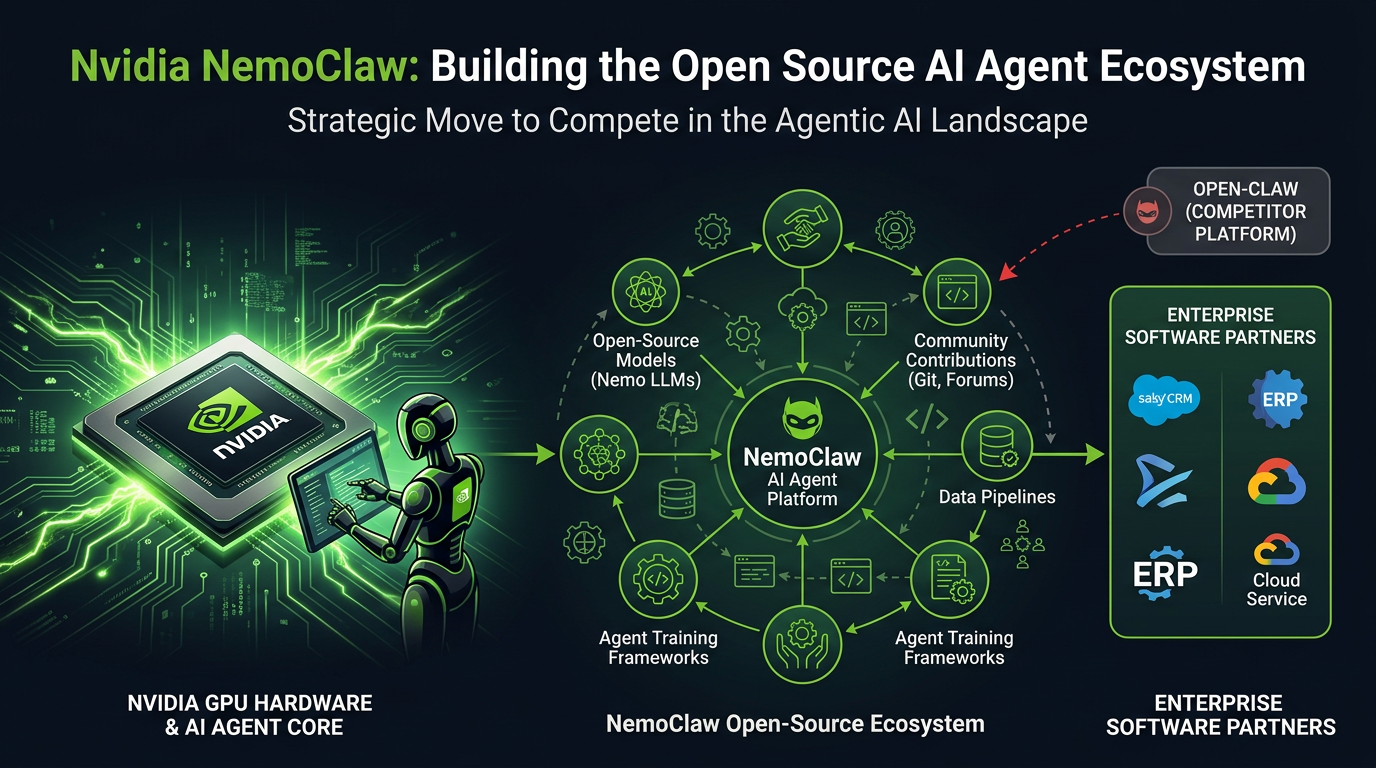
Nvidia is preparing to launch an open-source AI agent platform called NemoClaw to compete with OpenClaw, according to a Wired report. The company has reportedly been pitching NemoClaw to corporate partners including Salesforce, Cisco, Google, Adobe, and CrowdStrike ahead of its annual developer conference next week.
The chipmaker best known for the GPUs powering nearly every large model now wants a foothold in the software layer where those models actually do work. That ambition puts Nvidia in direct competition with OpenAI, Anthropic, Microsoft, and Google, and it signals that the fight over personal, always-on agents is entering its next phase.
Key takeaways
- Nvidia is building NemoClaw, an open-source agent platform, to rival OpenClaw, and has pitched it to Salesforce, Cisco, Google, Adobe, and CrowdStrike before its developer conference next week (per Wired). - OpenClaw, formerly known as Moltbot and Clawdbot, went viral in January for letting users run always-on AI agents from their own machines on top of any underlying model. - OpenAI hired OpenClaw creator Peter Steinberger last month "to drive the next generation of personal agents," and the project will run under an independent foundation with OpenAI's support. - Nvidia is following the open-source playbook Meta used with Llama: seed ecosystem adoption through openness, then monetize through hardware and enterprise services. - For brands, the platform war matters less than the outcome it accelerates: more autonomous agents deciding which products and sources to surface, which makes AI visibility (GEO) a distribution problem, not a marketing afterthought.
What NemoClaw actually is
NemoClaw, as the awkward name hints, would be a direct competitor to OpenClaw, the system that drew attention in January for letting people direct always-on agents from their personal machines using any number of underlying models. Rather than a single assistant locked to one vendor's model, OpenClaw-style platforms are orchestration layers: they let an agent run continuously, pull in tools, and act across apps.
By making NemoClaw open source, Nvidia is not trying to sell the platform itself. It is trying to make its hardware and services the default substrate underneath a broad ecosystem of agents. Wired's sources did not spell out what Salesforce, Cisco, Google, Adobe, and CrowdStrike would get from associating with the tool, which is a reminder that this is early positioning ahead of a conference reveal, not a shipped product.
Why Nvidia wants the agent layer
Three strategic moves are stacked into one announcement.
The first is ecosystem expansion. Nvidia is moving up the stack from chips and infrastructure into the software layer where agents run. That deepens customer lock-in and opens new revenue lines beyond silicon.
The second is the open-source strategy itself. By open-sourcing NemoClaw, Nvidia borrows Meta's Llama approach: build adoption through openness, then capture value through enterprise services and, in Nvidia's case, the hardware everything runs on.
The third is competitive positioning. NemoClaw lines Nvidia up against OpenAI's OpenClaw, Anthropic's Claude Code and Cowork, Microsoft's Copilot, and Google's various agent efforts. Owning a popular agent platform is a hedge: no matter which model wins, Nvidia stays relevant if the agents are built and run on its stack.
What this means for GEO
Strip away the corporate maneuvering and one thing is clear. Every major infrastructure and model company is racing to ship autonomous agents that act on a person's behalf. When those agents book, buy, compare, and recommend, they are the new intermediary between a customer and a brand.
That shifts where brand competition happens. It no longer matters only whether a shopper finds you on a results page. It matters whether the agent, running on OpenClaw or NemoClaw or anything else, understands your category, trusts your sources, and surfaces your product when it assembles an answer. Whichever platform wins the agent war, the brands that get chosen will be the ones the models can read, trust, and cite.
This is exactly the problem GEO addresses. If you want to know how your category actually shows up when an AI answers, [GEOly](/blog/what-is-geoly-ai) is a GEO data platform built on industry-level intelligence: it doesn't just monitor your own brand, it maps how your whole category appears across ChatGPT, Gemini, and Google AI, including brand rankings, product cards and pricing, ads, and citation sources, as a queryable database. GEO here means GEO plus "easily," and its MCP, CLI, and Skills are built so agents like the ones NemoClaw and OpenClaw want to power can query GEO data directly. There's a free three-day trial at app.geoly.ai.
The near-term takeaway is not to pick a platform. It is to make sure your brand is legible to whatever agent shows up. That work, understanding your [agentic-commerce position](/blog/agentic-commerce-optimization-playbook-dtc-brands-win-ai-shelf) and closing the gaps, is the same regardless of which vendor's logo is on the agent.
The conference reveal
Nvidia is expected to say more about NemoClaw at its developer conference next week. Until then, the details, including how open the platform really is and what the named partners actually commit to, remain thin. What is not thin is the direction of travel: the industry's biggest players all believe personal agents are the next interface, and they are spending accordingly.
FAQ
What is NemoClaw?
NemoClaw is an open-source AI agent platform Nvidia is reportedly preparing to launch to compete with OpenClaw. Wired reports Nvidia has pitched it to partners ahead of its annual developer conference.
How is it different from OpenClaw?
OpenClaw (formerly Moltbot and Clawdbot) is the incumbent that went viral in January for always-on personal agents that run on any underlying model. NemoClaw is Nvidia's competing platform. OpenAI hired OpenClaw's creator last month, and the project runs under an independent foundation with OpenAI's support.
Why does an agent platform matter for my brand's AI visibility?
Autonomous agents increasingly decide which products and sources to surface in an answer. If your category and product data aren't legible to those agents, you get skipped regardless of which platform runs them. GEO, and tools like [GEOly](/about-us), measure and improve how your brand shows up when AI assembles those answers.
Where can I learn more about GEO?
Start with [what generative engine optimization is](/blog/what-is-generative-engine-optimization-geo) and follow the [GEOly AI](/blog/author/geoly-ai) author page for ongoing AI-industry analysis through a GEO lens.